

Survival isn't a matter of battery life. When you're miles offshore and the electronics fail, your safety depends on mechanical simplicity and human effort. You know that relying on a complex, expensive electrical system for your life's most basic need is a gamble you can't afford to lose. Space is tight in a life raft. Weight matters in a bug-out bag. A compact seawater desalinator must function when every other system stops. It's about reliability in extreme environments where failure isn't an option.
This guide details the mechanics of total water independence without a single spark of electricity. You'll learn how to transform ocean water into life-saving freshwater using the latest in non-electric desalination technology. We'll analyze why the QuenchSea 3.0 is the essential survival-grade tool for 2026. We'll explore its lightweight design, its role as a reliable backup for yachts, and how it integrates into your existing emergency kit. From mechanical integrity to practical deployment, this is your blueprint for portable hydration.
Key Takeaways
- Define a compact desalinator as a non-electric device under 5kg that prioritizes water security in offshore survival scenarios.
- Learn how manual reverse osmosis leverages mechanical force to convert salt water into freshwater without any electrical components.
- Compare the high reliability and 90% cost savings of manual units against complex, battery-dependent marine systems.
- Identify the three pillars of tactical selection-weight, durability, and repairability-when choosing a compact seawater desalinator.
- Explore why the QuenchSea 3.0 serves as the ultimate non-electric backup for life rafts, yachts, and emergency kits.
Why Compactness is Critical for Seawater Desalination
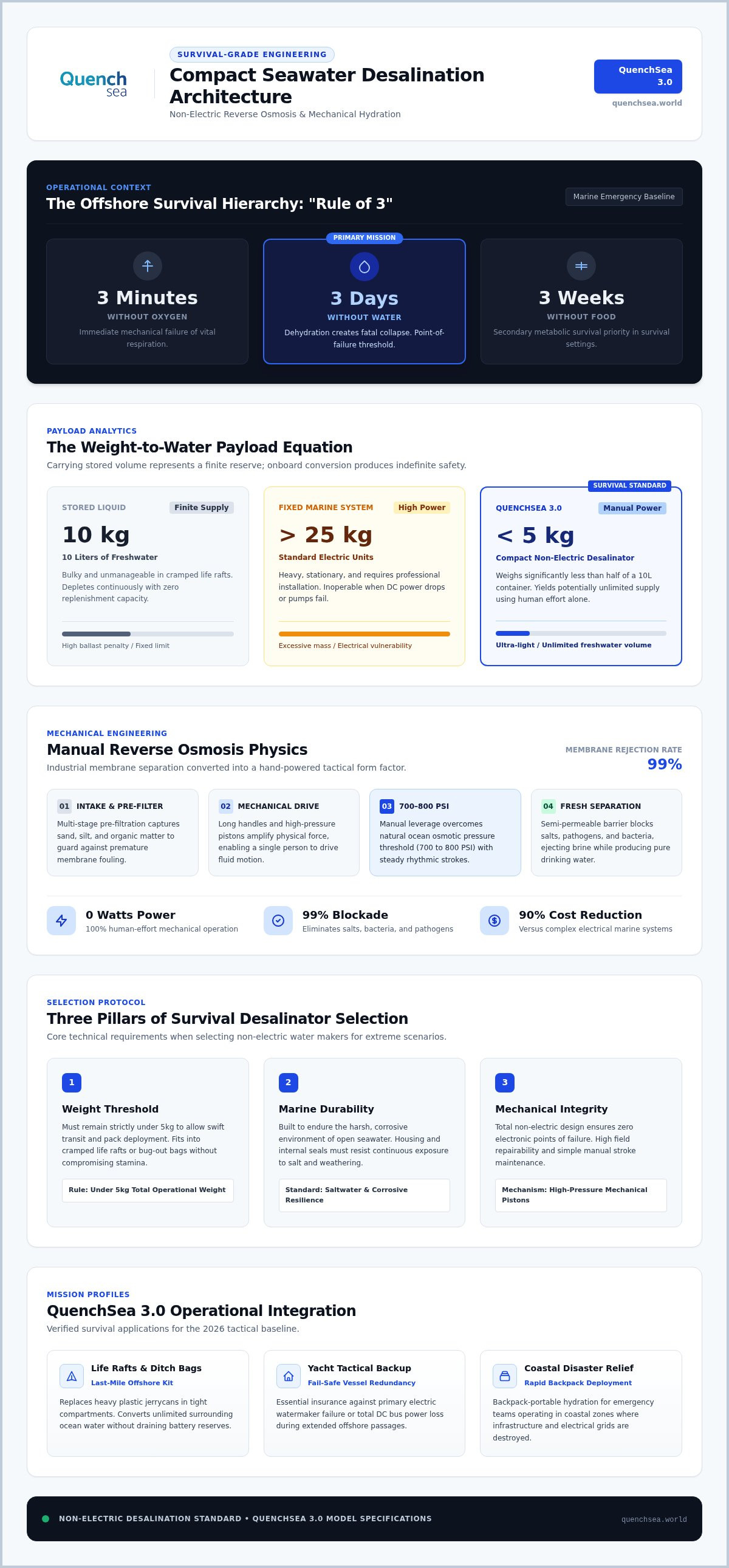
In extreme environments, weight is a liability. A true compact seawater desalinator is defined by two specific criteria: it must weigh under 5kg and function entirely without external power. This isn't a design preference; it's a mechanical necessity for survival. When you're offshore, the "Rule of 3" dictates your priorities. You can survive three minutes without air, three weeks without food, but only three days without water. In a marine emergency, water is your primary mission. Relying on a complex, battery-dependent system introduces a point of failure that can be fatal. A compact seawater desalinator is the bridge between ocean survival and hydration.
Most traditional marine water makers are heavy, stationary, and expensive. They often weigh over 25kg and require professional installation. For a solo sailor in a life raft or a prepper with a bug-out bag, these units are useless. You need a tool that relies on human effort and the fundamental principles of reverse osmosis to remove salts and impurities. Carrying stored water is a defensive posture with a finite end. Producing water is an active survival strategy that extends your window of safety indefinitely.
The Weight-to-Water Ratio
The math of survival water is unforgiving. Ten liters of freshwater weighs exactly 10kg. This volume is bulky and difficult to manage in a cramped life raft or during a coastal evacuation. In contrast, a single compact desalinator like the QuenchSea 3.0 weighs significantly less than half of that 10L container. By choosing the device over the liquid, you reduce your pack weight while gaining access to a potentially unlimited supply.
In marine storage, volume often matters more than raw weight. Space in a ditch bag is at a premium. A desalinator that fits in the palm of your hand replaces rows of heavy plastic jerrycans. This efficiency is vital for "last-mile" survival, where you must move quickly and maintain your physical stamina. Every kilogram you shed from your gear is energy saved for the task of staying alive.
Emergency vs. Daily Use Portability
For yacht owners, a compact unit serves as a tactical backup. It's the fail-safe for when the primary electric water maker suffers a pump failure or the vessel loses all DC power. It's a survival-grade insurance policy that stays tucked away until the moment of crisis. Disaster relief teams face similar requirements. They need equipment that can be deployed from a backpack in coastal zones where infrastructure has collapsed and electricity is non-existent.
Portability ensures that hydration remains a constant, even when the grid is gone. Whether you're equipping a professional vessel or a personal emergency kit, the goal is total water independence. Understanding your life raft water supply requirements is the first step in building a resilient survival plan. A manual device provides the reliability that electronic gadgets simply cannot match in the harsh, corrosive environment of the open sea.
How Manual Reverse Osmosis Works in Small Frames
Reverse osmosis is a mechanical separation process. It forces seawater through a microscopic membrane. This barrier blocks 99% of salts, bacteria, and pathogens. Industrial plants use massive electrical pumps to achieve this. A compact seawater desalinator relies on human-generated pressure. This transition from industrial scale to portable hardware requires precise engineering. According to the USGS guide to desalination, membrane technology is the most efficient way to separate salt from water without the high energy costs of thermal distillation.
Overcoming Osmotic Pressure Manually
To push water through an RO membrane, you must overcome osmotic pressure. For ocean water, this threshold sits between 700 and 800 PSI. That's a staggering amount of force for a hand-held device. A compact seawater desalinator solves this through mechanical advantage. Long handles and high-pressure pistons amplify your physical effort. This allows a single person to generate the necessary drive. Pumping isn't about speed. It's about a steady, rhythmic stroke. Consistency maintains internal pressure. It ensures a constant flow of freshwater while flushing out brine. If the rhythm breaks, the pressure drops, and the process stalls.
Membrane Longevity in Portable Units
The semi-permeable membrane is the core of the system. It's also the most vulnerable component. Sand, silt, and organic matter can clog the microscopic pores. This leads to membrane fouling. Pre-filtration is mandatory. A multi-stage filter captures larger particles before they reach the high-pressure chamber. A compact desalinator is a mechanical filter, not a chemical treatment. It physically strips away minerals rather than neutralizing them. This mechanical nature makes it reliable but requires basic maintenance to keep the pores clear.
To ensure your output is safe, always use a TDS (Total Dissolved Solids) meter. This device measures the electrical conductivity of the water. It verifies that the salt rejection rate remains high. If the TDS reading climbs, inspect your pre-filters. It might be time to replace the RO cartridge. Maintaining this hardware is straightforward. It's essential for long-term survival. For those building a dependable emergency kit, investing in a high-performance manual desalinator ensures you're never at the mercy of a broken pump or a dead battery.
Comparing Compact Desalination: Manual vs. Electric vs. Solar
Choosing a compact seawater desalinator requires a cold assessment of potential failure points. In a survival scenario, complexity is a threat. Electric water makers rely on a fragile chain of components including batteries, wiring, and control boards. If any link in that chain fails, your water supply vanishes. Manual systems strip away these vulnerabilities. They prioritize mechanical integrity over convenience. When the goal is staying alive, the fail-safe choice is always the one you can power yourself. Following CDC field water treatment recommendations ensures your process effectively removes salts and pathogens, but the delivery method determines your long-term resilience.
Manual vs. Electric: The Reliability Gap
Salt air is a corrosive agent that aggressively targets electrical circuitry. Even marine-grade electronics eventually succumb to the humidity and salt spray of the open ocean. A manual compact seawater desalinator uses robust mechanical seals and reinforced polymers instead of wires. There's no battery tax. This is the hidden cost and weight of carrying spare power sources or maintaining a charging system. If your vessel loses DC power, an electric unit becomes dead weight.
Cost is another decisive factor. Professional marine electric installations frequently exceed $3,000. Manual units provide the same life-saving freshwater at a cost roughly 90% lower. This price gap allows you to invest in other critical survival gear without compromising on your primary water source. For many offshore sailors, a manual water maker for boat safety is the most logical backup for a primary electric unit. It provides total water independence without the high-stakes risk of electrical failure.
Solar Desalination vs. Manual RO
Solar-powered units are often marketed as "set and forget" solutions. This is a dangerous assumption in an emergency. Solar panels require significant surface area and perfect alignment with the sun. They're fragile and easily damaged during a vessel abandonment or a severe storm. If it's night, or if the sky is choked with storm clouds, solar production stops immediately. You can't schedule your thirst around the weather.
A manual RO device works in any light condition, at any time of day. It fits in a backpack, whereas solar arrays are bulky and difficult to transport. The objection that manual pumping is too hard ignores the mechanical advantage engineered into modern handles. These devices are designed for extended use by a single operator. You don't need athlete-level strength; you need a consistent rhythm. In a crisis, the ability to produce water at 2 AM during a gale is more valuable than a solar panel that only works in the noon sun.
Tactical Selection: What to Look for in a Survival Desalinator
A compact seawater desalinator is a high-stakes investment. In a crisis, your gear must perform without hesitation. Tactical selection relies on the "Three Pillars" of survival hardware: weight, durability, and ease of repair. If a device is too heavy, you'll hesitate to carry it. If it's fragile, the salt environment will destroy it. If it requires specialized tools to fix, it's a liability in the field. You need a tool that balances these factors to ensure long-term hydration in extreme conditions.
Material Integrity and Saltwater Corrosion
Survival-grade materials are non-negotiable. Cheap plastics degrade under UV exposure and crack under the 800 PSI required for reverse osmosis. Look for reinforced polymers and 316-grade stainless steel components. These materials resist the corrosive nature of salt spray and maintain structural integrity during impact. Avoiding planned obsolescence is vital. Your emergency gear shouldn't have a shelf life that expires when you need it most. High-quality construction ensures the device remains functional after years of storage in a ditch bag. Understanding the physiological stakes is critical; knowing why is drinking sea water dangerous reinforces the need for a device that never compromises on salt rejection rates.
Output Expectations for Personal Survival
Manage your expectations regarding volume. A manual compact seawater desalinator is a tool for survival, not a luxury water source for showers or washing decks. The industry "sweet spot" for manual units is 2 to 3 liters per hour. This output provides enough freshwater for two people to maintain hydration without causing extreme physical exhaustion. Pushing for higher volume often requires larger, heavier pumps that defeat the purpose of a portable kit. Focus on a device that delivers a consistent, safe flow with manageable physical effort.
Ease of operation is a tactical requirement. You must be able to use the device even if you're exhausted, cold, or injured. Long-stroke handles and ergonomic grips reduce the strain on your joints. Field maintenance must be tool-free. If a membrane needs cleaning or a seal needs inspection, you should be able to access the internal chambers with your bare hands. This simplicity ensures that you can keep the system running when professional help is unavailable. Secure your offshore safety by adding the QuenchSea 3.0 to your survival manifest today. It's engineered for the reality of the open sea, focusing on what truly works when everything else fails.
QuenchSea 3.0: The Ultimate Compact Desalinator
The QuenchSea 3.0 is more than a tool; it's a calculated response to the volatility of extreme environments. Born from a vision of global water security and refined through extensive crowdfunding and engineering, this compact seawater desalinator eliminates the most dangerous variable in survival: reliance on external power. In a crisis, batteries drain and fuel runs out. The QuenchSea 3.0 relies solely on manual pressure. It's a mission-driven solution designed to empower sailors, travelers, and relief workers with total water independence.
Engineered for the Extremes
The 3.0 model features a reinforced build specifically for the harshest conditions on Earth. Whether it's stored in a marine safety kit or strapped to a bug-out bag, the device maintains its mechanical integrity against salt, impact, and pressure. The "plug-and-pump" interface is stripped of complexity. You don't need an engineering degree to deploy it. You simply connect the intake, engage the handle, and begin the desalination process. This simplicity is a tactical advantage when you're facing exhaustion or environmental stress. It's a survival-grade piece of hardware that focuses on what works when everything else fails.
The QuenchSea Mission
Innovation at QuenchSea isn't just about hardware. It's about a global responsibility to solve water scarcity. Hydro Wind Energy developed this technology with the vision of providing low-cost, high-performance water solutions to those who need them most. When you invest in a unit, you're supporting humanitarian efforts to provide clean water access in regions where infrastructure is non-existent. This dual-purpose approach makes the QuenchSea 3.0 Desalination Device a unique tool in the market. It bridges the gap between individual preparedness and global impact.
The manual pump system is designed for high efficiency with low physical overhead. It utilizes a long-stroke piston to maximize pressure output while minimizing operator fatigue. This mechanical advantage is what allows a single person to produce freshwater at a survival-critical rate. By stripping away the electronics and focusing on pure mechanical separation, the QuenchSea 3.0 stands as the most reliable compact seawater desalinator available for 2026. It's the definitive choice for those who refuse to leave their survival to chance.
Mastering Your Marine Water Security
In extreme environments, the difference between a crisis and a controlled situation is your gear. You've learned that mechanical simplicity outlasts electronic complexity. You understand that a manual system provides a level of reliability that batteries cannot match. A compact seawater desalinator is no longer a luxury; it's a critical component of any offshore vessel or emergency kit. By removing the dependency on external power, you eliminate the most common point of failure in survival hydration.
The QuenchSea 3.0 represents this standard of survival-grade engineering. It requires no batteries or fuel. It relies entirely on manual pressure to deliver life-saving freshwater. This device is already used by sailors and disaster relief teams worldwide to overcome the harshest conditions. By prioritizing durability and ease of repair, you ensure that your hydration is never at the mercy of a power failure or circuit corrosion. It's a calculated, mechanical solution for a volatile world.
Take the final step toward total preparedness. Secure your QuenchSea 3.0 and ensure your water independence today. You now have the technical knowledge to master your environment. Stay prepared. Stay hydrated.
Frequently Asked Questions
How much water can a compact desalinator produce per hour?
A manual compact seawater desalinator typically produces between 2 and 3 liters of freshwater per hour. This volume is engineered to meet the hydration needs of two people in survival conditions without causing excessive physical fatigue. Output depends on a steady pumping rhythm rather than raw speed. It's a practical solution for life rafts and emergency kits where every drop of potable water is critical for maintaining stamina and cognitive function.
Is it physically difficult to pump a manual seawater desalinator?
Pumping isn't a test of athlete-level strength. The QuenchSea 3.0 uses a long-stroke handle and high-pressure pistons to provide a significant mechanical advantage. This design allows a single operator to overcome osmotic pressure through consistent effort. You don't need to pump fast. A slow, rhythmic motion maintains the internal pressure required for reverse osmosis. This makes the device accessible to most adults, even in high-stress or physically demanding environments.
Does a compact desalinator remove viruses and bacteria as well as salt?
Yes, reverse osmosis technology is highly effective at removing biological contaminants. The microscopic pores in the RO membrane block 99% of dissolved salts, bacteria, viruses, and other pathogens. This mechanical separation process ensures the output is safe for consumption in remote areas. While the primary mission of a compact seawater desalinator is salt removal, its ability to strip away harmful microorganisms is a vital secondary defense against waterborne illnesses.
How long does the RO membrane last in a portable unit?
The lifespan of an RO membrane depends heavily on water quality and maintenance. In a portable unit, the membrane can process thousands of liters if you consistently use pre-filters to remove sediment. Saltwater doesn't wear out the membrane, but sand and organic matter will clog the pores over time. Storing the device properly between uses and flushing it with freshwater when possible will significantly extend the operational life of the core filter.
Can I use a compact seawater desalinator on brackish or river water?
You can use the device on brackish or river water, but you must prioritize pre-filtration. Brackish water actually requires less physical effort to desalinate because it has a lower osmotic pressure than seawater. However, river water often contains high levels of silt and organic debris that can foul the membrane quickly. Always use the multi-stage intake filters to capture these particles before they reach the high-pressure RO chamber to prevent permanent damage.
Do I need any tools to maintain a QuenchSea 3.0 in the field?
No specialized tools are required to maintain the QuenchSea 3.0 in the field. It's engineered for survival-grade reliability, which means the internal chambers and filters are accessible by hand. This tool-free design is a tactical necessity for offshore sailors and disaster relief teams who cannot carry heavy kits. You can inspect seals, clean pre-filters, and replace the RO cartridge using only your bare hands, ensuring the system remains operational in any crisis.
What happens if the membrane gets clogged with sand or debris?
If the membrane gets clogged, you'll notice a significant drop in freshwater output and increased resistance in the pump handle. This usually happens when the pre-filters fail to stop sand or silt. To resolve this, you must stop pumping immediately to avoid damaging the internal seals. You can then open the device to inspect the membrane. If cleaning the surface doesn't restore flow, you'll need to replace the RO cartridge with a spare.
Is the water produced by a manual desalinator safe for long-term consumption?
Water produced by manual reverse osmosis is safe for hydration in survival and emergency scenarios. The process removes the high salt concentrations that lead to dehydration and organ failure. To verify safety, use a TDS meter to check the salt rejection rate. While it provides high-purity water, it's a mechanical filter rather than a chemical treatment. For long-term off-grid living, you may need to supplement the water with minerals typically found in terrestrial sources.