

Your most critical survival asset shouldn't depend on a circuit board. When you're miles offshore, the infinite water supply promised by high-end systems often vanishes the moment your house batteries fail. You've likely felt the weight of that risk while staring at a dwindling stack of jerry cans or considering the high cost of portable desalination for sailing. It's a common pain point. Traditional water makers are often too heavy, too expensive, and far too reliant on fragile electronics for the harsh marine environment.
This 2026 guide shows you how to secure a fail-safe freshwater source that operates entirely by hand. You don't need fuel, solar arrays, or a degree in marine engineering to keep your crew hydrated. We'll break down the mechanics of manual reverse osmosis and explain why the QuenchSea 3.0 is the ultimate insurance policy for your vessel. You'll learn how to strip away the complexity of your plumbing and gain the confidence that comes with true mechanical reliability.
Key Takeaways
- Eliminate the single point of failure in your water supply by integrating portable desalination for sailing that operates independently of your vessel's power grid.
- Understand the mechanical principles of manual reverse osmosis and how to generate the 800+ PSI required for desalination using only human power.
- Reduce vessel weight and complexity by replacing bulky, deck-cluttering jerry cans with a streamlined manual backup system designed for extreme environments.
- Evaluate the sustainability of manual water production by analyzing realistic flow rates and the physical exertion required for long-term crew hydration.
- Discover why a robust, hand-powered desalinator like the QuenchSea 3.0 is the ultimate insurance policy for your life raft and emergency preparedness strategy.
The Reality of Water Security for Offshore Sailing
Freshwater is the ultimate single point of failure in blue-water cruising. You can lose a mast and still limp to port. You can lose an engine and sail home. But if you lose your water supply, the clock starts ticking immediately. Many sailors rely on massive battery banks and complex reverse osmosis desalination technology to stay hydrated. These systems are efficient, but they are fragile. A single electrical short or a corroded wire can render a high-cost installation useless. This vulnerability drives the critical need for reliable portable desalination for sailing.
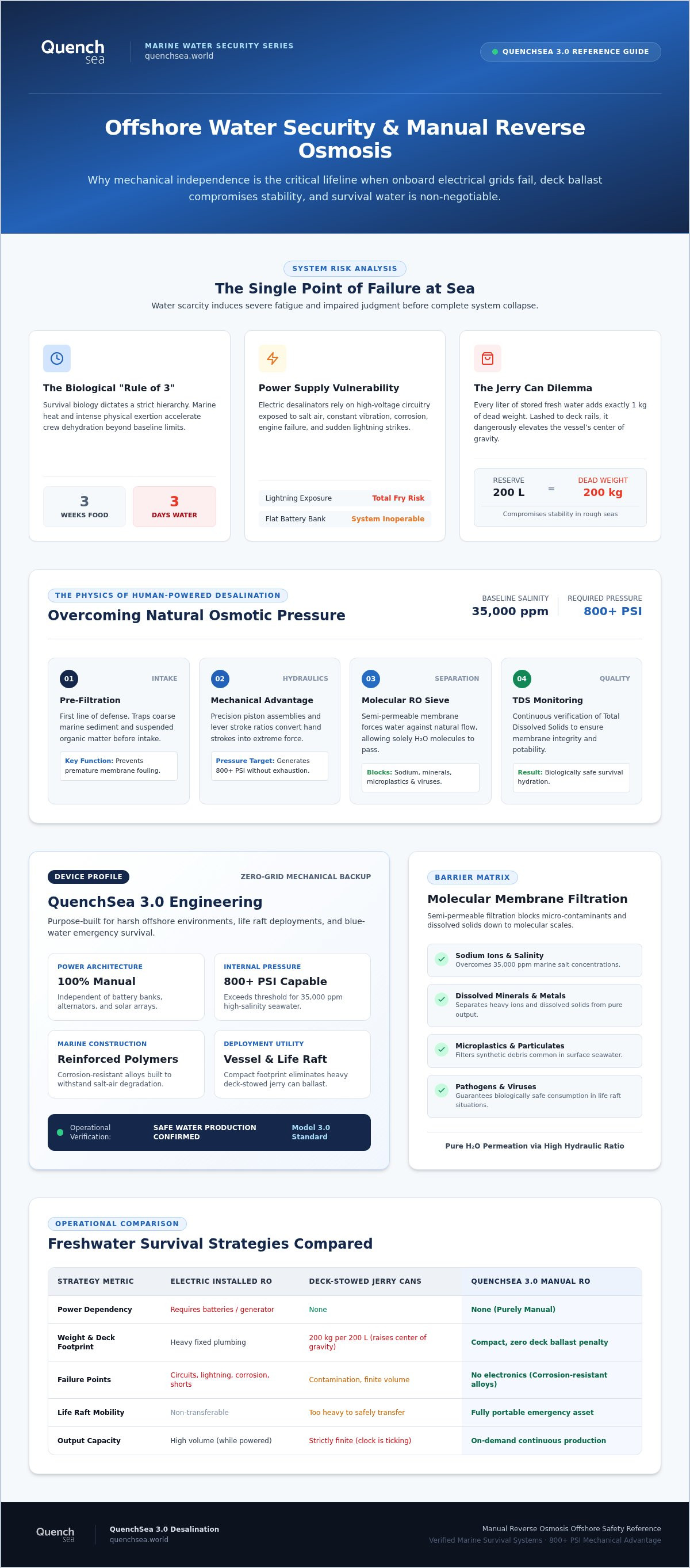
The traditional solution has been to carry excessive jerry cans. This approach carries hidden costs. Water is heavy; one liter weighs exactly one kilogram. Stowing 200 liters of backup water adds 200kg of dead weight to your vessel. When this weight is lashed to deck rails, it raises your center of gravity and compromises stability in heavy seas. Mechanical independence offers a better way. It replaces dead weight with a functional tool that produces water on demand.
Freshwater as a Critical Yacht System
Survival experts often cite the "Rule of 3". You can survive three weeks without food, but only three days without water. In a marine environment, heat and physical exertion accelerate this timeline. Water scarcity doesn't just cause thirst. It induces severe fatigue and clouds tactical judgment. A dehydrated crew makes mistakes that lead to accidents. This is why your life raft water supply must be the foundation of your safety audit. You shouldn't just carry water. You should carry the means to create it.
The Limits of Onboard Power
Yacht electronics exist in a state of constant decay. Salt air, vibration, and moisture are relentless. Lightning strikes can fry every circuit on board in a millisecond, leaving your primary water maker dead. Even without a catastrophic event, battery depletion is a constant threat during long passages with limited solar gain. There is a specific irony in owning a "portable" water maker that requires a generator to function. If your engine fails or your fuel is contaminated, that device becomes expensive ballast. True independence requires a purely mechanical backup. You need a system that works when the screens go dark and the batteries are flat. Portable desalination for sailing ensures that your survival isn't tethered to a fuse box.
How Manual Reverse Osmosis Works Without Electricity
Manual reverse osmosis removes the reliance on high-voltage pumps. It uses a human-powered lever to create the pressure needed to separate pure water from brine. This process drives seawater against a semi-permeable membrane, allowing only H2O molecules to pass through. By stripping away the electronics, you eliminate the risk of circuit failure in a salt-saturated environment. This mechanical simplicity is the core advantage of portable desalination for sailing.
The science relies on overcoming natural osmotic pressure. To force water through a membrane in the opposite direction of its natural flow, you must exert significant force. Desalinating seawater at 35,000 ppm salinity requires a minimum osmotic pressure of 800 PSI. Modern units achieve this through sophisticated mechanical advantage, converting steady manual strokes into high-pressure hydraulic force. The membrane acts as a molecular sieve, blocking sodium ions, dissolved minerals, and larger contaminants like microplastics.
Pre-filtration is the first line of defense. It captures sediment and organic matter before they reach the delicate RO membrane. This step prevents premature fouling and ensures the system remains operational during long passages. Without effective pre-filtration, the membrane would clog quickly, rendering the device useless when you need it most.
The Engineering of Pressure Ratios
Lever-action designs and precision piston assemblies reduce the physical burden on the user. By optimizing the stroke length and pressure ratios, engineers have made it possible for a single person to generate survival-grade volumes of water without exhaustion. Modern 2026 units utilize reinforced polymers and corrosion-resistant alloys. These materials withstand extreme internal pressures and the abrasive nature of salt air. This hardware-focused approach ensures durability and mechanical integrity in the harshest conditions.
Filtration Beyond Salt
Safety goes beyond salt removal. Modern membranes are engineered to block pathogens and viruses, ensuring the output is biologically safe for consumption. Total Dissolved Solids (TDS) monitoring allows the crew to verify membrane integrity in real-time. This level of precision is why manual reverse osmosis seawater systems are now the gold standard for blue-water safety. For those seeking a reliable backup that prioritizes functionality over fluff, the QuenchSea 3.0 provides this industrial-grade filtration in a handheld format.
Portable vs. Installed: Finding the Right Balance
Choosing between an installed system and a portable device isn't a matter of "either/or" for the serious sailor. It's a matter of mission requirements. Large, DC-powered water makers can produce 100 liters per hour, enabling luxuries like hot showers and onboard laundry. However, these systems are heavy, complex, and static. Portable desalination for sailing serves a different, more critical purpose. It provides essential hydration without the massive power draw or the need for permanent hull modifications.
Maintenance is a primary differentiator. Installed units are high-maintenance assets. They require "pickling" with biocide chemicals if left idle for even a week. Failure to do so leads to membrane fouling and expensive repairs. Portable gear eliminates this burden. You can rinse it, dry it, and stow it in a locker until needed. There are no through-hull fittings to leak and no complex plumbing to winterize. This simplicity reduces the total cost of ownership while increasing vessel safety.
The Case for Mechanical Redundancy
Redundancy is the hallmark of professional seamanship. World cruisers and ocean racers carry a manual water maker for boat safety because it functions when every other system fails. Unlike petrol-driven portable units, a manual device requires no flammable fuel or spare parts. It is the only truly energy-independent solution. If your primary electric desalinator suffers a pump failure or an electrical short, the manual unit keeps your crew hydrated. It is an insurance policy that pays out in freshwater.
Installation Complexity vs. Instant Deployment
Plumbing a permanent water maker involves significant time and technical skill. You must manage intake strainers, high-pressure pumps, and dedicated electrical circuits. In contrast, portable units offer instant deployment. They are ready for use the moment they are pulled from storage. This flexibility allows you to move the device between vessels or take it ashore for coastal camping. A compact desalinator fits easily into a standard marine locker or a grab bag, ensuring it is accessible during an abandon-ship scenario. You gain the security of an infinite water supply without the engineering headache of a permanent install.
Choosing a Portable Desalinator: 5 Performance Metrics
Maintaining a vessel for blue-water cruising involves more than just water security; it requires robust hardware for every component on deck. For those looking to upgrade their vessel's identification hardware with high-quality, marine-grade accessories, learn more about Tower Flags' durable custom brackets and poles.
Selecting gear for offshore use requires a disciplined engineering mindset. Lab specifications often fail to reflect the reality of a pitching deck or a cramped life raft. To identify reliable portable desalination for sailing, you must look past marketing fluff and prioritize mechanical integrity. Survival isn't about peak performance; it's about sustained reliability. Just as you would prioritize high-quality, shelf-stable provisions from a conserverie artisanale en ligne for your galley, use these five metrics to evaluate any manual unit before adding it to your manifest.
First, evaluate the realistic flow rate. Manufacturers often quote theoretical maximums. You need to know what a human can produce over several hours of steady work. For a survival-grade device, aim for 2 to 4 liters per hour. Second, assess the physical exertion. Desalination requires 800+ PSI. If the mechanical advantage is poorly designed, the crew will face exhaustion before they meet their hydration needs. Third, verify the salt rejection rate. Safe drinking water must stay below 500 TDS (Total Dissolved Solids) to prevent long-term kidney stress. Fourth, examine the build quality. Marine-grade, UV-resistant materials are essential to survive the abrasive salt-air environment. Finally, check the maintenance cycle. You must be able to replace the RO membrane in the field without specialized tools or complicated procedures.
Liters per hour is a misleading stat if the pumping effort is too high. High output is useless if you're too fatigued to maintain the pace. Ergonomic handle design and a smooth piston stroke allow for long-duration operation. This is especially critical for solo sailors or small crews. You don't want to burn more calories and sweat more water than you're producing. Match the device's output to your crew's daily requirements while accounting for the physical cost of production. Efficiency is the difference between a tool and a liability.
Durability in Salt-Air Environments
Survival gear often sits idle in a locker for years. A survival desalination device must be ready for instant deployment. Non-electric units have a superior shelf-life because they don't rely on batteries that degrade or circuits that corrode. Look for impact-resistant housings and non-corrosive internals like reinforced polymers. If a device can't survive a five-foot drop onto a fiberglass deck, it doesn't belong on your boat. Secure your vessel's water security by choosing a tool built for the worst-case scenario. Explore the QuenchSea 3.0 technical specifications to see how we meet these survival standards.
QuenchSea 3.0: The Yachtsman's Fail-Safe Solution
The QuenchSea 3.0 is the hardware answer to a life-critical question: what happens when the power dies? This device isn't a luxury gadget; it's a survival-grade tool engineered for high-stakes marine environments. It provides reliable portable desalination for sailing by removing every vulnerable electronic component. By focusing on mechanical integrity, the 3.0 model ensures that your vessel's freshwater supply remains secure regardless of battery health or engine status. It is the culmination of years of engineering focused on one goal: keeping sailors alive when their primary systems fail.
Integrating this device into your emergency plan is a mandatory step for modern safety protocols. Traditional fixed systems are useless if you have to abandon ship. The QuenchSea 3.0 fits directly into a standard grab bag, moving with the crew to the life raft. This portability transforms it from a simple backup into a primary survival asset. It bridges the gap between limited emergency rations and the infinite resource of the ocean, ensuring that hydration is never a variable in your survival equation.
Survival-Grade Specs for the 2026 Sailor
Long-distance crossings demand gear that requires zero consumables. The QuenchSea 3.0 operates without fuel, batteries, or solar input, relying entirely on human-generated hydraulic force. Its robust RO technology is designed to handle varying sea temperatures and high salinities found in tropical and mid-ocean routes. The system maintains consistent salt rejection rates even in challenging conditions, ensuring the output remains safe for long-term hydration. The QuenchSea 3.0 serves as the ultimate mechanical insurance policy, providing a guaranteed bridge to safety when primary vessel systems fail.
Deployment and Routine Maintenance
Reliability depends on readiness. Keeping your QuenchSea 3.0 operational requires minimal effort compared to the pickling requirements of complex installed units. After use, simply rinse the system with freshwater and allow it to dry before stowing it in its protective case. This prevents salt crystallization and protects the membrane from premature fouling. We recommend integrating the unit into your monthly safety drills. Have the crew practice deployment and pumping for ten minutes to ensure everyone understands the mechanical rhythm. This familiarity reduces panic and improves efficiency during a real emergency. Secure your water security before your next offshore passage. Explore the QuenchSea 3.0 for your next voyage.
Master Your Vessel's Water Security
True offshore independence requires stripping away the layers of complexity that lead to failure. By choosing portable desalination for sailing, you remove the reliance on fragile battery banks and complex plumbing. You've seen how manual reverse osmosis provides a reliable, energy-independent path to hydration when your primary systems go dark. This isn't just about convenience; it's about mechanical integrity in the face of the ocean's unpredictability.
The QuenchSea 3.0 offers a survival-grade solution that fits in a grab bag. It delivers high-rejection filtration through purely manual operation, ensuring you never run out of drinking water. With robust construction designed for the salt-air environment and global shipping available for offshore sailors, it's the ultimate insurance policy for any blue-water crossing. Don't leave your crew's safety to a circuit board. Secure Your Water Independence with QuenchSea 3.0. Prepare your vessel for the worst-case scenario and sail with the confidence of mechanical reliability.
Frequently Asked Questions
Can you drink salt water if it's filtered through a regular portable water filter?
No, regular portable filters are designed for freshwater sources and cannot remove dissolved salts. Standard filtration media like hollow fiber membranes or activated carbon are too porous to block sodium ions. Drinking seawater through these devices won't prevent dehydration and can be fatal. Only reverse osmosis technology generates the pressure required to separate salt from H2O at a molecular level. It's a critical distinction for survival.
How much physical effort is required to pump a manual desalinator?
Pumping a manual desalinator requires consistent, rhythmic physical effort to overcome 800+ PSI of osmotic pressure. The QuenchSea 3.0 utilizes mechanical advantage to reduce the burden on the operator. While it's more demanding than turning a tap, it's designed to be sustainable for an average adult during survival situations. Maintaining a steady pace is more effective for portable desalination for sailing than applying short bursts of high force. It's about endurance.
How long does the reverse osmosis membrane last in a portable unit?
The reverse osmosis membrane in a portable unit typically lasts for several thousand liters of production under normal conditions. Its longevity depends heavily on the use of pre-filtration to block sediment and biological matter. If the membrane becomes fouled by oils or heavy silt, its efficiency will drop. The QuenchSea 3.0 is engineered for field service, allowing you to replace the membrane easily without specialized tools or professional assistance. It's built for reliability.
Is the water produced by QuenchSea 3.0 safe for children and the elderly?
The freshwater produced is safe for all age groups, including children and the elderly, provided the system is operated correctly. The QuenchSea 3.0 removes the vast majority of salts, pathogens, and microplastics from seawater. It's essential to use a TDS meter to verify that the output remains below 500 parts per million. This ensures the water meets international standards for safe, long-term consumption during offshore passages or emergencies. It's pure hydration.
Can a portable desalinator be used for daily water needs on a small boat?
Portable units are engineered for essential hydration and drinking water rather than high-volume domestic needs. While you could technically use it daily, the manual effort required to produce water for showers or laundry is impractical. It serves best as a primary drinking water source for minimalist vessels or as a critical backup for larger yachts. It provides security without the weight and power consumption of a permanent 100L/hr installation. It's a tool, not a luxury.
What happens if the intake hose gets clogged with seaweed or debris?
If the intake hose becomes obstructed, you'll notice increased resistance or a total loss of suction. The QuenchSea 3.0 includes a pre-filter to protect the internal RO membrane from damage caused by seaweed or debris. If a clog occurs, stop pumping immediately to prevent pressure spikes. You should clear the intake strainer and flush the hose with clean water before resuming operation. Regular inspection is standard for portable desalination for sailing. It's simple maintenance.
Do I need to 'pickle' or preserve the unit if I don't use it for a few months?
Manual units don't require the complex chemical pickling processes common in large electric water makers. If you plan to store the device for several months, flush it thoroughly with freshwater to remove all salt residue. Once flushed, drain the unit and allow it to dry completely before stowing it in its case. This simple maintenance routine prevents biological growth and salt crystallization, ensuring the device is ready for instant deployment. It's designed for long-term readiness.
Is a manual water maker better than carrying extra water tanks?
A manual water maker provides a superior balance of weight and security compared to carrying excessive tanks. Every liter of tanked water adds one kilogram of weight to your vessel, which can impact performance and stability. While tanks offer immediate access, they're a finite resource. A manual desalinator provides an infinite supply from a compact footprint. Most sailors prefer a hybrid approach, using tanks for convenience and a desalinator for absolute redundancy. It's the ultimate insurance policy.