

In a mid-ocean crisis, an expensive electric water maker is just a heavy paperweight if your batteries fail. You know that offshore survival isn't about luxury. It's about mechanical certainty. When electronics short-circuit and space in the life raft is at a premium, you need a tool that operates independently of your power grid. This QuenchSea 3.0 review provides a technical, field-ready analysis of how this manual desalinator handles the brutal reality of the open sea. We examine if this compact device truly offers the reliability required for a worst-case scenario.
You're likely concerned about the physical exhaustion of manual pumping or whether a handheld unit can actually meet World Health Organization standards for potable water. We agree that a backup is only useful if it's functional under extreme duress. This analysis promises a deep dive into the 60-bar hydraulic system and its 98% salt rejection capabilities. We will evaluate the unit's ergonomics, its triple pre-filtration process, and the logistics of producing five to eight liters of fresh water per hour. This is a look at hardware built for the mission. It's time to see if the QuenchSea 3.0 belongs in your grab bag.
Key Takeaways
- Understand how the QuenchSea 3.0 operates at 60 bar pressure without batteries or fuel to provide a fail-safe water source in emergencies.
- Verify the 98% salt rejection rate and learn how to achieve the 5 to 8 liters per hour output in real-world marine conditions.
- This QuenchSea 3.0 review analyzes the reinforced lever architecture and triple pre-filtration system engineered for extreme durability.
- Master the "pickling" storage method and field-cleaning protocols required to protect your RO membrane from salt crystallization and biological growth.
- Determine if this compact, survival-grade tool meets the rigorous reliability and volume requirements for your vessel's emergency grab bag.
What is the QuenchSea 3.0? Specifications and First Impressions
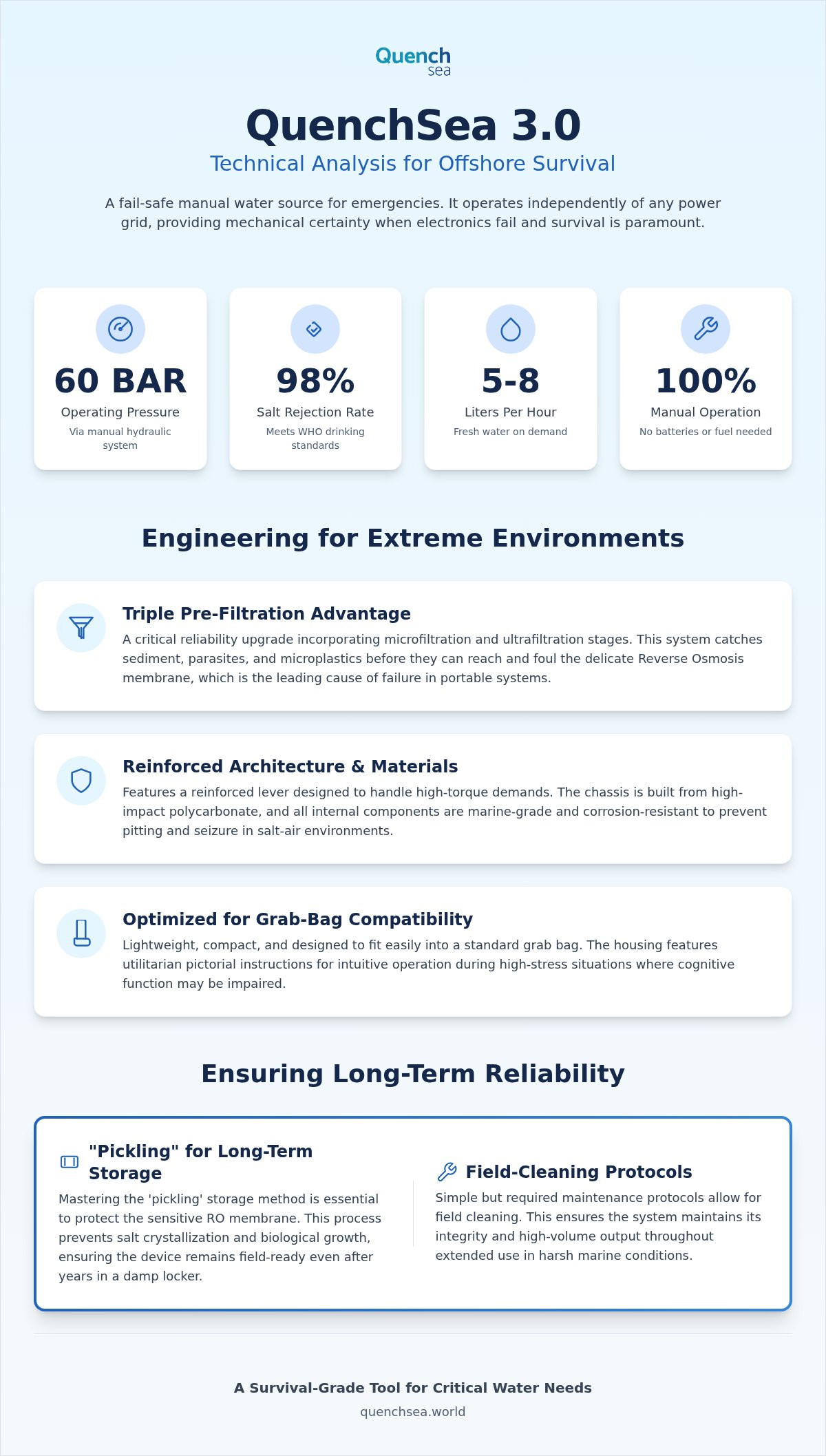
The QuenchSea 3.0 is a manual, handheld desalination system. It isn't a luxury accessory. It's a life-critical survival tool designed for the harshest offshore environments. This QuenchSea 3.0 review identifies it as a human-powered reverse osmosis unit that converts seawater into potable water without batteries or fuel. It produces between 5 and 8 liters per hour. It achieves a 98% salt rejection rate, meeting WHO standards for safe drinking water. This device provides a mechanical safeguard for when your primary systems fail.
Engineering for the marine environment requires specific material choices. The chassis utilizes high-impact polycarbonate to withstand drops and internal pressure. All internal components are corrosion-resistant and marine-grade. This isn't just for sailors. It's engineered for life rafts, yacht grab bags, and coastal emergency kits. It provides a reliable freshwater source when primary electric water makers fail or when you're forced into a survival craft. Every purchase also supports global water access, adding a humanitarian dimension to its technical utility.
The Core Technology: Manual Reverse Osmosis (MROD)
Survival requires volume. This device utilizes a manual hydraulic lever to generate 60 bar of pressure. This force drives seawater through an industrial-grade reverse osmosis technology membrane. It strips away dissolved solids, pathogens, and salt. Unlike slow solar stills that rely on evaporation, manual RO provides water on demand. It's a mechanical solution for high-volume needs. It trades physical effort for immediate hydration. The system works as long as you can pump. It's an efficient conversion of human energy into life-sustaining fluid.
Unboxing the 3.0: Portability and Build Quality
First impressions reveal a device optimized for grab-bag compatibility. It's lightweight and compact. The housing features utilitarian pictorial instructions for stress-induced operation. This is critical when cognitive function is impaired by dehydration. There are no fragile external parts to fail. The build quality feels rugged. In this QuenchSea 3.0 review, the lack of delicate components is a major advantage. It's a solid tool that prioritizes mechanical integrity over aesthetics. It's a compact gear piece that fits easily into a standard grab bag and feels capable of surviving a season in a damp locker without losing its operational edge.
Engineering Evolution: How QuenchSea 3.0 Improves on Previous Models
Survival gear must evolve based on field failure. The QuenchSea 3.0 is a direct response to user feedback from earlier iterations. While early prototypes proved the concept of portable desalination, the 3.0 focuses on structural longevity and mechanical efficiency. It maintains the core 60 bar pressure requirement but reinforces the mechanical leverage needed to achieve it. This version prioritizes the total lifecycle of the hardware, from active pumping to long-term storage in corrosive, salt-heavy lockers. It's a necessary advancement for manual boat water makers intended for blue-water use.
Addressing the Durability Gap
Early manual desalinators often faced handle failure under sustained load. The 3.0 features a reinforced lever architecture specifically designed to handle the high-torque demands of the internal hydraulic system. By utilizing advanced marine-grade plastics instead of heavy metals, the device avoids the pitting and seizure common in salt-air environments. This materials science approach ensures the seals remain intact even when the unit is stored as a backup for years. The reinforced stress points allow for more aggressive pumping without the fear of snapping the lever when you need water most.
The Triple Filtration Advantage
Protecting the RO membrane is the primary engineering challenge for any survival tool. In this QuenchSea 3.0 review, the new triple pre-filtration system stands out as a critical reliability upgrade. It incorporates microfiltration and ultrafiltration stages to catch sediment, parasites, and microplastics before they reach the delicate membrane. This prevents premature fouling, which is the leading cause of failure in portable systems. If you're building a grab bag for an offshore passage, you can secure your survival-grade desalinator here.
The desalination process is physically demanding. By stripping away larger contaminants early, the 3.0 ensures the human energy you expend goes toward salt rejection rather than fighting a clogged filter. These components are field-replaceable. You don't need a workshop to swap a filter in a life raft. This modularity is a hallmark of survival-grade gear. It allows for sustained operation in sediment-heavy coastal waters where lesser systems would seize. The 3.0 isn't just a desalinator. It's a complete, ruggedized filtration laboratory that fits in one hand.
Performance Analysis: Output, Salt Rejection, and Ergonomics
Performance in the field differs from the lab. This QuenchSea 3.0 review focuses on the intersection of mechanical output and human endurance. While the technical specifications claim an output of 5 to 8 liters per hour, achieving this requires a disciplined pumping rhythm. You must maintain a steady 60 bar of pressure. In a survival situation, your body is the engine. Efficiency isn't just a specification. It's a requirement for life. The device delivers on its promise, but only if the operator understands the physical stakes involved.
The 'Human Cost' of Fresh Water
Pumping is work. To reach the upper limit of 8 liters per hour, you need to commit to a consistent cadence. Don't rely on arm strength alone. This leads to rapid fatigue. Instead, use your body weight. Lock your elbows and use your core to drive the lever. This technique preserves your caloric reserves and ensures a steady flow of permeate. A sustainable strategy involves pumping for 15 minutes every hour. This prevents muscle failure and keeps the RO membrane active. It's about pacing, not speed. Exhaustion is a secondary threat in survival scenarios. Manage it carefully.
Seawater typically contains 35,000 ppm of Total Dissolved Solids (TDS). The QuenchSea 3.0 reduces this to below 1,000 ppm. This meets World Health Organization potable water standards. It's the difference between hydration and rapid dehydration. Understanding why is drinking sea water dangerous is vital for any offshore sailor. The biological reality is that your kidneys cannot process high salinity. This device solves that problem mechanically by stripping the salt before it enters your system.
Water Quality Testing
The taste of the output is distinct. Reverse osmosis water lacks the minerals found in commercial bottled water. It may taste "flat" or neutral. This is a sign of high-purity filtration. Beyond salt rejection, the ultrafiltration stage targets pathogens and viruses. It removes biological threats that could cause gastrointestinal distress. You aren't just getting desalted water. You're getting sterile hydration. This QuenchSea 3.0 review confirms that the output quality remains consistent even in sediment-heavy waters. The triple pre-filtration system ensures that the water you drink is clear, safe, and free from the contaminants that compromise health in a crisis.
Operational Logistics: Maintenance and Long-Term Reliability
Survival equipment is only effective if it functions after months of neglect. This QuenchSea 3.0 review emphasizes that mechanical reliability is a partnership between the engineer and the owner. Long-term storage in a salty, humid environment is the greatest threat to any desalinator. You must manage the RO membrane's health to ensure it delivers fresh water when your primary system fails. Reliability is not a static feature. It is a result of proper operational logistics.
The "pickling" process is the most critical maintenance task for any manual RO unit. It involves circulating a preservative solution through the device to inhibit biological growth. Without this, bacteria and mold will colonize the membrane, rendering it useless. Unlike electric units that require complex plumbing for pickling, this manual system allows you to perform the procedure using the hand lever. It's a straightforward task that guarantees a shelf-life of up to three years in a life raft water supply. Proper pickling ensures the tool is ready the moment you deploy it.
Membrane Care in Marine Environments
Biofouling isn't the only risk. Salt crystallization can physically puncture the RO membrane if the unit is stored with brine inside. Always perform a freshwater flush after use. If performance degrades, indicated by increased pumping resistance or a rise in TDS levels, the membrane likely needs replacement. Keep your grab bag in a temperate location. Excessive heat can compromise the chemical integrity of the RO elements over time. A cool, dry locker is the ideal environment for long-term readiness.
Field Repairability
Mechanical systems eventually require part replacement. The QuenchSea 3.0 is designed for field maintenance without specialized tools. Most issues stem from O-ring wear or valve debris. You can clean the triple pre-filters by hand, removing sediment that would otherwise choke the system. For long-distance sailors, a basic spares kit containing replacement seals and a spare membrane is essential. This allows for total independence from shore-based repair facilities during a passage.
The pictorial guide on the housing remains a vital asset during high-stress repairs. It provides a visual checklist when cognitive fatigue sets in. Reliability isn't just about the build quality. It's about your ability to keep the machine running in a crisis. You can order your QuenchSea 3.0 and essential spares here to ensure your vessel is truly prepared for the unexpected. Maintaining your gear is as important as owning it.
The Verdict: Is the QuenchSea 3.0 Right for Your Vessel?
The QuenchSea 3.0 review process confirms one reality. This device is the most cost-effective insurance policy for ocean hydration available today. It isn't a luxury convenience. It's a survival-grade tool designed for the moment your primary systems go dark. If you're an offshore sailor, a coastal prepper, or a responsible vessel owner, this hardware belongs in your emergency kit. It provides a definitive answer to the fear of water scarcity in a marine crisis. While it requires physical effort, the trade-off is absolute independence from the grid.
Every tool has trade-offs. The 3.0 build is robust and eliminates the fragile failure points found in earlier models. Its "No battery. No fuel." mission ensures it works when electronics short-circuit. However, you must be prepared for the physical demand of manual pumping and the discipline of periodic maintenance. This is a tool for those who prioritize reliability over ease. It's a calculated, mechanical solution for high-stakes environments where failure is not an option.
QuenchSea 3.0 vs. Electric Water Makers
Redundancy is the hallmark of a prepared mariner. Even the most advanced electric water makers are vulnerable to pump failures, blown fuses, or battery depletion. The QuenchSea 3.0 serves as the ultimate backup. It offers a significant weight advantage for small crafts and life rafts where every kilogram matters. Carrying a survival desalination device that fits in a grab bag ensures you have a path to freshwater even if you're forced to abandon ship. It bridges the gap between high-tech convenience and low-tech survival.
The Humanitarian Impact Factor
Choosing this desalinator extends beyond personal safety. The brand operates with a visionary ambition to solve the global water crisis. Every purchase directly funds clean water projects in regions where potable water is a luxury. The goal is clear. The organization aims to deploy 100 million devices by 2035 to provide sustainable water access globally. When you invest in your own safety, you support a broader mission of global responsibility and innovation.
Don't wait for a system failure to realize you're unprepared. Mechanical simplicity is your greatest asset in a survival situation. It's time to equip your vessel with a tool that works as hard as you do. Secure your survival lifeline with QuenchSea 3.0 today and ensure your freshwater supply is never dependent on a battery.
Secure Your Offshore Hydration Strategy
Mechanical reliability is the only currency that matters when electronics fail at sea. This QuenchSea 3.0 review highlights a tool that trades physical effort for life-sustaining certainty. By achieving a 98% salt rejection rate without batteries or fuel, it provides a fail-safe backup for your primary water systems. It's a compact, ruggedized solution that fits into any emergency grab bag. Marine, defense, and emergency professionals depend on this technology because it removes the variable of power failure from the survival equation.
You now understand the engineering evolution and maintenance protocols required to keep this device mission-ready. The choice to carry a manual desalinator is a choice for total grid independence. It ensures that fresh water remains accessible as long as you have the strength to pump. Don't leave your hydration to chance or aging batteries. Equip your vessel with the QuenchSea 3.0 today and gain the peace of mind that comes with proven, survival-grade hardware. Your future self will thank you for the preparation.
Frequently Asked Questions
How much water can the QuenchSea 3.0 realistically produce in an hour?
The QuenchSea 3.0 realistically produces between 5 and 8 liters of fresh water per hour. This output depends on the operator maintaining a consistent pumping rhythm and the required 60 bar of pressure. While environmental factors like water temperature influence flow rates, the hydraulic system is engineered to provide practical volumes for survival. It's a significant improvement for anyone conducting a QuenchSea 3.0 review for offshore use.
Is it difficult to pump the QuenchSea 3.0 manually?
Pumping requires sustained physical effort to reach the necessary 60 bar of pressure. It's designed to be manageable by utilizing body weight rather than relying solely on arm strength. The reinforced lever architecture in the 3.0 model improves ergonomics compared to earlier versions. Most users find that a pacing strategy, such as pumping for 15 minutes every hour, prevents exhaustion while ensuring a steady supply of potable water.
Does the QuenchSea 3.0 remove bacteria and viruses from seawater?
Yes, the device effectively removes bacteria, viruses, and parasites through a combination of triple pre-filtration and reverse osmosis technology. The system includes microfiltration and ultrafiltration stages specifically designed to catch biological contaminants before they reach the RO membrane. This ensures the output isn't just desalted but is also biologically safe for consumption. It provides a sterile hydration source that is critical for long-term health in survival situations.
How long does the RO membrane last before it needs replacement?
The RO membrane typically lasts for several years if properly maintained and stored. Its lifespan depends heavily on regular freshwater flushing and the "pickling" process to prevent biofouling during periods of inactivity. If you notice a significant rise in Total Dissolved Solids (TDS) or increased resistance during pumping, it's likely time for a replacement. Keeping spare membranes in your grab bag ensures your vessel remains independent of shore-based supply chains.
Can I use the QuenchSea 3.0 to filter brackish water or pool water?
The QuenchSea 3.0 is specifically engineered for seawater desalination, but it can process brackish water. You shouldn't use it for pool water or chemically contaminated sources because chlorine can permanently damage the RO membrane. The system's primary mission is to provide fresh water from the ocean. Using it on sediment-heavy brackish sources will require more frequent cleaning of the pre-filters to maintain optimal flow and pressure throughout the process.
What maintenance is required to keep the device ready for an emergency?
Maintenance focuses on protecting the RO membrane from salt crystallization and biological growth. After every use, you must perform a freshwater flush to remove brine from the internal system. For long-term storage, the "pickling" process is essential. This involves circulating a preservative solution through the unit to inhibit mold and bacteria. These simple steps ensure the hardware remains functional and reliable for years while stored in a damp marine environment.
Does the QuenchSea 3.0 meet WHO drinking water standards?
Yes, the QuenchSea 3.0 meets World Health Organization (WHO) standards for potable water. It achieves a 98% salt rejection rate, typically reducing seawater salinity from 35,000 ppm to well below the 1,000 ppm threshold for safe consumption. This technical performance is a core focus of any QuenchSea 3.0 review. It provides the biological and chemical safety required to maintain hydration and kidney function during an extended offshore emergency.
Can the device be stored in a life raft for several years?
The device is designed for long-term storage in life rafts and grab bags. When properly pickled with a preservative solution, the internal components and RO membrane can remain shelf-stable for up to three years. Its high-impact polycarbonate chassis and marine-grade materials are built to withstand the corrosive environment of a survival craft. Regular inspections of the seals and periodic re-pickling will ensure the tool is ready for immediate deployment.