

What happens to your survival plan when the batteries die and the horizon is nothing but salt water? You understand that in a marine emergency, electricity is a luxury you cannot always guarantee. Integrating a reliable non-electric seawater filter into your kit is the only way to ensure hydration when your primary power systems fail. Relying on a complex, power-hungry water maker is a high-stakes gamble you don't have to take.
This 2026 guide reveals how to transform harsh brine into life-saving hydration using advanced manual reverse osmosis technology. You'll discover how to achieve total independence from the power grid while saving space and reducing the high costs associated with traditional electric units. We strip away the fluff to focus on mechanical integrity and survival-grade performance.
We'll explore the mechanical reliability of the QuenchSea 3.0, examine how it meets World Health Organization drinking water standards, and outline the exact steps to maintain water security in extreme environments. From life raft essentials to portable bug-out bags, you'll learn why manual desalination is the only bridge between seawater and survival.
Key Takeaways
- Learn why standard sediment filters fail against dissolved salts and why manual reverse osmosis is the only mechanical solution for survival.
- Discover how hand-powered pumps generate the necessary pressure to drive desalination without batteries, fuel, or solar power.
- Compare the weight and reliability of a non-electric seawater filter against traditional electric water makers in "dead-ship" emergencies.
- Identify the essential pre-filtration steps needed to protect your RO membrane from sand and algae in coastal environments.
- Examine the engineering behind the QuenchSea 3.0, focusing on its corrosion-resistant design for 2026 marine safety standards.
Why Standard Non-Electric Filters Fail with Seawater
Standard survival filters are built for the woods, not the waves. Most portable units designed for hiking or backpacking focus on removing suspended solids like silt, sand, and organic debris. They utilize porous membranes or activated carbon to trap floating particles. Seawater presents a different chemical challenge entirely. Salt is a dissolved solid. It doesn't float in the water; it is chemically integrated into the solution.
If you pass seawater through a standard charcoal or ceramic filter, the resulting liquid remains toxic. These devices lack the mechanical architecture to separate sodium chloride ions from water molecules. To solve this, you need a specialized non-electric seawater filter that utilizes reverse osmosis. This process requires significant physical pressure to force water through a semi-permeable membrane while rejecting the salt. Without this mechanical force, the output remains undrinkable.
Filtration vs. Desalination: A Critical Distinction
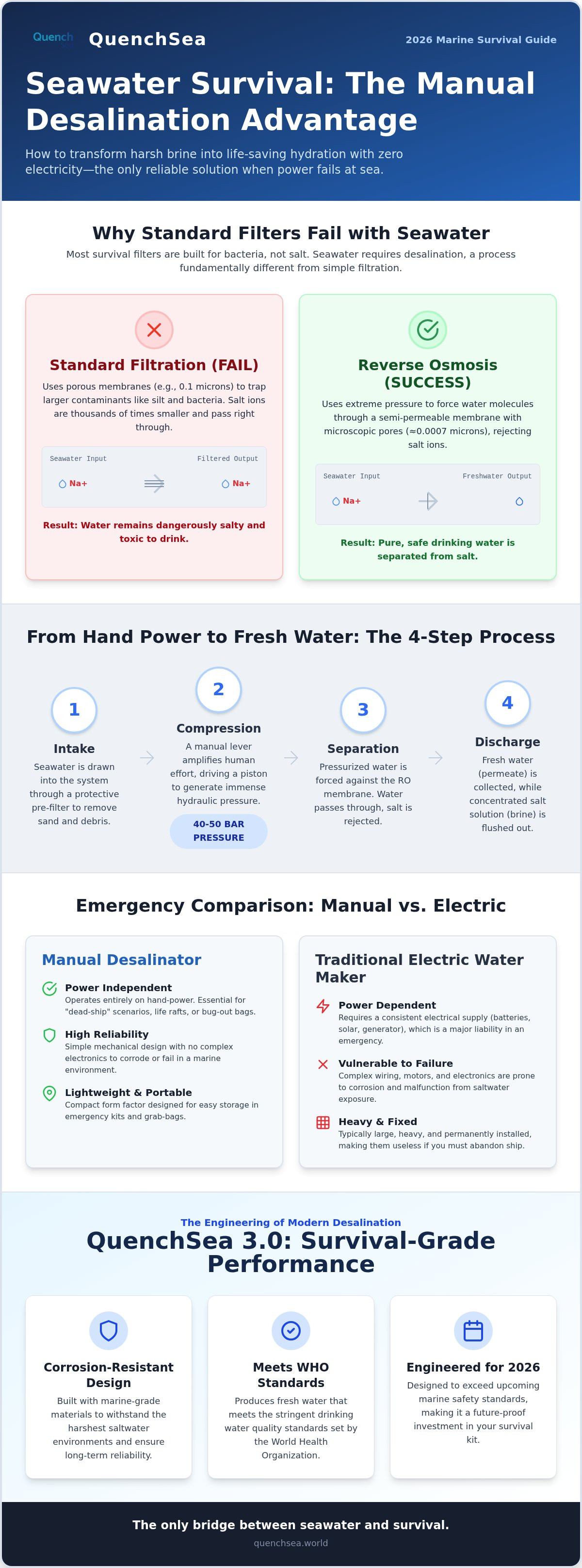
The difference lies in pore size and molecular weight. A standard hollow-fiber filter might have pores as small as 0.1 microns. This is sufficient to block bacteria and protozoa. However, salt ions are roughly 0.0007 microns in size. They are thousands of times smaller than the gaps in a typical camping filter. Relying on passive filtration for ocean water is like trying to stop sand with a chain-link fence.
Desalination is not a passive process. It is an energy-intensive separation. While a gravity filter relies on the weight of the water, a non-electric seawater filter requires manual leverage. You must generate enough pressure to overcome the natural osmotic pressure of the ocean. This force allows the membrane to strip away the salt molecules, leaving pure hydration on the other side. Mechanical integrity is the only substitute for electrical power in this environment.
The Risks of Inadequate Seawater Treatment
Drinking incorrectly filtered seawater is a death sentence in a survival scenario. If your filter fails to remove the salt, you are ingesting a solution that is roughly three times saltier than human blood. This triggers hypernatremia. Your kidneys must pull water from your own cells to flush out the excess sodium. Instead of hydrating, you are effectively poisoning your system from the inside out.
DIY survival filters made from sand, charcoal, or cloth are useless against salt. They may clear the water of visible dirt, but the biological reality remains unchanged. Ingesting this water accelerates dehydration and leads to rapid organ failure. Understanding why is drinking sea water dangerous is critical for any offshore voyager. Relying on a tool not specifically engineered for desalination is a fatal mistake in high-stakes environments.
The Mechanics of Manual Reverse Osmosis (RO)
Reverse osmosis (RO) is the gold standard for desalination. In industrial settings, high-voltage electric motors drive this process. In a survival environment, those motors are a liability. Corroded wires or dead batteries turn an expensive water maker into dead weight. A non-electric seawater filter operates on the principle of hydraulic pressure. You aren't just sifting water; you're using mechanical force to overcome the natural osmotic pressure of the ocean. This requires a sustained pressure of approximately 40 to 50 bar to be effective.
The system divides the intake into two distinct flows. The 'permeate' is the fresh, desalinated water that successfully passes through the membrane. The 'brine' is the concentrated salt solution that is rejected and flushed away. Managing this ratio is critical. If the brine isn't cleared efficiently, the membrane will clog, rendering the device useless. High-performance units balance these flows to ensure maximum output with minimum physical fatigue.
From Hand-Power to Fresh Water
Turning human effort into 50 bar of pressure requires precision engineering. A manual pump uses a lever system to amplify your strength. This mechanical advantage allows a single operator to drive the desalination process without external power. The sequence follows a logical, mechanical progression:
- Intake: Seawater enters the system through a dedicated pre-filter.
- Compression: The manual lever drives a piston to create the necessary hydraulic pressure.
- Separation: Water molecules pass through the RO membrane while salt and contaminants are rejected.
- Discharge: Fresh permeate is collected while concentrated brine is expelled from the system.
Manual RO is the process of forcing seawater through a membrane using physical effort. It's a direct conversion of calories into hydration.
Membrane Technology in 2026
Modern membranes have evolved significantly. By 2026, thin-film composite (TFC) membranes have become the standard for portable units. These membranes consist of multiple layers engineered to maximize water flow while maintaining a 99.9% salt rejection rate. They offer higher flux, meaning they produce more water per stroke than older, less efficient designs. They're also specifically treated to resist mineral scaling and biofouling. These are the primary causes of failure in marine environments where salt and microorganisms quickly degrade inferior hardware. Understanding the nuances of manual reverse osmosis seawater ensures you choose equipment that won't fail when the stakes are highest.
Reliability is the only metric that matters at sea. You can explore the technical specifications of the QuenchSea 3.0 to see how these mechanical principles are applied in a survival-grade tool. When the grid goes down, your ability to generate pressure determines your survival.
Non-Electric vs. Electric Water Makers: A Comparison
Power is a liability in a marine emergency. Traditional electric water makers rely on a complex chain of dependencies: house batteries, solar arrays, charge controllers, and intricate wiring. If any link in that chain fails due to corrosion or electrical surge, your water production stops. A non-electric seawater filter eliminates these points of failure. It replaces sensitive electronics with mechanical certainty. In a "dead-ship" scenario where the engine won't start and the batteries are submerged, a manual system is the only tool that still functions.
Weight is a tax on speed and safety. Fixed electric desalination systems often exceed 20kg once you account for the motor, pumps, and housing. They're bolted to the hull, making them useless if you have to abandon ship. Portable manual units weigh approximately 2kg. This 90% reduction in mass allows for tactical flexibility. You can move the device from the galley to a life raft in seconds. Maintenance follows a similar logic. Repairing an electric unit at sea requires specialized multimeters and spare circuit boards. Maintaining a manual device usually involves nothing more than basic seal replacements and O-ring lubrication.
Cost-efficiency extends beyond the initial purchase. Electric systems demand a robust power infrastructure. To run a standard water maker, you often need to upgrade your solar capacity or carry extra fuel for a generator. A manual system requires zero external energy. It turns physical effort directly into hydration, making it the most cost-effective backup for any offshore vessel.
When to Choose Manual Desalination
Reliability dictates your choice. For life raft water supplies, a manual unit is mandatory. Batteries are a single point of failure that you can't afford when adrift. Short-handed sailors also benefit by reducing the constant draw on the house battery bank, preserving power for navigation and AIS. For those focused on emergency preparedness, the "set and forget" nature of manual tools is superior. They don't suffer from parasitic battery drain or firmware glitches during long-term storage.
Operational Trade-offs
You must understand the output reality. Electric systems are designed for luxury, providing high volumes for showers and cleaning. Manual systems are survival-grade tools designed specifically for drinking water. Efficiency depends on ergonomics. In high-stress situations, a well-designed handle and lever system are critical to prevent operator fatigue. Choosing the right manual water maker for boat use means balancing your need for volume against the absolute requirement for mechanical fail-safes. When survival is the goal, simplicity wins.
Tactical Deployment: Using Manual Filters in Survival
Survival is a test of efficiency. Once you deploy your non-electric seawater filter, your primary goal is maintaining a sustainable output. In a marine emergency, your energy is a finite resource. You must treat water production as a disciplined mechanical task. Set up your station in a stable position where you can use your body weight to drive the lever. This reduces muscle fatigue and ensures you can maintain the required 40 to 50 bar pressure for extended periods.
Pre-filtration is your first line of defense. Raw seawater contains sand, micro-plastics, and algae that can foul a membrane in hours. Always use the provided pre-filter or a fine mesh to clear the intake. If you're operating from a coastal camp, source your water from deeper areas away from the breaking surf to minimize sediment intake. Integrating a non-electric seawater filter into your emergency kit requires more than just the hardware; it requires a tactical understanding of the environment.
Marine Survival Strategies
Rough seas make every task dangerous. Secure your desalinator to the life raft using high-strength lanyards to prevent loss during a capsize. You should integrate the device into your standard life raft water supply protocol immediately upon deployment. Follow the 'Rule of 3' strictly. While you can survive three weeks without food, three days without water is the hard limit. Start pumping before dehydration sets in to maintain cognitive function and physical strength.
Off-Grid Coastal Use
Coastal environments offer more stability but present different challenges. Silt and organic runoff from shorelines can clog filters faster than open-ocean water. When packing your gear, ensure you have a dedicated bug out bag water desalination strategy that includes spare pre-filters. Freshly desalinated water is biologically pure but lacks essential minerals. For long-term survival beyond 48 hours, consider adding electrolyte tablets to your permeate to prevent mineral deficiencies.
Hydration is the foundation of any survival plan. You can order the QuenchSea 3.0 to ensure you have a reliable, non-electric solution ready for your next offshore voyage or coastal expedition. Store your produced water in clean, opaque containers to prevent algae growth and ration it according to your physical exertion levels.
QuenchSea 3.0: The Engineering of Modern Desalination
The QuenchSea 3.0 represents the pinnacle of manual desalination technology. Engineered to meet 2026 marine safety standards, this non-electric seawater filter prioritizes mechanical integrity over complex electronics. Every component is selected for long-term ocean exposure. The chassis utilizes high-impact, corrosion-resistant polymers that withstand UV degradation and constant salt spray. This isn't a luxury gadget; it's a mission-critical tool designed for the harshest environments on Earth. By eliminating electrical dependencies, the 3.0 model provides a fail-safe solution for offshore sailors and emergency responders alike.
A single operator can achieve consistent production rates required for life-saving hydration. The system is optimized for a 99.9% salt rejection rate, ensuring the output meets World Health Organization standards. The intuitive assembly ensures the device remains functional even in high-stress environments where fine motor skills are compromised. You don't need a technical manual to understand the lever mechanics. It's designed for immediate deployment when every second counts. The mechanical advantage built into the handle allows for sustained pumping without the rapid onset of physical exhaustion common in older designs.
Survival-Grade Durability
The 3.0 model incorporates years of field data and user feedback. We've reinforced the internal piston assembly to handle sustained high-pressure cycles without mechanical failure. The impact-resistant chassis protects the sensitive RO membrane from the shocks common in disaster relief scenarios. Unlike electric units that require regular "pickling" or maintenance runs, the QuenchSea 3.0 is designed for maintenance-free operation during long-term storage. It stays ready in your grab bag or life raft for years. When the crisis hits, the seals remain tight and the pump remains primed. This reliability is the result of precision engineering focused on the "last mile" of survival.
A Global Solution for Water Scarcity
The impact of this technology extends beyond individual survival kits. It's a scalable solution for humanitarian crises and remote coastal villages. In areas where the power grid is non-existent, a manual non-electric seawater filter provides a permanent bridge to clean water. Defense agencies also utilize these units for tactical water sourcing during littoral operations. When moving fast in coastal zones, carrying heavy water supplies is impossible. Producing it on-site is the only logical choice. This makes the QuenchSea 3.0 an essential component of any disaster relief water supply strategy. We provide the hardware that turns the ocean from a threat into a resource.
Ensuring Hydration Beyond the Grid
The ocean doesn't forgive a lack of preparation. You now understand that standard sediment filters are powerless against dissolved salts. Only a dedicated non-electric seawater filter utilizing manual reverse osmosis can bridge the gap between toxic brine and life-saving hydration. We've explored how mechanical leverage effectively replaces high-voltage motors. This gives you absolute independence from failing batteries, corroded wiring, and complex electronics. It turns the vast ocean into a viable resource rather than a biological threat.
Reliability is your most valuable asset in a marine emergency. The QuenchSea 3.0 is engineered for this exact reality. It offers hand-powered reliability for 2026 survival standards with no batteries and no fuel; just safe drinking water. It's a survival-grade tool trusted by marine professionals worldwide to perform when every other system fails. By mastering these manual techniques, you ensure that your safety remains in your own hands.
Don't leave your hydration to chance when the stakes are highest. You have the knowledge and the mechanical solution to overcome water scarcity in the most challenging environments. Secure your survival with the QuenchSea 3.0 Desalination Device. Stay prepared, stay hydrated, and stay empowered.
Frequently Asked Questions
Can a non-electric seawater filter remove 100% of the salt?
No, it removes approximately 99.9% of dissolved salts. Total removal is physically impossible with reverse osmosis; however, the reduction is sufficient to meet World Health Organization (WHO) standards. Modern membranes reduce seawater TDS from 35,000 mg/L to below 500 mg/L. This level is safe for human consumption and prevents the physiological dangers of salt ingestion. It ensures you remain hydrated in high-stakes marine environments during critical survival situations.
How much physical effort is required to pump a manual desalinator?
Pumping requires a consistent physical effort equivalent to a light cardio workout. You must generate 40 to 50 bar of hydraulic pressure to drive the reverse osmosis process. The QuenchSea 3.0 uses a lever-action handle to amplify your strength, making it manageable for a single operator. Efficiency depends on using your body weight rather than just arm strength. This mechanical advantage allows for sustained production without the rapid onset of physical exhaustion.
How long does the reverse osmosis membrane last in a manual filter?
A standard RO membrane in a non-electric seawater filter can last for several years if maintained correctly. Lifespan is measured by the volume of water processed and the quality of the intake. Heavy sediment or algae will shorten its life; always use a pre-filter to block large particles. Replacing the membrane is a simple mechanical task that doesn't require specialized tools. This ensures long-term reliability in the field during emergencies.
Can I use a manual seawater filter for lake or river water too?
Yes, you can use these devices for freshwater sources, but it's not the most efficient choice. Reverse osmosis membranes are designed to remove microscopic dissolved ions; this is overkill for most lakes or rivers. While it will produce pure water, the high pressure required makes it more labor-intensive than a standard gravity filter. It serves as a versatile backup for coastal bug-out bags where water sources vary between salt and fresh.
Is the water produced by a manual desalinator safe for long-term drinking?
Yes, the permeate produced is biologically and chemically safe for consumption. It meets international drinking water standards by removing 99.9% of salts, bacteria, and viruses. However, desalinated water lacks essential minerals like magnesium and calcium. For survival periods exceeding 48 hours, you should supplement your diet with electrolytes. This prevents mineral deficiencies while maintaining the hydration levels necessary for cognitive function and physical endurance during high-stakes marine emergencies or disaster relief.
What happens if the membrane gets clogged with sand or salt?
A clogged membrane results in increased pumping resistance and decreased water output. Salt scaling occurs if the system isn't flushed with fresh water after use. Sand or silt clogging is prevented by using a high-quality pre-filter. If the membrane fails, you must replace the internal cartridge. The QuenchSea 3.0 is designed for easy field maintenance. This allows you to swap components and restore water production quickly without needing specialized tools or power.
Do manual seawater filters require any chemical additives?
No, a non-electric seawater filter relies entirely on mechanical separation. The process uses physical pressure to force water through a semi-permeable membrane. No chlorine, iodine, or other chemical treatments are needed to remove the salt. This makes the system ideal for long-term storage, as you don't have to worry about expiring chemical stocks. It provides a pure, hardware-based solution for generating freshwater in any marine environment without relying on external energy.
How does the QuenchSea 3.0 compare to emergency water rations?
The QuenchSea 3.0 provides an indefinite supply of water, whereas rations are a finite resource. A single device can produce liters of water daily as long as you have the physical energy to pump. Rations are heavy, bulky, and eventually run out. Carrying a 2kg manual desalinator is more weight-efficient than carrying 20kg of water pouches. It represents a shift from a supply-based mindset to a production-based survival strategy for 2026.