

Your ultra-light hollow fiber filter is a useless piece of plastic the moment you hit a coastline. Standard filters handle bacteria. They cannot touch dissolved salts. This technical oversight leaves you stranded with 8.3 pounds of water per gallon in your pack. Mastering bug out bag water desalination is the only way to turn the ocean into a viable hydration source.
You already know that carrying a three-day water supply is a logistical nightmare. Stop lugging dead weight. Start processing the environment. This guide breaks down why traditional filtration fails in saltwater and how to integrate manual reverse osmosis into your 2026 kit. You'll learn to build a lightweight system that handles biological pathogens and salt without relying on batteries. We're moving beyond basic filtration toward true coastal self-sufficiency.
Key Takeaways
- Standard 0.1-micron survival filters cannot remove dissolved salt ions. They are designed for biological pathogens, not coastal salinity.
- Manual reverse osmosis provides a fail-safe against grid failure. It uses human power to generate fresh water without batteries or fuel.
- Integrating bug out bag water desalination eliminates the tactical liability of carrying heavy water. You can process the environment instead of lugging 25 pounds of liquid.
- Build a modular hydration kit. Pair desalination for salt removal with biological filters for redundancy in freshwater environments.
- Survival-grade hardware like the QuenchSea 3.0 acts as a force multiplier. It turns the ocean into a reliable resource for your coastal route.
The Saltwater Trap: Why Most Bug Out Bags Fail on the Coast
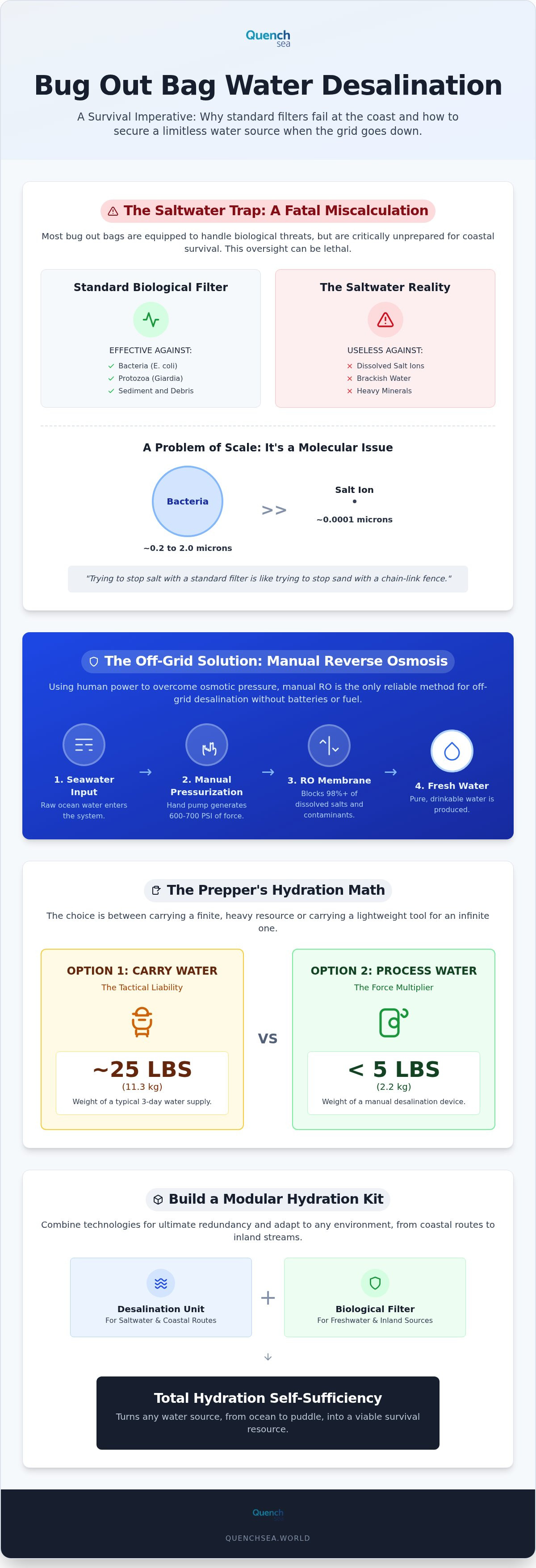
Most survivalists pack a 0.1-micron filter and call their hydration plan complete. This is a lethal assumption for anyone living within fifty miles of a coastline. Standard filters are designed for biological threats like Giardia or E. coli. They are physically incapable of removing dissolved salt. If your route includes a coast, bug out bag water desalination is a non-negotiable requirement. Understanding the limits of your gear is the first step toward effective hydration management.
Drinking even slightly brackish water triggers a rapid physiological decline. When you ingest salt, your body must use its existing water reserves to flush the excess sodium through your kidneys. This leads to hypernatremia. You don't just stay thirsty; you dehydrate faster than if you had drank nothing at all. Coastal storm surges exacerbate this risk by pushing seawater miles inland. This process turns previously "fresh" wells and streams into undrinkable brine during a crisis.
Biological Filtration vs. Desalination
The difference between these two technologies is a matter of scale. A typical bacteria cell is roughly 0.2 to 2.0 microns in size. A salt ion is approximately 0.0001 microns. Trying to stop salt with a standard hollow fiber survival filter is like trying to stop sand with a chain-link fence. Boiling is equally useless in this context. Evaporation leaves the salt behind, meaning boiling seawater only concentrates the brine and makes it more toxic. Integrating a hand operated water purifier saltwater kit is the only mechanical solution for this molecular problem.
Mapping Your Bug-Out Route
You must identify "Salt Zones" where freshwater sources are likely to be compromised. During a grid-down scenario, municipal water treatment stops immediately. Coastal aquifers often suffer from saltwater intrusion when electric pumps fail. Modern Desalination processes are usually industrial and energy-intensive, but a portable survival desalination device allows you to bypass failing infrastructure. This ensures that bug out bag water desalination remains possible even when you are miles from a clean spring. Relying on public taps in a coastal evacuation is a gamble with your life. You need the ability to process the ocean directly.
Desalination Without Electricity: The Science of Manual RO
Manual reverse osmosis is the process of using mechanical force to separate pure water from saline solutions. It represents the pinnacle of off-grid hydration technology. While biological filters rely on gravity or simple suction, desalination without electricity requires overcoming the massive osmotic pressure inherent in seawater. This isn't a passive process; it's an active mechanical victory over chemistry. It ensures your survival when the grid fails and batteries die.
To move water against its natural gradient, you must apply force. A hand-powered pump creates this pressure, forcing seawater through a semi-permeable membrane. This membrane acts as a molecular barrier. It permits H2O molecules to pass while trapping 98% of dissolved salts and minerals. Without this mechanical force, the water would remain trapped in its saline state, useless to your biology. The pump effectively acts as a hydraulic engine fueled by your own effort.
Pre-filtration serves as the shield for your RO membrane. Raw ocean water is often loaded with sediment, algae, and micro-debris. If these contaminants reach the delicate RO membrane, they cause fouling, which permanently degrades performance. Integrating a multi-stage pre-filter into your bug out bag water desalination setup is essential for gear longevity. While industrial systems must carefully manage the environmental impact of desalination and brine disposal, portable manual units offer a clean, low-impact solution for the individual survivor. Proper filtration prevents the membrane from becoming a single-use item.
The Mechanics of the Hand Pump
Manual RO units utilize hydraulic leverage to generate between 40 and 50 bar of pressure. This is roughly 600 to 700 PSI. Efficient engineering allows a human operator to maintain this pressure through a steady pumping rhythm. The energy expenditure is a calculated trade-off. The calories burned during a pumping session are a small price for several liters of fresh water. You are essentially trading physical labor for a renewed lease on life. In a coastal bug-out, this bug out bag water desalination capability is your most valuable calorie spend.
Membrane Integrity and Maintenance
A high-grade membrane is the heart of the system. It rejects nearly all dissolved solids, ensuring the output meets safe drinking standards. However, durability depends on maintenance. Salt crystallization is the primary enemy of the system. You must flush the pump with fresh water after every session to clear the membrane pores. If you're looking for a tool that balances this technical precision with rugged durability, the QuenchSea 3.0 is designed for these exact high-stakes conditions. A well-maintained membrane can provide reliable hydration across hundreds of uses in the field.
Weight vs. Output: The Prepper’s Hydration Math
Water is the heaviest essential in your pack. At 8.3 pounds per gallon, a standard 72-hour supply for one person weighs approximately 25 pounds. This creates a "Water Weight Wall" that limits your mobility, increases fatigue, and slows your evacuation speed. For coastal preppers, bug out bag water desalination offers a way to break this linear relationship between duration and weight. By carrying a tool instead of a tank, you transition from hauling a finite resource to producing an infinite one.
Hauling water is a passive drain on your physical reserves. Every mile traveled with a 50-pound pack increases the risk of joint injury and heat exhaustion. In a survival situation, your goal is to minimize load while maximizing capability. A manual desalinator acts as a force multiplier. It allows you to utilize the massive saline reservoirs of the coast, effectively turning the ocean into your primary water source. This shift in strategy transforms your hydration plan from a countdown toward empty into a sustainable cycle of production.
The 72-Hour Weight Comparison
The math is clear. A traditional bug-out bag requires at least nine liters of water for a three-day trek, which adds nearly 20 pounds of dead weight to your shoulders. In contrast, a tactical setup featuring a QuenchSea 3.0 and a single one-liter bottle weighs significantly less. The unit becomes lighter than the water it replaces within the first few hours of operation. This "break-even point" is reached almost immediately. Instead of starting your journey at maximum weight, you start light and process water as needed at every coastal waypoint.
Energy Conservation in Bug-Out Scenarios
Energy management is survival management. Carrying an extra 20 pounds of water burns significantly more calories per mile than carrying a lightweight desalinator. While pumping water requires physical effort, this work can be performed during periods of strategic rest. You can process four to six liters of water per hour using manual leverage. This allows you to replenish your supply while your legs recover from the trail. Pumping is a controlled, stationary activity; hauling weight is a constant, grueling tax on your cardiovascular system. Reducing pack weight preserves your stamina for navigation and security tasks. Bug out bag water desalination isn't just about water; it's about protecting your primary engine: your body.
The psychological benefit of this system is equally vital. Fear often stems from the depletion of critical supplies. When you rely on a finite water bladder, every sip brings you closer to a crisis. With a manual reverse osmosis device, that anxiety disappears. You gain the technical confidence of knowing that as long as you can reach the coast, you have access to life-sustaining hydration. This certainty allows you to maintain focus and make better tactical decisions under pressure.
Integrating Desalination into a Modular Bug Out Bag
Survival is a modular challenge. Your gear must adapt to changing terrain, especially when moving from inland forests to salt-heavy coastlines. A standard hydration setup is often too rigid. Integrating bug out bag water desalination requires a "Coastal Tier" mindset. This approach ensures you aren't just carrying gear, but deploying a system capable of handling any water source you encounter. It transforms your pack from a static weight into a dynamic processing station.
A professional hydration strategy follows the PACE plan. Primary: Your on-person water bottle for immediate use. Alternate: A biological filter for freshwater streams. Contingency: A manual desalinator for brackish or seawater. Emergency: Chemical tablets for a final, last-ditch effort. This hierarchy provides total redundancy. If you move inland, your biological filter handles the pathogens. If you hit the coast, your desalinator takes over. You never want to rely on a single point of failure.
The 3-Tier Water Module
- Tier 1: Immediate Consumption. A 1-liter Nalgene or stainless steel canteen provides instant access during high-intensity movement. It's your buffer between processing sessions.
- Tier 2: Biological Filtration. A Sawyer Mini or LifeStraw manages bacteria and protozoa in freshwater sources. This remains your inland workhorse for rivers and lakes.
- Tier 3: Desalination. The QuenchSea 3.0 provides the capability to process seawater. This tier turns the ocean into a viable resource when all other sources are dry or contaminated.
Storage is the final piece of the module. Collapsible bladders are superior for weight management. They take up zero space when empty but can hold liters of desalinated water at camp. Hard bottles are better for immediate use and durability. Use a mix of both to maintain flexibility. This allows you to process large batches of water during rest periods and carry only what you need for the next leg of the journey.
Tactical Deployment and Usage
Don't bury your desalinator at the bottom of your pack. Store it in a side pocket or an external pouch for rapid access. In urban coastal environments, use a tactical water desalination approach. This involves processing water in concealed locations to maintain a low profile and avoid unwanted attention. Urban runoff and flooded basements often contain high salinity after a storm surge, making the desalinator essential even when you aren't standing on a beach.
Field maintenance is non-negotiable. Your kit must include a small TDS meter to verify water quality and a syringe for back-flushing the pre-filters. These tools ensure your RO unit remains operational through multiple deployment cycles. To secure your coastal hydration needs and complete your modular build, invest in the QuenchSea 3.0 and ensure your kit is ready for the 2026 reality.
The QuenchSea 3.0: Survival-Grade Desalination
The QuenchSea 3.0 isn't a consumer gadget. It's a ruggedized hydraulic tool engineered for the absolute worst-case scenario. When the grid collapses and fuel supplies vanish, electronic and thermal desalination methods become obsolete. This device relies solely on manual leverage and advanced membrane technology to provide life-sustaining hydration. It's the primary engine for any serious bug out bag water desalination strategy in 2026. It turns a survivalist from a scavenger into a producer.
Field performance is the only metric that matters in a crisis. The QuenchSea 3.0 delivers a consistent output of 4 to 6 liters of fresh water per hour. This volume exceeds the daily requirements for a single person in high-stress environments. More importantly, it achieves a salt rejection rate of 98%. This ensures that the output meets WHO standards for safe drinking water by reducing Total Dissolved Solids (TDS) to safe levels. You aren't just getting "less salty" water; you're getting pure, potable hydration from the most abundant resource on earth.
Built for the Extremes
Reliability in austere environments requires uncompromising material choices. The QuenchSea 3.0 utilizes marine-grade plastics and high-tensile stainless steel to resist the corrosive nature of salt spray and sand. The engineering team focused on simplicity as a core feature. By minimizing the number of moving parts, they reduced the potential points of mechanical failure. This disciplined approach to design earned the unit a Red Dot Design Award. It reflects a product that prioritizes the user's physical needs and ergonomic constraints during high-stress states. It's built to be operated by a tired, dehydrated survivor without the need for specialized tools.
Final Checklist for Your Coastal BOB
Owning the gear is only half the battle. You must verify your equipment before the "Big One" hits. Inspect your RO membrane and pre-filters every six months to ensure they haven't been compromised by humidity or heat. Keep a 2-pack of replacement membranes in your kit to extend your operational timeline. A single membrane is a resource; a backup is a strategy. Bug out bag water desalination is a skill as much as it is a tool.
Technical confidence comes from repetition. Don't wait for a disaster to break the seal on your device. You should practice how to desalinate seawater manually during your training hikes. Learn the rhythm of the pump and the setup of the intake hoses. This muscle memory will be your greatest asset when adrenaline and fatigue take over. A coastal bug-out route is only as viable as your ability to source water along the way. Equip your bug out bag with the QuenchSea 3.0 today and secure your hydration future.
Secure Your Coastal Route
Coastal survival is a high-stakes game of logistics. Relying on a finite water supply is a tactical error that leads to rapid physical decline. By integrating bug out bag water desalination into your 2026 kit, you replace heavy weight with a dynamic production system. You move from scarcity to calculated abundance. This shift allows you to maintain speed and tactical focus when every second counts.
The QuenchSea 3.0 provides this capability without the need for electricity or fuel. It's a lightweight, portable tool trusted by defense and humanitarian agencies in the world's most austere conditions. You've seen the math behind the weight savings. You understand the science of manual reverse osmosis. Now it's time to finalize your modular hydration plan. Eliminate the saltwater trap for good.
Secure your coastal survival with the QuenchSea 3.0.
You're no longer limited by the water you can carry. You're empowered by the water you can create. Stay prepared and stay mobile.
Frequently Asked Questions
Can a LifeStraw or Sawyer filter remove salt from ocean water?
No. Standard survival filters utilize hollow fiber membranes with pore sizes around 0.1 microns. Dissolved salt ions are approximately 0.0001 microns, which is far too small for these filters to trap. Using a biological filter on seawater will result in salt-rich water that remains undrinkable and dangerous to your kidneys.
How much water can a manual desalinator produce per hour?
The QuenchSea 3.0 produces between 4 and 6 liters of fresh water per hour. This output depends on the operator maintaining a steady, rhythmic pumping pace. This volume is more than enough to sustain an individual or a small group during a coastal evacuation, providing a reliable flow of hydration from the ocean.
Is manual desalination physically difficult in a survival situation?
It requires physical effort, but the system is engineered for maximum hydraulic leverage. You must generate 40 to 50 bar of pressure to overcome osmotic resistance. While it's more work than a gravity filter, the calorie expenditure is significantly lower than the energy required to carry 25 pounds of water over long distances.
How long does the RO membrane last in a bug-out bag?
A reverse osmosis membrane has a shelf life of several years if kept in its original, sealed packaging. Once you begin using it, the lifespan depends on the turbidity of the source water and your maintenance habits. Regularly flushing the system with fresh water after use is the best way to ensure bug out bag water desalination remains a viable long-term option.
Can I use a manual desalinator for brackish water or just seawater?
Yes, it is highly effective for both. Brackish water contains lower salt concentrations than the open ocean, which actually makes the pumping process easier. Using the device on brackish sources reduces the physical strain on the operator and can extend the operational life of the RO membrane by reducing the salt load.
Does the QuenchSea 3.0 require any batteries or solar power?
No. The device is 100% human-powered. This manual design ensures that the unit remains functional during EMP events, total grid failure, or extended periods of cloud cover. It's a mechanical solution built for environments where electronic components are likely to fail or become a liability.
What happens if I drink seawater without desalinating it first?
You will experience rapid, life-threatening dehydration. To process the high sodium content of seawater, your body must use more water than you actually consumed to flush the salt through your kidneys. This leads to a net water loss, triggering hypernatremia, organ failure, and eventually death. Never drink seawater raw.
Is the QuenchSea 3.0 light enough for a standard 72-hour backpack?
Yes. The unit is specifically designed for portable survival kits and tactical packs. Since one gallon of water weighs 8.3 pounds, carrying a three-day supply is a massive tactical disadvantage. Integrating bug out bag water desalination allows you to ditch that dead weight and process fresh water as you move along the coast.