

The most capable portable seawater desalinator isn’t automatically the right one for your trip. If you’re ready to buy portable seawater desalinator equipment, start with how much water you need, what power is available, and how you’ll verify the output. A hand lever avoids reliance on external power, but every litre still takes manual effort.
That’s the trade-off to weigh for marine safety, emergencies, or off-grid coastal use. This guide compares power sources, practical output, operating needs, and purchase configurations to help you choose a system that fits your plan. QuenchSea 3.0 is hand-lever powered and produces 6-8 L/hr in suitable conditions. Output may be lower with colder or saltier water.
Test produced water with a TDS meter or supplied TDS pen, and drink it only when the reading is below 1 000 ppm. Do not assume filtered water is safe based on appearance alone. Test a small amount first, and only drink when the TDS reading is below 1 000 ppm. If the water tastes salty or unusual, do not drink it. These RO membranes only work with QuenchSea version 3.0.
Key Takeaways
- Before you buy portable seawater desalinator equipment, define who needs water, where you’ll use it, and how long your supply must last.
- QuenchSea 3.0 produces 6-8 L/hr in suitable conditions. Colder or saltier water may reduce output, and manual operation takes ongoing effort.
- Follow the pictorial instructions and test the output with a TDS meter or supplied TDS pen. Drink it only when the reading is below 1 000 ppm.
- Do not assume filtered water is safe based on appearance alone. Test a small amount first, and only drink when the TDS reading is below 1 000 ppm. If the water tastes salty or unusual, do not drink it.
- Compare purchase configurations by their included equipment. QuenchSea 3.0 has a 3-month limited warranty, and average delivery is approximately four weeks after ordering.
Is a Portable Seawater Desalinator Right for Your Water Plan?
A portable desalinator is a backup or field tool, not an unlimited water supply. Before you buy portable seawater desalinator equipment, define who needs drinking water, where you’ll use it, and how long you need the supply to last. Then compare your plan with the device’s output and the work required to produce it.
Different situations call for different calculations. Marine safety planning may focus on a reserve for crew during an unexpected disruption. For emergency preparedness, consider who may need water and whether someone can operate the device when needed. For off-grid coastal travel, estimate daily drinking-water needs for the trip, not just a single use. The term “watermaker” is common in boating; the Watermaker (Desalinator) overview describes the technology and different power methods.
- Marine safety: Plan around crew size, expected time at sea, and the device’s role as backup capacity.
- Emergency preparedness: Identify likely users and include the operator’s time and effort in your plan.
- Off-grid coastal travel: Estimate needs for each day, then account for conditions that could reduce production.
Estimate the water demand before choosing a device
List the people who may rely on the device and estimate their drinking-water needs for the scenario. QuenchSea 3.0 produces 6-8 L/hr in suitable conditions. That is a production rate, not a daily amount guaranteed in real use. Colder or saltier feed water may lower output. The up-to-192 L/day figure comes from multiplying 8 L/hr by 24 hours, so it applies only in ideal conditions and doesn’t account for manual effort or downtime.
Use the lower end of the output range as a cautious planning reference. Don’t build a plan that depends on maximum production around the clock. The key question is whether the expected demand can be met during the hours people can realistically operate the device.
Check whether the operating method fits the situation
QuenchSea 3.0 runs through a hand lever. The device requires ongoing user effort. It doesn’t run unattended or produce water continuously without someone working the lever. Consider who will operate it, when they can do so, and whether the manual method suits your crew or emergency setup.
The QuenchSea 3.0 Desalination Device buyer’s guide provides broader product context for assessing fit. Before relying on produced water, test it with a TDS meter or supplied TDS pen. Drink it only when the reading is below 1 000 ppm. Do not assume filtered water is safe based on appearance alone. Test a small amount first, and only drink when the TDS reading is below 1 000 ppm. If the water tastes salty or unusual, do not drink it.
Which Portable Desalinator Specifications Matter Before You Buy?
Compare specifications that affect real use, not just headline output. Check production rate, power source, size, filtration stages, and operating limits. If you plan to buy portable seawater desalinator equipment for a boat or emergency kit, measure the storage space and consider whether the people who may need to use it can operate the device.
| Specification | QuenchSea 3.0 | What to consider |
|---|---|---|
| Power source | Hand lever only | No external electricity, batteries, fuel, or solar panels are required. Manual operation does require user effort. |
| Output | 6-8 L/hr | Colder or saltier feed water may reduce production. Treat the range as conditions-dependent, not a guaranteed rate. |
| Weight and dimensions | 6 kg; 61.5 × 13.5 × 34.5 cm | Measure the intended storage space and account for the unit’s weight when packing or moving it. |
| Filtration | Pre-filtration followed by reverse osmosis | The optional ultrafiltration pre-filter is sold separately and intended only for very murky or high-turbidity water. |
| Feed-water temperature | Must not exceed 45 °C (113 °F) | Keep the source water within this operating limit. |
Compare output, portability, and power requirements
Read an advertised maximum as a reference, not a promise of the amount you’ll collect in every setting. QuenchSea 3.0 produces 6-8 L/hr in suitable conditions, and output can be lower with colder or saltier feed water. Its manual lever avoids dependence on an external power supply, but it isn’t an unattended system. Check the unit’s footprint and the space needed to access and operate it. A compact fit in storage is useful only if you can deploy the device when required.
Understand filtration and replacement-part compatibility
The system uses ceramic-and-stone and mesh pre-filters before the reverse-osmosis membrane. The optional ultrafiltration pre-filter is sold separately and intended only for very murky or high-turbidity water. These RO membranes only work with QuenchSea version 3.0. The product is designed to stay below 1 000 ppm TDS; typical output is 400-500 ppm in suitable conditions, but readings can vary. Test produced water with a TDS meter or supplied TDS pen, and drink it only if the reading is below 1 000 ppm.
Once these specifications fit your storage, power, and water-quality needs, compare QuenchSea 3.0 purchase options.
Manual or Powered: Which Portable Seawater Desalinator Fits Your Setup?
Power source determines what a desalinator depends on, while operating method determines what you must contribute. Neither manual nor powered systems suit every buyer. A powered unit may fit a setup with dependable access to its required power source. A hand-operated device may be more practical where that access is absent. Compare the system with the conditions you expect rather than assuming one approach is always better.
Some portable watermakers are designed to run from AC power. That makes access to a suitable power source part of the operating plan. A listing that identifies AC power alone doesn’t establish a system’s output, reliability, or operating cost. Ask yourself whether the power source will be available where and when you need to produce water, and whether the setup supports your intended use.
When power independence matters most
QuenchSea 3.0 is powered by its hand lever only. It requires no external electricity, batteries, fuel, or solar panels. This can suit a remote marine or off-grid setting where those power sources aren’t part of your plan. For a fixed location with dependable power access, a powered design may be worth considering instead. In boating research, the phrase Manual Boat Water Makers can help frame the broader non-electric context.
Assess your environment before you decide:
- Power access: Identify whether your intended location has the power source a powered system needs, and whether you can rely on it in the scenario.
- Mobility: Consider whether the device will stay in one place or move with you. A hand lever avoids planning around a power connection, but you still need to operate it.
- Backup role: Decide whether you’re selecting a primary production method or a contingency tool for times when other power sources aren’t available.
What manual operation means in practice
A hand-operated system trades dependence on external power for human effort. With QuenchSea 3.0, the user must work the lever to produce water. It isn’t automatic and won’t run continuously without someone operating it. Account for the operator’s availability and effort alongside the amount of water you expect to need.
Its stated output is 6-8 L/hr, and actual production may be lower with colder or saltier feed water. Use that range to frame your plan, not as a guarantee of what you’ll collect. Match expected demand to realistic operating time, then consider whether the people present can maintain the required manual operation. If no one can reliably operate the lever, power independence alone won’t make the device the right fit.
Before you buy portable seawater desalinator equipment, weigh both sides of the trade-off: access to power and capacity to provide hands-on effort. Choose the method that fits your actual operating environment.
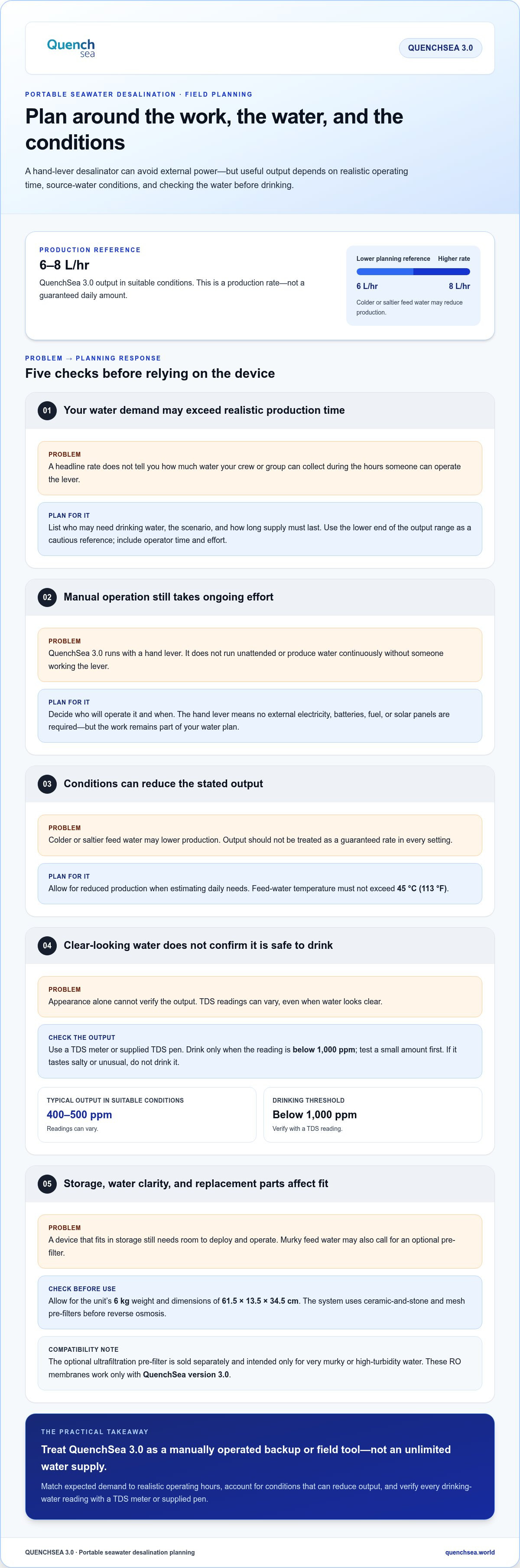
What to Prepare Before Using a Portable Seawater Desalinator
Safe operation starts before you produce water. Keep the pictorial instructions and a way to measure total dissolved solids (TDS) ready, then test the output instead of relying on how it looks. QuenchSea 3.0 is designed to stay below 1 000 ppm TDS; typical output is 400-500 ppm in suitable conditions. Readings can vary, so test each output batch before drinking.
- Read the pictorial instructions. Review them before use so you understand the operating sequence and can follow it as intended.
- Prepare a TDS meter or supplied TDS pen. Keep the testing tool ready before collecting output. The TDS pen is included with one purchase configuration.
- Test the output before drinking. Measure the batch with the TDS tool. Drink it only when the reading is below 1 000 ppm.
Test every output batch before drinking
Use a TDS meter or the supplied TDS pen to check produced water. Don’t use appearance as a safety test, and don’t treat taste alone as proof that water is safe. If the reading is 1 000 ppm or higher, don’t drink the water.
This step matters even when water looks clear or a previous batch measured below the threshold. Test the output you’re about to drink and follow the device instructions throughout operation.
Respect the device’s feed-water and use limits
Keep feed-water temperature at or below 45 °C (113 °F). Colder or saltier water may reduce output, so don’t assume the device will produce at the same rate in every environment. A lower production rate affects how much water you can collect during a given operating period. For broader ocean-survival context, understand why drinking seawater is dangerous, then plan to verify desalinated output rather than relying on appearance or expectation.
Build testing into your routine, not as an afterthought. Before operating, set out the instructions and testing tool. After collecting each batch, measure its TDS and apply the below-1 000 ppm threshold. If you can’t test the water, don’t treat its appearance or taste as a substitute for measurement. A clear procedure makes the device’s output easier to assess during marine, emergency, or off-grid use.
Preparing your test process is part of preparing the device. Explore QuenchSea 3.0 and plan for output testing before you rely on it.
Choose and Buy QuenchSea 3.0 for Your Preparedness Plan
A useful purchase starts with a clear readiness checklist. QuenchSea 3.0 is a manual seawater desalinator designed for marine safety, emergency preparedness, and off-grid coastal use. Match the configuration to the equipment you want on hand, then plan for hands-on operation, output testing, and the conditions where you’ll use it. The device produces 6-8 L/hr in suitable conditions, with lower output possible in colder or saltier water.
Select the configuration that matches your readiness checklist
Choose based on the equipment you want included, not on an assumption that every accessory comes standard. The three configurations vary in spare parts and testing equipment. The ultrafiltration pre-filters are intended only for very murky or high-turbidity water.
- Unit only, $400: Includes QuenchSea 3.0 with its pre-installed RO membrane, ceramic-and-stone pre-filter, and mesh pre-filter.
- Unit + spares, $500: Includes the unit, two spare RO membranes, and two ultrafiltration pre-filters.
- Unit + spares + TDS pen, $540: Includes the unit, two spare RO membranes, two ultrafiltration pre-filters, and a TDS testing pen.
The ultrafiltration pre-filter is optional, sold separately, and intended only for very murky or high-turbidity water. If you’re choosing a configuration for preparedness, consider whether you already have a TDS meter and whether spare membranes or the optional pre-filters fit your intended use.
Order with clear expectations
QuenchSea 3.0 comes with a 3-month limited warranty. Average delivery is approximately four weeks after ordering. The device includes pictorial instructions; review them before use so you understand the operating steps and can prepare to use the hand lever correctly.
Build output verification into your plan, too. Test produced water with a TDS meter or supplied TDS pen, and
Each purchase also supports QuenchSea’s one-for-one donation pledge and mission to deliver 100 million devices by 2035. If the hand-lever operation, output range, and included equipment suit your preparedness plan, order QuenchSea 3.0 and review the pictorial instructions as part of getting ready to use it.
Make Your Water Plan Ready Before You Need It
Turn your buying decision into a usable plan. Decide who will operate the device, where you’ll store it, and how you’ll verify the water before relying on it. If you buy portable seawater desalinator equipment, think beyond the purchase: preparedness depends on a clear process and knowing who is responsible for each step.
QuenchSea 3.0 is Applus certified and uses a hand lever, so it doesn’t require external power. Its one-for-one donation pledge supports the mission to deliver 100 million devices by 2035. Consider these details alongside practical fit: the right device is one your intended users can operate as planned.
If QuenchSea 3.0 suits your water needs and operating environment, order QuenchSea 3.0. Review the included pictorial instructions and prepare your testing routine before you need to produce water. A little preparation now can help you approach marine, emergency, or off-grid use with greater confidence.
Frequently Asked Questions
Can a portable seawater desalinator make enough water for daily needs?
It may meet some drinking-water needs, depending on demand and realistic operating time. QuenchSea 3.0 produces 6-8 L/hr in suitable conditions, and colder or saltier water may reduce that rate. The up-to-192 L/day figure applies only in ideal conditions, not as a guaranteed daily yield. Before you buy portable seawater desalinator equipment, estimate how much water your group needs and how long someone can operate the lever. Manual production takes ongoing user effort.
Is QuenchSea 3.0 powered by electricity, batteries, or fuel?
No. QuenchSea 3.0 operates through its hand lever only and doesn’t require external electricity, batteries, fuel, or solar panels. Someone must operate the lever to produce water, so it won’t run continuously without effort. This independence from external power can matter in remote or emergency settings where power access is limited. Include the operator’s workload in your plan, especially if the device may need to supply water over an extended period.
How do I know whether desalinated water is safe to drink?
Test the output with a TDS meter or supplied TDS pen, and
What is included with QuenchSea 3.0?
The unit includes a pre-installed RO membrane, a ceramic-and-stone pre-filter, and a mesh pre-filter. The $500 configuration adds two spare RO membranes and two ultrafiltration pre-filters. The $540 configuration also includes a TDS testing pen. The ultrafiltration pre-filter is optional, sold separately, and intended only for very murky or high-turbidity water.
Can I use QuenchSea 3.0 with any seawater temperature?
No. Feed-water temperature must not exceed 45 °C (113 °F). Colder or saltier source water may also lower output, so the stated production range isn’t guaranteed in every environment. Consider the conditions where you’ll collect seawater, and test the produced water rather than assuming it meets the drinking threshold. Use a TDS meter or supplied TDS pen to verify each output batch.
How long is the warranty, and when does delivery usually take?
QuenchSea 3.0 has a 3-month limited warranty, and average delivery is approximately four weeks after order placement. Review the available options on the QuenchSea purchase page to select the configuration that fits your preparation plan.
Do QuenchSea RO membranes fit older versions of the device?
The RO membrane is distinct from the ceramic-and-stone and mesh pre-filters, so identify which component you’re replacing before selecting a spare.