

Which survival dinghy water desalinator can you carry, set up, and operate when space is tight and conditions are rough? A compact device earns its place only if you can stow it securely, reach it when needed, and operate it without overloading the person doing the work.
A manual reverse-osmosis desalinator can be one layer of your emergency water plan, but it shouldn’t be the whole plan. It removes salt from seawater without electricity, batteries, or fuel, but still requires sustained physical effort. Stored water remains essential for immediate needs. QuenchSea 3.0 is a hand-powered option designed for marine safety and emergency use.
This guide covers fit, stowage, operating demands, maintenance, and realistic use before an emergency. You’ll also learn what manual desalination can and can’t do, so you can choose equipment that suits your dinghy and build a practical plan around it.
Key Takeaways
- Assess a survival dinghy water desalinator by how well it fits your stowage, operating, and upkeep needs, not by freshwater production alone.
- Understand how manual reverse osmosis separates much of the salt from seawater, and follow the device’s instructions for its specific operating steps.
- Compare power source, effort, storage needs, maintenance, and intended use. Use the product documentation to understand the details that affect your setup.
- Prepare before departure: review the instructions, keep the device accessible, and plan how to manage operating tasks without assuming who can perform them.
- Consider whether QuenchSea 3.0’s hand-powered design, which needs no external power, suits your emergency needs, while keeping carried water central to your plan.
What a survival dinghy water desalinator must solve
A survival dinghy water desalinator converts seawater into freshwater for emergency use. It offers another way to obtain water at sea, but it doesn’t replace the water already carried in the craft. Its practical value depends on whether you can stow it, reach it, and operate it in difficult conditions.
In a hand-powered unit, pressure pushes seawater through a membrane that separates much of its dissolved salt. This process is called reverse osmosis (RO). Ordinary filtration is different: a filter may capture particles, but it doesn’t necessarily remove dissolved salt. A survival dinghy water desalinator needs to address that specific challenge, not simply make seawater look clearer.
Why a dinghy needs a different water plan
A yacht may have more room for stored water and equipment. A dinghy or life raft has tighter storage, less working space, and fewer places to secure gear. Every item needs to justify the space it takes up and remain reachable without getting in the way of other essential equipment.
Water needs also depend on who is aboard, how long the emergency lasts, and the conditions people face. Exposure, movement, and limited time can affect both the need for water and the ability to produce it. Plan around your actual craft and likely workload, not an assumed output or ideal operating conditions. For a broader look at carried supplies, see this life raft water supply guide.
Desalination, filtration, and stored water are not interchangeable
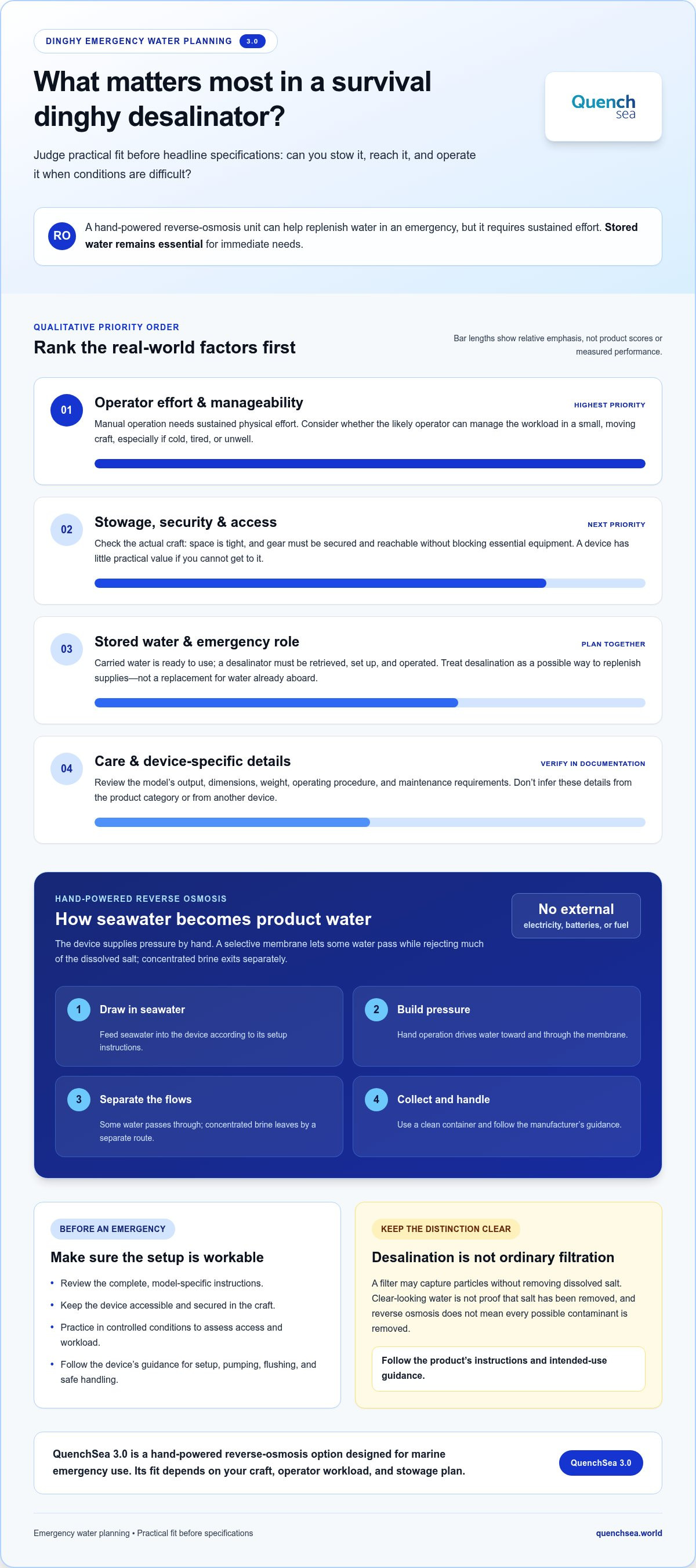
Stored water is ready to use. A desalinator must be retrieved, set up, and operated before it produces water. Manual operation takes sustained effort, which can be harder when the craft is moving or the operator is cold, tired, or unwell.
These resources are complementary, not interchangeable. Carry water for immediate needs, then treat a desalinator as a way to replenish the supply if the emergency continues and conditions allow. Don’t drink seawater as a substitute: its salt content can worsen dehydration.
How a hand-powered reverse-osmosis desalinator makes freshwater
A manual reverse-osmosis desalinator uses pressure to push seawater through a selective membrane. Water molecules pass through while the membrane rejects much of the dissolved salt and other solids. The device needs no external electricity or fuel, but the operator supplies the energy by hand.
What happens inside a manual reverse-osmosis device
Models vary, but the process generally involves an intake, a pressure mechanism, a membrane, and separate flows for product water and concentrated brine. The broad stages are:
- Draw in seawater. The intake feeds seawater into the device according to the model’s setup instructions.
- Build pressure. Hand operation drives the pressure mechanism, forcing water toward and through the membrane.
- Separate the flows. The membrane allows some water to pass while rejecting much of the dissolved salt. The remaining concentrated brine exits through a separate route.
- Collect and handle the output. Direct the produced water into a clean container and follow the manufacturer’s guidance for its use and handling.
This is desalination, not simply clarification. A clear-looking sample isn’t proof that dissolved salt has been removed, and reverse osmosis doesn’t mean every possible contaminant has been removed. Follow the product’s instructions and intended-use guidance.
What operating a hand-powered desalinator involves
Manual operation removes reliance on electricity, batteries, or fuel, which is useful when those resources aren’t available. It doesn’t remove the need for effort. Producing water requires sustained pumping, so the operator’s workload matters, especially in a small, moving craft or when people are tired or exposed to the elements.
Learn the complete sequence before an emergency. Follow the model-specific instructions for setup, pumping, flushing, and safe handling. Don’t assume one device’s procedure applies to another, and don’t improvise steps that could affect operation or water quality. A practice session in controlled conditions can show whether the equipment is accessible and manageable in your setup.
For a closer look at the mechanics, read this manual reverse-osmosis engineering explainer. For broader emergency preparation, Ready.gov advises, “Store at least one gallon of water per person per day.” That is general U.S. emergency guidance, not a dinghy-specific ration. Use it as context, not as a substitute for marine planning.
If you’re weighing a hand-powered option for marine emergencies, review the QuenchSea 3.0 desalination device alongside your operating and stowage needs.
How to compare survival dinghy water desalinators
Start a useful comparison with the conditions you expect to face, not a headline specification. For a survival dinghy water desalinator, ask whether the likely operator can use it under stress, whether it can be stowed without blocking essential gear, and what routine care it needs. Then compare those demands with stored water and any powered water-making system you’re considering.
Which features matter most in a survival craft?
QuenchSea 3.0 is a hand-powered reverse-osmosis device designed for marine emergency use. It operates without electricity, batteries, or fuel. For any model, review its product information for output, dimensions, weight, operating procedure, and maintenance requirements. Don’t infer these details from the product category or from another device.
Check practical fit, too. Can you secure and reach the device in the craft’s actual storage layout? Can the intended operator manage the procedure and effort? Does its upkeep fit the time and resources available? The WHO’s guidance on desalination for safe water supply provides a broader public-health reference. Device selection still requires attention to the model’s instructions and intended use.
| Option | Power and operation | Stowage and upkeep | Key buyer question |
|---|---|---|---|
| Manual desalinator | Hand-operated; doesn’t depend on an external electrical supply or fuel, but requires physical effort. | Review the specific unit’s storage, setup, flushing, and maintenance instructions. | Can the likely operator use it reliably in the craft’s conditions? |
| Electric water maker | Uses electrical power; operating needs depend on the system. | Account for the unit and its power requirements within the vessel’s setup. | Will the required power be available and usable during the emergency? |
| Stored water | Ready to use without producing it first. | Uses limited storage space and represents a finite supply. | How does the carried reserve fit the expected crew, duration, and craft capacity? |
No single approach suits every emergency. Stored water provides immediate access, while desalination may support resupply if the device can be operated and maintained. Powered systems have a different set of operating requirements, including access to power. Use the table as a decision framework, then review product information rather than assuming similar devices share the same specifications.
How to plan for using a desalinator from a dinghy
A desalinator is useful only if it’s ready, reachable, and manageable when conditions change. Before departure, fit it into the craft’s water plan and rehearse the steps. Don’t wait until an emergency to discover that the device is buried beneath other equipment or that its operating sequence is unfamiliar.
Prepare and stow the device before an emergency
Practice setup and operation in controlled conditions, following the manufacturer’s instructions. This helps show whether the process suits the available working space and the people likely to use it. Rehearse safe handling, too, so the device doesn’t interfere with other priorities aboard.
Use this pre-departure checklist:
- Review the instructions. Know the model-specific setup, operation, flushing, and care steps.
- Rehearse the process. Practice before relying on the device at sea.
- Choose accessible stowage. Secure the unit and instructions where you can reach them without blocking essential emergency equipment. Protect them as the manufacturer directs.
- Check readiness. Inspect and maintain the device on the schedule and in the manner specified in its product guidance.
Set realistic expectations for water production
Output varies by model and operating conditions. Use the device’s published specifications as a planning reference, not a guarantee of what it will produce in every situation. Manual operation also takes effort and time. Conditions at sea may make setup and sustained use more difficult, so account for the workload rather than treating production as automatic.
Plan in layers: carry water for immediate needs, consider a desalinator as a possible resupply tool, and include other provisions relevant to the emergency. A device can’t replace sound survival priorities or crew judgment. If circumstances make operating it unsafe or impractical, the people aboard still need to respond to the situation first.
Agree in advance on how tasks could be shared, without assuming a fixed crew size or that every person can operate the device. Identify who understands the instructions and consider how the plan might change if someone becomes tired, unwell, or occupied with another essential task. Keep the arrangement flexible.
For more emergency context, read the emergency seawater survival guide. To assess a manual option for your setup, explore the QuenchSea 3.0 desalination device.
Is QuenchSea 3.0 a fit for your survival dinghy?
QuenchSea 3.0 is a hand-powered reverse-osmosis seawater desalination device designed for marine safety and emergency applications. It operates without electricity, batteries, or fuel. Consider it if you want a manual water-production option that doesn’t depend on a vessel’s power supply.
Fit still depends on your craft and your plan. A survival dinghy water desalinator needs to be stowable, accessible, and practical for the person expected to operate it. Manual operation requires effort, and desalination takes setup and time. The device should support your preparedness, not become a reason to carry less water or overlook other survival priorities.
Where the QuenchSea 3.0 fits in an emergency water plan
The no-electricity design can be useful in a dinghy where power sources may be limited or unavailable. QuenchSea 3.0 offers a way to produce freshwater from seawater by hand. Its role is supplementary: keep carried water available for immediate needs and include the device as one part of a broader emergency plan.
Other readiness needs may take priority if there isn’t enough secure storage, the operator can’t manage sustained manual effort, or the device can’t be accessed and used safely in likely conditions. Think through those limits before departure. Having a device aboard doesn’t guarantee that it can be deployed effectively when the craft is moving or people are under stress.
Make a decision using verified specifications and your use case
Before choosing QuenchSea 3.0 for a specific dinghy, compare its product information and instructions with your actual setup. Review the details for handling, storage, operation, and maintenance. Consider where it will be secured, how you’ll retrieve it, and whether the person expected to use it can follow its procedure in realistic conditions. Don’t assume a specification or care routine based on another model.
Then weigh those details against your intended emergency use. A manual reverse-osmosis device can suit a plan that calls for seawater desalination without an external power source, provided you account for the work involved. It may be less useful if it can’t be stowed accessibly, maintained as directed, or operated when needed. Keep stored water and the rest of your survival preparations central to the decision.
For a closer look at its intended use and product information, read the QuenchSea 3.0 buyer’s guide. Explore the QuenchSea 3.0 desalination device as you assess manual seawater capability for your marine preparedness plan.
Build a Water Plan You Can Use
A survival dinghy water desalinator earns its place when you can stow it, reach it, and operate it in realistic conditions. Compare the device’s documented requirements with your available space, the operator’s capacity, and the time and effort manual production demands. Practice before departure, and keep the manufacturer’s instructions accessible.
Most importantly, treat desalination as a backup layer, not a replacement for carried water or sound emergency judgment. Stored water covers immediate needs; a manual device may help replenish your supply if conditions allow. QuenchSea 3.0 uses hand-powered reverse osmosis and operates without electricity, batteries, or fuel. It’s designed for marine safety and emergency applications.
Review the product details and assess how they match your craft and preparedness plan. Explore the QuenchSea 3.0 manual desalination device for your marine emergency plan.
Frequently Asked Questions
Is a survival dinghy water desalinator worth carrying?
It may be worth carrying if you need a way to produce freshwater from seawater without electricity or fuel and can manage its storage and operation. The value of a survival dinghy water desalinator depends on available space, the likely operator’s ability, expected conditions, and how well the device fits your emergency plan. Treat it as a contingency tool, not a substitute for carried water. Learn and practice its operation before relying on it.
Can a hand-powered desalinator make seawater safe to drink?
A reverse-osmosis desalinator is designed to remove salt and reduce dissolved solids. Safe use depends on following the specific device’s instructions and product guidance. Don’t assume ordinary filters remove dissolved salt or that clear water is necessarily suitable to drink. Use the device as directed and handle its output according to the manufacturer’s guidance. Never use untreated seawater as a replacement for a properly managed drinking-water supply.
How much water can a survival dinghy desalinator produce?
Output depends on the model and operating conditions, so review the manufacturer’s specifications for the device you’re considering. Published information for QuenchSea 3.0 gives an output range of 6-8 liters per hour; actual production can depend on operating conditions and correct use. Don’t treat a stated rate as a guaranteed supply in an emergency. Production takes time and effort, so carry stored water where possible and plan for more than one contingency.
Does a manual seawater desalinator need electricity or fuel?
A hand-powered reverse-osmosis device can operate without an external electrical supply, batteries, or fuel. The operator provides the energy through manual effort, so “no power source required” doesn’t mean effortless operation. Read the model’s instructions and practice the procedure before departure. Consider whether the person expected to use it can manage the workload in likely conditions, including when the craft is moving or the operator is tired.
Can a water desalinator replace emergency water in a life raft or dinghy?
No. A desalinator adds a water-production capability, but it doesn’t replace stored emergency water or a complete survival plan. It must be accessed, set up, and operated, and real conditions may make that difficult. Plan for immediate water needs as well as the possibility of a longer emergency. Base your provisions on the craft, people aboard, expected duration, and applicable safety guidance, rather than depending on a single device.
What should I check before carrying a desalinator in a dinghy?
Review the model’s specifications, storage requirements, operating instructions, maintenance guidance, and intended use. Make sure the device can be secured and reached without obstructing essential equipment. Practice its procedure before departure, and protect and maintain it as the manufacturer directs. Base your water plan on documented output and realistic operating conditions, not an assumed rate or specifications from another model. Include stored water in your emergency preparations.