

If you were forced to abandon ship sixty miles offshore tonight, would your marine ditch bag water supply actually sustain you until the rescue team arrives? Most sailors carry enough water to survive for forty-eight hours, yet they often overlook the logistical reality of a long-term drift. Relying solely on finite plastic pouches creates a hard ceiling on your survival timeline. It's a calculated risk that many offshore voyagers aren't truly prepared to manage when the horizon remains empty.
You already know that every ounce in your emergency kit must earn its place. Managing limited space while fighting the constant threat of dehydration requires more than just stacking rations; it demands a tactical, hardware-focused approach. This article will show you how to master the logistics of emergency ocean hydration by balancing stored rations with manual desalination technology. We've stripped away the fluff to focus on what works in high-stakes environments.
We'll provide a comprehensive breakdown of the 2026 hydration landscape. You'll learn to optimize your bag's weight-to-utility ratio, verify the shelf life of your current stores, and integrate survival-grade hardware like the QuenchSea 3.0. This strategy ensures you have a fail-safe plan that turns the ocean from a threat into a sustainable resource.
Key Takeaways
- Understand the physiological priority of freshwater and why hydration is the primary failure point in life raft scenarios.
- Implement a three-tier tactical strategy to optimize your marine ditch bag water supply by balancing finite rations with production hardware.
- Calculate the weight-to-utility ratio of your gear to replace heavy water containers with lightweight, manual desalination tools.
- Audit your crew size against the 1.5-liter daily requirement to ensure your "First-Day" supply meets modern safety standards.
- Leverage current reverse osmosis technology to establish an infinite water source that doesn't rely on batteries or fuel.
The Hydration Crisis: Why Water is the #1 Failure Point in Marine Emergencies
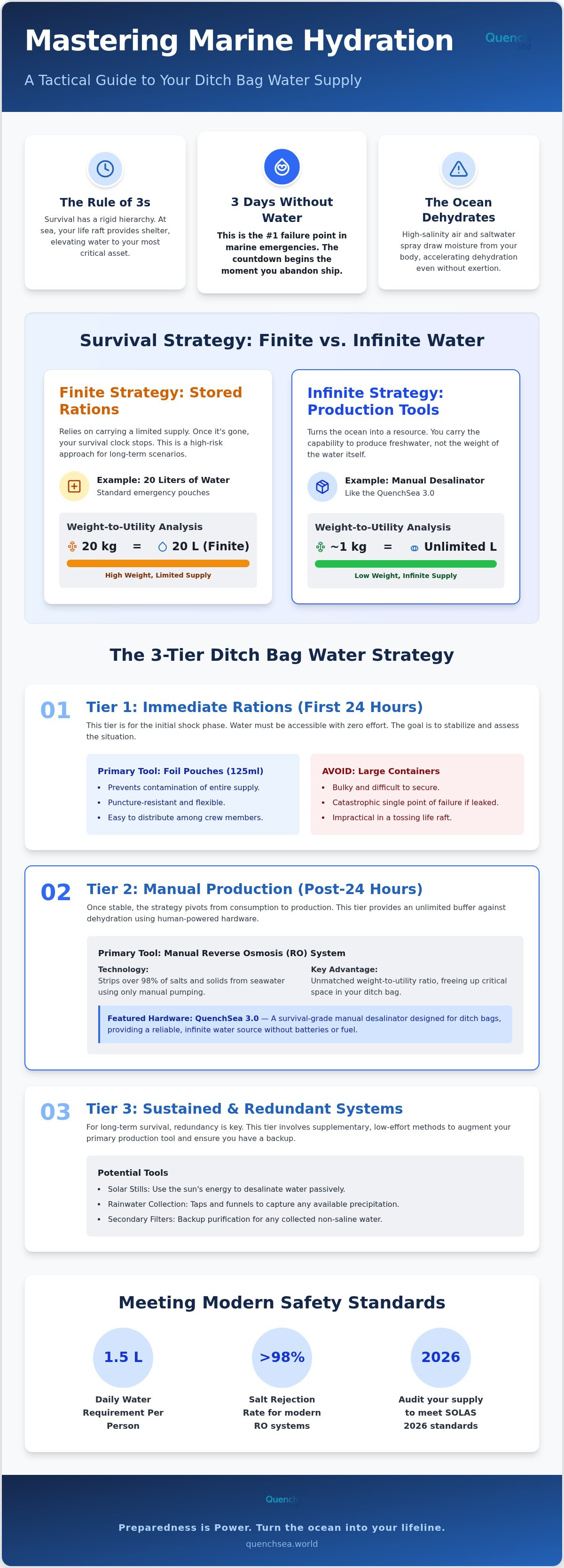
Survival follows a rigid hierarchy. You've likely heard the "Rule of 3s." Three minutes without air. Three hours without shelter in extreme conditions. Three days without water. On the open ocean, your life raft provides the shelter. This immediately elevates your marine ditch bag water supply to the status of your most critical asset. Without a reliable source of freshwater, the countdown begins the moment you leave the deck.
The ocean environment is paradoxically dehydrating. Saltwater spray and high-salinity air draw moisture from the skin and lungs. If you succumb to the temptation of the sea, the consequences are lethal. You can learn more about why is drinking sea water dangerous, but the biological reality is simple: your kidneys cannot process the excess sodium without using more freshwater than you consumed. Relying solely on stored rations is a "finite survival" strategy. It places a hard expiration date on your life.
The Survival Window: Dehydration Timeline at Sea
Heat and humidity accelerate fluid loss rapidly. Even without physical exertion, a survivor in a life raft can lose over a liter of water per day through perspiration and respiration. High ambient temperatures lead to hyperthermia, which spikes your body's water demand. The psychological toll is equally dangerous. Thirst clouds judgment. It leads to lethargy and fatal errors in navigation or signaling. Osmotic thirst is a physiological condition where high concentrations of salt in the blood pull water out of the cells, causing them to shrink and malfunction.
Finite vs. Infinite Water Supplies
Most ditch bags rely on "Stored Rations." These are typically 125ml foil pouches or aluminum cans with a 5-year shelf life. They are reliable but heavy and strictly limited. Once the last pouch is empty, your survival clock stops. "Production Tools" represent the shift to an infinite strategy. These include manual desalinators and solar stills. By utilizing various water purification methods, you move from carrying weight to carrying capability. This transition is essential for any long-term survival scenario where rescue might be delayed by weather or distance.
Anatomy of a Modern Marine Ditch Bag Water Supply
Redundancy is the foundation of survival engineering. In extreme marine environments, if you rely on a single water source, you effectively have no source at all. A professional marine ditch bag water supply utilizes a three-tier system: Immediate, Intermediate, and Sustained. This tiered architecture ensures you meet the rigorous life raft water supply SOLAS standards for 2026 while maintaining a packable footprint. Each tier serves a specific physiological and tactical purpose, allowing you to manage your hydration levels from the moment you hit the water until you are safely recovered.
Tier 1: Emergency Stored Rations
The first 24 hours after a ditching event are defined by shock, cold, and physical trauma. During this window, you need water that requires zero mechanical effort or cognitive load to access. 125ml foil pouches are the gold standard for this phase. Their small volume prevents contamination of your entire supply and makes them easy to distribute among crew members. These pouches are flexible and puncture-resistant. They won't shatter or dent like rigid cans during a high-impact capsize. Never pack large jugs or 2-liter bottles in a portable bag. They are bulky, difficult to secure in a tossing life raft, and represent a catastrophic single point of failure if the container leaks.
Tier 2: Manual Desalination Hardware
Once the initial shock subsides, your strategy must pivot from consumption to production. Manual reverse osmosis (RO) systems provide an unlimited buffer against dehydration. This hardware leverages the desalination process to strip 98% of salts and dissolved solids from seawater using only human power. The weight-to-utility ratio is unmatched. While 20 liters of stored water weighs 20kg, a single 1kg manual RO unit provides the same volume over just a few days of operation. This efficiency frees up critical space for medical supplies and signaling gear.
High-performance hardware must remain non-electric. Batteries and circuit boards are prone to failure in corrosive saltwater environments. A manual pump ensures your marine ditch bag water supply remains operational regardless of your vessel's power status. It doesn't rely on fragile electronics that can't handle submersion. You should supplement this hardware with collapsible collection bladders for storage and electrolyte tabs to maintain your mineral balance. Integrating a tool like the QuenchSea 3.0 into your kit transforms your ditch bag from a finite resource into a long-term survival system. This level of preparedness is what separates a lucky survivor from a disciplined professional.
Storage vs. Production: The Weight-to-Volume Survival Analysis
Every liter of freshwater you pack into a marine ditch bag water supply adds exactly one kilogram of dead weight. This creates a "Survival Ceiling." It's the finite limit of your endurance based on the physical mass you can carry. If you pack 10 liters of water, you add 10kg to your bag. In contrast, the QuenchSea 3.0 weighs approximately 1kg. This single piece of hardware provides a production capacity that far exceeds its own mass within the first day of operation. It shifts your status from a consumer of limited resources to a producer of sustainable ones.
Space efficiency is equally critical. Waterproof ditch bags have limited internal volume. Filling that space with bulky water containers displaces other life-saving equipment like medical kits, thermal protective aids, or signaling devices. Reliability analysis also favors a hybrid approach. While storage pouches can leak or puncture during a chaotic evacuation, modern mechanical systems are engineered for durability. You must weigh the risk of a silent leak against the manageable risk of mechanical maintenance in a high-stress environment. For broader vessel safety, many sailors also rely on proactive monitoring from inTouch R&B to keep a constant watch on critical systems like bilge pumps and HVAC units, ensuring they catch mechanical issues before they turn into emergencies.
The 72-Hour Threshold
Storage wins for short-term rescue scenarios lasting under three days. Pouches provide immediate, effortless hydration when you're too exhausted to operate machinery. However, once you cross the 72-hour mark, a manual desalinator becomes lighter than the volume of water it has produced. This is the logistical break-even point. You must also consider your bag's buoyancy budget. A ditch bag overloaded with water weight may lose its positive buoyancy. If the bag sinks during the transfer to a life raft, your entire marine ditch bag water supply is gone before the first sunset.
Mechanical Reliability in 2026
Engineering breakthroughs in 2026 have significantly improved membrane durability and pumping efficiency for manual RO units. These systems now handle higher turbidity and offer superior salt rejection rates compared to older models. Field maintenance is no longer a complex task; it's a streamlined process. Modern hardware allows survivors to perform essential checks and part replacements without specialized equipment. No-tool maintenance is a non-negotiable survival requirement for any piece of mission-critical hardware used in a life raft. This ensures that even in a pitching raft with cold, wet hands, you can keep your water production online.
Tactical Implementation: Building Your Water Strategy
Building a resilient marine ditch bag water supply is a matter of engineering, not guesswork. You must follow a structured protocol to ensure your hydration strategy survives the high-stress transition from a sinking vessel to a life raft. A tactical approach eliminates decision fatigue when every second counts. By following these five steps, you establish a system that balances immediate needs with long-term endurance.
- Audit your crew size. Calculate your requirements based on the 1.5-liter daily minimum per person. For a crew of four, a 72-hour window requires 18 liters of freshwater. Carrying this entire volume in storage is logistically impractical; your strategy must pivot to production.
- Pack a "First-Day" supply. Include 500ml of stored pouches per person. This typically means four 125ml units per crew member. This supply provides immediate, effort-free hydration during the initial shock and recovery phase.
- Integrate a manual desalinator. Use the QuenchSea 3.0 as your primary production engine. It serves as the backbone of your survival kit, converting the ocean into a sustainable resource once your initial pouches are depleted.
- Include electrolyte powders. Reverse osmosis water is chemically pure but lacks essential minerals. Powders mitigate the "flat" taste and prevent hyponatremia by replacing salts lost through perspiration and stress.
- Schedule monthly inspections. Salt air and temperature fluctuations can degrade gear over time. Verify that pouch seals haven't been compromised and ensure the RO membrane is stored according to manufacturer specifications to prevent fouling.
Packing for Accessibility
Strategic placement determines your survival speed. Store your "First-Day" pouches near the top of the bag for instant retrieval. Your manual desalinator must be secured in a dedicated compartment, always tethered to the bag or the life raft with a high-strength lanyard. Losing your hardware overboard is a catastrophic failure that ends your production capability. For those operating near shorelines, consult our bug out bag water desalination guide for specific coastal packing nuances.
The Survival Pumping Schedule
Managing human energy is as critical as managing water. Avoid pumping during the heat of midday to prevent excessive fluid loss through perspiration. Establish a shift-based rotation where crew members operate the manual pump for 15 to 20 minute intervals. This rotation prevents muscle fatigue and ensures steady output. Use collapsible bladders to store produced water immediately. Building a reserve during cooler night hours provides a psychological and physiological safety net for the following day. To secure your long-term hydration, order the QuenchSea 3.0 for your emergency kit today.
The QuenchSea 3.0: Survival-Grade Production for Your Ditch Bag
The 2026 marine safety landscape demands hardware that performs when every other system fails. The QuenchSea 3.0 is the definitive mechanical solution for your marine ditch bag water supply. It transitions your survival strategy from passive consumption to active production. This device is a specialized QuenchSea 3.0 Desalination Device designed to meet the extreme demands of yacht safety and offshore voyaging. It functions when electronics fail and batteries die. It provides a level of autonomy that stored rations simply cannot match.
Technical specifications define its utility. At approximately 1kg, the unit fits into standard ditch bags without compromising your buoyancy budget. It utilizes advanced reverse osmosis technology to remove over 98% of salts and dissolved solids. Hourly freshwater output is directly linked to operator effort. This rewarding feedback loop provides life-sustaining hydration in exchange for disciplined physical input. The compact dimensions ensure it displacing minimal space, leaving room for other mission-critical gear. It is the logical choice for any professional mariner prioritizing long-term survival over short-term hope.
Ruggedized for the Ocean
Extreme environments destroy inferior gear. The QuenchSea 3.0 utilizes industrial-grade, corrosion-resistant polymers designed for long-term salt exposure. These materials, which can be derived from certified recycled PP pellets, maintain their mechanical integrity in the harshest conditions. The 2026 engineering upgrades include an ergonomic handle designed specifically for exhausted survivors. This design choice reduces physical fatigue during extended pumping sessions. It allows for a more efficient transfer of energy. The "Plug and Pump" architecture ensures high-stress operation remains simple. It requires no specialized tools or complex assembly. You can deploy it in seconds, even with cold, wet hands in a pitching life raft.
Reliability at sea is only half the story. Every purchase supports global disaster relief water supply efforts. This is mission-driven engineering. It bridges the gap between high-stakes marine survival and essential water access for vulnerable populations in the last mile. You aren't just buying a tool; you're participating in a global solution for water scarcity. The same technology that protects your crew also empowers communities facing freshwater crises. It is a dual-purpose investment in safety and global responsibility. Equip your ditch bag with the QuenchSea 3.0 today.
Secure Your Survival Horizon
Survival at sea is a logistical challenge that leaves no room for error. You've seen how a modern marine ditch bag water supply must evolve beyond simple storage to incorporate active production. By balancing immediate-use pouches with the infinite capacity of manual desalination, you eliminate the "Survival Ceiling" that limits most offshore kits. This strategy ensures your crew remains hydrated regardless of the rescue timeline. It transforms the ocean from a threat into a sustainable resource.
Relying on hardware that operates without batteries or fuel is a professional necessity. The shift from carrying dead weight to carrying mechanical capability allows for a lighter, more functional ditch bag. You are now equipped with the tactical framework to audit your gear and implement a fail-safe hydration plan. Preparedness is the only variable you can control in a high-stakes environment.
Don't leave your endurance to chance. Upgrade your marine safety kit with the QuenchSea 3.0. It's used by maritime professionals worldwide; this compact, survival-ready device uses manual RO technology that requires zero power. Prepare for the extreme so you can navigate with confidence.
Frequently Asked Questions
How much water should I pack in my marine ditch bag per person?
You should aim for a minimum of 1.5 liters per person per day to meet basic physiological needs. For a marine ditch bag water supply, this usually translates to a "First-Day" supply of 500ml in stored pouches followed by manual production. Packing the full volume for a multi-day drift is physically impossible due to weight. Use production hardware to bridge the gap and ensure you meet survival standards without overloading your bag.
Can a manual desalinator replace all stored water in a life raft?
A manual desalinator shouldn't replace your initial stored rations. You need immediate, effort-free hydration during the first 24 hours of shock and recovery when physical exertion might be impossible. The QuenchSea 3.0 serves as your "infinite" backup once those finite pouches are depleted. This hybrid approach ensures you have water the moment you hit the raft and a sustainable source for the days that follow. Relying on just one method is risky.
How long does a manual RO membrane last in storage?
Most manual RO membranes have a shelf life of several years when kept in their original, vacuum-sealed packaging. Extreme temperature fluctuations can degrade the material over time. It's vital to inspect your marine ditch bag water supply annually to ensure the membrane hasn't dried out or become brittle. If the seal is compromised, the membrane's ability to reject salts may be reduced. Always replace consumables according to the manufacturer's recommended schedule.
Is it hard to pump a manual desalinator when you are dehydrated?
Pumping requires physical exertion, which is why you shouldn't wait until you're severely dehydrated to begin production. The QuenchSea 3.0 features an ergonomic handle designed to minimize fatigue during operation. Establishing a crew rotation schedule helps manage energy expenditure effectively. If you start pumping while you still have energy from your initial rations, you can build a freshwater reserve in collapsible bladders before the physical toll of survival becomes too great.
Do manual water makers remove viruses and bacteria from seawater?
Yes, the reverse osmosis technology used in these devices removes more than 98% of dissolved solids. This process effectively filters out salt, bacteria, viruses, and microplastics. While the primary goal in a marine environment is desalination, the membrane acts as a high-precision barrier against biological contaminants. This ensures the water you produce is safe for consumption without the need for additional purification tablets, provided the intake remains clear of oil or fuel spills.
What happens if my ditch bag water supply freezes or gets too hot?
Extreme temperatures can compromise the integrity of both pouches and hardware. Stored water pouches may burst if frozen or degrade if exposed to intense heat for years. For the desalinator, a wet membrane can be ruined by freezing. Keep your ditch bag in a protected, accessible location on your vessel. If you're sailing in polar or tropical regions, perform more frequent inspections to ensure your marine ditch bag water supply remains survival-ready.
How do I maintain my QuenchSea 3.0 while it's sitting in the bag?
Maintenance for a stowed QuenchSea 3.0 is straightforward but essential. Perform monthly visual inspections of the pump housing, handle, and tethers. Ensure the unit is clean and dry before it goes into the bag to prevent mold or corrosion on external parts. Every six months, you should verify that the RO membrane remains sealed. If you've used the device for training, you must flush it and apply a preservative solution before long-term storage.
Are there any chemicals required to operate a manual desalinator?
No chemicals are required for the actual production of drinking water. The system relies entirely on manual pressure to force seawater through the reverse osmosis membrane. You don't need to carry heavy bottles of purification drops or worry about chemical shelf lives during an emergency. While you may use specialized solutions for long-term membrane preservation during storage, the water-making process itself is purely mechanical. This makes it a reliable, "plug and pump" solution.