

Your ditch bag is a ticking clock if it only contains plastic pouches of water. When disaster strikes, static rations are a finite resource that dictates your survival window. You understand the high-stakes reality of marine emergencies. You've likely felt the fear of running out of supplies or doubted whether your primary electric systems would function after a catastrophic failure. Reliability isn't found in a bottle. It's found in hardware.
This 2026 guide teaches you how to secure a reliable, long-term supply for your yacht survival kit water needs using the latest in manual desalination technology. We'll move beyond the limitations of storage and focus on sustainable production. You'll learn why manual reverse osmosis is the ultimate backup, how the QuenchSea 3.0 Desalination Device provides an infinite supply without power, and exactly what your hydration checklist should look like for the modern era. Stop counting liters. Start mastering your environment.
Key Takeaways
- Shift from storage to production. Hardware-based sourcing provides an infinite supply during maritime emergencies.
- Prioritize mechanical reliability. Learn why the QuenchSea 3.0 Desalination Device is the essential manual backup to failing electric systems.
- Optimize your yacht survival kit water strategy. Use a "Water First" packing philosophy to fit high-output production gear into compact ditch bags.
- Demand survival-grade hardware. Identify the technical features that ensure tool-free operation under extreme physiological stress.
- Eliminate the ticking clock. Secure a sustainable hydration plan that turns the ocean into a reliable resource rather than a threat.
The Hierarchy of Marine Survival Gear for Water
Survival at sea is a cold calculation of resources against time. Most sailors treat hydration as a logistics problem. They pack pouches. They store bottles. This is a tactical error. True security requires a multi-tiered system. You need immediate rations, but you must prioritize active production. The "Rule of 3s" dictates that you can survive three days without water. In the salt-spray and high-heat environment of a life raft, that window shrinks rapidly. Your yacht survival kit water strategy needs to be as rugged as your hull. It must be built for the worst-case scenario.
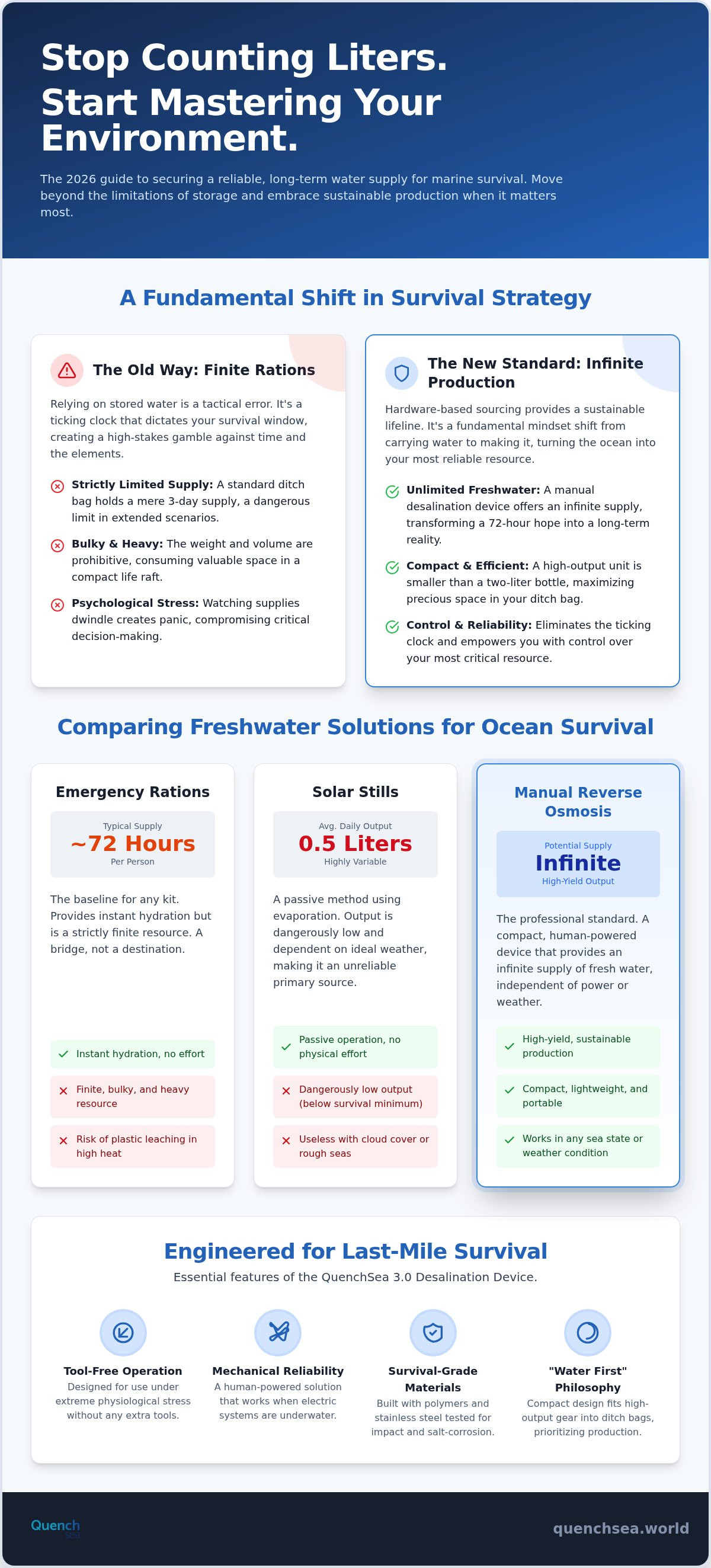
Distinguish your gear into three distinct categories: rations for immediate use, collection tools for rain, and production devices for desalination. Static rations are finite. Rain is unpredictable. Production is the only variable you can control. Relying exclusively on a life raft water supply of pre-packaged pouches ignores the reality of extended drift scenarios. If rescue doesn't arrive within 72 hours, your survival depends entirely on your ability to generate freshwater from the ocean surrounding you.
Finite Rations vs. Infinite Production
Biological limits are non-negotiable. A standard 125ml water pouch barely wets the tongue. In high-heat marine environments, dehydration leads to delirium and organ failure within 48 hours. Carrying enough water for a week is impossible in a standard ditch bag. The volume is too great. The weight is prohibitive. Hardware solves this. A manual desalination process unit provides an infinite supply in a package smaller than a two-liter bottle. It's a fundamental shift in mindset. You stop carrying water and start making it. This moves your survival strategy from a 72-hour hope to a long-term reality. Hardware beats bulk water every time.
The Evolution of Portable Desalination
By 2026, the technology behind the survival desalination device has become a handheld necessity. Early iterations were often too complex for stressed, exhausted users. Today's manual reverse osmosis units are designed for tool-free operation. They're built from survival-grade polymers and reinforced stainless steel. When selecting gear, prioritize units that meet 2026 SOLAS requirements. These devices are tested for impact, salt-corrosion, and mechanical durability. Fixed electric water makers are excellent for daily use in the galley. They're useless in a life raft. You need a portable, human-powered solution that works when the batteries are underwater and the engines are silent.
Comparing Freshwater Solutions for Ocean Survival
Deploying a yacht survival kit water strategy requires understanding the mechanical reality of your environment. You have three primary choices: carry it, distill it, or produce it. In a life raft, space is your most valuable currency. Every pound of weight must justify its presence through long-term utility. Understanding how modern marine watermakers work allows you to evaluate which system will actually keep you alive when your primary vessel is lost. Relying on battery-dependent systems in a ditch scenario is a gamble you shouldn't take. You need hardware that functions independently of the grid and the engine room.
Emergency Water Rations (The Baseline)
Vacuum-sealed packets are the standard entry point for most kits. They offer instant hydration without any preparation or physical effort. However, they are a strictly finite resource. A standard ditch bag might hold a three-day supply of rations. If rescue is delayed or weather pushes you off course, you face a hard mathematical limit. Plastic leaching is a secondary risk; high-heat environments can contaminate pouches over time. Psychologically, watching your last liter disappear creates a state of panic that compromises decision-making. Rations are a bridge, not a destination.
Solar Stills (The Passive Backup)
Solar distillation relies on evaporation and condensation mechanics. It's a "set and forget" method that uses the sun's energy to separate salt from water. While passive, the output is dangerously low. Most stills produce approximately 0.5 liters per day. This is well below the minimum biological requirement for an active adult in tropical conditions. Cloud cover and rough sea states further degrade this efficiency. If you rely solely on a solar still, you are essentially gambling on the weather. It serves as a supplementary tool, but it cannot be your primary survival line.
Manual Reverse Osmosis (The High-Yield Standard)
A manual water maker for boat use is the professional standard for a reason. It uses high-pressure membranes to force seawater through a microscopic filter. This process of desalination without electricity converts human effort directly into drinkable water. The output is measured in liters per hour, not milliliters per day. Modern units are designed for ergonomic efficiency, allowing a survivor to produce several liters of water with manageable physical output. By integrating a device like the QuenchSea 3.0 Desalination Device into your yacht survival kit water protocol, you secure an infinite supply. It's a rugged, mechanical solution that works as long as you can move the handle. For those serious about preparedness, investing in manual hardware is the only way to ensure the ocean remains a resource rather than a threat.
Essential Features of a Survival-Grade Water Maker
Survival gear isn't built for convenience. It's built for mechanical certainty. Recreational-grade hardware often prioritizes lightweight aesthetics or lower price points. In a maritime emergency, those compromises are fatal. Survival-grade hardware must withstand the internal pressure required for reverse osmosis while resisting the relentless corrosive force of the ocean. Choosing the right yacht survival kit water production tool requires a focus on material science and ergonomic engineering. If a device requires specialized tools or a stable laboratory environment for maintenance, it has no place in your ditch bag.
Reliability in extreme environments depends on two non-negotiable material standards: 316 stainless steel and high-impact marine polymers. These materials prevent pitting and stress-corrosion cracking that occurs when cheaper alloys are exposed to salt spray. Every yacht survival kit needs a fail-safe, non-electric production method. When the electronics are fried or submerged, your survival rests on a purely mechanical interface. This interface must be intuitive enough to operate during the onset of hypothermia or severe psychological stress. Maintaining a dedicated yacht survival kit water strategy means selecting hardware that can survive years of dormancy without failure.
Mechanical Integrity and Ruggedness
Brittle plastics are a liability. Exposure to high UV levels and salt spray can cause standard polymers to degrade and shatter under pressure. Survival units utilize UV-stabilized, reinforced composites that maintain structural integrity over years of storage. Handle ergonomics are equally critical. You'll be pumping for extended periods while fatigued. A poorly designed grip causes blisters and muscle failure, effectively ending your water production. Additionally, integrated pre-filtration systems are essential. They protect the delicate RO membrane from silt, algae, and particulates that would otherwise cause an immediate clog in turbulent coastal waters.
Field Serviceability and Storage
If you can't fix it in a life raft, it's not survival gear. Professional-grade units prioritize user-serviceable components like field-swappable seals and tool-free membrane access. This eliminates the need for complex maintenance intervals that render other units useless in the field. Long-term storage protocols are also vital for readiness. You must understand the state of your membrane before you depart. A dry-stored RO membrane maintains its structural integrity for years in a sealed environment, whereas a wet-stored unit requires monthly chemical cycling to prevent irreversible biofouling and bacterial growth. This distinction ensures your QuenchSea 3.0 Desalination Device is ready the moment you need to deploy it.
Building Your Water-Centric Ditch Bag Checklist
Space in a ditch bag is your most limited resource. Traditional survival guides often suggest packing bulk water pouches as the primary solution. This is a tactical error. A single gallon of water weighs 8.3 lbs (3.76 kg). This weight penalizes your mobility and displaces other life-saving tools. Adopt a "Water First" packing philosophy that prioritizes production hardware over bulk storage. By focusing on gear that generates freshwater, you ensure your yacht survival kit water strategy remains viable for weeks rather than hours. Reliability is found in the ability to produce, not just the ability to store.
The QuenchSea 3.0 Desalination Device serves as the tactical core of this hydration kit. It provides a bridge between the ocean and your biological needs. When building your kit, ensure every component is ruggedized for salt-water exposure and high-impact scenarios. Your hydration gear must be the most accessible part of your bag. If you can't deploy it in sixty seconds while wearing a life jacket, your checklist needs a redesign.
Primary Production and Storage
Your core device must be a manual RO unit with a proven output of at least 4 liters per hour. This capacity is necessary to sustain a small crew under high-heat stress. Pair this production unit with food-grade, flexible water bladders. Unlike rigid plastic bottles, collapsible bladders save volume when empty and are easier to tether to a life raft. Use reflective, high-visibility labeling on all hydration gear. In low-light emergencies or heavy weather, you need to identify your yacht survival kit water components by touch and sight instantly. Efficiency saves lives.
Support Tools and Sanitation
Extended survival requires maintenance. Pack at least two replacement pre-filters and a membrane cleaning kit. These items are small but prevent silt and algae from fouling your RO membrane in coastal waters. Include disinfection tablets as a secondary safety layer. While reverse osmosis removes most pathogens, tablets provide essential protection if your storage bladders become contaminated by seawater or bacteria during handling.
Monitoring is as critical as production. Keep a waterproof hydration log and a graphite pencil in your kit. Track hourly production and individual consumption rates. Survivors often "ration to death" by withholding water while their bodies fail. A log ensures you consume enough to maintain cognitive function and physical strength. Equip your ditch bag with survival-grade hardware to turn the ocean into a sustainable resource.
QuenchSea 3.0: Engineered for Last-Mile Survival
The QuenchSea 3.0 Desalination Device represents the pinnacle of mechanical survival engineering. It isn't a luxury accessory. It is a tactical necessity. By stripping away electronic sensors and battery dependencies, the design ensures 100% mechanical reliability when other systems fail. This device is the definitive disaster relief water supply tool for 2026. It's built for the "last mile" of survival. That critical window where your yacht survival kit water resources determine the outcome of your journey. Defense and humanitarian agencies across the globe rely on this hardware because it performs in environments where infrastructure has collapsed and power is non-existent.
No Power, No Problem
Reliance on stored power is a critical vulnerability. In a life raft, batteries are a liability that eventually dies or short-circuits. The QuenchSea 3.0 utilizes a rugged manual lever-action pump to drive the reverse osmosis process. This manual operation provides a decisive tactical advantage. You aren't limited by charge cycles or solar availability. You are only limited by your own physical stamina. From a weight-efficiency standpoint, the device is transformative. It weighs approximately 1kg but can replace over 20kg of static water storage. This allows you to reclaim vital space and buoyancy in your ditch bag for other life-critical gear. The interface is purposefully intuitive. Even under the high-stress conditions of a maritime emergency, non-technical crew members can operate the device without complex training. It turns a survival situation into a manageable mechanical task.
Technical Specifications for 2026
The 2026 model features advanced high-rejection membranes designed for extreme durability. These components ensure that output water meets strict safety standards even in the highest salinity ocean environments. Durability is baked into every hardware component. The chassis uses UV-stabilized, glass-reinforced composites and 316-grade stainless steel to prevent salt-air degradation and stress-corrosion cracking. These marine-grade materials ensure the device remains functional after years of dormancy in a damp locker. Every design choice focuses on mechanical integrity and longevity. The result is a tool that provides an infinite freshwater supply as long as you can move the handle. When you are miles from the nearest coast, you need hardware that doesn't quit. Equip your vessel with the QuenchSea 3.0 Emergency Water Maker.
Mastering Your Marine Environment
Survival is a matter of hardware and calculated preparation. You now understand that relying on static pouches is a high-risk strategy. True security comes from active production. By prioritizing mechanical reliability and ruggedness, you eliminate the ticking clock of finite rations. Your yacht survival kit water strategy must center on tools that function when every other system fails. The shift from carrying bulk weight to deploying high-yield production gear is the most critical update you can make to your safety protocol for 2026.
The QuenchSea 3.0 Desalination Device is the definitive tool for this mission. It requires no electricity or fuel. Defense and humanitarian agencies worldwide have survival-tested this hardware. It's lightweight, rugged, and portable enough for any ditch bag. Don't leave your hydration to chance or weather. Secure your yacht survival kit with the QuenchSea 3.0 and ensure you have an infinite supply of freshwater. You've prepared your vessel. Now prepare your crew for the ultimate challenge. The ocean is a resource. Use it.
Frequently Asked Questions
Can I drink salt water if I have no other choice?
No. Drinking seawater is a fatal mistake. It triggers a net loss of hydration as your kidneys work to flush the excess salt. This process accelerates organ failure and delirium. A robust yacht survival kit water plan relies on mechanical desalination to provide a biological baseline. Never consume untreated ocean water. Use reverse osmosis to strip the salt and secure your survival window.
How much water can a manual desalination device produce per hour?
Output varies by device and operator. The QuenchSea 3.0 Desalination Device produces approximately 4 to 6 liters of freshwater per hour. This volume is sufficient to sustain multiple survivors under extreme heat stress. Maintaining a steady, rhythmic pumping action optimizes the pressure within the membrane housing. This mechanical efficiency ensures you generate a surplus of water rather than just a survival minimum.
What is the shelf life of a manual emergency water maker?
Shelf life is dictated by membrane state and seal integrity. Dry membranes stored in original, vacuum-sealed packaging can last for several years without degradation. Once used, the system requires chemical preservation to prevent bacterial growth. For a dependable yacht survival kit water strategy, perform an annual inspection of all O-rings and moving parts. Replace any components showing signs of UV damage or salt-air corrosion to ensure immediate functionality.
Do manual desalinators work in all ocean temperatures?
These devices function across a wide thermal range, typically from 2°C to 45°C. However, cold water is denser and more viscous. This increase in viscosity requires more physical force to drive the reverse osmosis process. You may notice a slight decrease in hourly output in frigid environments. Despite these variations, the mechanical process remains reliable as long as the intake remains free of ice and floating debris.
How much physical effort is required to operate a manual RO unit?
Operating a manual RO unit requires consistent physical effort similar to using a high-pressure floor pump. The QuenchSea 3.0 Desalination Device features a long-handle lever design to maximize mechanical advantage and reduce operator fatigue. To maintain peak efficiency during a crisis, rotate pumping tasks among all capable survivors. This strategy prevents muscle exhaustion and ensures a continuous flow of freshwater without compromising the physical health of the crew.
Is the water produced by manual RO safe for long-term consumption?
Yes. Reverse osmosis technology effectively removes 99% of dissolved salts, pathogens, and microplastics. The water produced is safe for extended use in emergency scenarios. While it lacks the mineral profile of shore-based water, it is biologically pure and prevents the rapid onset of dehydration. Survival-grade hardware is engineered to provide this level of purity consistently, turning a hostile ocean into a life-sustaining resource.
Can I use a manual desalinator for brackish water or only seawater?
These units are optimized for seawater but handle brackish water with high efficiency. Because brackish water contains less salt, the osmotic pressure required is lower. This makes pumping physically easier and often increases the total volume produced per hour. Caution is required in coastal or industrial areas where chemical contaminants may be present. Always deploy the pre-filtration system to block silt and organic matter from fouling the membrane.
What happens if the RO membrane gets clogged during a survival situation?
Clogging is usually caused by organic matter or suspended solids. Survival-grade units feature integrated pre-filters to capture these particulates before they reach the RO membrane. If you experience a sudden drop in production, check the intake and pre-filter for obstructions. Field-serviceable designs allow for tool-free maintenance in a life raft. Carrying spare pre-filters in your yacht survival kit water bag ensures that you can restore production immediately.