

In a life-critical marine emergency, a high-end electric water maker is nothing more than expensive ballast if your batteries fail. You understand the stakes. Relying on complex, power-hungry systems in a survival scenario is a calculated risk that often fails to account for the harsh reality of the ocean. It's natural to feel overwhelmed by the choice between high-capacity electric units and emergency manual tools. You need gear that works when everything else breaks.
This desalination device review cuts through the marketing fluff to provide a technical comparison of the leading portable technologies available in 2026. We'll show you exactly how to evaluate the trade-offs between manual and electric systems. You'll learn how to verify salt rejection rates against World Health Organization standards to ensure your water is actually safe. We'll also highlight why a rugged, non-electric backup is the only way to guarantee hydration when your primary power grid goes dark. By the end, you'll have the technical confidence to choose a system that delivers under pressure.
Key Takeaways
- Categorize the 2026 landscape into fixed, hybrid, and manual units to identify which system fits your specific risk profile.
- Use this desalination device review to weigh high-volume electric output against the absolute mechanical reliability of manual survival tools.
- Establish 99% salt rejection and active TDS monitoring as the baseline performance metrics for any survival-grade water maker.
- Verify how manual RO engineering overcomes common skepticism by delivering high-performance filtration without dependency on batteries or fuel.
- Explore why a rugged, hand-powered backup like the QuenchSea 3.0 is the essential insurance policy for every offshore vessel.
Understanding the Desalination Device Landscape in 2026
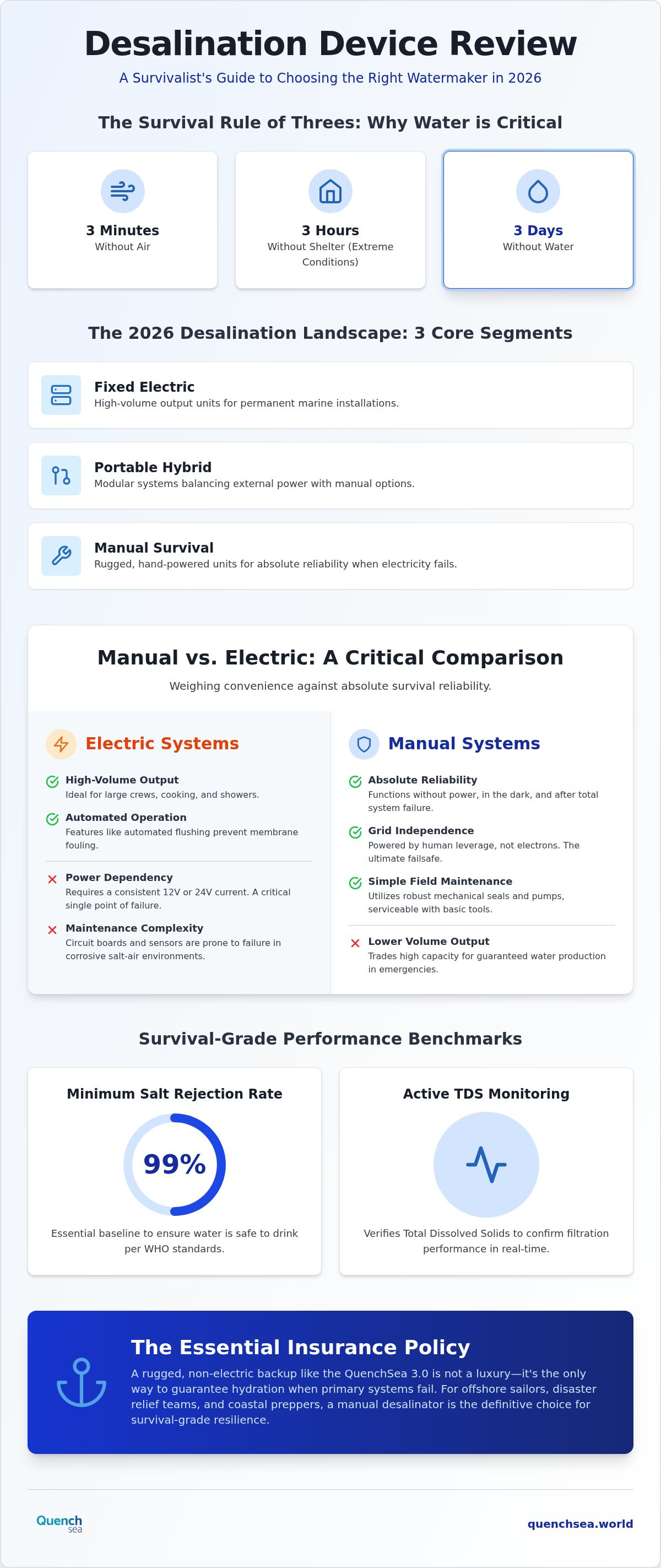
In an offshore crisis, your priorities are dictated by biology. You can survive three minutes without air. You can survive three hours without shelter in extreme conditions. But you won't last three days without water. This "Survival Rule of 3" makes water production your primary mechanical objective. Portable desalination defines any system capable of converting seawater into potable water in remote or emergency areas. It's the difference between a controlled situation and a fatal one.
This desalination device review analyzes a market that has shifted significantly. In 2026, the global water desalination market is estimated at $20.76 billion. While large-scale systems dominate the volume, individual preparedness has driven innovation in the portable sector. We categorize these devices into three core segments:
- Fixed Electric: High-volume output units designed for permanent marine installations.
- Portable Hybrid: Modular systems that attempt to balance external power with manual options.
- Manual Survival: Rugged, hand-powered units built for absolute mechanical reliability when electricity fails.
The trend is clear. Interest has moved away from luxury yacht accessories toward rugged, non-electric solutions. People want independence from the grid. They want a tool that functions when the battery bank dies or the engine room floods. For a comprehensive overview of desalination methods, the science of salt separation remains consistent; however, the hardware has become leaner and more resilient to meet these high-stakes demands.
The Evolution of Portable Reverse Osmosis
The hardware has transitioned from bulky military-grade kits to compact, consumer-available tools. Engineering breakthroughs in membrane technology now allow for lower-pressure manual operation. You no longer need a high-torque industrial pump to overcome osmotic pressure. Modern membranes are more efficient. They work with the physical force a human can generate. Pre-filtration has also advanced. It acts as a sacrificial layer. By removing sediment and bio-matter before it hits the RO membrane, these systems last longer in turbid coastal waters.
Who Needs a Portable Desalinator?
Reliability isn't just for explorers. Offshore sailors require a failsafe backup for their primary electric water makers. If your 12V or 24V system shorts, you need a manual alternative. Disaster relief teams also rely on these tools in "last-mile" coastal zones where infrastructure has collapsed. Finally, coastal preppers use them for off-grid hydration. In these environments, a portable desalinator isn't a luxury gadget. It's a survival-grade necessity designed to keep you alive when the traditional supply chain breaks.
Manual vs. Electric Watermakers: A Critical Comparison
Choosing a water maker isn't just about calculating gallons per hour. It is about risk management. In any desalination device review, the primary tension lies between convenience and survival. Electric systems offer high-volume output but introduce a single point of failure: the power grid. Manual systems trade volume for absolute mechanical reliability. You must decide which trade-off you can live with when the shoreline disappears.
Power dependency is the hidden risk of the modern offshore vessel. Most high-capacity units require consistent 12V or 24V current. If your battery bank shorts, your alternator fails, or an electrical fire forces a total shutdown, the process of desalination stops. You are left with a heavy, useless machine. Manual units eliminate this dependency. They rely on human leverage, not electrons. They function in the dark, in the wet, and after a total power loss.
Maintenance complexity also separates these two categories. Salt air is corrosive to electronics. Electric systems utilize circuit boards, pressure sensors, and automated solenoids. These components are prone to failure in high-humidity environments. Manual systems are utilitarian. They use robust mechanical seals and physical pumps. They are easier to service in the field with basic tools. For those who prioritize resilience, it's wise to explore survival-grade hardware that simplifies the engineering to its most dependable form.
The Case for Electric Systems
Electric units remain the standard for high-demand maritime operations. If you are cooking for a large crew or require fresh water for showers and equipment wash-downs, automation is essential. These systems feature automated flushing cycles that prevent membrane fouling without manual intervention. They prioritize comfort and volume. They are the right choice for stable coastal cruising where emergency scenarios are a secondary concern.
The Case for Manual Desalination
In a crisis, mechanical simplicity wins. Manual units require zero battery, fuel, or solar input. They are operational 24/7, regardless of the vessel's status. Weight and footprint also favor the manual approach. While electric units are often fixed installations, manual tools are grab-bag-ready. Every blue-water vessel should carry a manual reverse osmosis seawater unit as a secondary backup. It ensures that even if the primary system fails, your ability to generate life-saving water remains intact.
Performance Benchmarks: What Makes a Top-Rated Desalinator?
A technical desalination device review requires more than a list of features. It demands hard data. When your life depends on a single piece of hardware, you don't look for "good enough." You look for survival-grade benchmarks. The primary metric is the salt rejection rate. For seawater to be safely potable, a device must remove 99% of dissolved salts. This isn't an arbitrary figure. It's the engineering standard required to meet World Health Organization (WHO) guidelines. Anything less increases the risk of dehydration and kidney stress at a time when your body is already under extreme duress.
Performance isn't just about chemistry; it's about physics. You must evaluate the liters-per-hour output against the physical effort required. In a survival situation, energy conservation is a priority. If a manual pump requires more calories and hydration to operate than it produces in fresh water, it's a liability. Top-rated units optimize the mechanical advantage. They allow you to generate life-saving water without inducing rapid muscle fatigue. This balance is what separates professional tools from recreational gadgets.
Verification is the final pillar of performance. You can't taste the difference between 98% and 99% rejection, but your body can feel it. Field-testing with a Total Dissolved Solids (TDS) meter is essential. It provides an objective confirmation that your membrane is intact and functioning. Without a way to verify output, you're guessing. In the middle of the ocean, guessing is not a strategy.
The Science of Salt Rejection
Reverse osmosis (RO) membranes function at a molecular level. These semi-permeable barriers are engineered with pores small enough to block sodium and chloride ions while allowing smaller water molecules to pass through. It's a mechanical separation process that requires significant pressure to overcome the natural osmotic state of seawater. Cheap filters often rely on simple carbon or ceramic elements. These will never remove salt. Only a high-pressure RO membrane can reach the 99% rejection threshold required for ocean survival. Total Dissolved Solids (TDS) measures the concentration of dissolved substances in water, providing a direct metric for salt rejection and overall purity in an ocean survival context.
Durability and Material Integrity
Seawater is one of the most corrosive environments on earth. A desalinator must be built with marine-grade materials to survive. Stainless steel and high-impact, UV-stabilized plastics are mandatory. These materials resist the relentless degradation of salt spray and intense sun exposure. If you're storing a unit in a life raft, it must also withstand extreme temperature fluctuations and physical impact. Field maintenance is equally critical. You need a device that allows for easy cleaning and membrane replacement without specialized tools. Reliability is born from simplicity and rugged engineering.
Field Review: Testing Reliability in Extreme Environments
Skepticism is rampant in survival forums. Many users question if a hand-powered tool can actually generate the 40 to 50 bars of pressure required for reverse osmosis. This desalination device review confirms that modern engineering has solved this. It isn't about raw strength; it's about mechanical advantage. 2026 hardware utilizes high-ratio leverage systems that convert manageable hand motions into the intense pressure needed to force water through a membrane. You aren't fighting the ocean. You're outmaneuvering it with physics.
Deployment scenarios dictate the hardware's success. In a life raft, stability is non-existent. You need a device that anchors to your body or the raft's frame to prevent losing it overboard. Ergonomics matter here. A handle designed for a full-body pumping motion is superior to one that relies solely on forearm strength. Conversely, coastal camping deployments face different threats. Sand and silt are the primary enemies. Without proper intake management, these abrasives can ruin a membrane in hours. Reliability is a combination of robust hardware and disciplined user operation.
Operational longevity is the final hurdle. A high-quality membrane can produce hundreds of liters, but performance will degrade without maintenance. You must track your output. If the pumping resistance increases significantly while the flow rate drops, your membrane is likely scaling or fouled. To ensure your gear is ready for the next crisis, you should order a survival-grade desalination device built for long-term field resilience.
Overcoming the "Physical Effort" Myth
Critics often cite pumping fatigue as a dealbreaker. They overlook the metabolic math. The energy expended while pumping is a fraction of the metabolic cost of advanced dehydration. Modern designs utilize ergonomic grips and optimized stroke lengths to minimize user strain. To maintain a steady flow, use a consistent, rhythmic cadence rather than rapid, jerky motions. This preserves both the mechanical seals and your own stamina. In a survival situation, the slow, steady production of water is your most valuable asset.
The Reality of Saltwater Pre-filtration
The quality of your intake water directly impacts your membrane's lifespan. Turbidity, or the cloudiness caused by suspended particles, is a membrane killer. This is why multi-stage pre-filtration is non-negotiable. A survival desalinator must use a sacrificial pre-filter to catch sediment before it reaches the RO core. If you're storing the device after use, you must "pickle" it. This involves flushing the system with a preservative solution to prevent bacterial growth and membrane drying. Neglecting this step turns a life-saving tool into a brick.
Why the QuenchSea 3.0 is the Definitive Choice for Survival
The QuenchSea 3.0 Desalination Device stands as the culmination of manual reverse osmosis engineering. While previous sections of this desalination device review established the technical benchmarks for performance, the 3.0 model provides the hardware to meet them. It's designed for high-stress environments where failure isn't an option. This unit removes 99% of salt, providing WHO-standard drinking water through purely mechanical force. It represents a strategic shift from luxury gadgets to survival-grade tools. By focusing on the essentials of fluid dynamics and material science, it offers a level of certainty that electronic systems cannot replicate.
Versatility is its primary strength. The device fits seamlessly into yacht grab-bags and disaster relief water supply kits. It bridges the gap between individual preparedness and humanitarian response. When evaluating the desalination device price, the value proposition is clear. Fixed electric systems often require thousands in installation and maintenance. The QuenchSea 3.0 offers a fraction of that cost while providing a level of reliability that electronics can't match. It's a one-time investment in a lifetime of water security.
Rugged Design for High-Stakes Missions
The 3.0 model prioritizes mechanical integrity above all else. Its manual operation empowers the user in any condition, regardless of battery levels or fuel availability. The size is optimized for standard marine emergency containers. It's compact, lightweight, and impact-resistant. This isn't just a commercial product; it's part of a mission-driven goal to provide global water access. Every component is engineered to withstand the corrosive reality of the ocean. The housing utilizes UV-stabilized, marine-grade polymers that won't degrade under the relentless tropical sun. It's a tool for those who understand that in a crisis, simplicity is the ultimate sophistication. By stripping away the unnecessary, the 3.0 ensures that water production remains a constant, not a variable.
Final Verdict: Choosing Your Water Security
This desalination device review concludes that the QuenchSea 3.0 is the definitive choice for emergency water production. It solves the reliability issues that plagued previous generations of portable RO units. For yacht owners, the recommendation is straightforward: use your electric system for daily comfort, but trust QuenchSea for your survival. It's the essential manual backup that turns a potential tragedy into a manageable situation. The device is easy to store, simple to deploy, and requires no technical expertise to operate. Secure your survival desalination device today and ensure your hydration is never dependent on a power grid. When the shoreline is out of sight and the power is out, this is the hardware you want in your hands.
Securing Your Offshore Hydration Strategy
True maritime safety isn't found in the convenience of automated systems but in the reliability of your failsafe backups. This desalination device review has demonstrated that while electric units provide volume, only manual reverse osmosis offers the absolute mechanical certainty required for survival. You've seen that salt rejection rates of 99% are non-negotiable for safe drinking water. You also understand that in a crisis, the simplest tool is often the most effective.
The QuenchSea 3.0 represents the peak of this engineering philosophy. It reduces seawater TDS by 99% using only manual pressure, ensuring you aren't dependent on batteries or fuel when they're most likely to fail. Lightweight and designed specifically for emergency grab-bags, it's already the trusted choice for marine professionals and disaster relief teams worldwide. Don't leave your hydration to chance when the power goes out. Equip your vessel with the QuenchSea 3.0 today. Take command of your water security and prepare for the unexpected with confidence.
Frequently Asked Questions
Is a manual desalination device hard to use for long periods?
Manual operation is manageable because of high-leverage engineering. While it requires physical input, the stroke length is optimized to reduce muscle fatigue during extended use. This design ensures that the energy you expend is significantly lower than the metabolic cost of advanced dehydration. It's built for sustainable, rhythmic pumping rather than short bursts of high-intensity effort.
Can I really drink the water produced by a portable desalinator safely?
Yes, provided the device achieves a 99% salt rejection rate. This level of filtration meets World Health Organization standards for potable water by removing dissolved solids and sodium ions. Using a TDS meter during your desalination device review in the field confirms the membrane is performing correctly and the water is safe for consumption.
How long does the membrane last in a device like the QuenchSea 3.0?
Membrane longevity depends heavily on the turbidity of the source water. With proper pre-filtration to remove sediment, a single reverse osmosis membrane can produce hundreds of liters before performance degrades. Using sacrificial pre-filters is the best way to extend this lifespan by protecting the sensitive RO core from physical abrasion and fouling.
What is the difference between a water filter and a desalination device?
Standard water filters only remove biological contaminants and sediment. They cannot block dissolved salt ions. A desalination device uses reverse osmosis technology to strip sodium and minerals at a molecular level. This process converts seawater into fresh water, whereas a traditional filter only purifies water that is already fresh but contaminated.
Do I need any tools or electricity to operate the QuenchSea 3.0?
The QuenchSea 3.0 requires zero electricity and no external tools for standard operation. It is a self-contained mechanical system designed for immediate deployment. This makes it a reliable choice for life rafts and emergency grab-bags where power sources and toolkits are often unavailable or compromised by salt water.
Can these devices be used to filter brackish water or just seawater?
These devices handle both seawater and brackish water efficiently. Brackish water actually places less osmotic pressure on the membrane, which often results in higher flow rates and less physical effort for the user. This versatility is essential for disaster relief teams operating in varying coastal environments where water salinity fluctuates.
How do I store a desalination device when it is not in use?
Long-term storage requires "pickling" the system with a preservative solution. This prevents bacterial growth inside the housing and keeps the membrane from drying out and cracking. You should always flush the unit with fresh water before applying the storage solution to remove any residual salt that could cause internal corrosion.
What happens if the RO membrane gets clogged in the field?
If a membrane clogs, it must be replaced using the spare units in your kit. You'll notice increased pumping resistance and a significant drop in flow rate when fouling occurs. Carrying a 2-pack of replacement membranes ensures you can restore water production in minutes without needing specialized tools or a workshop environment.