

In a maritime emergency, a lithium battery is just a heavy paperweight once the charge hits zero. Relying on complex electronics for survival is a risk. Eventually, those systems fail. If you're miles from the coast, the fear of a contaminated fuel tank or a seized generator is real. A portable water maker no fuel is required to run serves as the ultimate insurance policy. It ensures your access to freshwater remains as constant as the ocean itself.
We understand that true independence means stripping away the variables that cause system failure. This 2026 guide explores how manual desalination technology is revolutionizing off-grid survival by providing unlimited freshwater through pure mechanical force. You'll learn how to secure a reliable, lightweight backup that functions without electricity or fossil fuels. We will break down the engineering of the QuenchSea 3.0 and explain why human-powered reverse osmosis is now the essential standard for marine safety and disaster preparedness.
Key Takeaways
- Learn why manual pressure is replacing combustion and electricity as the 2026 standard for survival reliability.
- Understand the physics of mechanical leverage that allows you to overcome osmotic pressure without a generator.
- Compare the maintenance-free simplicity of mechanical RO systems against the high failure rates of complex electronics.
- Discover why a portable water maker no fuel required is the essential survival tool for life rafts and disaster relief zones.
- Explore the QuenchSea 3.0, a lightweight device capable of producing up to 6 liters of freshwater per hour using only human power.
The Evolution of the Portable Water Maker: Why 'No Fuel' is the New Standard
Traditionally, water makers were heavy, power-hungry machines reserved for luxury yachts with massive diesel generators. In 2026, the paradigm has shifted. Reliability is now the primary metric of performance. A portable water maker no fuel relies on manual pressure to achieve desalination, stripping away the dependencies that lead to system failure in extreme environments. This evolution defines the difference between a convenience gadget and a survival-grade tool.
For the modern offshore sailor or emergency responder, energy independence is the highest priority. Carrying petrol or diesel for a water maker creates a dangerous logistical chain. It adds dead weight to the vessel, increases fire risk, and introduces the constant threat of fuel contamination. By eliminating the combustion engine and the electric motor, we eliminate the variables that fail when conditions turn hostile. The shift toward manual systems reflects a broader move toward hardware that functions through mechanical integrity rather than digital complexity.
Even as we move toward mechanical backups, managing the digital tools we still use is simplified with the udoq German design multiple charging station for any mobile device, which provides a modular and organized way to keep your essential electronics ready before you head off-grid.
The Vulnerability of Powered Desalination
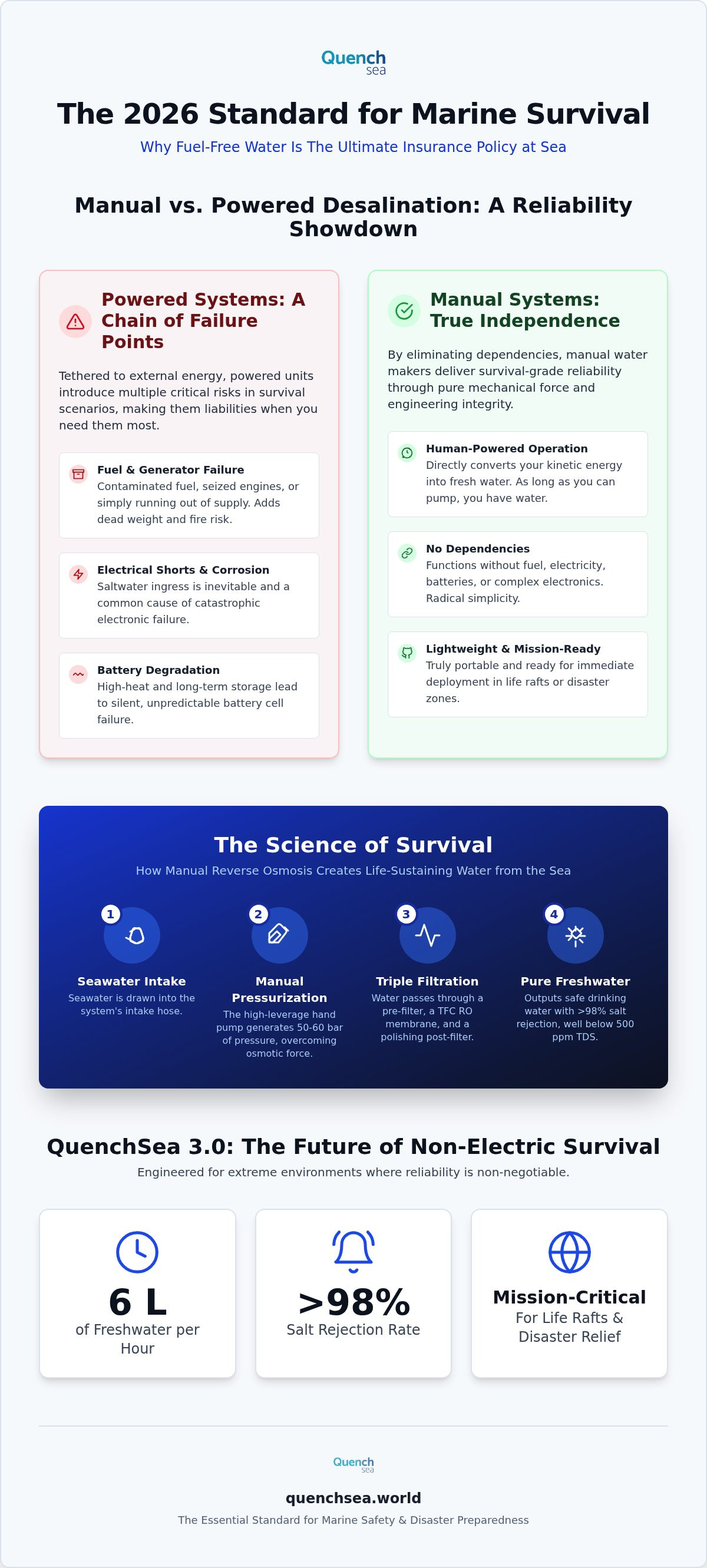
Powered units are often marketed as "portable," yet they remain tethered to external energy sources. These systems face multiple critical failure points that can leave a crew stranded without freshwater. Electrical shorts caused by saltwater ingress or corrosion are common. Fuel degradation or contamination during long-term storage can seize a generator in minutes. Additionally, battery discharge or total cell degradation in high-heat environments creates a silent risk. A device isn't truly portable if it requires a 2kVA generator to function. The weight penalty of extra fuel and the complexity of maintaining electric RO systems make them liabilities during a crisis. True preparedness requires a tool that is ready the moment it's unpacked.
Defining True Mechanical Independence
A fuel-free water maker is a closed-loop mechanical system designed to convert seawater into potable water using only human kinetic energy. This design respects the "Rule of 3" in survival: you can survive approximately three days without water. Relying on solar-powered units is a gamble; they fail in low-light conditions, during heavy storms, or when panels are obscured by salt spray and debris. How Manual Reverse Osmosis Works relies on the simple, repeatable application of physical pressure to overcome osmotic barriers. It is a predictable mechanical solution for an unpredictable world. By focusing on manual operation, you ensure that as long as you have the strength to pump, you have the ability to survive.
How Manual Reverse Osmosis Works Without Electricity
Desalination is a battle against physics. To extract freshwater from the ocean, you must overcome osmotic pressure. This requires force. While electric systems use high-wattage motors, a portable water maker no fuel relies on mechanical leverage. It generates the necessary 50 to 60 bar of pressure through human kinetic energy. It is a calculated exchange of effort for survival. This process ensures that you are never at the mercy of a dead battery or an empty fuel tank when your life depends on hydration.
The system utilizes a sophisticated triple-filtration architecture. It begins with a high-density pre-filter designed to capture suspended solids and organic matter. This stage is critical; it protects the sensitive RO membrane from premature fouling. Next, the pressurized water is forced through the semi-permeable barrier. Finally, a post-treatment filter polishes the water for taste and clarity. Understanding how reverse osmosis works helps users appreciate the engineering required to turn brine into life-sustaining fluid. The goal is a radical reduction in Total Dissolved Solids (TDS). High TDS levels lead to dehydration and kidney stress. A 98 percent salt rejection rate ensures your drinking water remains well under the 500 ppm safety threshold.
The Mechanics of the Hand Pump
Generating 60 bar of pressure manually sounds impossible without specialized engineering. It requires a high leverage ratio built into the handle and piston assembly. Hand-powered units use long-stroke handles to multiply the force applied by the operator. These systems include precision-engineered check valves that prevent backflow and maintain constant pressure against the membrane. This mechanical advantage ensures every stroke yields results. You can explore the technical details of the hand operated water purifier saltwater science to see how these internal valves manage high-pressure fluid dynamics without electronic sensors.
Membrane Technology in 2026
In 2026, Thin-Film Composite (TFC) membranes have reached a new peak of efficiency. These membranes are now optimized specifically for manual systems, requiring significantly less physical exertion to achieve high salt rejection. Modern TFC layers are thinner yet more durable, allowing for a higher flux rate at lower pressures. Manual RO is vastly superior to solar stills for volume; while a solar still might produce only a few cups of water per day, a manual RO device provides liters in a single hour. This high-volume output makes it the only viable solution for high-stakes marine emergencies. If you need a field-tested tool that embodies this mechanical innovation, the QuenchSea 3.0 provides the reliability required for true off-grid independence.
Manual vs. Powered Portable Water Makers: A Comparison
Efficiency in the field is measured by what you don't have to carry. A powered desalination system requires a generator, a fuel supply, and the water maker itself. This creates a massive footprint. In contrast, a portable water maker no fuel is required for fits inside a small backpack. The weight savings are significant. A manual unit like the QuenchSea 3.0 weighs only 6 kg, whereas a petrol-powered alternative can exceed 30 kg once you factor in the engine and a five-gallon jerry can.
Mechanical simplicity is the foundation of long-term survival. Powered systems rely on complex electronics, high-pressure pumps, and internal combustion engines. Each component is a potential failure point. If a circuit board corrodes or a fuel line clogs, the system is dead. A manual device uses a straightforward piston and valve design. It functions regardless of electrical surges or engine trouble. Maintenance is reduced to rinsing the system and replacing filters. There are no oil changes, spark plugs, or battery levels to monitor. This unbox-and-pump deployment speed is critical when every minute without freshwater counts.
Reliability in Austere Environments
The shelf-life of petrol is surprisingly short, often degrading in just 6 to 12 months. If you store a powered unit for an emergency, the fuel may be useless when you finally need it. A mechanical portable water maker no fuel depends on can sit in a locker for years. It's ready to deploy the moment you unbox it. Corrosion resistance is another critical factor. Salt spray is the enemy of electronics. By removing the wiring and sensors, you remove the risk of short circuits. Repairs in the field are also simpler. You don't need a diagnostic computer to fix a manual pump; you just need basic tools and spare seals.
Output vs. Effort: Managing Expectations
Powered units deliver higher gallons-per-hour (GPH) than manual devices. A petrol-driven system might produce 30 gallons an hour, while a manual unit produces 1 to 1.6 gallons. However, you must consider the "Survival Volume." An average adult needs roughly 2 to 3 liters of water per day to stay hydrated. A manual pump provides this in less than an hour of work. While a powered primary system is excellent for comfort, a manual backup is non-negotiable. If your primary generator fails or your fuel is contaminated, the ability to produce water through human effort becomes your only lifeline.
Mission-Critical Scenarios for Fuel-Free Desalination
Reliability isn't a luxury in a crisis. It's the baseline. When infrastructure collapses or your vessel is lost, the variables of fuel and electricity vanish. A portable water maker no fuel is required to operate bridges the gap between total dehydration and sustained survival. These devices are engineered for the "last-mile" of human endurance, where every gram of gear must justify its weight. In extreme environments, you can't afford to carry a tool that might not work. You need a tool that cannot fail.
In the immediate aftermath of a hurricane or tsunami, coastal freshwater sources are often inundated with salt or pathogens. Centralized relief efforts often take days to establish a supply chain. Rapidly deploying manual RO units allows individuals and first responders to source water directly from the ocean surge. This decentralization of water production saves lives. It removes the dependence on bulk water transport and heavy machinery. Humanitarian organizations and defense sectors prioritize this technology because it provides immediate, potable water without the logistical nightmare of shipping thousands of plastic bottles into a disaster zone.
The Life Raft Essential
Relying solely on stored water rations is a gamble against time. Most life rafts carry enough water for only a few days, but rescue operations in remote waters can take much longer. A manual desalinator provides a psychological and physical "water factory" that turns the surrounding ocean into a resource. It eliminates the dangerous rationing mindset that leads to cognitive decline and physical weakness. You can learn the specific steps of how to desalinate seawater manually to maximize your output during an emergency. Having this capability on board transforms a survival situation from a countdown to a sustainable hold-out. It gives the crew a task and a tangible result: life-sustaining hydration.
Tactical and Coastal Survival
Tactical water sourcing requires gear that moves with you. Whether you're navigating brackish marshes or open coastlines, a 6 kg device fits into a standard 72-hour "Go Bag" without compromising space for medical supplies or shelter. Traditional filters fail to remove dissolved salts, making them useless in coastal zones. A manual RO system solves this. For those operating in high-threat or remote areas, tactical water desalination offers a way to maintain hydration without revealing your position with the noise of a generator or the heat signature of a stove. The rugged housing of modern manual units is built to withstand the abrasive nature of sand and salt spray, ensuring the internal membranes stay protected during transit.
Secure your primary backup and ensure your team has access to freshwater in any environment by equipping the QuenchSea 3.0 today.
QuenchSea 3.0: The Future of Non-Electric Survival
The QuenchSea 3.0 represents the pinnacle of manual RO engineering. It is a calculated response to the inherent risks of power-dependent desalination. While other systems fail when the fuel runs dry or the battery dies, this device thrives. It is a portable water maker no fuel is required to operate, ensuring that your survival is never tethered to a supply chain. By focusing on mechanical integrity, we have created a tool that provides a reliable freshwater source in the most hostile environments on earth. This is not just a backup; it is a primary life-support system for the off-grid explorer.
Performance is defined by results. The QuenchSea 3.0 achieves a 98 percent salt rejection rate, stripping away dissolved solids to produce water that meets safe drinking standards. It delivers an output of 4 to 6 liters per hour. This volume is achieved through an ergonomic pumping mechanism that translates human effort into high-pressure hydraulic force. We have addressed the primary objection to manual desalination: the physical toll. Through precision engineering and optimized leverage, we have made the process efficient enough for anyone to use during a crisis. The mission behind this hardware is clear. We provide affordable, life-saving water technology to the people who need it most, from coastal yacht owners to humanitarian responders.
Engineering for the Extreme
Survival gear must withstand the elements it's designed to overcome. The QuenchSea 3.0 is constructed from robust, corrosion-resistant materials that survive constant exposure to salt, sun, and sand. There are no delicate circuit boards to fry and no internal combustion parts to seize. Its compact dimensions allow it to fit seamlessly into yacht lockers or 72-hour bug-out bags. Operation is intuitive. It requires no technical training or complex manuals. In an emergency, you simply deploy the intake, prime the system, and begin pumping. It is a streamlined mechanical solution that removes the guesswork from survival hydration.
Investing in Peace of Mind
Any comprehensive marine safety audit must include a plan for water production after a total power failure. The QuenchSea 3.0 is the logical conclusion to that audit. It offers a return on investment that cannot be measured in currency; it is measured in autonomy. This device never needs a recharge. It never needs a petrol refill. It only requires the will to survive. By removing the cost of energy from the desalination equation, you gain total independence from external resources. It is the ultimate insurance policy for your vessel and your crew. Secure your QuenchSea 3.0 for your 2026 expeditions and ensure you are never without a freshwater source, regardless of the conditions.
Secure Your Survival with Mechanical Independence
True preparedness means removing the variables that lead to failure. We've explored how the shift toward manual desalination eliminates the vulnerabilities of electrical shorts and fuel contamination. By prioritizing a portable water maker no fuel is required to operate, you choose a system built on mechanical integrity rather than digital complexity. This technology ensures that your freshwater supply remains consistent, even if your primary generator fails or your batteries die. It's about empowering yourself with tools that don't rely on a fragile supply chain.
With over 10,000 units deployed globally, the QuenchSea 3.0 represents a proven solution designed by survival engineers for extreme marine environments. It offers a future with no batteries, no fuel, and no limits. You can now navigate the most remote coastlines with the absolute confidence that hydration is always within reach. Every stroke of the handle is a direct investment in your autonomy. Take control of your off-grid security today and ensure you're never at the mercy of the elements. You have the power to sustain yourself; all you need is the right hardware.
Equip your vessel with the QuenchSea 3.0; the world's leading fuel-free desalinator.
Frequently Asked Questions
How much water can a portable water maker produce without fuel?
A portable water maker no fuel is required to operate can produce between 4 and 6 liters of freshwater per hour. This output depends on the operator's pumping speed and the salinity of the source water. For a single adult, this rate provides enough hydration for a full day in less than one hour of operation. This efficiency makes it a viable primary source for emergency life raft scenarios where volume is critical.
Is it physically difficult to pump a manual desalination device?
Pumping a manual desalinator requires consistent physical effort but is designed for manageable use. The QuenchSea 3.0 uses an ergonomic handle and a high leverage ratio to multiply the force you apply. While it's more demanding than turning a tap, the mechanical advantage allows an average adult to maintain production for extended periods. It's a calculated trade-off between physical energy and survival hydration.
Can a manual water maker remove 100% of the salt from ocean water?
No device removes 100 percent of dissolved salts, but a high-quality manual unit achieves a 98 percent rejection rate. This reduction brings the Total Dissolved Solids (TDS) level well below the 500 ppm safety threshold established for potable water. The remaining trace minerals are harmless and often found in standard tap water. The primary goal is to prevent the dehydration and kidney stress caused by high-salinity brine.
What is the lifespan of the RO membrane in a no-fuel water maker?
The RO membrane's lifespan depends on the turbidity of the source water and the consistency of pre-filtration. Under optimal conditions, a single membrane can process several hundred liters of seawater before rejection rates drop. Using the integrated pre-filters is essential to prevent clogging from sediment or organic matter. Regularly replacing these low-cost components ensures the expensive RO membrane remains functional for long-term deployments.
Do manual desalinators work in brackish water as well as seawater?
Manual desalinators are highly effective in brackish water and often operate with greater ease than in the open ocean. Brackish water has a lower salt concentration, which means there is less osmotic pressure to overcome. This results in a higher flow rate for the same amount of physical effort. Whether you're in a salt marsh or the deep sea, the mechanical reverse osmosis process remains the same.
How does QuenchSea 3.0 compare to traditional solar stills?
The QuenchSea 3.0 provides significantly higher volume and faster results than a traditional solar still. A solar still relies on evaporation and can take an entire day to produce a single cup of water. In contrast, this manual device produces liters in an hour. It also functions at night or during heavy storms when solar units are completely ineffective. It's the superior choice for high-stakes survival.
Does a portable water maker require chemicals to operate?
No chemicals are required for the desalination process itself. The system relies entirely on mechanical pressure and physical filtration barriers to separate salt from water. This makes a portable water maker no fuel is required for a safe and sustainable solution for long-term use. You don't have to worry about carrying heavy chemical treatments or managing the shelf life of purification tablets. The water is purified through pure physics.
What is the maintenance is required for a fuel-free desalination unit?
Maintenance is straightforward and focuses on mechanical cleanliness. You must rinse the system with freshwater after each use to prevent salt crystallization inside the pump and membrane. Periodically check the seals and lubricate moving parts with food-grade silicone if necessary. Replacing the pre-filters and the RO membrane at recommended intervals is the only other requirement. This simplicity ensures the device stays mission-ready for years.