

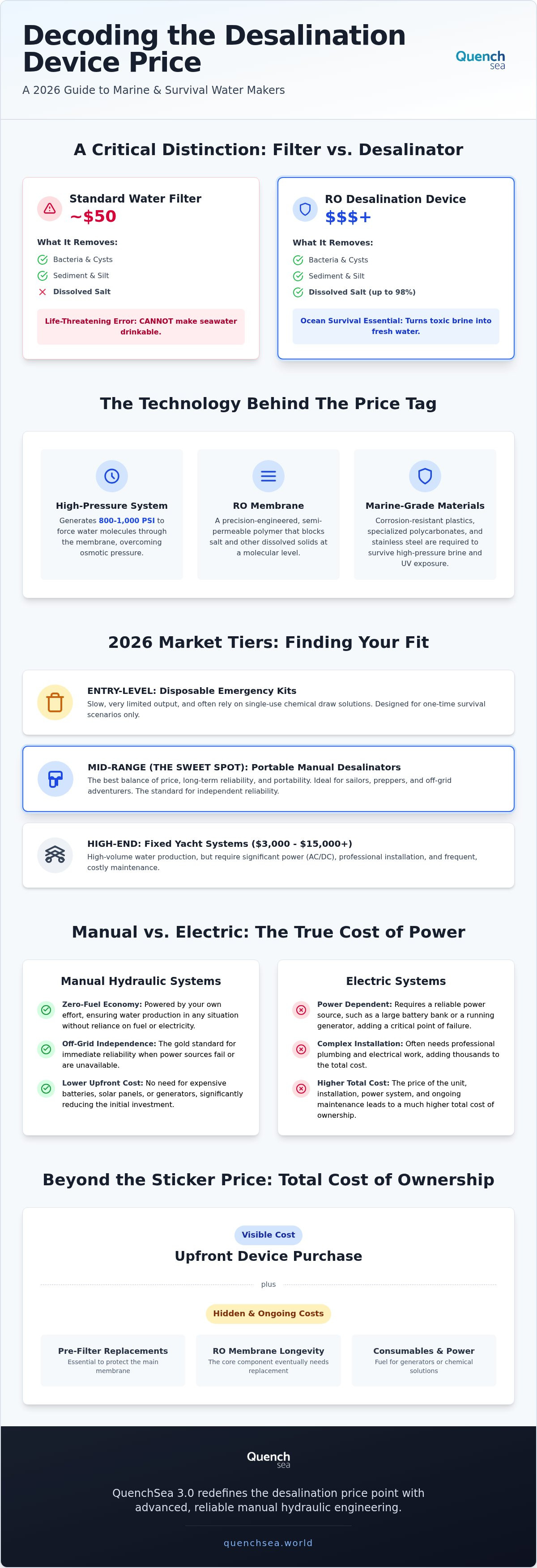
A $50 carbon filter is not a desalination device. Confusing these two tools in a marine emergency is a life-threatening error. While the desalination device price for professional yacht systems often starts at $3,000 and climbs past $15,000, you don't need a massive budget to secure a reliable source of fresh water. True value is measured in reliability-per-liter and mechanical integrity, not just the upfront cost.
We understand the confusion caused by high-priced electric units and hidden maintenance expenses. You need a clear, technical breakdown of what your money actually buys in 2026. This guide provides a direct look at the current market tiers to help you find a portable device that fits a survivalist budget. We'll analyze the difference between manual and electric systems, expose long-term filter costs, and identify which hardware offers the best performance for off-grid use.
Key Takeaways
- Identify the primary factors driving the desalination device price, from marine-grade construction materials to high-pressure hydraulic systems.
- Learn why standard filters fail at desalination and why Reverse Osmosis technology is the mandatory standard for ocean survival.
- Calculate the long-term ROI by comparing the weight and expense of stored bottled water against a portable manual water maker.
- Uncover the hidden operational costs of consumables, including pre-filter replacement cycles and RO membrane longevity.
- Discover how manual hydraulic engineering eliminates the need for expensive power sources like solar panels or fuel.
Understanding the Desalination Device Price Landscape
A common mistake among off-grid travelers is assuming a high-end backpacking filter can process seawater. It can't. Standard filters trap bacteria and sediment. They don't touch dissolved solids. Desalination requires removing salt at a molecular level. This fundamental difference is the primary driver of the desalination device price. You're paying for the ability to turn toxic brine into life-sustaining hydration. If a device doesn't utilize specialized membranes or thermal processes, it's just a filter, not a water maker.
In 2026, Reverse Osmosis (RO) dominates the portable market. While thermal distillation exists, it's inefficient for survival or marine use. It requires massive energy to boil water. RO uses mechanical pressure to force water through a semi-permeable membrane. This process is faster and more compact. However, the hardware required to generate that pressure is why these units cost significantly more than a gravity filter. Recent advancements in membrane durability have shifted the market. Modern membranes reject up to 98% of salt more efficiently than models from five years ago. This allows smaller pumps to produce more water, making portable units more viable for solo explorers.
The Technology Behind the Price Tag
High-pressure hydraulic systems are the heart of any RO unit. To overcome osmotic pressure, the system must generate between 800 and 1,000 PSI. Engineering a pump that survives saltwater at these pressures is expensive. The semi-permeable membrane is the second major cost center. These aren't simple screens. They are precision-engineered polymers. While "cheap" forward osmosis pouches exist, they often rely on expensive sugar-based draw solutions. This leads to a high cost-per-liter over time. Investing in a mechanical RO system eliminates the need for ongoing chemical purchases.
Market Tiers: From Survival to Luxury
The 2026 market is divided into three distinct segments based on output and power requirements:
- Entry-Level: Often disposable emergency kits. They use chemical draw solutions or small handheld pumps. They are slow, limited in output, and designed for one-time survival scenarios.
- Mid-Range: This is the "sweet spot" for sailors and survivalists. These portable manual desalinators offer long-term reliability without the complexity of a fixed install. They provide the best balance of desalination device price and durability.
- High-End: Fixed AC/DC yacht water makers. These systems provide high volume but require professional installation, significant power, and frequent maintenance.
Understanding these tiers prevents you from overpaying for capacity you don't need or under-investing in a tool that might fail when you need it most.
Key Factors Influencing Desalination System Costs
The desalination device price isn't just a reflection of brand name. It's a calculation of engineering tolerances. Saltwater is aggressive. It eats through standard metals in weeks. To survive it, a device needs more than just a pump. It needs materials that won't degrade when exposed to high-pressure brine and harsh UV rays. Every component must be rated for marine environments. This level of durability requires specialized manufacturing, which is the primary driver of cost.
Output capacity also dictates the hardware required. A system producing 4 liters per hour (LPH) is more compact and affordable than a system producing 60 LPH. As the output increases, so does the size of the RO membrane and the power of the pump. Furthermore, the number of filtration stages impacts longevity. Multi-stage pre-filtration protects the expensive RO membrane from silt, plankton, and oil. Without these sacrificial filters, your core membrane will clog, leading to a much higher total cost of ownership over time.
Manual vs. Electric: The Hidden Power Costs
Manual systems offer a massive upfront advantage. The QuenchSea 3.0 Desalination Device removes the need for complex electrical installations. Yacht-based electric systems often require professional plumbing and dedicated battery banks. This adds thousands to the total cost. Manual units use human power. This creates a "zero-fuel" economy. In a survival situation, your ability to produce water shouldn't depend on a charge controller or a diesel generator. Research into a portable desalination unit shows that while electric versions are becoming more efficient, manual hydraulic systems remain the gold standard for immediate, independent reliability. You pay for the hardware, not the power to run it.
Durability and Material Engineering
Corrosion resistance is the #1 driver of marine equipment pricing. Marine-grade plastics and specialized polycarbonates are used to keep weight low and integrity high. Stainless steel is utilized only for critical high-pressure components to prevent rust. High-pressure seals must withstand nearly 1,000 PSI without leaking; this precision manufacturing directly increases the initial cost of RO units. While consumer-grade filters might last a single season, industrial-strength membranes in a high-quality water maker are designed for years of service. If you're looking for a reliable solution, explore the latest manual RO technology that balances rugged materials with an accessible price point.
Manual Water Maker ROI: Portability vs. Fixed Installation
Every kilogram on a vessel has a cost. Carrying 1,000 liters of fresh water adds exactly 1,000 kilograms of dead weight to your hull. This mass reduces fuel efficiency, limits storage space, and dictates your mission's duration. For coastal explorers and sailors, the return on investment for a survival desalination device isn't just about the hardware. It's about the logistical freedom gained by converting the ocean into a renewable resource. When you stop paying for the transportation and storage of plastic bottles, the hardware pays for itself through operational efficiency.
The desalination device price for a portable manual unit represents a one-time capital expenditure that replaces a recurring consumable cost. Fixed installations on large yachts provide high volume, but they carry heavy maintenance schedules and high power draws. In contrast, a portable manual unit offers a superior weight-to-cost ratio, especially for life raft deployment where every ounce is scrutinized. It functions as a primary source for solo adventurers or as a fail-safe backup for larger crews. Reliability in a remote environment is the ultimate cost-saver.
The Cost of Carrying Water vs. Making It
Logistical expenses for freshwater storage on small vessels are often hidden. You pay in fuel, speed, and physical space. A manual RO device typically achieves a full return on investment after it produces its first 100 liters of potable water. This calculation assumes the average retail price of bottled water in remote or international ports. By utilizing manual reverse osmosis seawater technology, you eliminate the need for heavy storage tanks. Government data on factors influencing desalination costs confirms that while industrial scales differ, the individual explorer benefits most from reducing the "cost of weight" during transit.
Reliability as a Cost-Saving Metric
System failure in a remote environment is more than an inconvenience; it's a financial and safety crisis. If a primary electric water maker fails, the cost includes emergency repairs, potential towing fees, or a terminated expedition. Manual pumps offer significantly longer maintenance-free intervals because they lack complex electric motors, circuit boards, and cooling systems. You're investing in mechanical simplicity. When calculating the "cost of survival" in your emergency preparedness budget, the desalination device price of a manual unit should be viewed as a high-value insurance policy that requires no fuel or battery power to stay active.
Operational Expenses: Consumables and Maintenance
The sticker price is only the beginning of your investment. To calculate the true desalination device price, you must account for consumables over a five-year lifecycle. Neglecting maintenance doesn't just cost money. It leads to hardware failure when you're miles from shore. The Total Cost of Ownership (TCO) includes pre-filters, membranes, and storage chemicals. If you plan for these expenses upfront, you avoid the "emergency tax" of rush-shipping parts to a remote port.
Pre-filtration is your first line of defense. Sediment and ultrafiltration cartridges catch larger particles before they reach the RO membrane. These are sacrificial components. They are cheap to replace but vital for protecting the expensive core. If you skip a pre-filter replacement, you risk ruining the entire system. In 2026, high-quality sediment filters remain an affordable way to extend the life of your primary hardware.
Storage is the most overlooked expense. If an RO system sits idle for more than a few days, biological growth begins. You must "pickle" the system using specialized preservatives to prevent biofouling. This chemical step is mandatory for any non-daily use. Failure to pickle a membrane results in permanent damage and immediate replacement costs. Always include the price of preservatives in your annual survival budget.
The Lifecycle of an RO Membrane
Membranes degrade through biofouling, mineral scaling, and physical abrasions from fine silt. Industrial-scale membranes can cost thousands of dollars. Portable versions are more accessible but still represent the most expensive consumable in the kit. A manual RO membrane typically processes between 1,000 and 2,000 liters before performance degrades under optimal conditions. Monitoring the salt rejection rate is the only way to know when to invest in a new core. If the rejection rate drops below 95%, the membrane is reaching the end of its functional life.
Preventative Maintenance vs. Emergency Repair
Manual pumps require basic, disciplined upkeep. This usually involves seal kits and food-grade lubrication to maintain hydraulic efficiency. These kits are affordable and designed for user-servicing in the field. High-pressure electric units are different. They often require professional servicing due to complex wiring and motorized components. Clear pictorial instructions are essential for field repairs. They reduce operator error and prevent damage to high-pressure seals during reassembly. If you want to minimize your long-term expenses, invest in a manual desalination device that eliminates electrical repair costs and relies on simple, rugged mechanics.
Why QuenchSea 3.0 Redefines the Desalination Price Point
The 2026 market offers many complex solutions, but complexity often introduces a high "cost of failure." If your electronic water maker shorts out in a storm, the price you paid becomes irrelevant. The QuenchSea 3.0 addresses the desalination device price gap by stripping away every non-essential component. It replaces expensive circuit boards and heavy motors with a high-efficiency manual hydraulic system. This isn't just about affordability. It's about creating a tool that works when everything else fails.
Most portable units in this price bracket struggle to produce more than a liter or two per hour. The QuenchSea 3.0 delivers 4 to 6 liters of fresh water every hour while maintaining a 98% salt rejection rate. You don't need a professional installation or a dedicated battery bank to achieve these results. By focusing on mechanical leverage rather than electrical power, the device provides a mission-critical resource at a fraction of the cost of traditional yacht systems. It's the only low-cost manual RO device designed for both individual survival and large-scale relief operations.
Engineering for Affordability and Impact
The mission-driven approach behind this hardware focuses on accessibility. Traditional manufacturers often cater to the luxury marine market, driving prices up with decorative finishes and automated sensors. We focused on the core physics of Reverse Osmosis. This simplified mechanical design lowers the barrier to entry for sailors and off-grid explorers who need reliability without the luxury markup. This same engineering philosophy makes the device a vital asset for disaster relief water supply, where tactical solutions must be deployed rapidly to the last mile of a survival situation.
The Bottom Line for 2026 Buyers
The QuenchSea 3.0 is the leading value choice because it eliminates the hidden costs of ownership. You don't have to invest in solar panels, fuel, or complex wiring. Your only ongoing expenses are the pre-filters and the RO membrane, which are designed for easy field replacement. Before you commit to a desalination device price, use this final checklist:
- Does the device require an external power source that could fail?
- What is the cost-per-liter when accounting for replacement membranes?
- Can you repair the system yourself with basic tools?
- Is the salt rejection rate high enough to ensure long-term health?
For those prioritizing independence and mechanical integrity, the choice is clear. Stop relying on limited freshwater storage and take control of your hydration. View current availability and professional pricing for the QuenchSea 3.0 today.
Secure Your Water Independence
Finding the right desalination device price means looking beyond the initial transaction. You've identified the critical difference between freshwater filters and true RO systems. You've calculated the ROI of making water versus carrying it. The most significant takeaway is that reliability doesn't have to cost thousands. True water security depends on mechanical simplicity and rugged engineering. By removing the need for batteries and solar arrays, you gain a fail-safe system that operates anywhere in the world.
The QuenchSea 3.0 offers survival-grade reliability with a 98% salt rejection rate. It provides WHO-standard drinking water through a 100% manual hydraulic system. This technology is trusted by defense forces and humanitarian teams for its durability in high-stakes environments. It's time to stop worrying about your freshwater reserves and start focusing on your mission. Secure Your QuenchSea 3.0: The Most Affordable Professional Desalinator and take the first step toward total off-grid empowerment. You have the tools to overcome the environment. Now, go use them.
Frequently Asked Questions
How much does a portable desalination device cost on average?
The average desalination device price for portable marine systems in 2026 ranges from $3,000 to $15,000. Handheld emergency kits are available between $750 and $7,399 depending on their output capacity and build quality. While high-end industrial systems can exceed $500,000, most off-grid users find that mid-range manual units offer the best balance of reliability and cost for survival scenarios.
Are cheaper desalination kits effective for marine survival?
Cheaper kits are only effective if they utilize genuine reverse osmosis technology rather than simple filtration. Standard carbon or ceramic filters cannot remove dissolved salt from seawater. While forward osmosis pouches have a lower entry price, their slow production and high cost-per-liter make them unsuitable for long-term use. Professional survival requires a mechanical system built to withstand the high pressures of the desalination process.
What is the cost-per-liter of fresh water using a manual RO device?
Manual RO devices offer a superior cost-per-liter compared to purchasing and transporting bottled water in remote areas. While conventional desalination costs between €3 and €6 per cubic meter, the real savings come from reducing vessel weight and logistical complexity. Once the hardware is purchased, your only recurring costs are pre-filters and membranes. This makes manual units the most economical choice for long-term off-grid hydration.
Do I need to pay for professional installation for a portable water maker?
You don't need to pay for professional installation when using a portable water maker. These units are designed for standalone operation and require no permanent plumbing or electrical work. This is a major advantage over fixed yacht systems, which often require expensive technician labor for through-hull fittings and wiring. A portable device is ready for service the moment it's unpacked and deployed.
How often do the filters in a QuenchSea 3.0 need to be replaced?
QuenchSea 3.0 pre-filters are available in packs of two for $40.00 and should be replaced every 3 to 4 weeks under heavy use. RO membranes, priced at $60.00 for a two-pack, require replacement after processing 1,000 to 2,000 liters of water. Monitoring these cycles ensures your desalination device price stays low by preventing sediment damage to the high-pressure hydraulic core.
Why are manual desalination devices more expensive than standard water filters?
Manual desalination devices are more expensive than standard filters because they require high-pressure hydraulic components. To remove salt, a system must generate nearly 1,000 PSI of pressure. This requires precision-engineered pumps, high-pressure seals, and specialized semi-permeable membranes. Standard filters only remove bacteria and sediment, which requires much lower pressure and less robust materials than seawater processing.
Can I save money by using solar-powered desalination instead?
Solar-powered desalination is not a budget-friendly alternative for most individuals. Small systems producing 11 cubic meters daily can cost €40,000, while larger installations reach €400,000. These prices don't include the ongoing maintenance of battery banks and solar controllers. Manual hydraulic systems eliminate these electrical dependencies, providing a more direct and affordable solution for marine survival and disaster relief without the massive infrastructure costs.
What are the hidden costs of owning a yacht-scale water maker?
Hidden costs for yacht-scale systems include high energy consumption and frequent consumable replacements. These units often require 3 to 15 kWh per cubic meter, which may necessitate battery upgrades or generator use. Replacement sediment filters cost approximately $15.50 each and need changing every few weeks. You must also factor in the cost of professional winterization and membrane preservatives to avoid permanent hardware damage during storage.