

Rationing is a countdown to failure; desalination is a strategy for survival. When you're adrift, every drop of stored freshwater is a ticking clock. You already understand the crushing weight of traditional water rations in a cramped life raft. A dedicated ditch bag water maker changes the math entirely by turning an environment of scarcity into one of abundance. It's the difference between managing a depleting resource and commanding an infinite one.
We agree that in high-stakes marine emergencies, complexity is the enemy. You shouldn't have to worry about battery life or circuit failure when your life depends on hydration. This guide will teach you to master the essentials of emergency desalination. You'll learn why a manual water maker is the most critical tool in your survival kit for 2026. We'll break down the technical shift toward hand-powered reverse osmosis and show you how to optimize your gear for maximum reliability. Stop counting liters and start producing them. It's time to build a kit that works as hard as you do.
Key Takeaways
- Identify why water is the primary survival bottleneck and how to transition from finite rationing to active production.
- Master the mechanics of a ditch bag water maker to secure an infinite supply of freshwater without relying on batteries or fuel.
- Compare the reliability of manual reverse osmosis against electric systems to eliminate technical failure points in extreme conditions.
- Learn the tactical steps for packing and positioning your desalination device to ensure it's ready for immediate deployment.
- See how survival-grade engineering in the QuenchSea 3.0 provides a lightweight, fail-safe solution for high-stakes marine emergencies.
Why a Ditch Bag Water Maker is Your Survival Priority
A ditch bag water maker is not a luxury; it is a tactical necessity. Technically defined as a portable, manual reverse osmosis device, it serves as your primary defense against the "Rule of 3." You can survive three weeks without food, but only three days without water. In a life raft environment, water is the immediate bottleneck. Once your initial supply vanishes, your survival window closes rapidly. Hydration is also the primary factor in maintaining mental clarity. Dehydration triggers cognitive decline and hallucinations, leading to fatal errors in judgment during a high-stakes crisis. Secure your water source, and you secure your ability to think.
The Limitations of Emergency Water Rations
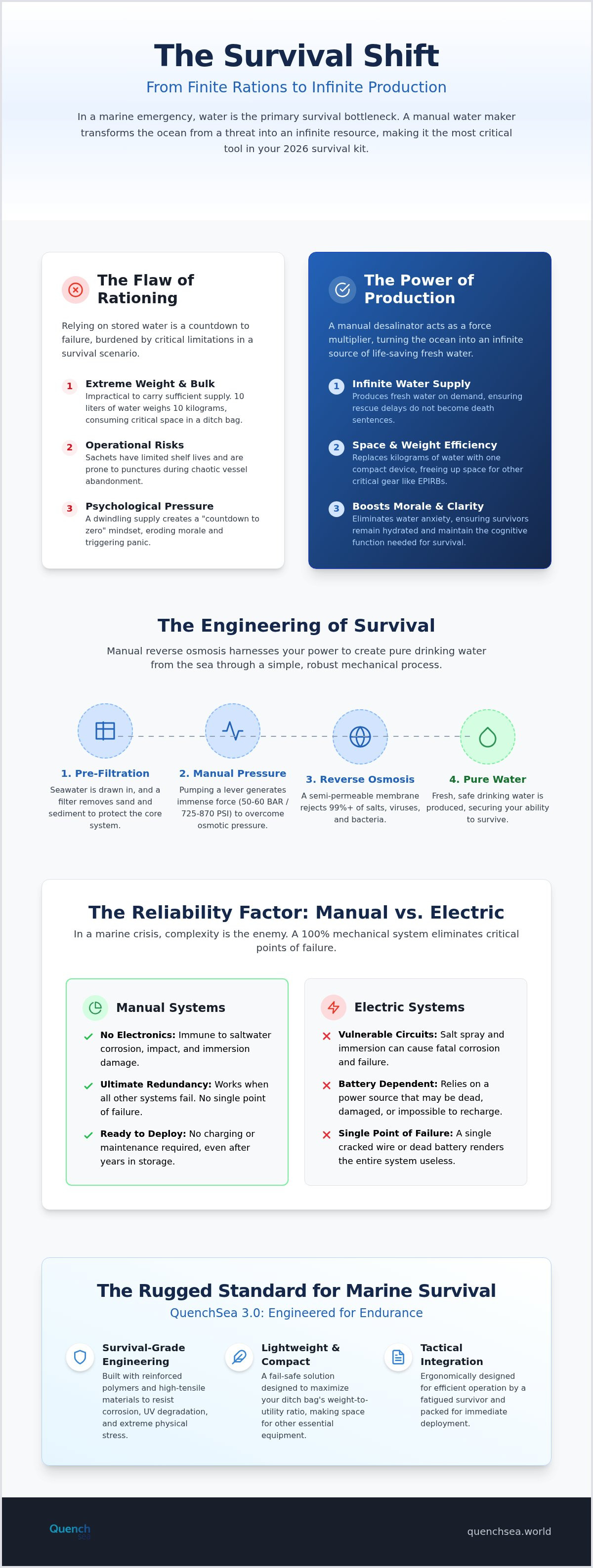
Traditional survival strategies often rely on pre-packaged water sachets. These are inherently flawed for long-term endurance. Carrying enough water for a full crew is physically impossible in a standard grab bag. For context, ten liters of water weighs ten kilograms and consumes massive volume. Space is a premium. Beyond the weight, sachets present operational risks. They have fixed shelf lives and are prone to punctures during the chaos of vessel abandonment. Most importantly, finite rations create psychological pressure. Watching your last sachet dwindle creates a "countdown to zero" mindset that erodes morale and triggers panic. When the crew sees the bottom of the container, group cohesion often fails. A production-based approach eliminates this anxiety.
Desalination as a Force Multiplier
A manual desalinator functions as a force multiplier in extreme environments. Instead of carrying a static, depleting resource, you carry the means of production. This device utilizes a manual reverse osmosis process to strip 99% of salts and contaminants from seawater. It turns the ocean into an infinite reservoir. By replacing bulk water with a compact unit, you drastically improve your bag’s weight-to-utility ratio. This allows you to allocate space for other critical survival tools like EPIRBs or medical kits.
A single ditch bag water maker provides unlimited freshwater for multiple survivors. This shift is a core component of a modern life raft water supply strategy. It ensures that rescue delays, whether days or weeks, do not become death sentences. Mechanical reliability replaces logistical anxiety. You aren't just surviving; you are operating a system designed for endurance. You transition from a victim of the sea to a technician of your own survival.
The Engineering of Manual Desalination: How It Works
Modern manual desalination is a triumph of mechanical engineering over chemical physics. Reverse Osmosis (RO) usually requires massive industrial pumps, but in a survival scenario, your arm becomes the power source. The desalination of saline water through RO involves forcing seawater through a semi-permeable membrane at extreme pressure. This membrane acts as a molecular sieve. It allows H2O molecules to pass through while rejecting 99% of salts, viruses, and bacteria. Survival-grade units utilize reinforced polymers and high-tensile materials to manage these internal stresses. These components resist corrosion and UV degradation better than traditional metals, ensuring the device remains functional after years of exposure to salt air.
Manual Pressure and Osmotic Resistance
Overcoming osmotic pressure is the primary engineering hurdle. For seawater, this requires approximately 50 to 60 bar (725 to 870 PSI) of sustained pressure. A high-quality ditch bag water maker uses mechanical leverage to make this action sustainable. Ergonomics are critical here. The pumping motion must be efficient enough for a dehydrated or fatigued survivor to maintain for extended periods. Pre-filtration serves as the first line of defense in this system. By removing suspended solids and sediment before they reach the primary RO membrane, the device prevents clogging and maintains a consistent flow rate under pressure.
No Power, No Problem: The Reliability Factor
Electronics are fragile in a marine crisis. Salt spray, immersion, and physical impact are constant threats that kill battery-dependent systems. Circuitry corrodes and capacitors fail. A 100% mechanical system eliminates these single points of failure entirely. These units are designed for maintenance-free storage, meaning they're ready to deploy after years of sitting idle in a grab bag. You don't need a charging port or a solar panel; you only need mechanical force. This simplicity is the ultimate redundancy. When every other system on the vessel fails, a mechanical water maker continues to operate. It is a dependable tool built for the harshest reality. To see how this engineering translates into a field-ready tool, explore the QuenchSea 3.0 design. It's built to provide a fail-safe water source when everything else goes wrong.
Manual vs. Electric Water Makers: Choosing for Your Grab Bag
Choosing between manual and electric systems isn't about preference; it's about evaluating risk. Portable electric water makers offer convenience, but they introduce complexity into an environment that demands simplicity. In a marine emergency, every electronic component is a potential failure point. If your battery fails or the charging cable is lost during abandonment, your electric device becomes useless ballast. A manual ditch bag water maker strips away these vulnerabilities. It relies on human effort, which is the only power source you can guarantee in a life raft.
Redundancy in Marine Safety
Comprehensive Safety at Sea preparation emphasizes the need for redundant systems. Even if your vessel is equipped with a high-capacity electric desalination plant, that system is bolted to a hull that might be sinking. You can't take your yacht’s primary RO unit into a life raft. This is where a manual water maker for boat safety becomes indispensable. It serves as your final line of defense. These survival desalination devices provide a tactical advantage because they are designed for the "abandon ship" scenario where power is non-existent and space is restricted.
Comparison Checklist
When evaluating gear for an emergency grab bag, the cost-to-utility ratio must be calculated based on worst-case scenarios. Manual units outperform electric alternatives in three critical areas:
- Weight: Manual units are typically 70% lighter than portable electric RO systems. This allows you to carry more medical supplies or signaling gear without exceeding the bag’s buoyancy limits.
- Power Independence: You have zero dependency on 12V or 24V power systems. You don't need solar panels, which are often ineffective in overcast conditions or heavy seas.
- Mechanical Simplicity: Manual devices use a straightforward pumping action. There are no complex digital interfaces to navigate while in shock or wearing gloves.
Investment in a manual system is an investment in certainty. While electric units are excellent for extending your range during normal cruising, they don't offer the same fail-safe assurance required in a ditch bag. You need a tool that works every time, regardless of the vessel’s electrical status. Reliability is the only metric that matters when the land is out of sight and the power is out.
Integrating a Water Maker into Your Emergency Ditch Kit
A survival kit is only as effective as your ability to deploy it under stress. Integration requires more than just dropping a device into a bag. You must follow a logical framework to ensure your ditch bag water maker is protected, accessible, and operational when the vessel is lost. Survival gear that is buried or broken is useless. Proper staging turns a collection of tools into a functional life-support system.
Execution of this system follows four critical steps. First, select a buoyant, high-visibility waterproof bag with sufficient volume. It must float even when fully loaded with dense mechanical gear. Second, position the water maker at the very top of the bag. You cannot afford to dig through flares and first aid kits while taking on water. Immediate access is mandatory. Third, bundle all critical accessories together. This includes collection bladders, intake hoses, and pre-filters. Use mesh organizers to prevent hose tangles. Fourth, implement routine training. Every crew member should perform a dry run deployment. Operating the pump should be muscle memory, not a puzzle solved during a crisis.
Strategic Packing for Rapid Deployment
Secure the unit against loss. Use a high-strength lanyard to lash the water maker to the bag's interior or the life raft's frame. If the raft capsizes in heavy seas, your production capability must remain attached. This level of preparation is equally vital for coastal emergencies. In these scenarios, bug out bag water desalination becomes the primary hydration strategy when local infrastructure fails. Always pack the unit in a padded section to protect the housing from sharp impacts during a hurried abandonment.
Maintenance and Long-Term Storage
Long-term storage requires mechanical discipline. RO membranes are sensitive biological environments. If you store the unit for more than six months, use a food-grade preservative or pickling solution. This prevents biological growth and keeps the membrane from drying out and cracking. Conduct annual inspections of the pump seals and intake valves to ensure they haven't perished. Check that the intake hose remains supple. Stiff or kinked hoses can crack in cold temperatures, which compromises the vacuum seal required for suction. A vacuum leak is a system failure. Ensure your crew is never without freshwater by adding a survival-grade desalination device to your emergency manifest today.
QuenchSea 3.0: The Rugged Standard for Marine Survival
The QuenchSea 3.0 is a mission-driven engineering solution designed for the uncompromising reality of the open ocean. While legacy brands often focus on high-cost luxury cruising, this device prioritizes survival-grade reliability for emergency scenarios. It functions as a specialized ditch bag water maker that bridges the gap between affordable equipment and elite performance. In 2026, it has become the benchmark for sailors who recognize that hydration is a mechanical problem requiring a mechanical solution. This device isn't just a backup; it's a primary life-support tool for your grab bag.
Designed for the Extreme
Durability is the core of the 3.0 model's architecture. The unit features an impact-resistant housing built to withstand the physical shocks of a vessel abandonment. High-pressure seals and reinforced internal components manage the 50 to 60 bar of pressure required for reverse osmosis without risk of structural failure. Its compact dimensions are specifically optimized for standard marine ditch bags, ensuring it doesn't displace other critical gear. The "no-fail" philosophy is evident in the reduced number of moving parts. By eliminating complex electronic sensors and motorized pumps, the design maximizes field-readiness. It is a tool built to be ignored for years and then relied upon for your life.
Freshwater Production on Demand
Practical utility defines the QuenchSea 3.0 Desalination Device. In real-world conditions, the unit produces 6 to 8 liters of drinking water per hour with a salt rejection rate exceeding 98%. This output is sufficient to sustain multiple survivors, moving beyond the limitations of individual rationing. Setup is streamlined for speed. You can transition from the bag to active production in under two minutes. This rapid deployment capability is essential when managing the initial shock of a maritime crisis.
A ditch bag water maker must be intuitive. The QuenchSea 3.0 uses a straightforward manual lever system that provides maximum mechanical advantage, making the desalination process sustainable for long-term use. It transforms the ocean from a threat into a resource. Don't leave your survival to chance or depleting rations. Equip your vessel with the ultimate survival tool and ensure your crew has access to an infinite supply of freshwater. Secure your QuenchSea 3.0 today and command your environment.
Command Your Survival on the Open Ocean
Survival in a marine crisis is determined by the reliability of your systems. You've seen why transitioning from finite water rations to active desalination is the only way to ensure long-term endurance. A manual ditch bag water maker eliminates the single point of failure inherent in battery-dependent electronics. It provides a lightweight, mechanical solution that works regardless of your vessel's power status. By prioritizing survival-grade engineering, you replace logistical anxiety with a predictable, high-output freshwater supply.
The QuenchSea 3.0 is built for this exact reality. Engineered to meet marine, defense, and disaster relief standards, it offers 100% manual operation with zero dependency on fuel or batteries. It's the ultimate ditch bag essential; compact, durable, and ready for immediate deployment. Don't leave your hydration to chance or a ticking clock.
Secure your survival with the QuenchSea 3.0 Desalination Device. Prepare with confidence and take control of your environment today.
Frequently Asked Questions
How much water can a manual ditch bag water maker produce per hour?
A high-performance ditch bag water maker like the QuenchSea 3.0 produces between 6 and 8 liters of freshwater every hour. This output ensures that multiple survivors can maintain hydration even in high-heat marine environments. Flow rates depend on the user's pumping rhythm and the temperature of the seawater. This capacity significantly exceeds the minimum daily requirement for a full crew, providing a critical safety margin during extended rescue delays.
Does a manual desalinator require a lot of physical strength to operate?
Modern engineering focuses on mechanical advantage to make pumping sustainable for everyone. While overcoming osmotic pressure requires force, the lever systems in survival-grade units are designed for ergonomics. You don't need elite strength to operate the device. The motion is rhythmic and manageable even for survivors experiencing fatigue or mild dehydration. It's built to be a practical tool that remains functional under the most exhausting emergency conditions.
Can I use a ditch bag water maker in freshwater lakes or only the ocean?
These devices are specifically engineered for seawater desalination, but the reverse osmosis process also removes bacteria and viruses from brackish or fresh water. You should exercise caution in freshwater environments containing high sediment or industrial chemicals, as these can foul the membrane quickly. Always use the provided pre-filters to protect the system. While its primary mission is ocean survival, the RO technology provides a versatile backup for various water-scarce scenarios.
How long does the RO membrane last in storage before it needs replacing?
An RO membrane can last for several years in storage if it is kept in a controlled environment and properly preserved. You must ensure the membrane doesn't dry out or develop biological growth. Using a food-grade pickling solution is the standard method for long-term preservation. We recommend inspecting the seals and membrane condition annually as part of your vessel's safety equipment audit. This ensures the unit is mission-ready when you actually need it.
Is the water produced by a manual RO unit safe to drink immediately?
Yes, the freshwater produced is safe for immediate consumption. The reverse osmosis membrane strips away over 98% of salts and eliminates most pathogens, including bacteria and viruses. You'll notice the water is clear and lacks the brackish taste of seawater. Because the process is mechanical and doesn't rely on chemical additives, there's no waiting period for purification. It provides instant hydration the moment it leaves the collection hose.
What maintenance is required for a survival water maker like QuenchSea 3.0?
Maintenance is minimal but vital for reliability. After every use, you should flush the system with freshwater to remove salt crystals that can damage the membrane. For long-term storage in a grab bag, you must use a preservative solution to keep the internal components supple. Regularly check the intake hoses for kinks and ensure the pump handle moves smoothly. These simple steps guarantee your ditch bag water maker performs perfectly during a crisis.
Can a manual water maker remove viruses and bacteria as well as salt?
Reverse osmosis technology is highly effective at removing biological contaminants. The membrane's pores are small enough to block nearly all viruses, bacteria, and parasites along with salt molecules. This creates a dual-layer of protection for survivors. You aren't just getting salt-free water; you're getting water that is biologically safe. This is a significant advantage over simple solar stills, which may not always reach the temperatures required to neutralize certain resilient pathogens.
Is a water maker better than packing emergency water sachets?
A water maker is superior because it provides an infinite resource rather than a finite ration. Water sachets are heavy, take up massive volume, and eventually run out. A single manual device produces thousands of liters over its lifespan while weighing a fraction of a 72-hour water supply. It eliminates the "countdown to zero" anxiety that occurs when rations dwindle. For any serious offshore sailor, production is always a more robust strategy than simple storage.