

An electric watermaker may be the wrong choice if your vessel can’t spare the power. The manual vs electric watermaker decision isn’t simply about convenience. It comes down to whether you need regular onboard production or a way to make freshwater when electrical systems are unavailable.
It’s reasonable to want dependable water without adding electrical load, complicated installation, or another system to maintain. But manual operation takes physical effort, and a portable unit may not meet your crew’s everyday demand. Electric systems can produce water with less hands-on work, but they rely on a functioning power supply and may require plumbing and electrical installation.
This guide compares power needs, output, effort, installation, and maintenance so you can match a watermaker to your vessel, crew, trip length, and storage capacity. You’ll also learn which specifications and operating conditions to check before buying, and where a manual unit such as QuenchSea 3.0 may work as a power-independent backup rather than a universal replacement for an electric system.
Key Takeaways
- Choose a watermaker by its role onboard: routine water supply, emergency backup, or off-grid use.
- The manual vs electric watermaker comparison comes down to power access, hands-on effort, water output, and installation needs.
- Estimate your crew’s water demand and storage capacity before deciding whether a model’s verified output will be enough.
- Check model-specific performance figures, operating instructions, and maintenance requirements before you buy.
- QuenchSea 3.0 is a portable, hand-powered reverse-osmosis option designed to work without electricity, batteries, or fuel. Whether it suits your needs depends on its intended role and verified specifications.
Manual vs. electric watermaker: what changes onboard?
A watermaker desalinates seawater to produce freshwater. Manual and electric models share that purpose, but differ in how they generate the pressure needed for the process and how the operator supplies or manages that power.
Both types can use reverse osmosis (RO). In simple terms, pressure pushes seawater through a membrane that separates much of its dissolved salt. The manual vs electric watermaker choice is less about choosing a different purification principle and more about matching the power source and operating method to life aboard.
What does a manual watermaker do?
A manual watermaker uses human-powered pressure to push seawater through an RO membrane, so it can operate without onboard electricity. Producing water takes physical input from the operator. The effort and output depend on the specific device and its instructions. QuenchSea sells the QuenchSea 3.0, a portable, hand-powered RO desalination device designed to operate without electricity, batteries, or fuel.
How does an electric watermaker work?
An electric watermaker uses powered equipment, commonly including pumps, to pressurize seawater and produce freshwater. Its electrical draw, output, controls, and installation requirements vary by model and system design. Check the manufacturer’s specifications for power consumption and stated output, including the conditions used to measure it. Don’t assume every electric system has the same load or installation demands.
These differences affect everyday use. A vessel with reliable onboard power and regular water needs may prioritize routine production and less hands-on operation. A boat with limited power, or one that needs a backup for electrical outages, may value a manual option’s independence from the vessel’s electrical system. Neither approach is a universal winner. The right fit depends on crew demand, available power, trip plans, and the backup arrangement.
- Routine production: Compare expected demand with the model’s verified output and your storage capacity.
- Power-independent resilience: Consider whether manual operation fits the backup role and expected operating conditions.
- Vessel integration: Confirm each system’s electrical, plumbing, space, and operating requirements before choosing.
Think in terms of roles, not labels. An electric system may support routine production when power is available; a manual unit can add another way to make water when it isn’t. First define how you’ll use the watermaker, then compare specific models against that need.
How power, reverse osmosis, and water demand shape performance
Manual and electric watermakers use pressure to push seawater through a membrane that separates much of its salt. Performance depends on how that pressure is generated, how the system is configured, and the conditions in which it operates. Yachting Monthly’s practical guide to an onboard watermaker offers additional marine-use context.
For the manual vs electric watermaker decision, compare verified model specifications rather than assuming all units share the same output or power needs.
What does power independence mean at sea?
A manual system uses human input instead of an electrical supply to generate pressure. QuenchSea 3.0 is designed to operate without electricity, batteries, or fuel. That removes dependence on onboard power, but not the need for operator input, maintenance, or suitable seawater conditions. An electric system needs a compatible onboard power source, and its electrical demand varies by model. Check the manufacturer’s figures against your vessel’s available capacity.
How should you estimate your freshwater requirement?
Start with the number of people aboard and the trip duration. Estimate drinking needs separately from cooking, washing, and other freshwater uses. Then account for tank capacity and any stored backup drinking water. A short trip with full tanks has a different production requirement from a longer passage with a larger crew. Compare your estimated shortfall with the manufacturer’s verified output, including the conditions under which it was measured.
Use this comparison to identify what you still need to verify:
| Factor | Manual system | Electric system | Verify |
|---|---|---|---|
| Energy source | Operator input | Onboard electrical supply | Power needs and compatibility |
| Operating input | Physical operation | Powered equipment; operation varies | Instructions and operating demands |
| Water production | Model-specific | Model-specific | Output and test conditions |
| Vessel setup | Requirements vary | Electrical and system requirements vary | Installation and space needs |
Output figures are useful only when you understand their test conditions. Confirm whether the stated rate applies to your intended operating environment, then consider how often you can run the system and how much water you can store. If you’re assessing a power-independent option, compare the QuenchSea 3.0 device details with your demand estimate and operating requirements.
Manual vs. electric watermaker: compare the real trade-offs
The practical trade-off is between physical work and reliance on onboard power. Manual operation can become demanding if you need water frequently or for a larger crew. An electric system reduces hands-on pumping, but it can’t produce water without suitable power. Weigh each option against your vessel, crew, and intended use rather than assuming one is always better.
| Factor | Manual watermaker | Electric watermaker | What to verify |
|---|---|---|---|
| Power dependence | Can operate without vessel electricity, depending on the model | Requires a suitable onboard power source | Power requirements, compatibility, and any startup or operating load |
| Operator input | Requires physical operation; effort varies by design | Uses powered equipment; user interaction varies by system | Operating instructions and realistic duty cycle |
| Water output | Model-specific | Model-specific | Output rate and the conditions used to measure it |
| Installation | Requirements depend on the unit and how it will be used | May involve electrical and plumbing integration, depending on the system | Space, connections, installation steps, and maintenance access |
| Best-fit role | Potential backup or use where power is limited | Potential routine production where power is available | Whether the role matches crew demand and trip conditions |
When does an electric watermaker make more sense?
Consider an electric system if regular freshwater production is the priority and your vessel can support its electrical needs. Before deciding, check the unit’s documented power draw, output, installation requirements, and operating guidance. A system that looks suitable on paper still needs to fit your vessel’s available power and planned use. Compare the specific model, not assumptions about electric watermakers as a group.
When can a manual watermaker be the better fit?
A manual unit may suit a vessel or emergency plan where electricity, batteries, or fuel may be unavailable. Power independence doesn’t remove the need for physical operation, maintenance, or appropriate seawater conditions. Confirm that the crew can use it as directed and that its verified output fits the intended role. Manual desalination may be relevant for emergency, life-raft, or off-grid use, but shouldn’t be assumed to cover every vessel’s routine demand.
You may not need to choose only one. An electric system can serve as the primary source for regular production, while a manual unit adds another option if onboard power fails. That arrangement makes sense only if both devices suit the vessel and the crew can store, operate, and maintain them. Treat backup capacity as a specific requirement to verify, not as a substitute for planning water reserves.
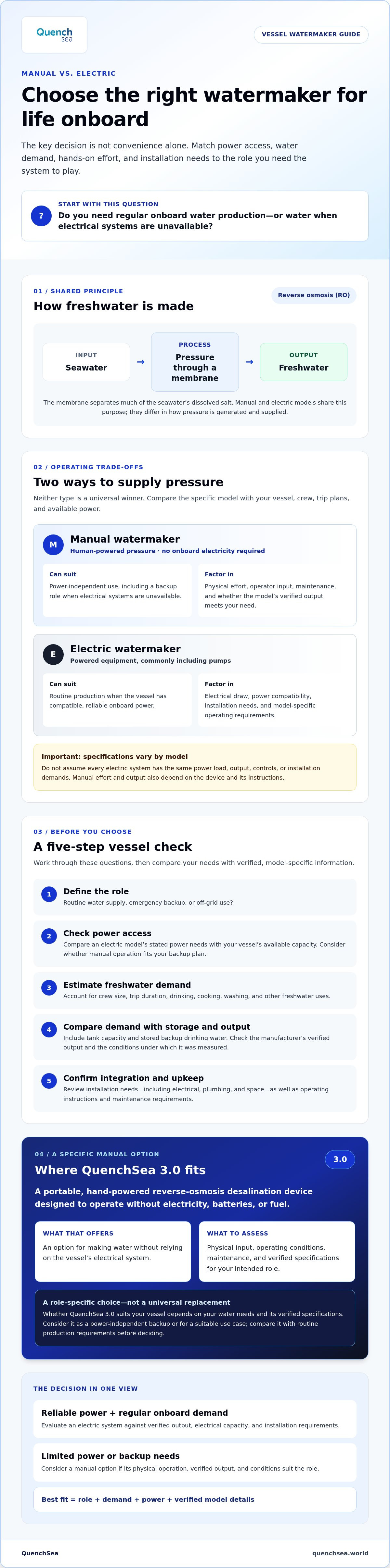
Choose a watermaker with this five-step vessel checklist
Turn the manual vs electric watermaker comparison into a vessel-specific decision. Start with the job the unit must do, then check whether its output, power requirements, and operating demands fit your crew and trip. Keep routine supply, emergency backup, and off-grid use distinct. A system suited to one role may not meet the needs of another.
- 1. Define the role. Decide whether the watermaker will provide routine freshwater, serve as an emergency reserve, or support off-grid use. This sets the performance and reliability requirements to assess.
- 2. Estimate demand. Record crew size, voyage duration, freshwater tank capacity, expected water use, and opportunities to replenish supplies. Work out how much water you need the device to produce, rather than asking only whether it can produce water.
- 3. Check available power. For an electric unit, confirm that your vessel’s electrical setup can support its documented requirements. For a manual unit, consider where power independence matters and whether physical operation suits the intended use.
- 4. Assess operation and upkeep. Review who will operate the system, how it will be used onboard, and what maintenance it requires. For manual equipment, check handling and operating instructions rather than assuming the effort will be manageable.
- 5. Verify specifications. Confirm output rates and the conditions behind them, power needs, installation requirements, operating guidance, and maintenance details with the manufacturer. Where installation involves vessel systems, seek qualified marine advice.
Match the watermaker to the trip and crew
A small crew on a short voyage with ample stored water may have different needs from a larger crew planning an extended trip. Note your expected opportunities to replenish supplies, then decide whether the watermaker is the primary source or a supplement to tank storage. Review the QuenchSea 3.0 buyer’s guide for product-specific evaluation, and compare its verified details with your planned use.
Plan for more than one water source
A watermaker is one part of a water-supply plan, not a reason to ignore stored reserves or backup arrangements. Consider how your crew would manage if production stopped or operating conditions changed. For emergency scenarios, consult the life-raft water-supply guide. To assess a power-independent option for your use case, review the QuenchSea 3.0 desalination device.
Where QuenchSea 3.0 fits in a manual-versus-electric decision
QuenchSea 3.0 is a portable, hand-powered reverse-osmosis desalination device. It uses manual pressure and is designed to operate without electricity, batteries, or fuel. That makes it a power-independent option to assess for marine safety, emergency preparedness, and off-grid use. It isn’t an electric watermaker, and that distinction matters when deciding whether it suits your vessel’s needs.
Think of it as a possible supplement or backup, not an automatic replacement for an electric system. If your crew needs routine water production, compare the device’s current documented output with your demand, trip length, and storage. A manual unit may not meet every vessel’s everyday needs. For more marine context, see this manual boat watermaker guide.
What role could QuenchSea 3.0 serve?
Its independence from vessel power may be relevant if electrical power is unavailable or you’re planning for an emergency or off-grid situation. But suitability depends on more than power access. Consider how much water you need, whether the crew can operate the device as instructed, and whether its verified output supports the specific backup or supplementary role you have in mind.
What should buyers confirm before choosing it?
Check current product documentation before relying on performance claims. Confirm the output information and the conditions under which it was measured, then review operating requirements, maintenance guidance, and any water-quality or safety qualifications. Don’t assume manual operation will be effortless or that a backup device can supply all the water your crew requires. The manual boat watermaker guide can help you consider its marine use alongside your vessel’s needs.
The right manual vs electric watermaker choice depends on the job: routine production, emergency resilience, or off-grid use. Match that role to your crew’s water demand, available power, storage, and the device’s verified specifications. If a portable, hand-powered option fits your plan, explore the QuenchSea 3.0 and review its product details before deciding.
Choose the setup that fits your voyage
The right manual vs electric watermaker depends on the job it needs to do. Electric systems can support routine production when your vessel has suitable power. Manual units offer another option when that power isn’t available, but physical operation and verified output still matter.
Before choosing, match the system to your crew’s water needs, trip length, storage, and backup plan. Then check model-specific output, operating requirements, installation demands, and maintenance guidance. A primary system and a separate backup may fit better than expecting one device to cover every situation.
QuenchSea 3.0 is a portable, hand-powered reverse-osmosis device designed to operate without electricity, batteries, or fuel. It may suit a power-independent backup or a specific off-grid use, but confirm its documented performance against your requirements before relying on it.
Explore the QuenchSea 3.0 and review its details as you build a water plan for your vessel. A clear plan helps your crew make a practical choice.
Frequently Asked Questions
Is a manual watermaker better than an electric watermaker?
Neither type is universally better; the right choice depends on your vessel’s power supply, water demand, and intended use. An electric system may suit routine production if your onboard electrical setup can support it. A manual unit avoids reliance on vessel power but requires physical operation. For the manual vs electric watermaker decision, compare specific models’ verified output, operating requirements, installation needs, and maintenance guidance.
Can a manual watermaker produce enough water for a boat?
It depends on the model and the boat’s freshwater needs. Estimate demand based on crew size, trip duration, drinking water, other uses, and available tank storage. Then compare the shortfall with the manufacturer’s verified output and the conditions behind that figure. Don’t assume a manual unit can meet every vessel’s routine demand. Depending on its specifications, it may be more appropriate as a supplementary source or backup.
How does a manual watermaker work without electricity?
A manual watermaker uses human input to create pressure, pushing seawater through a reverse-osmosis membrane that separates much of its salt. It doesn’t need an electrical supply to generate that pressure, but it does require operator effort. QuenchSea 3.0 is a portable, hand-powered reverse-osmosis device designed to operate without electricity, batteries, or fuel. Check the product’s instructions for operating steps and use requirements.
Do electric watermakers use a lot of power?
Power use varies by model, system design, and operating conditions, so there’s no single figure that applies to every electric watermaker. Check the manufacturer’s stated electrical demand and compare it with your vessel’s available power. Also consider the system’s output and how often you expect to run it. Confirm compatibility with your electrical setup before buying, and seek qualified marine advice if installation requires vessel modifications.
Can a manual watermaker be used as an emergency backup?
A manual watermaker can be considered for emergency backup if its verified output, instructions, and intended use match your plan. Its ability to operate without vessel power can provide an alternative if electricity is unavailable, but it still requires physical operation and suitable conditions. QuenchSea 3.0 is intended for marine safety, emergency, and off-grid applications. Review current product documentation before relying on it for your crew’s water needs.
Is a manual watermaker difficult to operate?
Manual operation requires physical effort, but the amount varies by device and operating conditions. Review the manufacturer’s instructions and assess whether the people who may need to use it can operate it as directed. Consider the operating procedure as part of your vessel’s preparedness plan. Don’t assume a manual unit will feel effortless or that its output will suit your needs without checking model-specific details.
What should I check before buying a watermaker for a boat?
Start by defining whether you need routine production, emergency backup, or an off-grid option. Estimate crew demand, trip length, freshwater storage, and replenishment opportunities. Then verify the model’s output and test conditions, power requirements, installation needs, operating instructions, and maintenance guidance. For an electric system, confirm onboard electrical compatibility. For a manual unit, assess operator effort and handling. This makes the manual vs electric watermaker decision specific to your vessel.