

What if your watermaker still works when the batteries are dead? A seaworthy manual reverse osmosis system can provide a non-electric backup, but a compact size alone doesn’t show whether it’s practical aboard your vessel. Consider how you’ll store and operate it, how much effort pumping requires, and whether its documented output fits your crew and trip.
It’s reasonable to ask whether hand-powered desalination can produce enough water for your needs, or whether an electric system is a better fit. The answer depends on your vessel, onboard power, water demand, and the equipment’s intended role. QuenchSea 3.0 uses hand power to desalinate seawater without electricity, batteries, or fuel.
This guide explains how to assess marine fit, compare manual and powered watermakers, and account for operating demands and equipment limits. You’ll also learn how to include a manual device in a backup plan for your vessel, crew, and route, and why practicing before you depend on it matters.
Key Takeaways
- Define the device’s role first: an emergency backup and a primary water source have different demands.
- Understand the basic reverse osmosis process, including how seawater becomes freshwater and where manual effort comes in.
- Compare manual and powered systems by power dependence, operating input, and intended role. Check the specifications against your needs.
- Use a readiness checklist to assess crew requirements, access, storage, instructions, and practice before relying on a seaworthy manual reverse osmosis system.
- Consider whether QuenchSea 3.0’s hand-powered, electricity-free operation fits your vessel’s backup plan and intended marine use.
What makes a manual reverse osmosis system seaworthy?
A seaworthy manual reverse osmosis system is one that suits its intended role aboard a vessel, not equipment that’s universally indestructible. In practice, marine fit means the unit can be stored, accessed, operated, and cared for in the conditions you expect at sea.
Start by defining the job. A device intended to supply routine freshwater faces different demands from one carried as an emergency reserve. Then consider salt exposure, vessel movement, available workspace, and the crew’s ability to operate it. A compact unit may be easier to stow, but size alone doesn’t establish marine readiness.
Which marine conditions should a buyer consider?
Think about where and how you’ll use the system, not just how portable it is. A locker near a wet deck may be exposed to moisture and salt spray. A device used in a small cockpit or life raft may have little room for setup, and movement on a vessel can make it harder to maintain a stable working position.
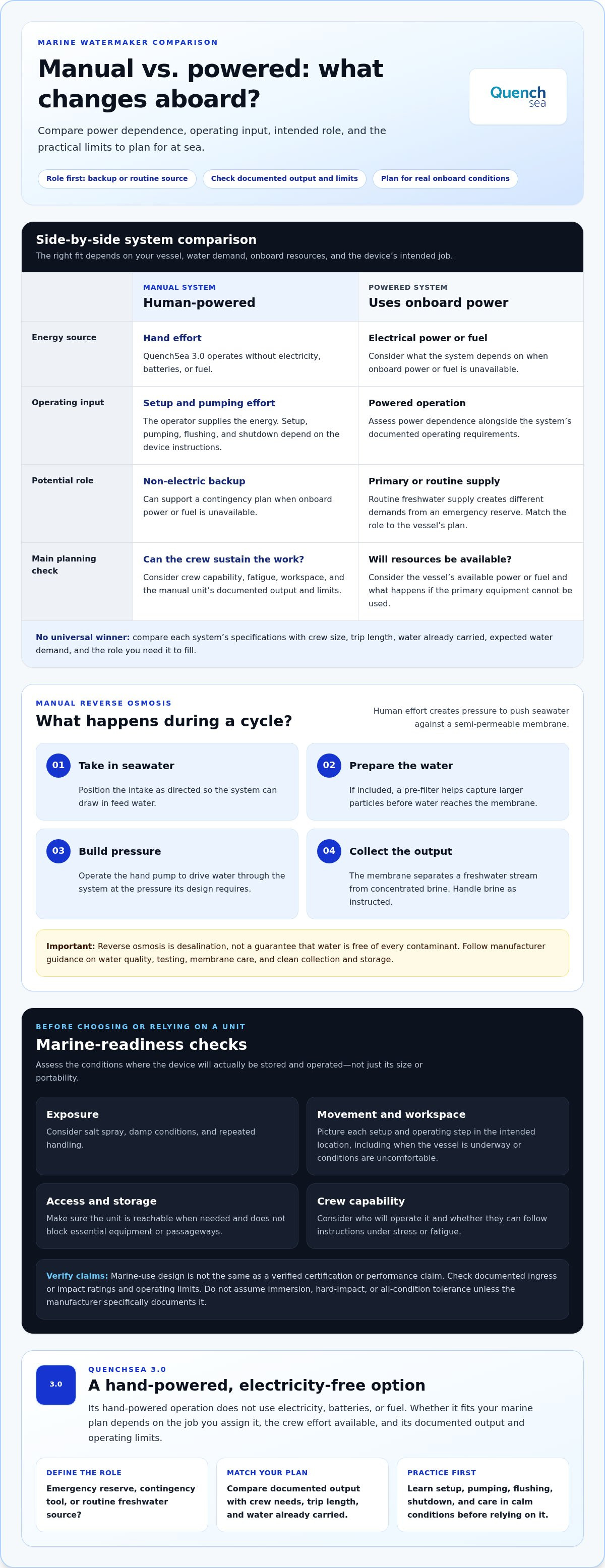
Before choosing, map the practical constraints:
- Exposure: Consider how the device and its components may encounter salt spray, damp conditions, and repeated handling.
- Movement and workspace: Picture each setup and operating step in the location where you intend to use the unit, including when the vessel is underway or conditions are uncomfortable.
- Access and storage: Make sure the unit can be reached when needed and stored without blocking essential equipment or passageways.
- Crew capability: Consider who will operate it and whether they can follow the instructions under stress or fatigue.
Marine-use design is not the same as a verified certification or performance claim. Treat claims about seaworthiness as a starting point, then distinguish them from documented ingress or impact ratings and any operating limits in the product documentation. Don’t assume a device can tolerate immersion, hard impacts, or every marine condition unless the manufacturer specifically documents that capability.
What job should a manual watermaker perform?
Decide whether you need an emergency reserve, a contingency tool for when onboard power or fuel is unavailable, or a routine freshwater source. Manual operation can support a non-electric backup plan, but it also takes crew effort. The right fit depends on the water already carried, crew size, trip length, and how much responsibility you expect the device to take on.
For example, a coastal day trip with stored drinking water presents a different backup need from a longer passage with several people aboard. Estimate the crew’s water needs and plan for the loss of your primary supply or powered equipment. Then compare that plan with the manual device’s documented output, operating requirements, and limits. Don’t assume an emergency tool can replace the vessel’s broader water plan.
Reverse osmosis uses pressure to move water through a membrane while separating much of its dissolved salt; Reverse Osmosis Explained offers a general overview of the process. For more product-selection context, the QuenchSea 3.0 buyer’s guide covers the portable hand-powered option and its intended uses.
How does manual seawater reverse osmosis work in real use?
A manual reverse osmosis system turns human effort into pressure. That pressure pushes seawater against a semi-permeable membrane, which lets water molecules pass through while holding back much of the dissolved salt. The freshwater is collected separately from the more concentrated water left behind. The Climate Technology Centre & Network outlines seawater desalination methods, including reverse osmosis, in its overview of ways to produce freshwater.
In broad terms, a cycle moves through four stages:
- Take in seawater: Position the intake as directed so the system can draw in feed water.
- Prepare the water: If the system includes a pre-filter, it helps capture larger particles before water reaches the membrane.
- Build pressure: Operate the hand pump to drive water through the system at the pressure its design requires.
- Collect the output: The membrane separates a freshwater stream from concentrated brine. Handle the brine as the product instructions specify.
What happens during a manual RO cycle?
The operator supplies the energy. Each pump stroke helps move seawater through the system. Hand-powered operation avoids dependence on electricity, batteries, or fuel, but it still takes effort and has limits. Setup, pumping, flushing, and shutdown steps vary by device. Follow the product instructions closely, including guidance on intake placement and membrane care. Practice in calm conditions before relying on the process in an emergency.
Reverse osmosis is desalination, not a universal guarantee that water is free of every contaminant. The membrane is designed to separate salt and other substances according to the system’s performance and limits. Water quality can depend on the device, source water, and correct operation. Don’t infer potability from appearance or taste alone; follow the manufacturer’s water-quality guidance and any testing instructions. Clean collection and storage matter after water leaves the unit, too.
How should buyers interpret freshwater production?
Read output figures as specifications tied to stated operating conditions, not as a promise of identical production in every situation. Seawater conditions, setup, and the operator’s pace can affect how much water is collected. Compare documented output and operating requirements with the amount your crew may need during the contingency you’re planning for. Then decide how the device fits alongside stored water and other supplies.
Make that calculation practical. Consider who will pump, how often the system may need to run, and whether the crew can keep using it if conditions become tiring or uncomfortable. Don’t build a backup plan around a best-case figure alone. The manual reverse osmosis engineering guide explains the process in greater technical detail.
For a non-electric backup option, explore how the QuenchSea 3.0 hand-powered desalination device fits your vessel’s broader water plan. A seaworthy manual reverse osmosis system is a useful part of that plan when its documented limits, operating demands, and intended role align.
Manual or powered marine watermaker: which fits your vessel?
The central trade-off is straightforward: a manual watermaker exchanges powered convenience for independence from onboard electricity. That independence can matter if a vessel loses power or fuel, but pumping takes crew effort. A powered system reduces hands-on operation, yet depends on its energy source and installation. The right choice depends on water demand, power access, and the system’s intended backup role.
| Factor | Manual watermaker | Powered watermaker |
|---|---|---|
| Power dependence | Operates through hand-powered pumping, without electricity, batteries, or fuel. | Requires an appropriate onboard power source to operate. |
| Operating input | Requires a crew member to set up and pump according to the product instructions. | Uses powered operation, reducing the need for continuous hand pumping. |
| Likely role | Can serve as an emergency reserve, contingency option, or off-grid tool. | May suit routine water production where the vessel’s system and energy supply support it. |
| Planning considerations | Account for operator availability, effort, documented output, and storage. | Account for energy access, installation, documented output, and system requirements. |
This is a comparison of roles, not a promise that one type will always produce more water or require less maintenance. Those details vary by model. Compare current documentation for output and the conditions behind it, energy requirements, operating limits, maintenance instructions, and installation needs. Don’t choose based on a headline production figure alone.
When does a manual system make practical sense?
A manual unit can add a separate layer to an emergency plan, including life-raft readiness or off-grid use, where vessel power may be limited or unavailable. It can also provide a contingency aboard a yacht whose primary water equipment depends on electricity or fuel. Consider who can operate the device, where it will be stored, and how the crew will reach it if normal systems are disrupted.
Manual desalination doesn’t remove the need to carry adequate water for a planned passage. Treat it as part of a broader plan, not an assumed substitute for the supply you expect to need. For a seaworthy manual reverse osmosis system to be useful as backup, its published output and operating requirements must match a realistic contingency, not just an ideal scenario.
When is a powered watermaker the better primary option?
If your routine water demand is high, a powered system may be a better fit, provided its documented production capacity matches your needs. Its convenience comes with dependence on the vessel’s electrical supply and the system’s operating requirements. Include that dependency in plans for power loss, fuel access, or equipment problems. A manual unit can complement a powered primary system by providing a non-electric contingency rather than replacing it.
Compare the trade-offs against your vessel’s water plan, crew, and typical use. The manual boat water makers overview provides additional context for assessing non-electric options alongside other onboard watermaking approaches.
Use this marine-readiness checklist before choosing a manual RO system
A useful checklist turns broad claims into questions specific to your vessel. Before choosing a seaworthy manual reverse osmosis system, compare its current product documentation with your boat’s layout, the crew who may need it, and the emergency plan it must support. A device that looks compact on paper still needs to be reachable, understandable, and practical to use in its intended location.
- Define its role: Decide whether it’s an emergency reserve, a contingency option, or part of routine freshwater planning.
- Match it to the crew: Identify who will operate it and whether another crew member can take over if needed.
- Check access: Choose a location where the intended user can reach and set up the device for the scenario you’re planning for.
- Plan storage: Find a secure spot that follows the product’s storage instructions and won’t obstruct access to other safety equipment.
- Read the operating instructions: Understand setup, intake, operation, shutdown, and any device-specific limits.
- Review care requirements: Follow the documented cleaning, flushing, inspection, and maintenance steps. Don’t assume salt exposure is harmless or that generic marine-equipment care applies.
- Practice the procedure: Have each intended operator learn the sequence before the device becomes part of an emergency plan.
Check vessel fit, access, and storage
Test the proposed location against how people actually move around the vessel. Can the operator open the locker, retrieve the unit, and work through setup without blocking a passage or interfering with other gear? Consider the conditions in which you expect to use it, and follow the manufacturer’s storage and care guidance. A “marine use” label doesn’t replace specific handling or maintenance instructions.
Then run a simple scenario test: can the intended user access, set up, and operate the system as instructed? Use the product documentation rather than memory or assumptions. If setup requires a clear work surface, a particular intake position, or steps that aren’t practical where the unit is stored, adjust the plan before relying on it.
Build the device into a water contingency plan
Include the watermaker alongside, not instead of, stored drinking water, rationing procedures, and other safety equipment. Decide who operates it, who can take over, and where the instructions will be kept. Make sure the crew understands its place in the wider response, including when to conserve stored water and when to use the manual system. The life raft water supply guide offers broader context for planning around limited water in an emergency.
Preparedness comes from matching the device to a defined job, then practicing that job. Explore the QuenchSea 3.0 hand-powered desalination device as a non-electric option for a marine backup plan.
Is QuenchSea 3.0 the right manual seawater RO system for your needs?
QuenchSea 3.0 is a portable, hand-powered reverse osmosis desalination device designed to convert seawater into safe drinking water without electricity, batteries, or fuel. It’s designed for marine safety, yachts, life rafts, emergency preparedness, and off-grid coastal use. Its key advantage is independence from a vessel’s power supply. Its key planning consideration is that a crew member must operate it by hand.
Fit depends on the job you need it to do. If you want a contingency for power loss or an emergency reserve, a manual unit can complement stored water and other onboard supplies. If you expect it to meet routine water demand, assess the crew’s needs and the device’s documented production and operating limits first. Don’t assume a portable device suits every vessel or emergency scenario.
Where QuenchSea 3.0 fits in a marine water plan
On a yacht, the device can serve as a backup alongside the vessel’s broader freshwater plan. For a life raft or emergency kit, portability and operation without external power may be relevant, but the intended storage location and the user’s ability to operate it still matter. In off-grid coastal settings, its hand-powered design avoids dependence on electricity, batteries, or fuel when those resources aren’t available.
Think of it as a tool with a defined role, not an automatic replacement for carried water or a powered watermaker. Before deciding, compare the current product specifications with the conditions you expect, including how many people the system must support and how long the contingency may last. Check that the stated output and operating procedure align with your plan.
What to review before putting it aboard
Read the current operating instructions before relying on the device. Review its care and maintenance guidance, water-quality information, storage requirements, and stated limitations. Then consider whether the person expected to use it can reach the unit, follow the setup steps, and sustain the required manual operation in the planned scenario. Practice ahead of time so the process is familiar before conditions become difficult.
- Define the role: Decide whether it’s for emergency use, backup desalination, or another specific need.
- Check crew fit: Match documented output and operating demands to crew size and expected use.
- Plan placement: Store it where intended users can access it and follow product storage instructions.
- Learn the limits: Use the current documentation for operation, care, and water-quality guidance.
A seaworthy manual reverse osmosis system earns its place when its intended role, practical demands, and documented limits fit the vessel’s plan. Explore the QuenchSea 3.0 manual desalination device as a portable, hand-powered option for marine and emergency preparedness.
Turn your water plan into a practiced routine
A backup matters most when the crew knows when and how to use it. Before your next departure, choose a realistic water contingency, assign responsibilities, and walk through the procedure where you expect to operate the device. Keep the instructions accessible and make sure the plan still works if the usual power source is unavailable.
Revisit the plan when your crew, vessel, or trip changes. A seaworthy manual reverse osmosis system should have a clear role in your water strategy, with its operating limits understood before conditions become difficult. Preparedness isn’t just equipment aboard. It’s equipment the crew can use with confidence.
For a portable hand-powered option designed for marine safety, yachts, life rafts, and off-grid use, explore the QuenchSea 3.0 manual desalination device. Build the plan, practice the steps, and head out better prepared.
Frequently Asked Questions
Is a manual reverse osmosis system suitable for a yacht?
Yes, a manual system can suit a yacht as an independent backup if its documented limits match the vessel’s needs. Consider whether the crew can use it if the electrical system is unavailable and whether there’s a workable place to set it up. A seaworthy manual reverse osmosis system should complement the yacht’s water plan, not automatically take over routine production.
Can a manual RO system make seawater safe to drink?
A manual RO system can desalinate seawater, but don’t assume desalination alone proves the water is safe in every situation. Reverse osmosis reduces salt and dissolved solids, while actual water quality depends on the device, source water, and correct operation. Follow the product’s current water-quality guidance, including any testing instructions, and use clean containers for collection and storage. Don’t judge safety by appearance or taste alone.
How much water can a hand-powered desalination system produce?
Production depends on the specific device and its operating conditions, so use the manufacturer’s current published output rather than a general estimate. Compare that figure with the number of people who may depend on the system and the length of the contingency. Plan separately for a short delay and an extended interruption, and account for other water supplies instead of treating a watermaker’s maximum rate as guaranteed.
Does a manual seawater RO system need electricity or fuel?
A hand-powered model such as QuenchSea 3.0 doesn’t require electricity, batteries, or fuel to operate; the user supplies the effort by hand. That can be useful if a yacht’s electrical system is down or fuel access is limited. Manual operation still requires setup and sustained use according to the instructions. Check the specific model’s requirements, and don’t confuse independence from onboard power with effort-free operation.
Can a manual desalination device replace a yacht's main watermaker?
Usually, it’s more practical to treat a portable manual device as a backup than to assume it can replace the yacht’s main watermaker. The right choice depends on the manual unit’s documented output, crew demand, and how long it may need to support them. Keep planned water supplies and other contingencies in the plan. If considering it as a primary source, compare its specifications with the vessel’s full routine demand.
What should I check before storing a desalination device aboard?
Read the storage and care instructions for the exact model before choosing a locker. Make sure the location is secure, accessible to the intended operator, and suitable for the product’s stated storage conditions. Keep the operating instructions where the crew can find them, and note any required inspection or maintenance steps. Don’t assume salt exposure, moisture, or long periods in storage won’t affect the device.
Is a manual watermaker useful in a life raft?
It may be useful as part of a life-raft water contingency if the specific device’s size, storage conditions, and operating procedure fit the raft’s equipment plan. Consider whether a user can retrieve and operate it in the available space, and how the crew will collect and store the water. Review the instructions before packing it, and keep it alongside, not instead of, other planned emergency water supplies.