

What happens when the circuit breaker trips and the batteries stay dark 800 miles from the nearest coast? For most blue-water cruisers, this isn't a hypothetical question. It's a persistent fear. You understand that relying solely on power-hungry systems for your survival creates a critical vulnerability. Integrating a manual water maker for boat safety provides the ultimate tactical redundancy. Electrical failure is a reality of offshore passage making. It shouldn't be the reason you run out of drinking water.
You know that traditional emergency gear is often too bulky or too expensive for the average cruiser. However, you also know that having a non-electric backup is the only way to guarantee water security during a total power loss. This article will help you master the essentials of manual desalination so you can maintain a fail-safe freshwater supply without fuel or batteries. You'll gain the confidence to handle long-distance crossings with a compact, lightweight solution that won't clutter your bilge or drain your refit budget.
We'll analyze the 2026 landscape of survival-grade hardware. We will compare the efficiency of modern reverse osmosis devices like the QuenchSea 3.0 against legacy standards. Finally, we'll show you how to integrate these mechanical tools into your vessel's safety protocol to ensure peace of mind regardless of your electrical status.
Key Takeaways
- Eliminate the risk of total freshwater loss by identifying the critical failure points of complex electrical desalination systems.
- Master the mechanics of reverse osmosis to operate a manual water maker for boat safety during power-critical offshore scenarios.
- Evaluate flow rates and material durability to select a desalinator capable of withstanding extreme marine conditions and long-term storage.
- Secure energy independence with survival-grade hardware that produces life-sustaining water without relying on batteries or fuel.
- Explore the engineering behind the QuenchSea 3.0, a lightweight and accessible solution for reliable freshwater production at sea.
Why Every Vessel Needs a Manual Water Maker
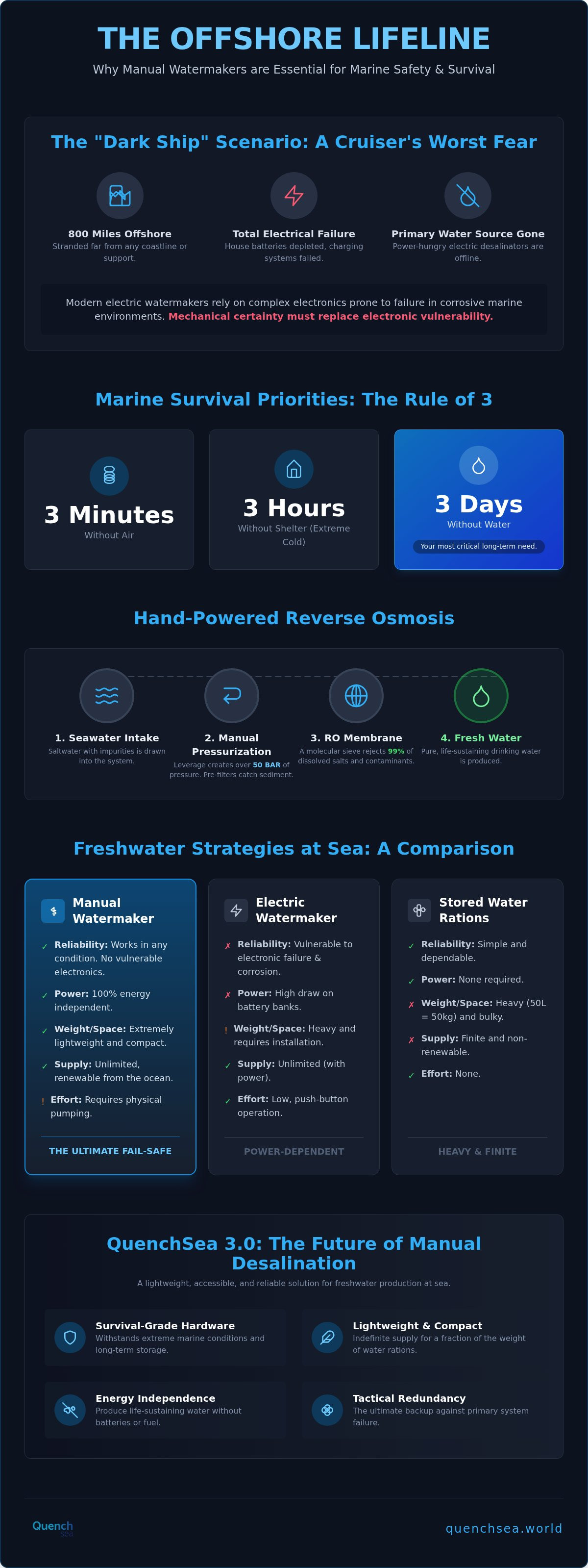
Electricity and saltwater are natural enemies. Most modern cruising yachts rely on complex electric water makers that depend on solenoids, circuit boards, and sensitive sensors. These components are prone to failure in the corrosive marine environment. When a circuit board fries or a solenoid jams, your primary water source vanishes. Integrating a manual water maker for boat safety isn't just a backup plan. It's the only system that functions when your house batteries are depleted or your electrical cabinet is flooded. Mechanical certainty replaces electronic vulnerability.
Energy independence is the ultimate goal for offshore sailors. High-draw appliances like autopilots and refrigeration often drain battery banks faster than solar or wind can replenish them. If your charging system fails, water production is usually the first luxury to be cut. A hand-powered device bypasses this risk entirely. You trade physical effort for hydration. This provides a massive psychological edge. Knowing you can create fresh water in any condition reduces the stress of a "dark ship" scenario. You aren't just waiting for rescue; you're actively sustaining your crew.
The logistics of emergency storage are equally compelling. Carrying 50 liters of emergency water adds 50kg of dead weight to your vessel. This takes up valuable locker space and affects performance. A compact manual device, such as the QuenchSea 3.0, offers an indefinite supply for a fraction of that weight. It converts the surrounding ocean into a resource rather than a threat. You stop managing a finite ration and start managing a renewable supply.
Beyond the Life Raft: Tactical Yacht Redundancy
Don't relegate your manual unit to a dusty life raft locker. It belongs in your primary safety rotation. Integrate it into your ditch-kit for rapid deployment during a hull breach or fire. Some energy-conscious sailors use their manual units for small-batch drinking water to conserve battery power for critical navigation tools. This proactive approach keeps the equipment tested and the crew trained. Review our offshore water maker checklist to see how to stage your gear for maximum efficiency.
The "Rule of 3" in Marine Survival
Survival priorities at sea are brutal and clear. You can survive three minutes without air, three hours without shelter in extreme cold, and three days without water. In the context of ocean hydration, the Rule of 3 dictates that water becomes your most immediate biological requirement once you've secured physical safety from the elements. A manual desalinator utilizes the reverse osmosis process to extend your survival timeline from a few days to several weeks. It turns a desperate situation into a manageable passage.
The Engineering of Hand-Powered Reverse Osmosis
The engineering behind a manual water maker for boat use relies on overcoming osmotic pressure through pure mechanical force. In nature, water flows from low salt concentrations to high ones. Reverse Osmosis (RO) flips this process. By applying over 50 bar of pressure, you force seawater through a microscopic barrier. This barrier, a semi-permeable membrane, acts as a molecular sieve. It rejects 99% of dissolved salts while allowing pure H2O molecules to pass through. Desalination has become a growing source of drinking water globally, but at sea, the challenge is generating that massive pressure without a motor.
Mechanical leverage is the core of the design. Long handles or lever systems translate human motion into the high-pressure environment required for desalination. Without this mechanical advantage, the physical toll would be unsustainable. However, the membrane is fragile. Pre-filtration systems are vital. They catch plankton, silt, and sediment before they reach the RO membrane. If these particles bypass the pre-filter, they clog the microscopic pores and render the device useless. High-quality survival gear prioritizes this multi-stage protection to ensure the longevity of the internal hardware.
The process is a balance of physics and material science. Every stroke of the pump must maintain consistent pressure to keep the water flowing through the membrane. If the pressure drops, the salt rejection rate decreases. This is why the structural integrity of the pump body is critical. It must withstand hundreds of pounds of force over thousands of cycles without flexing or leaking. When selecting gear, look for hardware that emphasizes mechanical simplicity over complex, failure-prone parts.
TDS and Water Quality: What is Safe to Drink?
Safe drinking water is measured by Total Dissolved Solids (TDS). The World Health Organization generally recommends a threshold below 500ppm for palatability. A functional manual water maker for boat survival must consistently hit these targets. Beyond salt, the RO membrane provides a biological barrier. It effectively removes bacteria, viruses, and even microplastics. Maintaining the membrane through regular rinsing ensures the device continues to meet these critical safety standards during a passage.
Ergonomics: The Reality of Manual Pumping
Producing one liter of water requires consistent physical input. The ergonomics of the pump determine how long a person can operate the device before fatigue sets in. Lever-action pumps typically offer better mechanical advantage than straight piston styles. They allow the operator to use larger muscle groups, such as the back and legs, rather than relying solely on arm strength. Modern designs focus on smooth, rhythmic strokes to maximize output per calorie burned. You can explore how advanced handle design improves these survival outcomes in extreme environments.
Manual vs. Electric vs. Rations: A Comparison
Choosing a hydration strategy for a 30-40ft yacht involves balancing risk, weight, and operational complexity. While high-output electric systems offer convenience, they introduce multiple failure points that can leave a crew stranded. A manual water maker for boat operations serves as the ultimate fail-safe. It replaces fragile electronics with rugged mechanical components. This shift from complexity to simplicity is vital when you're days away from the nearest port. If the power dies, your ability to produce water shouldn't die with it.
Electric systems require significant maintenance. They need complex pickling procedures to prevent biological growth in the membranes during periods of non-use. If your power fails, you often can't even run the necessary cleaning cycles to save the membrane. Manual devices are far more forgiving. They require basic rinsing and straightforward storage. This mechanical simplicity translates directly to reliability during a blue-water crossing. The investment in a manual unit provides survival value that outweighs the cost of replacing high-end electronic sensors or burnt-out pumps.
Space efficiency is a critical factor for smaller vessels. Storing enough water for a transoceanic passage is often impossible on a 30ft boat. A compact manual device takes up less room than a few spare jerry cans while providing an unlimited supply. It allows you to maintain a light, fast vessel without sacrificing safety. You stop being a freighter and start being a self-sufficient cruiser.
The Failure Points of Electric Systems
Salt air is a relentless conductor. It penetrates marine electronics, causing rapid corrosion in circuit boards and wiring harnesses. Even expensive electric desalinators can be rendered useless by a single blown fuse or a corroded solenoid. This is why experienced sailors consider manual backups the gold standard for blue-water cruising. They ensure that even in a total electrical blackout, you can still produce potable water. For a deeper look at your options, consult our manual seawater desalination guide.
Desalination vs. Stored Water Rations
Relying on stored rations presents a dangerous shelf-life problem. Plastic containers can degrade over time, leaching chemicals into your supply or developing leaks that go unnoticed until the water is needed. The weight penalty is also severe. Carrying 100 litres of water adds 100kg to your displacement. In contrast, using the reverse osmosis (RO) process allows you to produce water on demand. Production is a sustainable strategy. Storage is a finite gamble. Converting the ocean into a resource is always more efficient than carrying it with you.
Choosing the Best Portable Desalinator for Your Boat
Selecting survival hardware requires a ruthless focus on utility. Lab-tested specifications rarely survive the reality of a storm-tossed cabin. When evaluating a manual water maker for boat security, you must prioritize the ratio of physical effort to water output. If a device requires four hours of intense labor to produce a single day's ration, it isn't a tool; it's a liability. You need a system that delivers enough volume to sustain your entire crew without inducing total physical exhaustion.
Build quality is the next non-negotiable factor. While stainless steel suggests strength, it adds significant weight to your ditch-bag. High-impact, marine-grade plastics and polycarbonates offer a superior balance of durability and portability. These materials resist the relentless UV exposure and salt corrosion that degrade standard equipment. Ensure the unit features an impact-resistant outer casing. A cracked housing in the middle of a passage is a catastrophic failure that basic tools cannot fix.
Ease of repair determines whether your backup remains functional after months of storage. You should be able to access the pre-filters and membranes using nothing more than a standard multi-tool. Look for designs with modular components and accessible seals. A manual water maker for boat use is only as reliable as your ability to maintain it on a swaying deck in low-light conditions. Portability is equally vital. If the device doesn't fit into a standard ditch-bag, it won't be there when you need to abandon ship.
Assessing Flow Rate and Capacity
A standard crew requirement is 2 to 3 litres of potable water per person per day. Maximum output ratings often reflect ideal conditions with warm, clean water. In reality, rough seas and suspended sediment can lower these figures significantly. Cold seawater increases the density and viscosity of the water, requiring higher pressure and reducing the overall flow rate through the RO membrane. Always choose a device with a rated capacity that exceeds your baseline needs to account for these environmental variables.
Durability in Harsh Saltwater Environments
Marine environments destroy inferior hardware. Your desalinator must utilize UV-stabilized materials and corrosion-resistant pump mechanisms. The seals are the most common point of failure. High-quality units use reinforced gaskets designed for thousands of high-pressure cycles. Before committing to a passage, verify the longevity of the pump mechanism and the availability of replacement seal kits. You can order the QuenchSea 3.0 to secure a survival-grade solution engineered for these exact conditions.
QuenchSea 3.0: The Future of Manual Desalination
The QuenchSea 3.0 represents a calculated evolution in offshore survival hardware. It bridges the gap between prohibitively expensive legacy systems and unreliable, low-output filters. This manual water maker for boat safety delivers high-performance reverse osmosis through a streamlined, utilitarian design. It isn't a luxury accessory. It's a survival-grade tool engineered for the harshest marine environments. By focusing on mechanical efficiency and material integrity, the QuenchSea 3.0 provides a dependable freshwater source that functions independently of your vessel's power grid.
Performance data confirms its utility. The device produces between 6 and 8 liters of drinking water per hour. This volume is sufficient to sustain a full crew during an emergency passage. Despite this high output, the unit remains portable, weighing just 6 kg. This weight-to-production ratio is a significant engineering achievement. It allows sailors to maintain energy independence without sacrificing storage space or performance. The mission is clear: provide a fail-safe solution that empowers travelers to overcome water scarcity in any environment.
The hardware utilizes an advanced energy recovery system to maximize human effort. Every stroke of the handle is optimized to maintain the high pressure required for salt rejection. This focus on mechanical leverage ensures that the device remains operable even during periods of physical fatigue. It's a hardware-focused reality that prioritizes results over decorative features. For the modern sailor or prepper, it provides the quiet authority of being prepared for a total electrical failure.
Why QuenchSea 3.0 Beats Legacy Units
Legacy desalinators from the 1990s were often heavy, bulky, and mechanically complex. Many produced less than one liter of water per hour, requiring hours of labor for a single person's daily ration. The QuenchSea 3.0 utilizes modern membrane technology that offers superior salt rejection and increased durability. It's smaller and lighter than its predecessors, making it easier to store and deploy. The simplified interface ensures that even non-technical users can operate the system effectively under the high-stress conditions of a blue-water crossing.
Integration and Deployment
Speed is critical during a maritime emergency. You can set up the QuenchSea 3.0 in under 60 seconds. The process is linear and sequential. Connect the intake and outfall tubes, secure the device, and begin pumping. Maintenance is equally straightforward. A simple freshwater rinse after use prevents salt crystallization and protects the RO membrane for long-term storage. Regular inspection of the pre-filters ensures the system is always ready for immediate deployment. Equip your vessel with the QuenchSea 3.0 today to ensure your crew has a fail-safe freshwater supply.
Ensure Freshwater Security on Every Passage
True offshore preparedness requires eliminating single points of failure. Electrical systems remain vulnerable to the relentless marine environment. A manual water maker for boat safety provides the definitive backup when your batteries fail or your primary desalinator breaks down. By utilizing advanced reverse osmosis technology, you can remove 99% of salts and contaminants with nothing more than mechanical leverage. This transition from managing finite rations to producing a renewable supply fundamentally changes your survival profile.
Possessing a tool trusted by marine, emergency, and defense professionals worldwide ensures you no longer rely on luck or a rescue signal. This survival-grade hardware requires no electricity or fuel. It simply works when you need it most. Don't wait for a power failure in the middle of a blue-water crossing to address your hydration needs. Take control of your vessel's safety and ensure your crew remains hydrated in any condition. Secure your offshore water supply with QuenchSea 3.0. Your independence at sea starts with a reliable, hand-powered solution.
Frequently Asked Questions
Can I really drink the water produced by a manual water maker?
Yes, the water is safe and potable. High-quality reverse osmosis membranes remove 99% of dissolved salts and biological contaminants like bacteria and viruses. This process creates fresh water that meets international safety standards. Regular monitoring with a TDS meter ensures the output remains below the 500ppm threshold recommended for long-term consumption.
How much physical effort is required to pump a manual desalinator?
Pumping requires consistent, rhythmic effort rather than explosive strength. Modern engineering utilizes mechanical leverage to reduce the physical toll on the operator. A manual water maker for boat use, such as the QuenchSea 3.0, incorporates an energy recovery system to maximize output per stroke. This allows a single person to produce life-sustaining volumes without reaching total physical exhaustion.
How long does the RO membrane last in a manual water maker?
Membrane longevity depends on water quality and diligent maintenance. With proper pre-filtration and regular rinsing, a high-grade RO membrane can remain functional for several years. Suspended solids and biological growth are the primary threats to the system. Replacing filters on schedule and using preservative solutions during storage will maximize the hardware's operational life.
Do I need to "pickle" or preserve the device when not in use?
Pickling is essential for any storage period exceeding seven days. This process involves circulating a food-grade preservative solution through the system to inhibit bacterial growth on the membrane. Failure to pickle the unit can lead to irreversible fouling and reduced salt rejection. Always perform a thorough freshwater flush before and after the pickling process to maintain mechanical integrity.
Can a manual water maker be used in freshwater or brackish water?
Manual desalinators function in brackish environments but are specifically optimized for seawater. Reverse osmosis technology handles varying salinity levels effectively. However, freshwater often contains different sediments or chemicals that can clog membranes faster than open-ocean saltwater. Using a manual water maker for boat survival in inland waterways requires diligent pre-filtration to protect the internal hardware.
What is the difference between a water filter and a manual desalinator?
Standard filters only remove suspended solids and bacteria. They cannot strip dissolved salts from seawater. A desalinator uses high-pressure reverse osmosis to force water through a semi-permeable membrane at the molecular level. This is the only mechanical method capable of turning saltwater into a viable drinking source during an offshore emergency.
Is the QuenchSea 3.0 approved for marine survival kits?
The QuenchSea 3.0 is engineered specifically for marine safety and extreme off-grid environments. It provides a survival-grade backup that significantly exceeds the production rates of many legacy emergency devices found in standard life rafts. While certain traditional models were designed for minimal survival rations, the QuenchSea 3.0 is the modern choice for sailors seeking high-output redundancy and total energy independence during long-distance passages.
How much water can a manual desalinator produce per hour?
Output varies by model and operator effort. The QuenchSea 3.0 produces between 6 and 8 liters per hour under standard conditions. In comparison, smaller legacy units often produce significantly less, sometimes as little as one liter per hour. These higher production rates ensure that a single device can provide enough water for an entire crew during a critical passage or a total power failure.