

An engine room fire severs every battery bank on your vessel in seconds. In this "dead ship" scenario, your high-capacity electric watermaker becomes an expensive piece of dead weight. You already understand that mechanical redundancy is the backbone of offshore safety. A commercial fishing boat emergency watermaker isn't just an optional add-on; it's the final line of defense against dehydration when complex systems fail. Relying solely on bottled water in a life raft is a gamble that limits your survival window to the volume of your canisters.
This 2026 fleet guide explores how to select a reliable, non-electric fail-safe to ensure your crew has an inexhaustible freshwater supply during a total power failure. We'll break down the latest SOLAS requirements and the engineering behind manual reverse osmosis units that produce up to 8 liters per hour. You'll learn how to maintain compliance without the high cost of electric backups, giving you total peace of mind during long hauls. We'll cover everything from membrane shelf life to integrating survival-grade hardware into your primary ditch kits for maximum reliability.
Key Takeaways
- Recognize why primary electric watermakers represent a single point of failure during flooding or electrical fires.
- Evaluate a commercial fishing boat emergency watermaker based on its ability to function instantly after long-term storage in harsh marine environments.
- Assess the survival advantages of manual desalination over complex electric systems that depend on external power or fuel.
- Audit your vessel's current freshwater redundancy and establish clear protocols for emergency gear maintenance and designated safety officers.
- Explore how survival-grade hardware like the QuenchSea 3.0 delivers an inexhaustible water supply using robust, manual reverse osmosis technology.
The Critical Need for Redundancy on Commercial Fishing Vessels
A total blackout at sea changes the math of survival instantly. Most modern vessels rely on high-output electric systems to provide fresh water for the crew. If the engine room floods or a fire melts your primary wiring, that sophisticated system becomes dead weight. A commercial fishing boat emergency watermaker serves as the only mechanical bridge between a power failure and severe dehydration. Unlike standard marine reverse osmosis watermakers that require significant voltage, a manual unit operates on human mechanical input. It removes the dangerous dependency on batteries, fuel, and complex circuit boards.
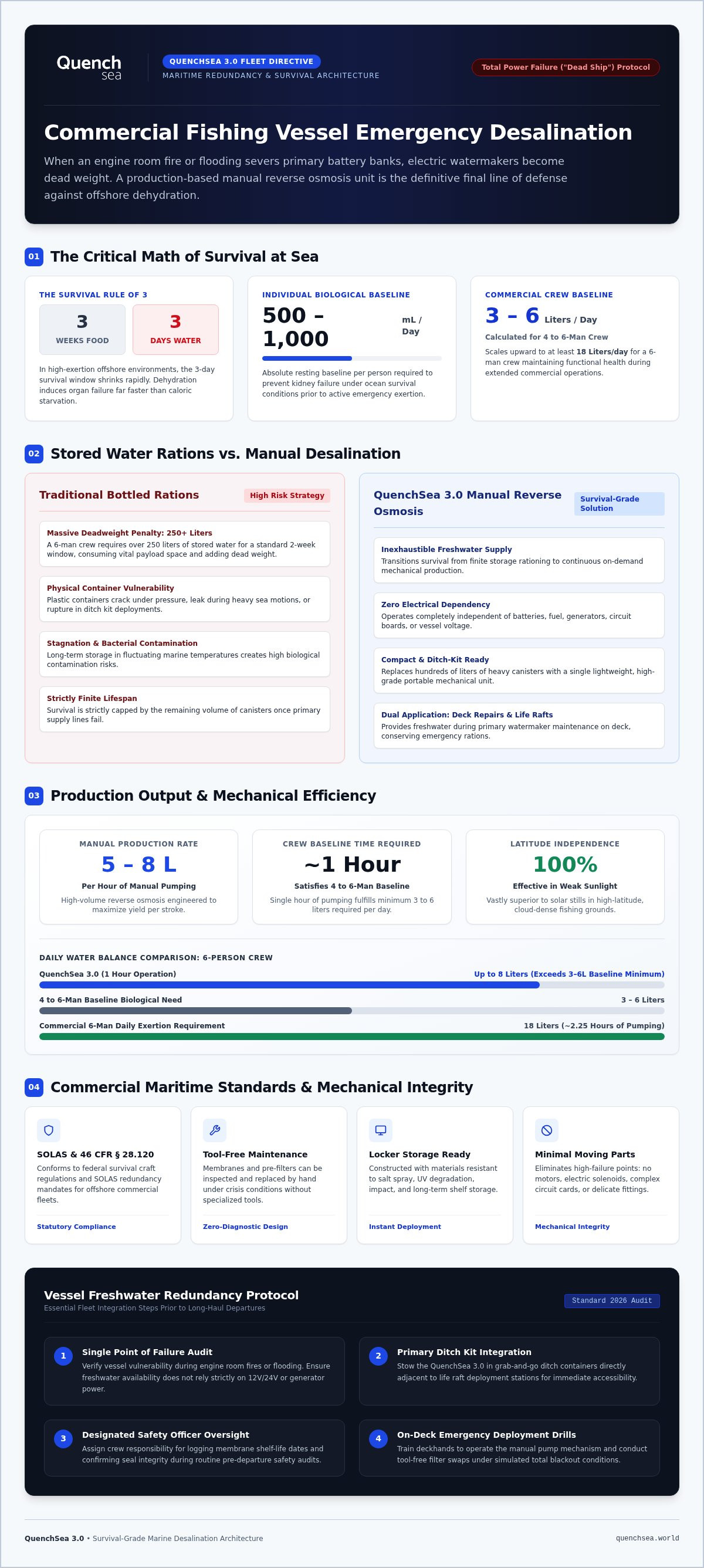
Survival at sea follows a strict hierarchy known as the "Rule of 3." You can survive three weeks without food, but you won't last more than three days without water. In the high-exertion environments common to commercial fishing, that window shrinks even faster. Stored water is a finite, heavy resource. It consumes critical space that could otherwise hold payload. Once your tanks are empty or contaminated, you're at the mercy of the elements. Survival-grade hardware is designed to eliminate this risk by providing a production-based solution rather than a storage-based one.
Beyond the Life Raft: Emergency Use on Deck
Redundancy shouldn't wait for a life raft deployment. If your main system goes down for repairs while you're in remote fishing grounds, a portable unit keeps the crew hydrated without tapping into your emergency rations. It allows you to reduce the deadweight of massive freshwater tanks, which increases your vessel's efficiency. Keeping a commercial fishing boat emergency watermaker accessible on deck ensures the crew stays functional during extended hauls, even when the primary infrastructure fails.
The Failure of Traditional Rations
Standard plastic water containers are notoriously vulnerable. They crack under pressure, leak during rough seas, or become contaminated by bacteria over time. The logistics of storing enough water for a full crew are staggering. A 6-man crew needs at least 18 liters per day just to maintain basic health. Over a two-week period, that's over 250 liters of deadweight. An emergency water maker replaces this bulky, finite supply with an infinite safety net. It provides fresh water as long as you have the strength to pump. Commercial environments demand hardware built for defense-level durability, not consumer-grade gadgets that fail under salt and UV exposure.
Evaluating Emergency Watermakers: Key Commercial Criteria
Survival-grade hardware must endure the corrosive reality of a salt-spray locker for years without seizing. When you select a commercial fishing boat emergency watermaker, reliability is the only metric that matters. The unit must function instantly after long-term storage. This requires high-grade materials resistant to UV degradation and impact. Commercial environments are violent. Equipment gets dropped, stepped on, and exposed to extreme temperatures. Look for a design with minimal moving parts. Complex mechanisms fail. Simple, manual reverse osmosis systems offer the best chance of success because they eliminate the need for specialized tools or electronic diagnostics.
Maintenance should be intuitive and tool-free. In a crisis, your crew won't have the luxury of a workbench or a manual. Filters and membranes must be swappable by hand. This ensures that even a stressed, exhausted deckhand can restore functionality if a pre-filter clogs. Adhering to 46 CFR § 28.120 survival craft regulations ensures your gear meets federal safety standards for offshore operations. Selecting hardware that prioritizes mechanical integrity over digital features is the hallmark of a prepared fleet manager.
Volume Requirements for Commercial Crews
A resting human requires a baseline minimum of 500 mL to 1,000 mL of fresh water daily to prevent kidney failure under ocean survival conditions. For a crew of four to six, your daily requirement scales to a minimum of 3 to 6 liters just for basic biological maintenance. High-volume manual RO units are superior to solar stills, especially in high latitudes where sunlight is weak or inconsistent. A manual pump capable of 5 to 8 liters per hour can satisfy an entire crew's daily needs in a single hour of operation. This efficiency preserves the crew's physical energy, which is a finite resource in a survival scenario.
Portability and Rapid Deployment
Emergency gear is useless if it's trapped in a sinking hull. A commercial fishing boat emergency watermaker must be light enough for a "grab-and-go" ditch bag. Units weighing around 6 kg (13 lbs) provide the necessary balance of robust construction and portability. Deployment speed is critical. You must be able to move from the locker to active freshwater production in under 2 minutes. Secure mounting points allow the operator to stabilize the unit on a moving deck or inside a life raft. If you're looking to upgrade your fleet's redundancy, consider a portable desalination solution built for rapid deployment.
Manual vs. Electric: Choosing Your Fail-Safe
Electric watermakers are engineered for comfort and high-volume production. They handle the heavy lifting for daily vessel operations. However, they rely on a fragile chain of components including solenoids, pressure sensors, and steady voltage. A single electrical short or a battery fire renders these systems useless. NIOSH commercial fishing safety research highlights that catastrophic vessel incidents often involve rapid power loss or flooding. In these "dead ship" scenarios, your primary survival tool must function without a grid. A commercial fishing boat emergency watermaker provides this absolute certainty. It trades the high-volume output of electric pumps for the unbreakable reliability of human-powered mechanics.
The cost of ownership differs significantly between the two. Electric systems require consistent annual servicing, membrane pickling, and software updates to remain operational. If a sensor fails in remote waters, the entire system might lock out. Manual units are designed for survival-ready storage. They sit in a locker for months or years and work the moment you grab the handle. While electric units are essential for standard operations, they shouldn't be your only source of water during a crisis. True maritime safety requires a tiered approach where a manual unit serves as the final, uncompromised backup.
The Case for Manual Reverse Osmosis
Manual systems replace high-draw electric motors with simple leverage. By using a robust pump handle, an operator generates the 55 bar of pressure required to force seawater through a semi-permeable membrane. This process follows established manual reverse osmosis seawater engineering principles to strip away salts and pathogens. Simplicity equals safety. There are no circuit boards to corrode and no wires to melt. In a survival situation, a commercial fishing boat emergency watermaker allows you to convert physical effort directly into hydration. It empowers the crew to stay alive through their own actions rather than relying on failing machinery.
When Electric Backups Fail
Even secondary electric backups face common failure points like salt-clogged pumps or blown fuses. If the vessel is taking on water, the engine room is often the first area lost. This severs the connection to your generators and house banks. A manual RO unit functions perfectly in a flooded cabin or a tossed life raft. It acts as the secondary backup to your primary electric system. It provides a production-based safety net that doesn't drain your remaining battery life. When the lights go out and the pumps stop, manual desalination is the only technology that remains standing.
Integrating Portable Desalination into Your Vessel’s Safety Protocol
Owning the right hardware is only the first step toward maritime resilience. You must integrate it into your vessel's daily operational reality. Safety protocols often fail because they remain theoretical until a crisis occurs. A commercial fishing boat emergency watermaker requires a practical, hands-on approach to be effective when the power dies. Start by auditing your current freshwater redundancy. Compare your finite stored volume against the infinite production potential of manual desalination. If your plan relies solely on plastic jugs, you have a single point of failure that won't survive a hull breach or a contaminated tank.
Designate a "Safety Water Officer" for each shift. This isn't just a title; it's a mission-critical role. This crew member is responsible for the mechanical readiness of your emergency gear. They ensure the unit sits in a high-visibility, rapid-access location. It shouldn't be buried under heavy nets, spare parts, or fouled gear. It must be reachable in a dark, tilting cabin during a "dead ship" scenario. Accessibility is the difference between survival and disaster.
Step-by-Step Emergency Drill
Conduct quarterly dry runs to build muscle memory for the entire crew. Start by retrieving the unit from the life raft water supply locker. Practice securing the intake line in simulated choppy conditions. You don't want to fumble with hoses when the deck is awash. Establish a clear rotation for manual pumping. Operating a manual RO unit at 30 to 40 strokes per minute is physically demanding. A 15-minute rotating schedule prevents fatigue. This ensures a consistent output of 5 to 8 liters per hour, keeping the crew hydrated and focused on recovery rather than physical collapse.
Maintenance and Storage Best Practices
Long-term storage demands specific mechanical care. RO membranes are sensitive to biological fouling and desiccation. Use food-grade sodium metabisulfite for pickling if the unit will sit for more than a month. This preserves the membrane's integrity. Inspect every seal and high-pressure hose for signs of UV damage or salt corrosion. 2026 compliance standards require documented maintenance logs. Record every test, flush, and filter change. A well-maintained commercial fishing boat emergency watermaker is a dependable tool. A neglected one is just extra weight in a life raft.
Don't wait for a total power failure to test your vessel's redundancy. Equip your fleet with the QuenchSea 3.0 today.
QuenchSea 3.0: The Survival-Grade Solution for Commercial Fleets
The QuenchSea 3.0 is a mechanical response to the volatility of the open ocean. For fleet managers, it solves the critical problem of total power failure. This commercial fishing boat emergency watermaker uses manual reverse osmosis to strip 98% of salts from raw seawater. It operates entirely without fuel, batteries, or external power. At a dry weight of 6.0 kg (13 lbs), it fits into standard commercial grab bags without compromising your payload capacity. It's a professional tool designed for those who work in extreme environments where failure isn't an option.
The internal mechanics are engineered to handle 5.5 MPa of operating pressure. An integrated safety release valve prevents over-pressurization, protecting the unit during high-stress use. This level of precision ensures the device remains a dependable partner when conditions deteriorate. It moves 20 liters of seawater feedflow per hour to produce life-saving hydration. By converting physical effort directly into fresh water, it empowers your crew to survive the most challenging "dead ship" scenarios.
Built for the Harshness of the Ocean
Marine environments destroy weak gear. The QuenchSea 3.0 uses corrosion-resistant materials designed for years of saltwater exposure. Its triple ultrafiltration and carbon pre-filtration stages protect the RO membrane from silt and algae. This ensures the unit remains functional even in high-turbidity coastal waters. The simple lever action allows any crew member to produce 5 to 8 liters of fresh water per hour. This performance meets the survival desalination device standards required for modern offshore operations. It provides a level of durability that consumer-grade gadgets simply can't match.
Securing Your Crew’s Future
Reliability in a crisis is the only metric that matters. While complex electric systems require constant maintenance, the QuenchSea 3.0 offers mission-driven reliability. It's already trusted by defense and humanitarian sectors for use in the world's most challenging zones. Implementing this hardware across your entire fleet provides a uniform safety standard. It removes the uncertainty of hydration during an abandon-ship event or a total engine room fire. A commercial fishing boat emergency watermaker is the only way to ensure your crew has an inexhaustible supply of fresh water when the grid goes dark. Your crew's survival shouldn't depend on a circuit board or a generator. It should depend on a tool built for the worst-case scenario. Equip your vessel with QuenchSea 3.0 today.
Secure Your Fleet’s Survival Net
Maritime safety isn't about hoping for the best. It's about engineering for the worst. A total power failure turns complex electric desalinators into dead weight instantly. Integrating a commercial fishing boat emergency watermaker into your primary safety protocol ensures your crew never faces the lethal threat of dehydration. You need a tool that functions when the grid goes dark. Reliance on finite stored water is a gamble that modern safety standards can't justify. Manual production is the only way to guarantee a continuous supply.
The QuenchSea 3.0 delivers mission-critical reliability. It requires no electricity, batteries, or fuel to operate. This is survival-grade hardware, trusted by defense and disaster relief teams in the most extreme environments. Its robust engineering provides an inexhaustible freshwater supply through simple mechanical leverage. Don't leave your crew's lives to chance or failing circuitry. Take control of your vessel's redundancy now. Upgrade your vessel safety with QuenchSea 3.0. Your preparedness is the final line of defense on the open ocean.
Frequently Asked Questions
Is a manual watermaker fast enough to support a full commercial crew?
A manual system like the QuenchSea 3.0 produces 5 to 8 liters of fresh water per hour. This output is sufficient to support a standard 4 to 6 person crew under emergency survival conditions. Since a resting human requires roughly 1 liter daily to prevent kidney failure, a single hour of operation satisfies the baseline needs of the entire team. Rotating the pumping task among crew members ensures consistent production without causing physical exhaustion.
How often do the filters in an emergency watermaker need to be replaced?
Replacement frequency depends on the turbidity of the seawater. In silt-heavy coastal waters or upwelling zones, pre-filters may foul faster than in the open ocean. You should inspect the triple ultrafiltration and carbon pre-filters after every emergency deployment or drill. For standard maintenance, replacing the RO membrane and pre-filters every two years ensures the commercial fishing boat emergency watermaker remains mission-ready. Always keep a log of operational tests to track filter integrity.
Can I use a portable desalination device in any ocean temperature?
Portable desalination devices operate effectively in most marine environments, but they have thermal limits. The QuenchSea 3.0 handles feed water temperatures up to 45°C (113°F). While warmer water reduces viscosity and makes pumping slightly easier, temperatures exceeding this limit can damage the delicate reverse osmosis membrane. In extremely cold high-latitude waters, the flow rate may decrease slightly due to increased water density, but the device will continue to produce potable water.
What is the shelf life of a QuenchSea 3.0 unit if left in storage?
The QuenchSea 3.0 is engineered for long-term storage in harsh marine lockers. Its shelf life is virtually indefinite if the unit is stored dry or properly pickled with food-grade biocide. The high-quality seals and rugged housing resist UV degradation and salt corrosion. You must perform a freshwater flush and inspection every 12 months to ensure the internal membranes haven't desiccated. This routine maintenance guarantees the hardware functions instantly during a total power failure.
Does a manual RO device remove bacteria and viruses as well as salt?
Manual reverse osmosis technology does more than just remove salt. The multi-stage filtration process, including triple ultrafiltration and a high-pressure RO membrane, effectively strips away 98% of total dissolved solids. This includes bacteria, viruses, and microplastics that often contaminate coastal waters. The resulting output is safe, potable water that meets WHO standards for emergency consumption. It provides a comprehensive biological and chemical safety net that standard solar stills cannot match.
How much physical effort is required to operate a manual watermaker?
Operating a manual desalinator requires consistent physical input, but modern lever mechanics optimize the process. The operator needs to apply approximately 10 kg of force per cycle at a cadence of 30 to 40 strokes per minute. While this is physically demanding, the high-yield design produces 1 liter of water in about 8 to 12 minutes. Rotating the duty between crew members every 15 minutes prevents muscle fatigue and maintains a steady production rate.
Can the QuenchSea 3.0 be used directly from a life raft?
The QuenchSea 3.0 is specifically designed for rapid deployment in life rafts. Its compact 6.0 kg footprint fits easily into standard ditch bags or survival craft lockers. The device includes secure mounting points, allowing you to stabilize the unit against the raft's floor or tubes during operation. Because it requires no external power or fuel, it is the ideal tertiary backup for crews forced to abandon their vessel in heavy seas.
Is manual desalination better than carrying extra bottled water?
Manual desalination is superior to bottled water because it provides an inexhaustible supply. Storing 1.5 liters per person for a 6-man crew adds significant deadweight and consumes critical cubic volume in a life raft. A commercial fishing boat emergency watermaker replaces this finite resource with a production-based solution. It eliminates the risk of contaminated plastic jugs and provides peace of mind that your water supply won't run out before rescue arrives.