

The lightest watermaker isn’t automatically the safest choice. A lightweight manual emergency watermaker must be manageable to carry, produce useful drinking water for your situation, and remain practical to operate when you’re tired or under pressure. That balance matters whether you’re preparing a life raft, outfitting a yacht, or building an emergency kit.
It’s reasonable to ask how much effort a hand-powered unit requires and whether its output suits your needs. Manual operation avoids dependence on electricity, batteries, and fuel, but makes carry weight, water production, and operating demands central to the decision. This guide compares those trade-offs and explains how to match a watermaker to your emergency scenario. It covers QuenchSea 3.0, which uses hand-powered reverse osmosis to desalinate seawater, along with practical checks to make before an emergency. You’ll finish with a clearer basis for choosing a unit you can carry, operate, and include in a workable water plan.
Key Takeaways
- Match a lightweight manual emergency watermaker to the people, trip duration, seawater access, and storage space in your plan.
- Compare manual desalination, powered systems, and stored water by the role each can realistically serve in an emergency.
- Assess the complete carry burden and the physical effort needed to operate a hand-powered device, not just its portability.
- Use product specifications and maintenance instructions to judge whether a watermaker fits your emergency needs.
- QuenchSea 3.0 uses hand-powered reverse osmosis to desalinate seawater without electricity, batteries, or fuel.
Purpose of a lightweight manual emergency watermaker
A lightweight manual emergency watermaker is a hand-operated device that processes seawater into drinking water when a dependable supply may be unavailable. It takes seawater as its feedwater and uses a manual mechanism to drive desalination. It serves as an emergency contingency, rather than an automatic household or onboard supply. In devices that use reverse osmosis, pressure pushes water through a semi-permeable membrane that separates it from much of the dissolved salt.
“Lightweight” has no universal threshold. A unit that’s easy to secure aboard a yacht may still be too burdensome for someone carrying an emergency kit over land. Judge the complete system against the mission: who will carry and operate it, how many people may need water, where it will be stored, and whether seawater will be accessible.
When a manual emergency watermaker earns space in a kit
A manual unit can add a source of water in a life raft, yacht, coastal emergency kit, or off-grid setting where seawater is available and external power may not be. It can also serve as a backup aboard a vessel with a powered watermaker. The purpose differs: a powered system may support routine onboard demand, while a manual device provides a contingency when power is unavailable or a primary system can’t be used.
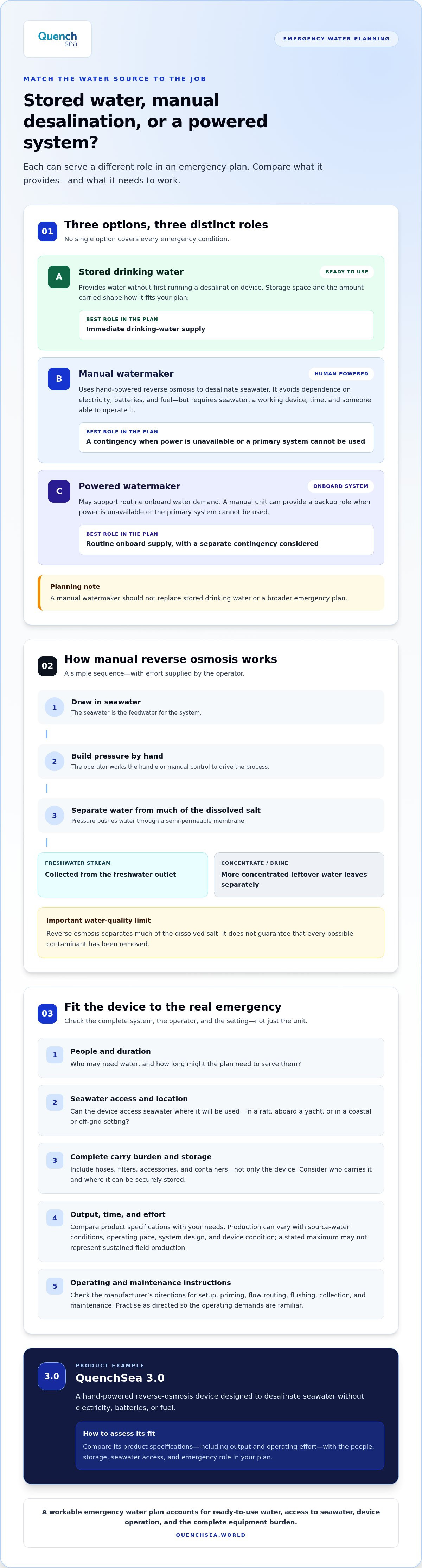
It shouldn’t replace stored drinking water or a broader emergency plan. Stored water is ready to use; desalination requires access to seawater, a working device, time, and someone able to operate it. Plan for immediate needs as well as the possibility that conditions make water production difficult. For raft-specific planning, consider how a life raft water supply fits the equipment and storage available in that setting.
What lightweight means in an emergency
Start with the full carry burden, not the device alone. Include hoses, filters, accessories, and containers needed to collect and hold water. A compact unit may be manageable until you add those supporting items. Then consider who will carry it: a solo user on shore, a crew sharing equipment aboard a yacht, and raft occupants facing limited storage have different constraints.
Stowage also affects the decision. On a vessel, locker space and secure placement may matter more than carrying comfort. In a shore-based kit, bulk and total weight affect how easily one person can move the equipment. Consider the intended user and route, and whether the system can be stored where it will be needed without blocking access to other essentials.
Set a practical limit for your situation. Don’t choose by an arbitrary weight cutoff or the “lightest” label alone. A lightweight manual emergency watermaker must be portable for its actual user, usable in its intended location, and appropriate for its emergency role. QuenchSea 3.0 is a hand-powered reverse-osmosis device designed to desalinate seawater without electricity, batteries, or fuel. Consider how that capability fits your specific plan.
How manual reverse osmosis turns seawater into drinking water
A manual reverse-osmosis watermaker uses a hand-operated pump to move seawater through a desalination system. The process has four basic stages: draw in feedwater, build pressure, separate a freshwater stream from much of the dissolved salt, and discharge the more concentrated leftover water, often called brine or concentrate. Follow the manufacturer’s instructions for the exact setup and operating sequence, which vary by device.
Inside the system, pressure drives water through a semi-permeable membrane. The membrane allows water to pass while retaining much of the dissolved salt in the concentrate stream. This is a separation process, not a guarantee that every possible contaminant has been removed. The US EPA’s information on drinking water regulations and contaminants provides context for why water quality involves more than salinity alone.
What the operator does during a pumping cycle
At a high level, the operator positions the seawater intake, starts the pump, and works its handle or other manual control to build pressure. The system routes water across the membrane, collects the separated freshwater at its outlet, and sends concentrate through a separate discharge path. Follow the device instructions for priming, flow routing, flushing, and collection. These details differ between models.
What affects practical water production
Production depends on more than the membrane. Source-water conditions, intake placement, operating pace, system design, and device condition can all affect the amount collected. A user pumping steadily in manageable intervals may get a different result from someone working at an unsustainable pace. Plan for the effort and time required, not just a stated output figure.
Don’t automatically treat advertised maximum output as sustained field production. A peak figure may reflect particular test conditions, while an emergency can involve changing water conditions, fatigue, interruptions, or limited collection capacity. For a lightweight manual emergency watermaker, assess output alongside who will operate it, how long they can maintain the pace, and how the water will be collected and stored.
Manual operation removes dependence on onboard electricity, batteries, and fuel because the operator supplies the pumping effort directly. That independence is valuable when power sources fail, but operating demand becomes central to the plan. Practise with the device as directed, noting how it starts, runs, collects freshwater, and handles concentrate.
For QuenchSea 3.0, use the product information to compare its specifications with your needs, including output and operating effort. General descriptions of reverse osmosis can’t establish device-specific performance. QuenchSea sells the hand-powered QuenchSea 3.0 desalination device, designed to operate without an external power source.
Manual, powered, or stored water: compare emergency water options
Emergency water planning is a system, not a single-device decision. A manual watermaker can produce freshwater from seawater without an external power source. A powered watermaker can support ongoing production while its energy supply is available. Stored water is ready immediately, but limited to what you carry. The right combination depends on access to seawater, expected duration, available storage, and who can operate the equipment.
Use this comparison to identify each option’s role and how the options can work together:
| Option | Power dependence | Portability | Production continuity | Preparation and likely role |
|---|---|---|---|---|
| Manual desalination | Requires operator effort, not electricity or fuel | Depends on the device and the complete kit | Depends on operator stamina, conditions, and verified device performance | Needs seawater access, setup, and practice; useful as a backup or off-grid source |
| Powered watermaker | Requires its specified power source | Depends on system design and installation | Can produce water while the system and power supply remain available | Requires setup and a functioning energy supply; may suit routine onboard demand |
| Stored drinking water | None for use | Can become bulky as reserves increase | Finite; supply runs down as it’s consumed | Needs advance storage and rotation; provides immediate water during a disruption |
Manual watermaker versus powered desalination
Manual and powered systems address different constraints. A hand-operated unit trades electrical input for human effort, so its practical output depends on the operator and the device’s performance. A powered watermaker reduces manual pumping but depends on its required energy source and system readiness. Compare the power likely to be available, expected demand, and whether someone can operate or maintain the equipment. Neither option suits every emergency.
Manual desalination versus carrying stored water
Stored water is immediately available, with no intake or operating cycle. Its limit is the amount prepared and carried. A watermaker can extend supply when seawater is accessible, but it must be set up and operated, and its components need care. Keeping stored water alongside a manual unit covers the time before production begins and remains useful if the device needs attention.
For a yacht, a powered system, manual backup, and stored reserve may serve distinct roles. A shore-based kit may prioritize equipment one person can transport. A lightweight manual emergency watermaker is most useful when it fits the user’s actual plan, rather than being treated as a substitute for every other source. QuenchSea 3.0 is a hand-powered seawater option for plans that need desalination without electricity, batteries, or fuel.
A practical checklist for choosing a lightweight manual emergency watermaker
Start with the emergency you’re preparing for. A device for one person’s coastal kit may not suit a yacht crew or a professional deployment team. Answer these questions before comparing models:
- Who needs water? Identify the likely users and who can operate the device.
- How long might you need it? Consider the likely duration and keep stored water as part of the plan.
- Where will it be stored? Check the available space aboard a vessel or in a shore-based kit.
- Will seawater be accessible? A desalination device depends on a suitable source and a workable intake location.
Your answers define the mission and help determine whether a lightweight manual emergency watermaker is practical for the people who will carry and use it.
Match the device to users and deployment conditions
For individual preparedness, assess whether one person can carry the complete system and operate it steadily. A crew may share the work, but account for who can take a turn if the primary operator becomes tired or unavailable. Professional deployments may involve different users, storage, and operating conditions, so match the device to the assignment. For raft-specific equipment planning, use the life raft water supply guide as a companion resource.
Compare the device’s stated output with your expected need, but don’t treat a maximum figure as a guaranteed result in every situation. Consider how the operator’s pace and conditions could affect production. If no one in the intended group can sustain the operating sequence, the unit may not fit that scenario, regardless of its listed output.
Prepare and practise before an emergency
Read the manufacturer’s instructions before packing the device. Practise the setup and operating sequence in appropriate conditions so the intake, controls, freshwater outlet, and collection container aren’t unfamiliar under pressure. Inspect and store the system as directed. Follow the maintenance steps and intervals in the product manual rather than relying on generic assumptions.
Check the complete kit against the instructions: required components, intake compatibility, discharge arrangement, and a clean way to collect freshwater. Learn how the device should be prepared, flushed, stored, and maintained. Keep the instructions with the equipment, where intended operators can find them.
When assessing QuenchSea 3.0, compare the product specifications and instructions with your needs. Focus on details relevant to your plan, such as weight, dimensions, output, operating effort, maintenance, and any stated certifications. QuenchSea 3.0 is a hand-powered reverse-osmosis device designed to operate without electricity, batteries, or fuel. Those design features describe its energy approach; your users and mission determine whether its complete setup is a practical fit.
Use the checklist to assess whether manual seawater desalination fits your plan, then explore QuenchSea 3.0 for emergency desalination without an external power source.
Where QuenchSea 3.0 fits in an emergency water plan
QuenchSea 3.0 is a portable, hand-powered reverse-osmosis device designed to turn seawater into drinking water. It operates without electricity, batteries, or fuel, making it an option for emergency plans where external power may be unavailable. It is designed for marine safety, life rafts, yachts, disaster relief, defence, and off-grid coastal use.
These scenarios share a need for seawater access, but their demands differ. A yacht owner may want a backup if onboard power or a primary system fails. A raft plan has strict limits on storage and operator capacity. A relief or defence deployment may involve different users and operating conditions. Fit depends on the mission, not the label alone. Assess the complete setup and the work required to use it before adding it to your kit.
QuenchSea 3.0 features relevant to emergency use
Its design combines portability, manual operation, and reverse osmosis. The device is intended to produce freshwater for survival situations, but the useful amount for a specific plan depends on its output and operating conditions. Don’t assume portability alone makes a unit suitable for a life raft or field kit. Consider the user, storage space, collection containers, and emergency procedures together.
Use the QuenchSea 3.0 buyer’s guide to review the product and compare its specifications with your requirements. This makes it easier to assess its role using details relevant to your own plan, rather than general descriptions.
Next steps before adding a watermaker to your kit
Start with the intended deployment. Identify the users, likely storage location, seawater access, and who can operate the device. Then compare the product information and instructions with those needs. If you’re preparing a raft, consider the device alongside raft-specific water storage and equipment limits. Keep drinking water in reserve; a manual watermaker complements preparation rather than replacing it.
Before relying on emergency equipment, learn the operating procedure and practise it as the manufacturer directs. Use the instructions for setup, collection, inspection, storage, and maintenance. Make sure the intended operator can follow the process and that the necessary components stay with the device. Practice turns a stored tool into equipment the user understands.
QuenchSea 3.0’s defining energy advantage is straightforward: it doesn’t need electricity, batteries, or fuel to operate. That can make it relevant where power access is uncertain, provided seawater is available and manual operation fits the situation. If you’re considering a lightweight manual emergency watermaker, judge it by product specifications and real deployment needs, not portability claims alone. Explore QuenchSea 3.0 as a manual seawater option for your emergency water plan.
Make your water plan ready for real conditions
Preparedness is more than choosing equipment. Decide where it will be kept, who will operate it, and how you’ll combine it with water already in reserve. Review the manufacturer’s instructions and practise the process before an emergency makes every step harder. Those actions turn a purchase into a usable plan.
A lightweight manual emergency watermaker is worth considering when your scenario includes seawater access and a need to produce water without relying on onboard power. QuenchSea 3.0 combines hand-powered reverse osmosis with a design intended for marine safety and emergency preparedness, without electricity, batteries, or fuel. The right fit depends on the product specifications and how well the device suits your users, storage, and operating conditions.
Before deciding, consider whether the intended operator can manage the manual process, whether you have suitable containers to collect water, and how your plan covers interruptions. Keep the decision practical. Equipment supports readiness only when people know how to use it.
Compare QuenchSea 3.0’s product details with your emergency checklist. Explore QuenchSea 3.0 for emergency seawater desalination, then build confidence through preparation and practice.
Frequently Asked Questions
How lightweight should a manual emergency watermaker be?
Light enough for the person who must move and operate it. There’s no universal weight limit for every emergency. Assess the packed system, not just the device: include accessories and containers needed to collect water. For a life raft, check that it can be stowed and retrieved without obstructing other gear. For shore use, practise carrying the complete kit along the route you expect to travel.
Can a manual watermaker produce enough drinking water for a crew?
It depends on the device’s stated output, how many people need water, and how consistently the crew can operate it. Compare product specifications with the group’s planned needs, then account for pauses, fatigue, and times when the device may be unavailable. A crew can share operating duties, but don’t assume everyone can pump or that production will continue without interruption. Keep a separate reserve for immediate use.
How much water can a hand-operated emergency watermaker produce?
Output varies by model and operating conditions, so there isn’t one reliable rate for every hand-operated watermaker. Check the product specifications and distinguish a stated maximum from the volume you can collect in your intended conditions. Practise the manufacturer’s procedure and measure the collected freshwater with a marked container. That gives the operator a practical reference without treating an estimate as a promise.
Does a manual emergency watermaker work without electricity or fuel?
Yes. A hand-powered model can operate without electricity or fuel because the user supplies the pumping effort. QuenchSea 3.0 is designed to run without electricity, batteries, or fuel. That makes it relevant to plans where electrical power may be unavailable, but it still requires seawater access and an operator who can follow the instructions. Review the device’s power requirements before packing it.
Is reverse-osmosis water from seawater safe to drink?
Don’t assume reverse osmosis alone makes every collected sample safe. The process removes salt and reduces dissolved solids, but source-water contamination and device condition also matter. Follow the manufacturer’s directions for checking and handling the output, and use an appropriate water-quality test if the instructions call for one. If seawater may contain pollutants or the output seems abnormal, don’t rely on appearance or taste as proof of safety.
What happens if a manual watermaker is stored without regular use?
It may be ready when needed if you store and maintain it as the manufacturer directs, but long storage without inspection can leave you uncertain about its condition. Before deployment, check the manual for storage limits, required maintenance, and the correct way to prepare the unit after storage. Confirm that required parts and collection equipment are present. Don’t improvise a maintenance schedule, since procedures differ between devices.
Should a life raft carry stored water as well as a manual watermaker?
Yes, where the raft’s capacity and emergency plan allow. Stored water is available immediately, while a watermaker requires setup, seawater access, and an operator. Treat them as complementary resources, not substitutes. Check that the complete watermaking kit fits without displacing essential raft equipment, and that users can reach it and understand how to operate it. Base the balance of stored water and equipment on the raft’s actual storage limits and intended occupants.