

In a survival situation, the most advanced piece of technology on your vessel is often the first thing to fail. Saltwater is relentless. It corrodes circuits, compromises seals, and turns high-tech luxuries into dead weight when you need them most. You've likely felt that knot of anxiety while staring at a complex control panel, wondering if a single blown fuse will leave you thirsty during a blue-water crossing. The reliability of off-grid watermakers isn't just a technical spec; it's a life-critical requirement for anyone operating beyond the reach of the grid.
You deserve a hydration strategy that doesn't depend on a battery bank or a fuel tank. This guide explores the engineering and field-tested reality of survival-grade desalination to ensure your water security in extreme environments. We'll break down the maintenance requirements for long-term use and show you how to produce safe drinking water that meets WHO standards without complex electronics. You'll learn to identify fail-safe mechanical solutions that prioritize durability over digital fluff. We will examine how to achieve total hydration independence through mechanical integrity and proven reverse osmosis principles.
Key Takeaways
- Define survival-grade standards by prioritizing systems that operate entirely without electricity, fuel, or specialized tools.
- Identify why electronic components and circuit boards are the primary failure points in high-salinity marine environments.
- Apply a two-step framework to audit power requirements and field serviceability when assessing the reliability of off-grid watermakers.
- Learn to mitigate environmental stressors like biofouling and high salt concentrations to protect long-term membrane integrity.
- Establish a zero-failure-point hydration strategy by integrating manual reverse osmosis technology as an essential fail-safe backup.
Defining Reliability in Off-Grid Watermakers
Reliability in an off-grid environment is binary. A system either produces potable water or it doesn't. When you're miles from the nearest port, the reliability of off-grid watermakers becomes the literal line between safety and a life-critical crisis. Standard marine equipment often prioritizes convenience and high-volume output. Survival-grade hardware, however, must prioritize functionality under total system collapse. It's the difference between a luxury and a lifeline.
True reliability means the device operates without external power, liquid fuel, or a toolbox full of specialized instruments. We must distinguish between operational reliability, which facilitates daily comfort, and emergency reliability, which ensures survival. In a crisis, you follow the rule of 3 survival. You have three days without water before physiological failure begins. A reliable watermaker must bridge that gap regardless of your vessel's electrical status or engine health.
The Fail-Safe Hierarchy
Primary electric systems are built for convenience. They're excellent for daily use but remain vulnerable to the "engineering of failure." A single corroded wire or a fried motherboard turns a complex system into dead weight. Solar-dependent RO units offer some independence but remain tethered to weather patterns and battery health. If the sun doesn't shine or the battery management system fails, the water stops. Manual reverse osmosis serves as the ultimate baseline for off-grid water security. It is the only method that remains 100% under the user's control. By understanding different desalination technologies, it becomes clear that mechanical simplicity is the most robust defense against environmental stressors.
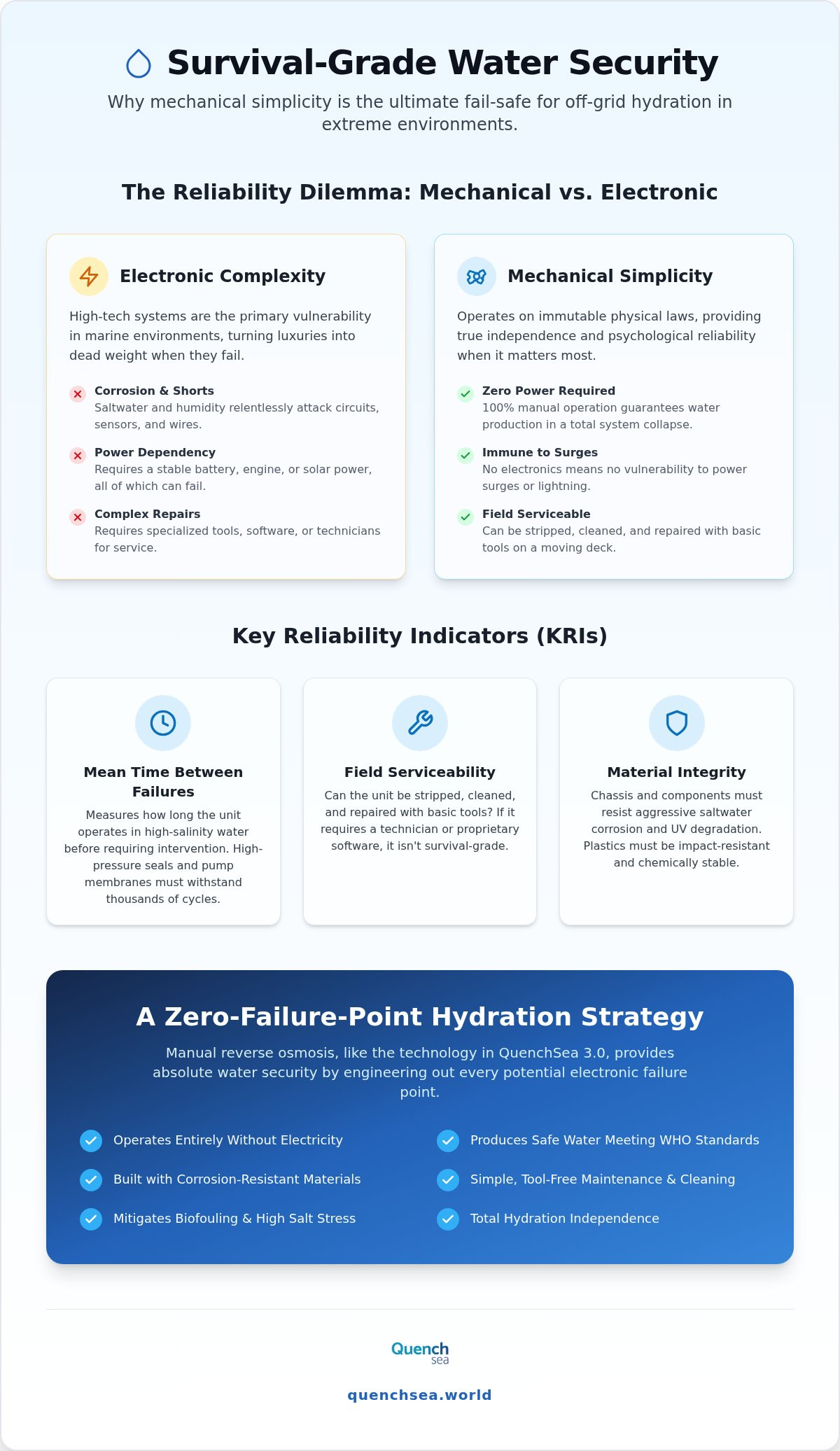
Key Reliability Indicators (KRIs)
To evaluate a system's true endurance, focus on three critical metrics:
- Mean Time Between Failures (MTBF): This measures how long the unit operates in high-salinity environments before requiring intervention. High-pressure seals and pump membranes must withstand thousands of cycles.
- Field Serviceability: Can you strip, clean, and repair the unit on a moving deck with basic tools? If it requires a factory technician or proprietary software, it isn't survival-grade.
- Material Integrity: The chassis and internal components must resist aggressive saltwater corrosion and UV degradation. Plastic components must be impact-resistant and chemically stable.
The reliability of off-grid watermakers is measured by the absence of failure points. Every removed wire, sensor, and circuit is one less thing that can break in the middle of the Atlantic. In survival engineering, less is always more.
Mechanical Simplicity vs. Electronic Complexity
Electronics are the primary vulnerability in marine hardware. Every sensor, wire, and circuit board represents a potential point of collapse. This is the "Engineering of Failure." In a saltwater environment, humidity and salt spray are constant. They target electronic contacts and motherboard traces, causing micro-corrosion that can paralyze a system without warning. Mechanical systems, by contrast, operate on physical laws like pressure and osmosis. They don't require software logic to function. This creates a psychological reliability that electronics cannot match. You know the device will work as long as you can move a lever. There is no "boot-up" sequence or error code to decode.
The reliability of off-grid watermakers depends on how they handle the environment. While digital displays provide convenience, they offer zero utility when a circuit board shorts. Mechanical logic is immutable. It doesn't crash, it doesn't require firmware updates, and it doesn't drain your batteries. When you're 500 miles from shore, you want hardware that responds to physical force, not digital commands. Stripping away the unnecessary parts reveals the core of survival engineering.
Why Electric Watermakers Fail
Electric watermakers rely on a chain of fragile components. Solenoid valves, pressure sensors, and pump motor brushes are common failure modes. A single lightning strike or a power surge can wipe out the entire control system instantly. These units also depend on high-wattage power banks or consistent engine runtime. In a total power-loss scenario, an automated system becomes an expensive obstacle. While researchers develop sustainable off-grid desalination systems to solve global water stress, the individual traveler needs a solution that survives a fried alternator. Dependency on complex power grids is a survival risk.
The Manual RO Advantage
Manual systems feature simplified fluid paths that minimize leak points. They utilize direct drive mechanisms, converting human energy directly into hydraulic pressure. Manual reverse osmosis is the most durable method for extracting freshwater from the sea because it eliminates the middleman of electricity. There are no brushes to wear out and no sensors to calibrate. If you can push a handle, you can produce water. For those seeking a fail-safe desalination backup, mechanical simplicity is the only logical choice. The reliability of off-grid watermakers is inversely proportional to their part count. Removing the electronics ensures that when the grid goes dark, your water keeps flowing. You gain empowerment through simplicity.
Environmental Stressors and Field Integrity
The ocean is a hostile laboratory. It tests hardware through a combination of chemical corrosion, biological attack, and physical pressure. While mechanical simplicity provides a foundation, the reliability of off-grid watermakers also depends on how well the system resists environmental stressors. Saltwater acts as a relentless solvent. It seeks out every microscopic gap in your seals. To maintain water security, your equipment must be engineered to survive the very elements it processes.
High salinity is the first hurdle. Average seawater contains approximately 35,000 parts per million (ppm) of Total Dissolved Solids (TDS). As salinity increases, the osmotic pressure required to extract freshwater rises. This puts immense physical stress on high-pressure seals and membrane housings. Biofouling is the second threat. In tropical waters, bacteria and algae thrive. They form biological films on the membrane surface, a process that can permanently reduce output or cause total system failure if not managed. Finally, sediment and turbidity act as abrasives. Without robust pre-filtration, suspended solids will score the high-pressure pump or puncture the delicate reverse osmosis membrane. Pre-filtration is your first line of defense; if it fails, the entire system follows.
Managing Membrane Health
Membrane longevity is the core of long-term hydration security. When water is forced through the RO membrane, the remaining brine becomes highly concentrated. If the system isn't flushed properly, salt crystallization occurs during storage. These crystals act like glass shards, shredding the membrane when you next apply pressure. Survival-grade units like the QuenchSea 3.0 Desalination Device are designed to handle these variables through optimized fluid dynamics. They ensure that the membrane remains hydrated and protected from the extreme osmotic pressures that would compromise lesser systems. Maintaining membrane health is a technical discipline, not a suggestion.
Material Science in Desalination
The reliability of off-grid watermakers is dictated by the materials used in their construction. Non-corrosive polymers and high-grade stainless steel are mandatory requirements. UV resistance is equally critical. Off-grid systems are often stored on decks or in life rafts where they face intense solar radiation. If the chassis isn't UV-stabilized, it becomes brittle and cracks under the hydraulic pressure of operation. Seal technology must also be sophisticated enough to prevent internal bypass. Even a microscopic leak of raw seawater into the freshwater output will cause salt contamination, rendering the water undrinkable. You need hardware that prioritizes material integrity over manufacturing costs. In the middle of an ocean crossing, the quality of your seals is the only thing that matters.
A Framework for Evaluating Watermaker Reliability
Assessing the reliability of off-grid watermakers requires a disciplined audit of technical specifications. You cannot rely on marketing claims when your hydration security is at stake. A survival-grade system must be evaluated through a rigorous framework that prioritizes mechanical independence and user-level repairability. Follow these five steps to audit any desalination system before deploying it into a high-stakes environment.
- Step 1: Audit Power Requirements. Determine if the unit requires a battery, solar panel, or liquid fuel. In a survival scenario, any dependency on external power is a potential point of failure.
- Step 2: Assess Field Serviceability. Can you swap the RO membrane or clear a pump blockage without a technician or proprietary tools? True reliability means the user can maintain the unit at sea.
- Step 3: Evaluate Pre-filtration. Seawater contains sand, plankton, and occasionally oil. Robust pre-filters are the primary defense for the expensive RO membrane.
- Step 4: Check Material Certifications. Ensure all wetted parts are food-grade and corrosion-proof. High-grade polymers and stainless steel are mandatory for saltwater contact.
- Step 5: Review Redundancy. Identify if the device is a primary convenience or a fail-safe backup. Every mission-critical vessel needs a manual alternative that works when the main grid fails.
The Maintenance-to-Reliability Ratio
Reliability is a function of readiness. High-tech systems often require complex maintenance cycles that are difficult to sustain in remote areas. For instance, electric units often require automated freshwater flushes or specialized "pickling" solutions to prevent biological growth during storage. By contrast, manual boat water makers offer a superior maintenance-to-reliability ratio. They utilize simpler internal architectures that don't require constant power to remain in a ready state. You spend less time servicing the machine and more time securing your water supply.
Testing and Certification
Total Dissolved Solids (TDS) testing is the primary metric for verifying the reliability of off-grid watermakers. Seawater typically measures around 35,000 ppm. A reliable watermaker must consistently reduce this to below 1,000 ppm to meet international drinking water standards. Third-party lab testing for salt rejection is non-negotiable for any survival tool. In the field, always use a calibrated TDS pen to monitor output. If the levels rise, it indicates a compromised membrane or a failing seal. To ensure your long-term safety, choose a certified desalination device that has been field-tested in extreme marine conditions.
QuenchSea 3.0: Built for Absolute Water Security
The QuenchSea 3.0 stands as the pinnacle of manual reverse osmosis engineering. It's the hardware realization of every reliability principle discussed in this guide. In extreme environments, your gear has to endure. Whether you're facing a catastrophic vessel failure or a regional disaster, this device provides a predictable, repeatable path to hydration. It eliminates the dangerous variables of battery health and circuit integrity. By removing the need for external power, it secures the reliability of off-grid watermakers in their most essential, survival-grade form. It's built for the harshest environments, from the high seas to disaster-stricken coastal zones.
Engineering the Fail-Safe
The mechanics of the QuenchSea 3.0 are simple, durable, and brutally effective. It uses a manual lever system to generate the intense hydraulic pressure needed to overcome osmotic resistance. This process removes salt and pathogens without chemical additives or complex electronics. It's a direct-drive solution. Sailors and emergency responders have field-proven its performance in the world's most demanding conditions. The unit is engineered to fit seamlessly into a life raft water supply kit. Its compact, rugged chassis withstands physical impacts and environmental stress that would compromise standard consumer-grade filters. There are no brushes to wear out and no sensors to calibrate.
Your Last Line of Defense
Every coastal bug-out bag or ocean-going yacht needs a manual RO backup. It's the only way to guarantee water security when primary systems fail. Mechanical independence offers a psychological advantage during high-stakes crossings. You aren't hoping for a solar charge or a functioning alternator. You're relying on a mechanical logic that simply doesn't change. The reliability of off-grid watermakers is ultimately measured by their ability to function when every other system on the boat has gone dark. The QuenchSea 3.0 is that final, unshakeable layer of redundancy. It ensures you never have to choose between a dead battery and dehydration. It's your insurance policy against the unpredictable nature of the open ocean. Secure your water independence with the QuenchSea 3.0 today.
Achieving Total Water Security
True water security requires stripping away the unnecessary. We've explored why mechanical simplicity consistently outperforms electronic complexity in saltwater environments. You now have a functional framework to audit power requirements, field serviceability, and material integrity before you deploy. The reliability of off-grid watermakers isn't found in a digital display or an automated flush cycle. It's found in the physical laws of reverse osmosis and the durability of survival-grade materials. You need a system that responds to your effort, not a battery's charge.
The QuenchSea 3.0 provides this exact level of mechanical certainty. It's hand-powered, requiring zero electricity or fuel to produce safe drinking water in the most hostile conditions. Marine and defense professionals worldwide trust this lightweight, portable device for emergency deployment. It removes the variables of power failure and circuit corrosion from your survival equation. Equip your vessel with the QuenchSea 3.0 manual watermaker to secure your hydration independence. You can overcome the ocean's harshest challenges with the right tools in hand.
Frequently Asked Questions
How long does a manual watermaker last before needing maintenance?
A manual watermaker like the QuenchSea 3.0 requires flushing after each use to prevent salt crystallization. Under standard survival conditions, a well-maintained RO membrane should last between 5 and 7 years. Reliability depends on the user performing a freshwater flush before long-term storage. Periodic seal inspections ensure the hydraulic pump maintains pressure. Without these simple steps, mineral buildup can compromise the system's output volume over time.
Can a hand-powered watermaker really produce enough water for a family?
The QuenchSea 3.0 is engineered to produce practical volumes of freshwater for survival. While it's a manual device, consistent operation can meet the critical hydration needs of multiple people. It focuses on the "Rule of 3" for survival, prioritizing life-critical hydration over luxury consumption. For a family in an emergency, it provides the necessary baseline to prevent dehydration without relying on a failing electrical grid or fuel-dependent systems.
What happens if the RO membrane gets clogged in the middle of the ocean?
If the RO membrane clogs, the primary cause is usually mineral buildup or biofouling. The reliability of off-grid watermakers depends on robust pre-filtration to stop sediment before it reaches the membrane. In the field, you can often restore performance by performing a high-pressure flush or replacing the pre-filter. The QuenchSea 3.0 is designed for field serviceability, allowing users to swap filters or membranes without returning to a factory or technician.
Is the water produced by a portable desalinator truly safe to drink?
Yes, the water is safe. Reverse osmosis technology removes over 98% of salt and reduces Total Dissolved Solids (TDS) from 35,000 ppm to well below the WHO threshold of 1,000 mg/L. This process also eliminates pathogens, including E. coli and other bacteria. Using a calibrated TDS pen reader allows you to verify water quality in real-time. This ensures the output consistently meets survival-grade safety standards in any remote marine environment.
Do I need special tools to repair an off-grid watermaker in the field?
One of the core advantages of manual systems is that they don't require specialized tools or diagnostic software. The QuenchSea 3.0 utilizes a modular, mechanical design that can be inspected and serviced with basic hand tools. This simplicity is vital for the reliability of off-grid watermakers. You can clear blockages or replace seals directly on a vessel deck, ensuring the unit remains operational when professional repair shops are inaccessible.
How does salinity level affect the reliability of my desalination device?
High salinity increases the osmotic pressure required to extract freshwater. Standard seawater is approximately 35,000 ppm, but some regions or inland seas may have higher concentrations. As salinity rises, the physical stress on the pump seals and the membrane increases. Survival-grade hardware is built to withstand these higher pressures. Consistent performance in high-salinity zones is a key indicator of a watermaker's mechanical integrity and long-term durability.
Can I use an off-grid watermaker for freshwater lakes or rivers?
The QuenchSea 3.0 is specifically engineered for seawater desalination. It's not designed for use on contaminated freshwater from lakes or rivers. Freshwater sources often contain different types of sediment, chemicals, and biological contaminants that can damage a high-pressure RO membrane designed for salt rejection. Using the device outside of its intended seawater application can lead to premature membrane failure and won't guarantee safe drinking water output.
What is the shelf life of a QuenchSea 3.0 device when stored in a life raft?
When stored correctly in a protected survival kit, the QuenchSea 3.0 has an extensive shelf life. The lack of batteries or electronic components means there are no circuits to corrode or power cells to leak over time. The RO membrane is the only component with a specific storage requirement. It must be kept in a "pickling" solution or sealed environment to prevent biological growth and remain ready for immediate emergency deployment.