

In a high-stakes maritime emergency, an expensive solar-powered desalination rig is just a collection of fragile glass and wires if the electronics fail or the sun disappears. You cannot gamble your life on intermittent power or complex circuitry. You need a military grade water purifier seawater solution that operates with mechanical certainty when every other system dies. True survival demands hardware that prioritizes rugged durability over electronic luxury.
We understand the fear of equipment failure during a crisis. It is a rational concern for anyone operating in remote coastal environments or offshore vessels. This article will help you secure a reliable freshwater supply by choosing the right off-grid desalination technology for your specific survival needs. We will examine the most resilient manual systems available in 2026, including the QuenchSea 3.0, and explain how to achieve total water independence without relying on a single battery or fuel source.
We'll break down the mechanical advantages of hand-powered reverse osmosis and compare portable units that fit easily into a bug-out bag. You will discover how to maintain a fail-safe backup for marine emergencies that bypasses the bulk and high cost of traditional electric water makers. This guide provides the tactical roadmap for selecting hardware that turns the ocean into a life-sustaining resource.
Key Takeaways
- Identify the critical vulnerabilities of power-dependent water systems and why mechanical simplicity is your primary defense during coastal emergencies.
- Master the physics of manual Reverse Osmosis to convert human effort into a reliable, potable water supply without batteries or solar panels.
- Compare survival-grade hardware using engineering-focused criteria like mean time between failures and weight-to-output ratios for maximum portability.
- Discover why the QuenchSea 3.0 serves as the definitive military grade water purifier seawater solution for 2026 by eliminating reliance on external fuel.
- Determine the optimal desalination strategy for your specific environment, whether you are managing individual survival or a larger coastal bug-out group.
The Reality of Off-Grid Water Scarcity in 2026
The desalination process traditionally requires immense energy. This creates a fatal bottleneck during equipment malfunctions or environmental disasters. If you're operating in a remote area, you can't call for repairs or wait for a replacement part. You need a military grade water purifier seawater solution that functions independently of any grid. Relying on technology with multiple points of failure is a gamble that survivalists cannot afford to take.
The Limits of Solar Desalination
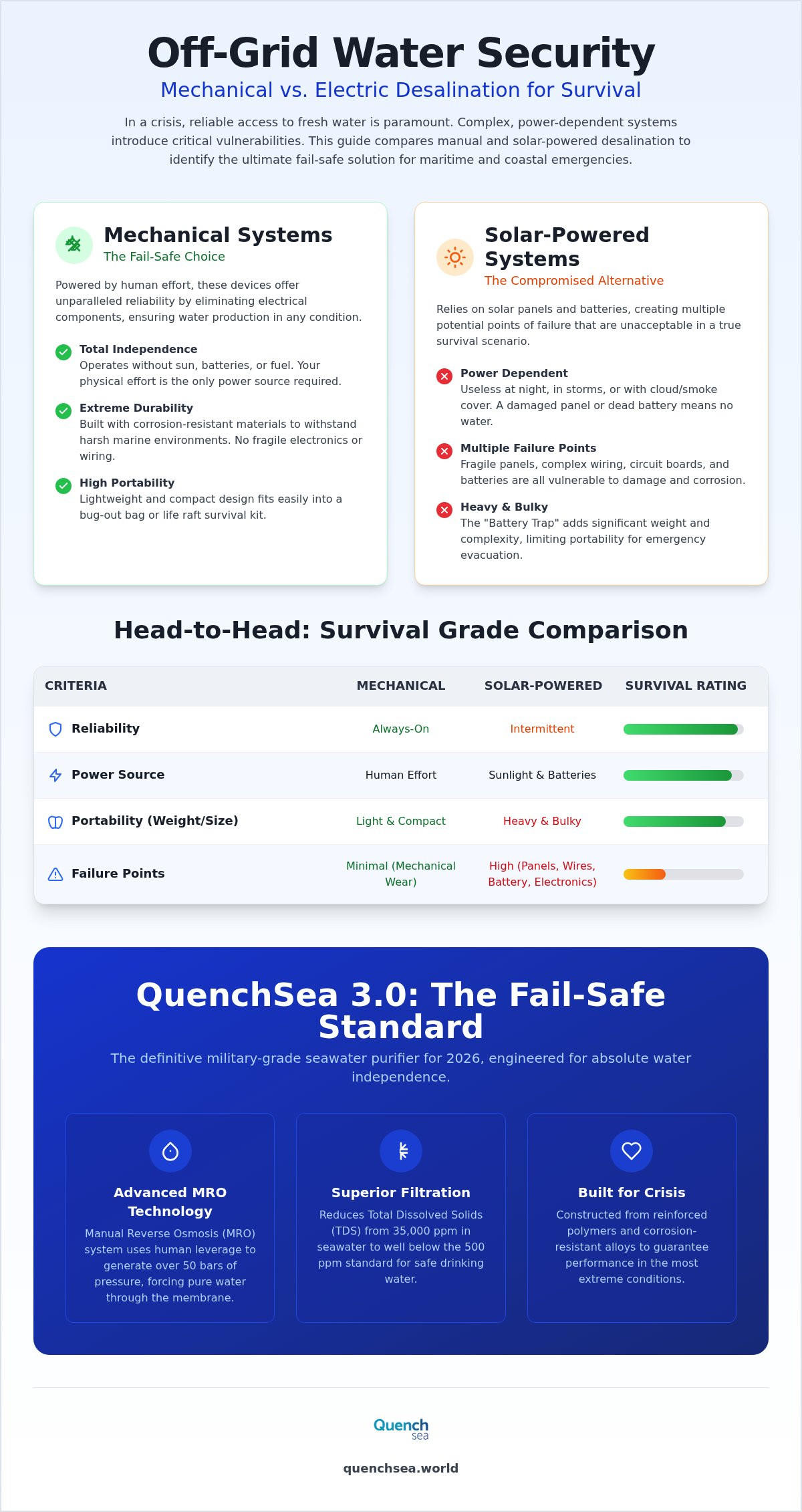
Solar-powered units are often marketed as the ultimate off-grid answer, but they suffer from severe intermittency. Cloud cover, smoke from wildfires, or simple nighttime renders them useless without heavy energy storage. This leads to the "Battery Trap." Energy storage systems add significant weight to your kit and have finite lifespans. Every wire and circuit board is a potential failure point. In corrosive marine environments, salt spray degrades electrical connections with surgical precision. A system that won't start because of a blown fuse or a drained battery is just dead weight in a crisis.
Why Marine Safety Demands Non-Electric Backups
In a life raft scenario, your primary vessel's water maker is usually underwater or powerless. Your survival depends entirely on what you can carry and operate with your own hands. A manual, mechanical device provides a critical psychological edge during high-stress events. You aren't a passive observer waiting for the sun to come out; you are an active participant in your own rescue. Having a military grade water purifier seawater device that requires only physical effort ensures you have a fail-safe backup when everything else breaks. For a deeper look at managing these specific risks, consult our Life Raft Water Supply: The 2026 Comprehensive Survival Guide. Mechanical simplicity is the only true guarantee of reliability in the 2026 survival landscape.
Mechanical vs. Solar Desalination: Breaking Down the Technology
Reverse Osmosis (RO) operates on a simple molecular principle. It uses a semi-permeable membrane to separate pure water molecules from salts, bacteria, and viruses. To achieve this, the system must apply pressure greater than the natural osmotic pressure of seawater. At the molecular level, this forces water through pores so small that salt ions are physically blocked. While industrial plants use massive electric pumps, a military grade water purifier seawater device relies on precision engineering to achieve the same result through human effort.
Safe drinking water requires a drastic reduction in Total Dissolved Solids (TDS). Raw seawater typically contains 35,000 parts per million (ppm) of dissolved salts. Survival-grade RO technology strips these contaminants away, delivering water well below the 500 ppm threshold for potability. Building a device that survives this process requires advanced material science. High-pressure cycles and constant salt-spray exposure will corrode inferior metals. Professional systems use reinforced polymers and corrosion-resistant alloys to maintain structural integrity under the 50+ bar of pressure required for desalination.
Manual Reverse Osmosis (MRO) Explained
Manual Reverse Osmosis is the process of using physical force to bypass membranes without external power. To reach the necessary 50+ bar of pressure, MRO devices utilize high-leverage handles and internal piston systems. This mechanical advantage allows an operator to produce freshwater in high-stress environments without exhausting themselves. Manual systems also protect membrane longevity. Unlike electric pumps that can generate excessive heat and rapid pressure spikes, hand-pumping provides a controlled, steady flow that preserves the delicate polyamide layers of the RO membrane. For those seeking sustainable desalination solutions, eliminating the electrical failure point is the most logical engineering choice.
Energy Efficiency in Desalination
When you compare the Watt-per-liter cost, manual systems are the clear winner for off-grid survival. Electric units require significant energy draws that drain batteries and necessitate heavy solar arrays. In contrast, a manual device has a zero-Watt operational cost. High-output electric units also suffer from heat generation and rapid mechanical wear in their high-RPM motors. Mechanical systems avoid these issues by operating at lower speeds with fewer moving parts. You can explore the specific design choices behind these systems in our guide on Manual Reverse Osmosis: The Engineering of QuenchSea 3.0. If you need a backup that never needs a charge, consider adding a manual unit to your tactical water kit today.
Evaluating the Best Off-Grid Desalination Systems
Selecting survival hardware requires a cold, mechanical assessment of performance metrics. You can't rely on marketing fluff when your hydration depends on the equipment in your kit. Reliability is the primary metric. In engineering terms, this involves maximizing the Mean Time Between Failures (MTBF). Every circuit board, sensor, and wire in an electric unit represents a potential failure point. A true military grade water purifier seawater system eliminates these vulnerabilities by prioritizing mechanical leverage over fragile electronics. If it doesn't work when soaked in salt water or dropped on a deck, it isn't survival-grade.
Portability and output efficiency follow reliability in the hierarchy of needs. High-volume output is a liability if the machine is too heavy to carry during a coastal bug-out. You must evaluate systems based on their weight-to-liter ratio. Furthermore, maintenance must be achievable in the field. If a device requires specialized tools or a technician to swap a membrane, it's a bottleneck. True off-grid systems utilize tool-free repair designs and readily available filters to ensure long-term operational readiness.
- Reliability: Zero reliance on external power or batteries to ensure 100% uptime.
- Portability: Compact dimensions that allow for storage in life rafts or tactical bags.
- Output: The ability to produce enough freshwater for a survival group without causing extreme physical exhaustion.
- Maintenance: Simplified internals that allow for rapid, tool-free cleaning and membrane replacement.
Industrial Skids vs. Portable Units
For those establishing permanent off-grid residences, such as the modular living solutions from Smart Spaces NZ, water security is a foundational requirement.
Fixed solar RO skids are effective for permanent off-grid coastal homes where weight and volume are secondary concerns. These systems provide high daily yields but are anchored to a single location. Tactical operators and sailors require the "Survival Tier." These are portable units designed for rapid deployment and mobility. If you're forced to abandon your primary vessel, a fixed system becomes an expensive loss. A portable military grade water purifier seawater device stays with you in the life raft. For a detailed look at mobile options, read our analysis of Manual Boat Water Makers: 2026 Non-Electric Desalination.
The Best Systems for Emergency Preparedness
Disaster relief scenarios demand immediate hydration without logistical delays. Gravity filters are excellent for inland freshwater but fail entirely against salt. Solar stills are often too slow to meet the metabolic needs of a stressed survivor. Hand-powered Reverse Osmosis systems provide the most reliable middle ground. They deliver immediate freshwater regardless of the time of day or weather conditions. To understand how these devices fit into your emergency kit, consult our Survival Desalination Device: The 2026 Guide to Emergency Ocean Hydration. Mechanical simplicity is the ultimate insurance policy.
Tactical Selection Guide for Remote Environments
Selecting a survival system requires a logical framework. You don't buy gear based on hope. You buy it based on mission requirements. First, assess your environment. Open ocean operations involve high salinity levels that chew through low-grade membranes. If you're moving between coastal and brackish inland waters, your military grade water purifier seawater device must be versatile enough to handle varying TDS levels without clogging. Precision engineering ensures the system remains operational despite these environmental shifts.
Step two is group size. An individual survivor needs roughly three liters of freshwater daily for basic metabolic function. If you're providing for a family or a small tactical team, your output requirements scale rapidly. Calculate the physical effort required to meet this volume. Step three involves a brutal power audit. If your primary strategy relies on solar, you have a single point of failure. Nightfall, storm surges, or heavy cloud cover will neutralize your water supply. Finally, evaluate transportability. A stationary unit is useless if you're forced into a coastal bug-out scenario. You need gear that moves as fast as you do.
- Environment: Match your membrane technology to the salinity of your operating area.
- Group Size: Ensure the liters-per-hour output meets the collective metabolic demand.
- Power Audit: Identify failure points in solar or battery-dependent systems.
- Mobility: Prioritize lightweight, compact designs for rapid evacuation.
Choosing for Yachting and Marine Safety
Marine safety isn't about having one system. It's about having redundant systems that don't share failure modes. Integrating a manual backup into your primary water-making strategy ensures that a total electrical failure isn't a death sentence. Life-raft-ready devices must be compact enough to fit in a ditch bag while remaining operational in heavy seas. For a complete breakdown of coastal survival gear, see our guide on Bug Out Bag Water Desalination: Survival Hydration for Coastal Bug-Outs.
Choosing for Disaster Relief and Defense
Humanitarian missions and defense operations require rapid deployment. You need a military grade water purifier seawater system that works the moment it hits the beach. Ruggedness is non-negotiable. Relief devices must withstand rough handling, sand ingress, and high-pressure cycles without cracking. These tactical solutions bridge the gap between initial landing and established infrastructure. Explore our Disaster Relief Water Supply: Tactical Solutions for Last-Mile Survival for more details. Secure your hydration independence by adding a QuenchSea 3.0 to your tactical loadout today.
QuenchSea 3.0: The Fail-Safe Standard for 2026
The QuenchSea 3.0 represents the pinnacle of mechanical water security. It is engineered specifically for the harshest marine and terrestrial environments. While larger industrial skids offer higher volume, this device offers absolute certainty. It is a military grade water purifier seawater solution that requires no batteries, fuel, or solar exposure to function. In a 2026 survival landscape, where power grids and electronic components are increasingly vulnerable, manual operation is the ultimate tactical advantage. It eliminates the "Battery Trap" and ensures your hydration is never dependent on a charging cycle.
This device features a robust construction designed to withstand repeated high-pressure cycles and constant salt-spray exposure. Its portable footprint allows it to be integrated into any tactical loadout, coastal bug-out bag, or life raft ditch bag. The high salt rejection rate ensures that even the most saline ocean water is converted into potable freshwater that meets survival standards. By stripping away the unnecessary electronic fluff, the QuenchSea 3.0 focuses on mechanical integrity and long-term durability. It is a critical component of a comprehensive emergency water strategy for 2026.
Survival-Grade Performance
Mechanical integrity is the core of the QuenchSea 3.0 design. It is built to be used when every other system on your vessel or at your campsite breaks. The device utilizes a high-leverage handle that makes manual desalination achievable even in high-stress emergency situations. You don't need a degree in engineering to operate it. The internal piston system is optimized for efficiency, allowing you to produce freshwater with controlled physical effort. This simplicity is vital during a crisis. "The QuenchSea 3.0 removes complexity to focus on turning seawater into survival." It provides the peace of mind that comes from knowing you are the power source.
The Future of Portable Desalination
The QuenchSea 3.0 bridges the gap between sophisticated industrial Reverse Osmosis and the raw, immediate needs of a survivor. It has a global impact, serving everyone from yacht owners seeking a non-electric backup to humanitarian teams providing disaster relief in remote coastal zones. It is the definitive military grade water purifier seawater tool for those who prioritize reliability over convenience. As environmental volatility increases, having a tool that functions independently of any grid is the only way to guarantee hydration. Don't wait for a system failure to realize the value of mechanical redundancy. Secure your freshwater independence with QuenchSea 3.0 today.
Secure Your Tactical Water Independence in 2026
Reliability in extreme environments is not a luxury; it is a survival requirement. We have analyzed why power-dependent desalination systems fail when you need them most. Mechanical simplicity provides the only true guarantee of hydration during coastal emergencies or offshore equipment failures. By prioritizing rugged, hand-powered technology, you eliminate the risks associated with fragile electronics and intermittent solar energy. A military grade water purifier seawater solution ensures that your life-sustaining resources remain under your direct control.
The QuenchSea 3.0 stands as the definitive choice for marine, emergency, and defense professionals worldwide. It utilizes compact, survival-grade RO technology to convert the ocean into freshwater with zero reliance on batteries, fuel, or solar power. This device is engineered to function when every other system on your vessel or in your bug-out kit dies. You have the power to turn the tide in your favor by choosing hardware that values mechanical integrity over complex circuitry. Equip your vessel with the QuenchSea 3.0 fail-safe water maker and take the first step toward total water independence. Stay prepared, stay hydrated, and stay empowered.
Frequently Asked Questions
Is a manual desalination system better than a solar one for survival?
Manual systems are superior for survival because they eliminate the dependency on external energy or weather conditions. Solar units fail at night or during heavy cloud cover. A manual device provides absolute reliability when you need it most. It removes the fragility of electrical components that often corrode in marine environments. For tactical operations, mechanical certainty is the only metric that matters for long-term safety.
How much water can a hand-powered desalination device produce per hour?
A high-performance manual device typically produces enough freshwater to meet the metabolic needs of an individual or small group. Production rates depend on the operator's physical input and the specific engineering of the internal piston system. These systems deliver life-sustaining volumes without causing excessive physical exhaustion. This ensures you can maintain hydration levels even in high-stress emergency environments where every liter is critical for survival.
Can you drink salt water if you use a portable RO device?
Yes, a portable RO device is specifically engineered to convert raw seawater into potable drinking water. It uses a semi-permeable membrane to block salt ions, viruses, and bacteria at a molecular level. This process effectively reduces Total Dissolved Solids (TDS) to safe levels. Using a military grade water purifier seawater system ensures the output meets international standards for human consumption during high-stakes survival or tactical operations.
Does an off-grid desalination system require a lot of maintenance?
Manual off-grid systems require significantly less maintenance than their electric or solar counterparts. They lack complex wiring, batteries, and sensors that frequently fail in corrosive salt-air environments. Routine care usually involves flushing the system with freshwater after use to prevent salt crystallization on the membrane. Survival-grade units are designed for tool-free maintenance. This allows operators to swap filters or clean internals rapidly while in the field.
What happens if the RO membrane gets clogged in a remote area?
If a membrane clogs in a remote area, survival-grade systems allow for immediate field replacement without specialized tools. Most tactical operators carry spare RO membranes and pre-filters as part of their standard kit. Manual devices are built with simplified internal access to facilitate these quick swaps. Regular use of pre-filters significantly extends membrane life by catching larger sediments before they reach the delicate reverse osmosis layers.
Is the water produced by QuenchSea 3.0 safe for long-term consumption?
Water produced by the QuenchSea 3.0 is safe for consumption because it utilizes advanced reverse osmosis technology to remove the vast majority of salts and contaminants. The system is designed to meet rigorous safety standards for emergency and defense applications. It provides a consistent supply of freshwater that supports long-term metabolic function. This makes it an essential tool for sailors, humanitarian workers, and anyone operating in water-scarce coastal regions.
How long does a manual desalination device last in a marine environment?
A high-quality manual desalination device can last for years when properly maintained and stored. These units are constructed from corrosion-resistant alloys and reinforced polymers specifically designed to survive salt-spray exposure. The lifespan depends largely on the frequency of membrane replacement and the consistency of freshwater flushing. Because there are no electronic circuits to degrade, the mechanical frame remains a dependable asset for long-term emergency preparedness and marine safety.