

The most energy-independent desalination system may be the one that doesn’t generate power at all. Off grid seawater desalination can rely on hand-powered equipment, solar panels, or fuel. Each approach has different requirements for output, storage, and upkeep.
Choosing between them starts with a practical question: what can keep producing water when grid power or fuel is unavailable? Reverse osmosis pushes seawater through a membrane that separates much of its salt, but the system still needs an energy source. The water supply also depends on more than the desalination unit alone.
This guide explains how desalination works, compares manual, solar-powered, and fuel-powered methods, and shows how to match an approach to your demand. It also covers water storage, maintenance, and backup planning. QuenchSea 3.0 is a hand-powered device that produces freshwater without electricity, batteries, or fuel. It can serve as one portable preparedness option, not a universal replacement for higher-volume systems. The aim is to build a resilient plan around realistic needs, not optimistic output assumptions.
Key Takeaways
- Off-grid desalination doesn’t have to mean energy-free. Compare manual effort, solar power, and fuel against the infrastructure each requires.
- Reverse osmosis uses pressure and a membrane to separate much of the salt from seawater.
- Choose an off grid seawater desalination approach by matching its energy source and scale to your actual water demand.
- Plan for changing conditions by separating routine needs from emergency reserves, then choosing suitable storage and backup supplies.
- A portable, hand-powered device such as QuenchSea 3.0 can have a role in a preparedness plan, but it isn’t a universal high-volume solution.
What Does Off-Grid Seawater Desalination Mean?
Off-grid seawater desalination produces freshwater from seawater without relying on grid-connected electricity or municipal water infrastructure. That independence can matter aboard a vessel, at a remote coastal site, or during a disruption that limits access to conventional utilities.
Off-grid doesn’t mean energy-free. A system may use human effort, solar power, or fuel to supply the energy needed to separate freshwater from salt. Options range from portable equipment for emergency use to larger installations designed to supply a remote location. The right setup depends on how much water it needs to produce and which resources are available where it will operate.
Desalination uses several processes, with reverse osmosis widely used in modern systems. The Desalination processes and technologies overview explains how different approaches remove dissolved salts. For off-grid planning, focus on what powers the equipment and whether that energy source is dependable in the intended setting.
What makes a desalination system off-grid?
An off-grid system doesn’t rely on grid electricity to operate. It may use manual effort, solar energy, or fuel instead. These options aren’t interchangeable: manual equipment depends on a person’s effort, solar equipment depends on its power setup and available sunlight, and fuel-powered equipment depends on a supply of fuel.
Off-grid also doesn’t mean portable. A fixed installation can operate independently of the electrical grid, while a compact device can be carried between locations. Portability describes how equipment can be moved; off-grid describes its relationship to utility infrastructure.
Where can off-grid seawater desalination be useful?
Potential settings include marine operations, coastal properties, remote work sites, and emergency response. Each presents different constraints. A vessel may have limited room for water storage, while a remote site may need to plan for changing sunlight or fuel resupply. Seawater access matters too: the system needs a workable way to draw from its source, and the site needs a plan for storing the freshwater it produces.
Relief teams face additional logistics, including moving water from the production point to the people who need it. A disaster relief water supply guide can help frame last-mile planning alongside decisions about equipment and storage.
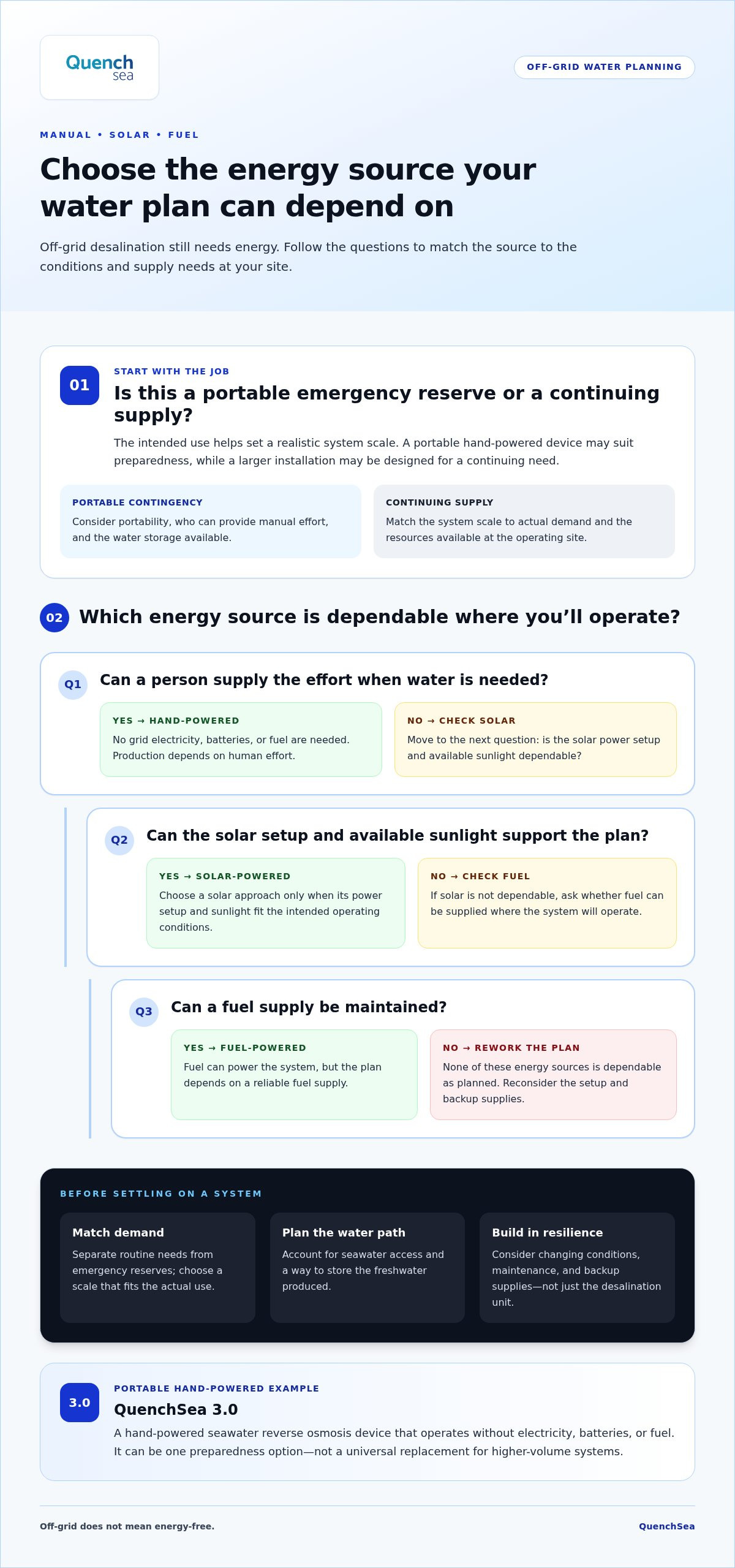
Before choosing a setup, define the job it must do. Is it a portable emergency reserve or a continuing supply for a remote location? That distinction helps set a realistic system scale and identifies what must support it, including seawater access, energy, and freshwater storage. No single arrangement fits every marine, coastal, or relief scenario.
How Off-Grid Seawater Desalination Turns Saltwater into Freshwater
Seawater contains dissolved salts, a measure of which is called salinity. Ordinary filtration can trap particles, but it doesn’t remove dissolved salt in the same way. Desalination uses a process designed to separate water from dissolved substances. In many modern systems, reverse osmosis applies pressure to seawater and directs part of it through a selective membrane.
Reverse osmosis desalination uses pressure to move water through a semipermeable membrane while restricting much of the dissolved salt. The process creates two streams: lower-salinity water that passes through the membrane, and a more concentrated reject stream carrying much of the salt left behind. The U.S. Geological Survey explains this and other approaches in its overview of How Desalination Works.
How reverse osmosis separates water from salt
A semipermeable membrane allows water to pass more readily than many dissolved substances. Pressure drives seawater toward and through the membrane. Because salt passage is limited, the water collected on the other side has a lower salt concentration. The concentrated remainder also needs to be managed as part of the system.
That distinction matters. Reverse osmosis desalination isn’t simply a finer version of a sediment filter, and it shouldn’t be treated as a universal purifier. It targets dissolved salts, but the process alone doesn’t establish that water is free of every possible chemical or biological contaminant. Water quality depends on the system and the water being treated.
What manual pressure changes in an off-grid system
In a grid-powered RO system, a pump supplies the pressure. In hand-powered equipment, a person supplies it instead. The separation principle remains reverse osmosis; the energy input changes. This allows water production without grid electricity, batteries, or fuel, but production depends on human effort rather than continuous powered operation.
Manual systems and larger installations serve different roles. A portable hand-powered device may suit a preparedness kit or a marine contingency, while a larger system may be designed for a continuing supply need. Neither scale is right for every situation. Consider who will provide the effort, how much water the use case requires, and what storage or backup is available. Don’t assume a portable device can replace a higher-volume supply system.
QuenchSea 3.0 is a portable, hand-powered seawater reverse osmosis device that operates without electricity, batteries, or fuel. Its manual pressure approach shows how reverse osmosis can fit into a preparedness plan alongside other water sources. Explore the QuenchSea 3.0 desalination device as a portable option for situations where external power isn’t available.
Manual, Solar, and Fuel-Powered Desalination: Compare the Trade-Offs
Each off-grid approach solves the energy problem differently. Manual systems exchange dependence on external power for human effort. Solar systems use photovoltaic panels and depend on sunlight, storage, and system design. Fuel-powered systems can run without grid electricity, but they need fuel and supporting equipment. The best fit depends on the workload, location, and resources you can reliably bring or maintain.
| Approach | Energy input | Typical scale and portability | Operational considerations |
|---|---|---|---|
| Manual | Human effort | Often portable; suited to personal or emergency needs | Output depends on sustained user effort and the situation. |
| Solar-powered | Sunlight converted to electricity | Can range from compact setups to larger installations; portability varies | Production depends on sunlight, system design, and any energy storage. |
| Fuel-powered | Fuel, commonly used with a generator | Can support larger or sustained workloads; equipment may limit mobility | Requires fuel supply, storage, and supporting equipment. |
This comparison isn’t a universal ranking. A solar setup can reduce reliance on fuel, but cloudy conditions or limited storage can affect operation. A fuel-powered system can provide energy when sunlight is inadequate, but only while fuel and supporting equipment remain available. Manual equipment avoids those external energy dependencies, yet puts the work on the user.
When does manual desalination fit an off-grid plan?
Manual desalination can serve as a portable backup or emergency option when grid power, batteries, or fuel aren’t available. Its suitability depends on expected water demand, the user’s capacity to provide effort, and operating conditions. Don’t assume it will meet every person’s routine needs. For a marine setting, a manual boat water maker guide offers context for considering non-electric equipment aboard a vessel.
When might solar or fuel-powered systems make more sense?
For higher or sustained demand, weigh system scale against available energy and operating requirements. A solar-powered system may suit a location with favorable sunlight and a design that accounts for periods of reduced generation. A fuel-powered system may suit a workload that needs generator power, provided fuel can be stored or replenished. Both options depend on a workable energy plan.
How to Plan an Off-Grid Seawater Water Supply
A workable water plan starts with the people and conditions it must support, not with a device’s headline capacity. Choose off-grid equipment to match expected demand with the energy or effort you can reliably provide. Separate routine consumption from emergency reserves, then account for periods when weather, access, or user availability may limit production.
Use this sequence to shape the plan:
- Estimate demand. List the users, intended duration, and essential uses, such as drinking and cooking. Keep routine needs separate from reserve water for disruptions. Avoid assuming one universal quantity will suit every person or situation.
- Assess the site. Consider reliable access to seawater, changing weather, available space, and how water will move from the source to the people using it. For solar-powered equipment, assess sunlight and the system design. For manual equipment, consider who can provide the effort.
- Match system scale to the job. Compare the expected workload with the system’s intended use. Output can vary with the equipment, water conditions, and operation, so don’t build a plan around unverified production assumptions.
- Plan storage. Decide how much water must be available between production periods and use clean, appropriate containers to hold it. Storage helps bridge gaps when the system can’t run, but it also requires space and a practical way to access the water.
- Set backup expectations. Decide what happens if the seawater source becomes inaccessible, conditions change, or the equipment can’t be operated. A separate reserve or alternative supply can reduce dependence on a single system.
Estimate water demand and operating conditions
Start with a realistic use case. Someone preparing for a short emergency has a different workload from a group relying on a remote supply over an extended period. Include the people expected to operate manual equipment, and plan for times when no one can run it. Weather and source access can change, so allow for those constraints rather than assuming steady production.
Next, decide which needs the desalination system must cover and which will draw on stored reserves. This helps reveal whether the plan needs a primary supply system, portable contingency equipment, or both. Don’t treat a device’s maximum output as a reliable daily total without accounting for operating conditions.
Plan storage, maintenance, and backup
Freshwater production is useful only if the water can be stored and handled appropriately. Keep containers clean and suitable for water storage, and follow the equipment manufacturer’s guidance for handling, cleaning, and care. Build maintenance into the plan rather than waiting for a problem to interrupt supply.
Keep a backup supply for periods when production stops or needs exceed what the system can provide. Off-grid desalination can strengthen preparedness, but no single piece of equipment removes every supply risk.
For a portable, hand-powered option in your preparedness plan, explore the QuenchSea 3.0 desalination device.
QuenchSea 3.0: Hand-Powered Off-Grid Seawater Desalination
QuenchSea 3.0 is a portable, hand-powered seawater reverse osmosis device designed to produce drinking water without electricity, batteries, or fuel. It provides a manual option for marine safety, emergency preparedness, disaster relief, defence, and off-grid coastal use, particularly when external power sources aren’t available.
Its role is specific. A portable manual device can add resilience to a water plan, but it isn’t automatically a replacement for a higher-volume system or a fit for every user’s daily demand. Decide based on how much water the situation requires, who can operate the device, and what storage and backup supply are in place.
What hand-powered operation offers off-grid users
QuenchSea 3.0 uses manual pressure to drive reverse osmosis. The person operating it supplies the effort instead of relying on grid electricity, batteries, or fuel. That makes its energy source straightforward, but doesn’t eliminate the work involved. Human capacity and the conditions in which the device will be used remain part of the plan.
Portability makes a manual device relevant to emergency kits, marine settings, and coastal preparedness, where users may value an option that doesn’t depend on powered infrastructure. It can also complement a larger supply setup as a separate contingency. Think through intended users and water demand before deciding what role it should play. Don’t assume a portable device will meet every need.
The QuenchSea 3.0 buyer guide provides product-focused context for evaluating how a hand-powered desalination device may fit a preparedness plan.
How to place a manual device in a broader water plan
Plan around the whole supply chain. Identify how the device fits with seawater access, the people available to operate it, and clean, appropriate storage for the water produced. Set aside a separate contingency supply for periods when the equipment can’t be operated or when needs exceed its intended role.
This layered approach keeps expectations grounded. A manual device offers an option when power and fuel aren’t available, while stored water and other planned resources help cover gaps. Review the plan against the actual setting, whether aboard a vessel, at a coastal location, or as part of emergency preparedness. Keep the device’s intended role clear rather than treating one tool as a complete water system.
Explore the QuenchSea 3.0 desalination device to see how a portable, hand-powered option can fit your off-grid water plan.
Build Your Water Plan Around the Conditions You Can Count On
Pressure-test your plan before you need it. Identify the conditions most likely to interrupt your normal water supply, then decide what role off grid seawater desalination should play. A practical plan accounts for the people who will use and operate the equipment, how water will be stored, and what you’ll rely on if production stops.
In some situations, a portable device can serve as one part of a wider preparedness setup rather than carrying the full demand alone. Think through your intended use and reserve needs, then assess whether a manual option fits. Clear expectations make it easier to choose equipment for the job, not just for its headline promise.
Explore the QuenchSea 3.0 desalination device as you shape your plan. Choose a portable, hand-powered option for your preparedness setup when producing freshwater without electricity, batteries, or fuel matters.
Frequently Asked Questions
Can reverse osmosis remove pathogens as well as salt?
Reverse osmosis is designed to separate water from dissolved salts, but don’t assume that every system removes every pathogen. Membrane condition, system design, handling, and possible contamination after treatment all matter. For example, water could be recontaminated while being transferred into an unclean container. Follow the specific device’s safety instructions and any guidance for treating or handling its output. Salt removal alone doesn’t establish that water is microbiologically safe.
Is water produced by desalination automatically safe to drink?
No. Desalination reduces salt, but drinking-water safety depends on the equipment, how it’s operated, the source water, and the product’s stated guidance. A damaged or improperly used system may not perform as intended, and clean output can be contaminated during collection or storage. Follow the manufacturer’s water-quality and safety instructions for the specific device. Don’t assume that clear-looking water, or water with less salt, is automatically safe to drink.
Can seawater desalination systems also treat brackish water?
Sometimes, but suitability depends on the feed water and the system’s design. Brackish water contains less dissolved salt than seawater, yet its salinity and other characteristics can vary by source. A system designed for seawater may not operate as intended on a different feed, and a brackish-water unit may not be suitable for seawater. Match the source to the equipment’s stated operating requirements rather than assuming one system handles both.
What happens if sediment enters a reverse osmosis desalination system?
Sediment can collect in parts of a system and may affect flow or performance, depending on the equipment and the amount and type of material. For instance, visibly sandy source water may place a different burden on filtration components than relatively clear water. Don’t improvise a cleaning or flushing procedure. Check the manufacturer’s instructions for source-water preparation, inspection, and care, and follow those steps for the specific system.
Does reverse osmosis remove minerals from desalinated water?
Reverse osmosis limits the passage of dissolved salts, which include minerals, but it doesn’t necessarily remove every dissolved substance completely. How much passes through depends on the membrane and system design, as well as operating conditions. The treated water’s mineral content can therefore differ from the source water. Don’t infer health effects from that difference alone; rely on relevant product information or qualified water-quality guidance for your situation.
How should desalinated water be stored after production?
Collect desalinated water in clean containers intended for drinking water, and keep them closed between uses to reduce the chance of contamination. Avoid transferring treated water through dirty equipment or mixing it with untreated water. Storage conditions and handling guidance can differ by product and setting, so follow the device maker’s instructions for collection and storage. In a boat or emergency kit, label containers clearly to distinguish treated water from seawater.
Can an off-grid desalination device be used as the only emergency water source?
Don’t assume it can serve as the sole source for every emergency. Suitability depends on the number of people, the duration, required water use, source access, and whether someone can operate the equipment under the conditions. For off grid seawater desalination, plan for interruptions as well as normal operation. Keep a separate reserve or alternative supply where practical, and make sure the plan covers times when the device can’t be used.