

The ocean is a paradox. It is an infinite resource that destroys the unprepared. Most coastal residents rely on power-hungry systems that turn into expensive scrap the moment the grid fails. You already know the risks of saltwater intrusion and the crushing energy costs of traditional setups. Finding a reliable off grid coastal water solution is about more than just buying a machine; it is about eliminating your reliance on a fragile energy grid. Relying on a single point of failure isn't a survival strategy. It is a liability.
You can achieve total maritime self-sufficiency without a single watt of external power. This guide outlines a tiered strategy designed for reliability in extreme environments. We provide a strategic framework to master coastal water sourcing through mechanical, atmospheric, and desalination methods. We will break down how to integrate manual reverse osmosis with redundant collection systems. This approach ensures your hydration remains secure during total power outages or rapid emergency evacuations. It's time to stop reacting to water scarcity and start engineering your independence.
Key Takeaways
- Identify the "Coastal Paradox" and navigate the biological risks of saltwater intrusion without relying on external infrastructure.
- Compare rainwater harvesting and groundwater sourcing to determine which high-volume methods suit your specific maritime environment.
- Construct a tiered off grid coastal water solution by calculating your baseline survival volume using a structured, redundant framework.
- Discover why manual reverse osmosis serves as the ultimate fail-safe, providing hydration when energy-dependent systems collapse.
- Learn to deploy portable desalination technology that maintains water security during emergency evacuations or total system failures.
Understanding the Challenges of Off-Grid Coastal Water Sourcing
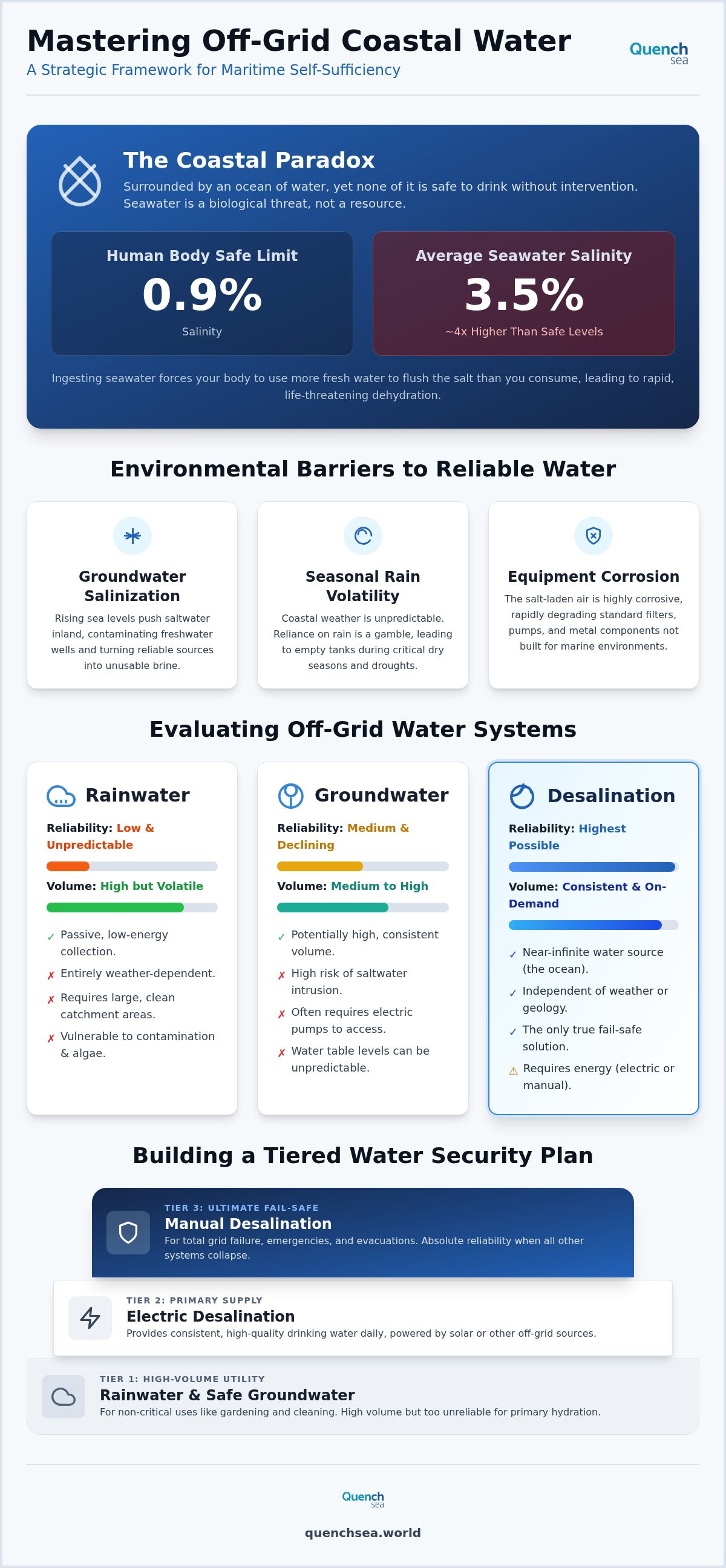
Living on the coast presents a unique engineering challenge often called the Coastal Paradox. You are surrounded by millions of gallons of water, yet none of it is biologically compatible with human life. Without a dedicated off grid coastal water solution, you are essentially stranded in a desert of liquid salt. The ocean is not a resource until it is processed. It is a hostile environment that demands mechanical intervention. Relying on the hope of consistent rain or stable groundwater is a tactical error in a maritime setting. You must understand the biological and environmental barriers before you can overcome them.
The primary obstacle is the metabolic cost of processing sodium. This is why drinking sea water is dangerous for the human body. When you ingest seawater, your system must expend more fresh water to flush out the salt than the volume you actually consumed. This creates a net loss of hydration. To survive, you need a clear overview of desalination processes to transform this abundant threat into a reliable asset. Traditional filtration won't work here. You need a system that addresses the molecular reality of salt.
The Salinity Trap: Why Saltwater Kills
Human cells operate through a delicate balance of osmosis. When high-salinity water enters your system, it creates an osmotic pressure gradient that pulls fresh water out of your cells and into the bloodstream. This process accelerates dehydration at a cellular level. Your kidneys are forced into overdrive to filter the excess sodium, but they have a hard physiological limit. Saline toxicity occurs when the salt concentration in your blood exceeds the kidneys' capacity to dilute it. For most humans, the safe limit for fluid intake is roughly 0.9% salinity. Since average seawater sits at 3.5%, the math of survival fails without mechanical desalination.
Environmental Barriers to Coastal Water
Establishing an off grid coastal water solution requires battling environmental hostility. Sea spray is a constant threat. It carries microscopic salt particles that corrode standard filtration housings and degrade mechanical seals. Equipment designed for inland use often fails within months of coastal exposure. You need hardware built for "survival-grade" durability.
- Groundwater Salinization: As sea levels rise and coastal aquifers are over-pumped, the "saltwater wedge" pushes further inland. This contaminates freshwater wells, turning a primary water source into a brine pit.
- Seasonal Rain Volatility: Coastal climates often swing between extreme humidity and prolonged droughts. Rainwater harvesting is a gamble that leaves your cisterns empty during the most critical times.
- Equipment Corrosion: The high-salt atmosphere creates a corrosive environment that eats through inferior plastics and metals.
Reliability requires a system that functions regardless of the weather or the state of the local water table. You cannot trust the environment to provide; you must engineer a way to take what you need from the sea itself.
Evaluating Off-Grid Coastal Water Systems: Rain, Ground, and Sea
Sourcing water on the coast requires a balance between volume and reliability. High-volume systems, like rainwater harvesting, are excellent for daily utility but are hostage to the weather. High-reliability systems, like desalination, provide a consistent baseline regardless of external conditions. A complete off grid coastal water solution integrates both to eliminate vulnerability. If you rely on a single method, you've already introduced a critical failure point into your survival plan. You must evaluate each system based on its mechanical resilience and energy requirements.
Rainwater Harvesting vs. Desalination
Rainwater is often the first choice for off-grid properties because it's passive. However, it's inherently unstable. Large catchment areas require significant space and constant maintenance to prevent organic contamination. If you live in an area with a six-month dry season, a 5,000-gallon tank is merely a countdown to a crisis. Algal blooms and sediment accumulation demand rigorous filtration. In contrast, desalination provides an infinite supply. While rainwater is a luxury of the seasons, desalination is a mechanical certainty. You don't need to wait for a storm when the ocean is at your doorstep. A secondary source isn't an option; it's a requirement for year-round security.
The Reliability Matrix: Electric vs. Manual
Complexity is the enemy of survival. Many modern off-grid setups favor solar-powered reverse osmosis (RO) systems. These are efficient until they aren't. A single fried circuit board or a depleted battery bank can render a $10,000 system useless. This is the "Single Point of Failure" (SPF). Manual systems bypass these risks. Understanding various manual desalination methods helps in choosing a system that balances complexity with survival needs. For those seeking a portable, hand-powered off grid coastal water solution, manual RO provides the ultimate fail-safe. It works when the grid is down and the batteries are dead.
The following table compares the primary systems used in maritime environments:
| System Type | Energy Input | Maintenance Level | Reliability |
|---|---|---|---|
| Rainwater Catchment | Passive (Weather) | High (Tank/Filter Care) | Low (Seasonal) |
| Electric Solar RO | Active (Solar/Battery) | High (Sensors/Motors) | Medium (SPF Risks) |
| Manual RO Device | Active (Human) | Low (Mechanical) | High (Fail-safe) |
Groundwater pumps offer another alternative, but they face the same electrical risks as solar RO. Furthermore, coastal wells are prone to saltwater intrusion as sea levels fluctuate. When the well turns brackish, only a desalination system can restore your supply. Relying on mechanical simplicity ensures that your water production is limited only by your own effort, not a technical malfunction.
The Critical Role of Manual Desalination in Off-Grid Reliability
Modern survival depends on mechanical simplicity. When the grid fails, your energy-dependent systems become dead weight. This is where a manual off grid coastal water solution transitions from a backup to a primary lifeline. It's about removing the middleman-the battery, the inverter, and the solar panel. If you can move your arm, you can produce water. This manual capability is the ultimate insurance policy against system-wide collapse. It turns a potential crisis into a manageable task.
The mechanics are straightforward but precise. A hand-powered pump generates the high pressure required to drive seawater through a semi-permeable membrane. For a deep dive into the engineering behind these tools, consult our survival desalination device technical guide. This process doesn't just filter; it desalinates at a molecular level. It's a reliable, repeatable method that yields hydration in minutes, not hours. Beyond the mechanical utility, there's a profound psychological benefit. Knowing you have a non-electric backup eliminates the fear of a total system failure. You aren't just surviving; you're maintaining control over your most basic need.
Why Mechanical Backups Save Lives
Mechanical backups save lives because they operate in the "Zero-Energy" zone. You don't need a clear sky or a gallon of diesel to survive. In corrosive coastal environments, salt air destroys circuit boards with surgical precision. Simple mechanical seals and rugged housings are far more resilient than sensitive electronics. Manual pressure overcomes osmotic resistance by physically forcing seawater through a molecular-grade barrier. This mechanical advantage ensures that your hydration is limited only by your physical output, not a blown fuse or a dead battery bank.
Manual RO vs. Traditional Distillation
Traditional distillation is an energy pit. Boiling water requires immense fuel or perfectly timed solar exposure. It's slow and tethered to a fixed location. Manual RO is different. It's built for movement. If you need to evacuate your coastal property, you can pack a manual device in a go-bag. Speed is a survival variable you can't ignore. Pumping is significantly faster than waiting for condensation. While a solar still might produce a few cups over a day, a manual RO unit produces liters in an hour. This efficiency makes it the superior off grid coastal water solution for high-stakes environments.
- Portability: Fits in a standard backpack for rapid evacuation.
- Speed: Immediate output without waiting for thermal cycles.
- Resilience: No electrical components to corrode or short circuit.
When you strip away the gadgets, you're left with what works. Manual desalination is the bedrock of a truly redundant water plan. It bridges the gap between high-tech comfort and survival-grade reality.
How to Build Your Tiered Coastal Water Security Plan
A single system is a single point of failure. True water security requires a tiered architecture. You need an off grid coastal water solution that scales from daily comfort to extreme survival. This plan prioritizes redundancy over convenience. It ensures your hydration remains intact when the primary infrastructure collapses. You don't wait for a crisis to build your defense. You engineer it now.
Step 1: Calculate your "Baseline Survival Volume." You must adhere to the rule of 3 survival to prioritize your physiological needs correctly. You can only survive three days without water. This is your non-negotiable limit. Every other system is secondary to this requirement.
Step 2: Install primary high-volume sourcing. Use rainwater catchment or solar-powered RO for daily utility. These systems handle the bulk of your needs during normal operations. They provide the volume necessary for a sustainable lifestyle but remain vulnerable to mechanical or weather-related failure.
Step 3: Establish storage and treatment protocols. Your cisterns must be sealed and treated to prevent biological contamination. Redundancy here means having multiple storage points to mitigate the risk of leaks or localized contamination. If one tank fails, the others must remain secure.
Step 4: Integrate a manual fail-safe. This is your last line of defense. It operates independently of the electrical grid or weather patterns. This complete off grid coastal water solution functions when all other systems fail. It is the only way to guarantee hydration during a total power outage or equipment breakdown.
Calculating Your Water Demand
Precision is vital. Survival mode requires approximately one gallon per person per day for drinking and basic sanitation. Off-grid living is different. It requires 10 to 20 gallons per day for hygiene, cooking, and maintenance. Factor in a 20% safety margin for equipment downtime. Filtration membranes eventually clog. Pumps require seal replacements. Your storage must bridge these maintenance gaps without compromising your baseline hydration. You aren't just planning for today; you're planning for the month your primary pump fails.
Setting Up the Redundancy Hierarchy
Chain your systems for maximum efficiency. Rainwater serves as the primary source when available. It flows into storage, then through filtration. When the rain stops, your solar RO takes over. If the power fails, you pivot to your manual backup. Mastering emergency seawater to drinking water techniques ensures you can deploy your fail-safe effectively. Your hierarchy should follow this logic:
- Rainwater: High-volume storage with UV or carbon filtration.
- Solar RO: Potable storage for direct consumption.
- Manual RO: Immediate survival hydration during total system failure.
Maintain a strict schedule. Inspect seals every three months. Test water quality monthly. Secure your fail-safe by investing in a survival-grade desalination device today. Redundancy is not a luxury; it is the difference between a functional property and a death trap.
QuenchSea 3.0: The Essential Fail-Safe for Coastal Survival
Redundancy is only as good as the hardware that supports it. When your solar array is buried under storm debris and your cisterns are contaminated, you need a solution that relies on nothing but your own effort. The QuenchSea 3.0 is the definitive off grid coastal water solution for those who refuse to leave their survival to chance. It is a tool designed for the "Last Line of Defense" scenario. This device eliminates the middleman of electricity, providing a direct mechanical path from the ocean to your glass. It is a survival-grade necessity for any maritime property.
Portability is a core requirement of modern preparedness. A fixed desalination system is a liability if you are forced to evacuate. The QuenchSea 3.0 transitions seamlessly from a coastal cabin setup to an emergency life raft or a mobile go-bag. It is compact enough for rapid transport but rugged enough for daily use. You don't just buy a filter; you invest in a mechanical guarantee of hydration. This is how you achieve true maritime self-sufficiency in an unpredictable world.
Engineering for Extreme Environments
Corrosion is the silent killer of coastal equipment. The QuenchSea 3.0 utilizes advanced, salt-resistant materials designed to withstand the relentless spray of the maritime zone. Every component, from the internal valves to the external housing, is engineered for durability. We have stripped away the unnecessary electronics that fail in high-humidity environments. The simplicity of the pump mechanism ensures that there are fewer parts to break and fewer points of failure. Manual pressure overcomes osmotic resistance by physically forcing seawater through a molecular-grade barrier. This mechanical advantage allows a single person to produce multiple liters of freshwater per hour, providing a sustainable baseline for survival without any external fuel or power source.
The Peace of Mind Factor
Every coastal property owner understands the fragility of the grid. Saltwater intrusion can ruin a well in hours, and a power surge can fry a solar inverter instantly. Having a manual desalinator in your emergency kit provides a psychological edge. It removes the fear of the "what if" by providing a "how to." Beyond individual use, this technology plays a critical role in humanitarian and disaster relief contexts. It provides clean water in areas where infrastructure has been completely erased. It is a tool of empowerment for travelers, professionals, and survivalists alike.
Don't wait for the next system failure to secure your water supply. Empower your off-grid journey with a mechanical guarantee. For a detailed breakdown of specifications and usage, consult our QuenchSea 3.0 Desalination Device buyer's guide. This is your ultimate off grid coastal water solution, built for the realities of 2026 and beyond. Take control of your hydration and ensure your independence from a fragile world.
Engineering Your Water Independence
Coastal survival is a matter of mechanical redundancy. You have learned that relying on a single, energy-dependent system is a tactical error. A robust off grid coastal water solution requires a tiered approach that prioritizes manual reliability over automated convenience. By calculating your baseline needs and layering high-volume sourcing with a fail-safe backup, you eliminate the threat of total system collapse. You're no longer at the mercy of a fragile grid or unpredictable weather patterns. Control is yours to maintain.
The QuenchSea 3.0 provides the mechanical certainty required for extreme environments. It utilizes manual reverse osmosis to deliver hydration without batteries or fuel. This is survival-grade durability built for 2026 and beyond. It's the same technology trusted by defense and emergency relief teams worldwide. You can now transition from a state of vulnerability to one of absolute preparedness. Your water security is in your own hands.
Secure your off-grid water supply with the QuenchSea 3.0 and ensure your maritime self-sufficiency remains unbreakable. Stay prepared. Stay hydrated. Stay independent.
Frequently Asked Questions
Can a manual water maker provide enough water for a family off-grid?
A manual water maker provides enough for baseline survival needs. While high-volume solar systems handle laundry and showers, a manual device like the QuenchSea 3.0 produces enough drinking water for a small family. It requires consistent physical effort to meet these demands. It serves as the ultimate insurance policy when primary systems fail. You can produce liters of water every hour with steady pumping.
Is it better to have a solar-powered system or a manual one for coastal living?
You should utilize both. Solar systems provide high volume but rely on fragile electronics and battery banks. A manual off grid coastal water solution offers absolute reliability regardless of technical failures. It doesn't care about cloud cover or battery health. If you live on the coast, you need a mechanical fail-safe that works when the grid is dead and the sun isn't shining.
How often do the filters in a manual desalination device need to be replaced?
Replacement frequency depends on the turbidity of your source water. Under normal conditions, pre-filters should be checked frequently to protect the RO membrane from sediment and organic matter. Using clean, settled seawater significantly extends the life of your components. Always keep spare membranes and pre-filters in your emergency kit. This ensures continuous operation during prolonged crises when supply chains are disrupted.
What happens if you drink ocean water in a survival situation?
Drinking untreated ocean water triggers rapid dehydration. The high salt concentration forces your kidneys to use more water for excretion than you actually consumed. This creates a net fluid loss and pulls water directly from your cells. Mechanical desalination is the only way to make seawater biologically compatible. Without it, ingestion leads to organ failure and death in a survival situation.
Can I use a manual desalinator for brackish well water as well as seawater?
Yes, manual RO devices are highly effective for brackish water sources. Brackish water has a lower salt concentration than full seawater. This means the pump requires less physical pressure to overcome osmotic resistance during the filtration process. It is an excellent way to salvage water from contaminated or salinized coastal wells. This makes it a versatile part of any off grid coastal water solution for remote properties.
How much physical effort is required to operate a hand-powered RO device?
Operating a hand-powered RO device requires steady, rhythmic pumping. You must maintain specific pressure levels to force water through the desalination membrane. It is a physical task, but the mechanism is engineered for maximum leverage and efficiency. A single operator can produce a sustainable volume of water without needing extreme athletic ability. It is designed for use by anyone in an emergency scenario.
Is the water produced by manual desalination safe for long-term consumption?
RO water is chemically and biologically safe because it removes the vast majority of contaminants. It is free from bacteria, viruses, and dissolved salts. For long-term consumption, many users choose to add minerals back into the water for taste and electrolyte balance. It remains the gold standard for pure, safe hydration in remote environments where traditional water sources are compromised or non-existent.
What is the best way to store desalinated water for off-grid use?
Store your produced water in food-grade, opaque containers. Coastal environments are high-heat and high-UV, which can degrade water quality quickly. Sunlight triggers algal growth in clear tanks, making the water unsafe. Use sealed containers to prevent salt air or insects from contaminating your supply. Rotate your stored water regularly to maintain freshness and ensure it is ready for immediate use during an emergency.