

In a maritime emergency, the ocean is a desert. You are surrounded by water you cannot drink, and your survival depends on a mechanical victory over osmotic pressure. It's a high-stakes reality where gear failure isn't an option. You likely distrust complex electronic water makers that rely on fragile circuitry or finite battery life. You need a solution that works every time you pull the handle.
This guide explains how a manual water purifier for saltwater turns life-threatening brine into safe, WHO-standard drinking water using only human power. We'll examine the engineering behind the QuenchSea 3.0, a device capable of 98% salt rejection and a reliable output of 5 to 8 liters per hour. You'll discover the physics of manual reverse osmosis, learn why triple pre-filtration is critical for membrane longevity, and gain the confidence to select a backup system that prioritizes mechanical integrity over digital fluff. We are stripping away the complexity to focus on what truly works when the stakes are highest.
Key Takeaways
- Understand the mechanical physics required to overcome 60 bar of osmotic pressure using human-powered lever systems.
- Discover why a manual water purifier for saltwater offers superior reliability and faster output compared to solar stills or complex electronic water makers.
- Learn critical field tactics for source water selection and system priming to protect your RO membrane from sand and silt.
- Explore the performance metrics of the QuenchSea 3.0, which produces 5 to 8 liters of safe drinking water per hour without fuel or batteries.
- Verify how modern portable desalination achieves 98% salt rejection to meet World Health Organization safety standards for total dissolved solids.
What is a Manual Water Purifier for Saltwater?
A manual water purifier for saltwater is a precision-engineered mechanical tool designed to solve the most lethal paradox of the ocean: being surrounded by water you cannot drink. Unlike standard hiking filters that rely on gravity or low-pressure suction, these devices use mechanical force to drive raw seawater through a semi-permeable membrane. This process, known as reverse osmosis, is the gold standard for desalination. It doesn't just strain out dirt; it physically strips dissolved salt ions from water molecules to create safe, potable hydration.
In a survival context, drinking untreated seawater leads to hypernatremia, commonly called "dehydration by salt." When you ingest high-salinity water, your kidneys must utilize more freshwater to flush the salt out than you actually consumed. This triggers a rapid, downward spiral of cellular dehydration. A manual RO system stops this cycle by delivering water that meets World Health Organization (WHO) safety standards, typically reducing total dissolved solids (TDS) to below 1,000 mg/L.
Why Standard Filters Fail in the Ocean
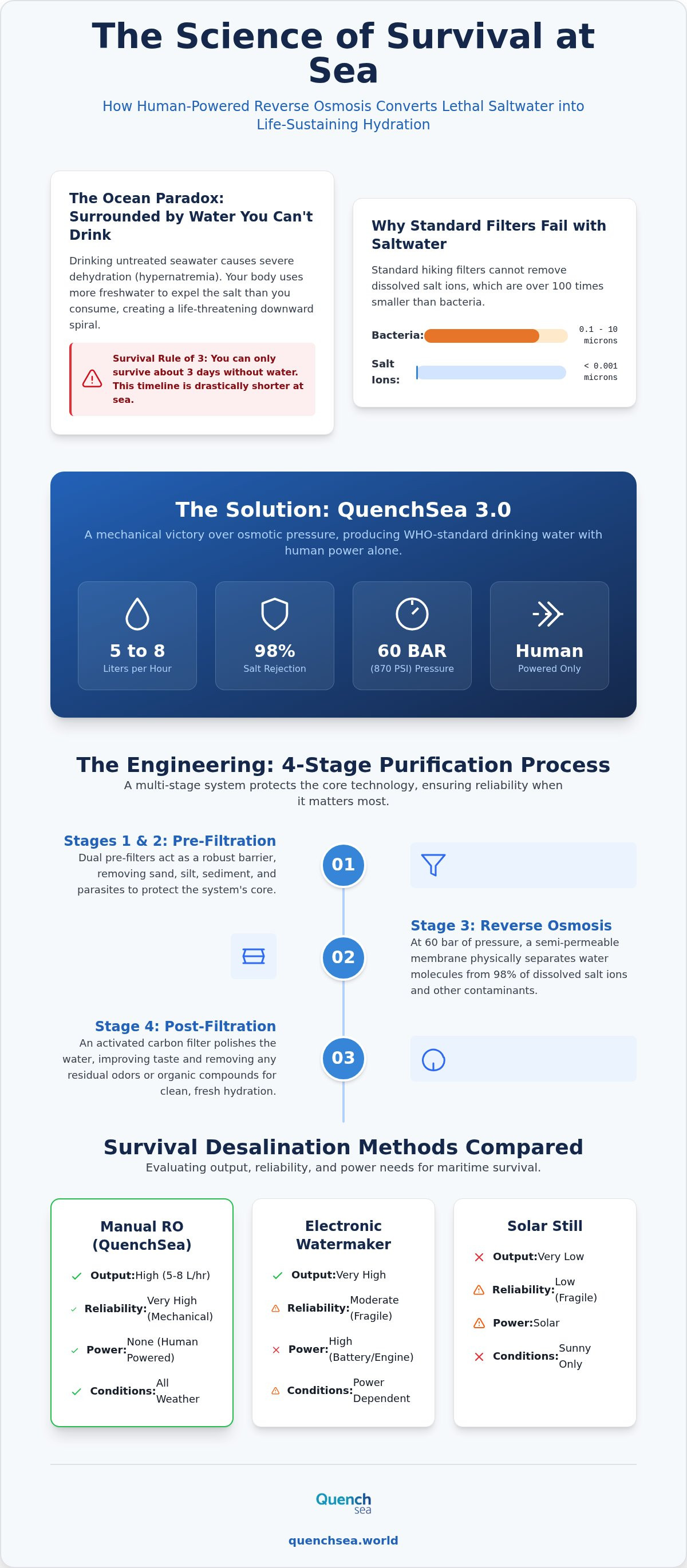
Standard micro-filters are designed to trap biological threats like bacteria and protozoa. These contaminants typically measure between 0.1 and 10 microns. Dissolved salt ions are significantly smaller, often measuring less than 0.001 microns. They pass through standard survival filters effortlessly. This nano-scale challenge is the primary reason you cannot use a "Lifestraw" style device on the coast.
Furthermore, seawater possesses high osmotic pressure that naturally resists filtration. To understand How Manual Reverse Osmosis Works, you must recognize that it requires significant pressure to reverse the natural flow of water toward higher salt concentrations. Boiling seawater is equally dangerous; without a professional distillation setup to capture steam, boiling merely evaporates the pure water and leaves behind a concentrated, toxic brine. Only a dedicated manual water purifier for saltwater can overcome these physical barriers through mechanical leverage.
The Role of Manual RO in Marine Safety
The "Rule of 3" in survival states that you can only last three days without water. At sea, sun exposure and wind-driven evaporation accelerate this timeline. Historically, sailors relied on bulky, fragile solar stills that produced negligible amounts of water and required perfect weather. Modern survival desalination devices have redefined maritime safety by providing a high-volume source of hydration that functions regardless of cloud cover or battery life.
These devices bridge the critical gap between a life raft and a rescue vessel. They provide a predictable output of 5 to 8 liters per hour, ensuring that thirst never becomes the primary cause of casualty. By prioritizing mechanical integrity over complex electronics, these purifiers offer a "last-mile" survival tool that works when every other system fails. They are compact, rugged, and essential for anyone operating beyond the reach of immediate land-based support.
The Engineering: How Manual Reverse Osmosis Works
Desalination is a battle against thermodynamics. To extract freshwater from the ocean, a manual water purifier for saltwater must overcome a 60 bar (6,000 kPa) pressure threshold. This is roughly 870 psi, or twenty times the pressure of a standard car tire. At this intensity, the device forces water molecules through a semi-permeable membrane while rejecting 98% of dissolved salts. This precision engineering ensures the output stays below the World Health Organization limit of 1,000 TDS, transforming toxic brine into life-sustaining hydration.
Human arms cannot generate 60 bar of pressure through direct force. Engineering solves this via hydraulic leverage. High-ratio lever systems translate a manageable 10 to 15 kg of handle force into the extreme internal pressure required for reverse osmosis. This mechanical advantage allows a single operator to maintain a steady output of 5 to 8 liters per hour. To maintain this efficiency, the device utilizes a triple filtration architecture. This protects the delicate RO membrane from sediment, microplastics, and bio-fouling, which would otherwise cause immediate mechanical failure.
The 4-Stage Purification Process
Reliability in the field depends on a sequential, multi-stage approach to water quality. The process follows a linear progression to ensure the RO membrane remains unobstructed:
- Stages 1 & 2: Pre-filtration stages remove suspended solids, sand, and parasites. These stages act as a sacrificial barrier for the more expensive components.
- Stage 3: This is the heart of the system. The high-pressure RO membrane blocks salt ions at the molecular level, allowing only pure H2O to pass.
- Stage 4: Post-filtration polishes the water, ensuring it is ready for immediate consumption.
Energy Recovery: Reducing the Physical Burden
Sustaining 5 to 8 liters of output per hour requires significant physical labor. Modern engineering reduces this burden by reusing waste pressure. In a standard system, the high-pressure brine (the salt concentrated water) is simply vented. However, advanced models capture this "spent" pressure to assist the next intake stroke. This mechanical recycling makes the QuenchSea 3.0 significantly easier to operate during long-duration survival scenarios.
An Energy Recovery Device is a mechanical component that captures the hydraulic energy of high-pressure reject brine to assist the operator's pumping stroke. By integrating this technology, the physical effort required to desalinate water drops by up to 30%. This ensures that even a dehydrated or weakened survivor can maintain the necessary flow rate to stay alive without reaching total physical exhaustion.
Comparing Desalination Methods: Manual RO vs. Alternatives
Survival efficiency is a numbers game. When selecting a manual water purifier for saltwater, you must weigh mechanical output against physical effort and environmental conditions. Passive systems like solar stills rely on evaporation, while chemical treatments target biological threats. Neither can match the high-volume, reliable output of manual reverse osmosis. In extreme environments, the difference between these methods is the difference between sustainable hydration and rapid physiological decline.
Chemical desalination is a common misconception in marine survival. Standard purification tablets or UV pens neutralize bacteria and viruses; they do nothing to remove dissolved salt ions. Ingesting "clean" saltwater still leads to hypernatremia and organ failure. Similarly, weight and portability are critical trade-offs. Carrying 20 liters of bottled water adds 20 kilograms to your gear and provides only a few days of hydration. A 1.1 kg manual RO device provides an effectively infinite supply as long as you have access to the sea.
Solar Stills: The Passive Alternative
Solar stills are often marketed as the ultimate low-effort solution. They use the sun's energy to evaporate pure water from brine, collecting the condensate in a reservoir. While they require zero physical labor, their output is dangerously slow. Under ideal, cloudless conditions, a standard inflatable solar still produces roughly 0.5 to 1 liter of water per day. This fails to meet the basic biological requirement of 2 to 3 liters needed to maintain cognitive function and physical strength.
Relying on solar stills introduces climate dependency into a life-critical situation. If it's overcast, raining, or dark, your water production stops. A manual RO system functions 24/7, regardless of weather. Use solar as a secondary backup to supplement your supply, but prioritize manual RO as your primary lifeline.
Electric vs. Manual: The Yachtsman's Dilemma
High-tech yachts often feature sophisticated electric water makers capable of producing hundreds of liters daily. However, these systems are vulnerable to battery depletion, motor failure, and electrical shorts in corrosive salt air. This is why manual boat water makers are mandatory equipment for serious offshore sailors. If your primary power grid fails, your hydration shouldn't fail with it.
The most critical argument for manual gear is the "Grab Bag" scenario. If you are forced to abandon ship, your fixed electric water maker stays with the vessel. A portable, hand-powered device is small enough to fit into an emergency life raft kit. It provides a mechanical guarantee of water that doesn't depend on a functioning engine or a full battery bank. It's the only tool that ensures you stay hydrated until rescue arrives.
Tactical Operation: Using a Manual Purifier in the Field
Deploying a manual water purifier for saltwater in a survival scenario requires more than physical strength; it demands tactical discipline. Your first priority is source water selection. Avoid the shoreline whenever possible. Breaking waves stir up sand, silt, and organic debris that overwhelm pre-filters and abrade the RO membrane. If you are land-bound, collect water in a container and allow it to settle for 30 minutes before intake. Open ocean water is significantly cleaner and extends the operational life of your consumables.
System priming is the next critical step. Airlocks within the pump housing prevent the device from reaching the pressure threshold required for desalination. Ensure the intake hose is fully submerged and pump slowly until you feel consistent mechanical resistance. If the handle feels spongy, check for seal leaks or loose fittings. If the handle becomes nearly impossible to move, your membrane is likely fouled by sediment or bio-matter.
Maintenance doesn't end when the bucket is full. For long-term storage, you must "pickle" the device. This involves flushing the system with a preservative solution to prevent bacterial growth and membrane decay. Without this step, residual salt and organic matter will destroy the internal components within weeks. Regular seal lubrication is also essential to maintain the hydraulic integrity of the pump.
Maximizing Membrane Life
Turbidity is the primary killer of portable RO systems. Murky coastal water requires additional pre-filtration layers to protect the primary membrane. After every session, perform a freshwater flush. Use the last half-liter of purified water to rinse the system. This prevents salt crystals from forming inside the membrane pores as the device dries. Additionally, be aware of temperature effects. Cold seawater is more viscous and requires more physical effort to pump than warmer tropical waters.
Biological Safety Standards
Safe hydration is measured by Total Dissolved Solids (TDS). The QuenchSea 3.0 is engineered to maintain 98% salt rejection, keeping the output below the WHO limit of 1,000 TDS. This process also provides ultra-filtration, removing microplastics and pathogens that standard filters miss. Drinking sea water is dangerous because the high salinity triggers a net loss of bodily fluids, causing lethal dehydration. Ensure your gear is mission-ready and order the QuenchSea 3.0 for your emergency kit.
QuenchSea 3.0: The Standard for Portable Desalination
The QuenchSea 3.0 is a mechanical breakthrough in survival hardware. It is a rugged, compact, and highly efficient manual water purifier for saltwater designed for the most demanding environments on earth. We built this device using reinforced high-impact polymers and industrial-grade RO membranes. It withstands the corrosive reality of long-term marine exposure without failure. It delivers a consistent output of 5 to 8 liters per hour. This performance isn't a projection; it's a result of calculated hydraulic ratios. This tool serves humanitarian relief teams and elite marine safety professionals alike. It prioritizes mechanical integrity over digital complexity.
Every design choice focuses on the survivor's immediate needs. The device weighs only 1.1 kg, making it light enough for any grab bag but durable enough for daily use. The industrial RO membrane is the heart of the unit, rejecting 98% of salt and pollutants. It turns life-threatening seawater into safe, WHO-standard drinking water using only human power. This is the new standard for portable desalination.
Why QuenchSea 3.0 is the Choice for 2026
In 2026, the cost-to-output ratio has become the defining metric for survival gear. QuenchSea 3.0 makes professional-grade desalination accessible for every life raft and emergency kit. In high-stress scenarios, cognitive function drops. This is why the device features clear pictorial instructions directly on the housing. It ensures that even an untrained or panicked survivor can produce potable water in seconds. This reliability has led to its integration into global disaster relief water supply chains. In these environments, last-mile survival depends on hardware that doesn't require a power grid or fuel.
Conclusion: Preparedness is a Mechanical Choice
Survival has shifted from passive waiting to active mechanical intervention. You no longer need to rely on the hope of rain or the slow drip of a solar still. Choosing a high-performance manual water purifier for saltwater is a calculated decision to control your own hydration. Before you head offshore, verify your gear with this final checklist:
- Confirm you have at least two spare pre-filters in your kit.
- Check that all seals are lubricated and the handle moves smoothly.
- Ensure the intake hose is clear of obstructions and the weights are attached.
- Verify you have a TDS meter to monitor the 98% salt rejection rate.
The ocean is unforgiving. Your hydration system should be the opposite. Don't wait for a crisis to realize your emergency supplies are insufficient. Secure your QuenchSea 3.0 Desalination Device today and ensure you have a mechanical guarantee of survival.
Master Your Marine Survival Strategy
Hydration at sea is a mechanical challenge that demands a mechanical solution. You've seen the physics behind high-pressure salt rejection and the tactical limitations of passive solar alternatives. Reliability comes down to hardware that functions without a power grid or clear skies. A manual water purifier for saltwater is no longer a luxury for elite vessels; it's an essential last-mile survival tool for any offshore journey.
The QuenchSea 3.0 delivers a calculated 98% salt rejection and a steady output of 5 to 8 liters per hour. It provides a reliable stream of potable water when electronic systems fail or batteries deplete. This engineering has earned recognition from Wired, Gizmodo, and CNN for its mission-driven design and rugged durability. When the stakes are life-critical, you need gear that prioritizes functionality over fluff.
Don't leave your safety to chance or unpredictable weather patterns. Take control of your emergency preparedness with a device built for the harshest environments on earth. Equip your emergency kit with the QuenchSea 3.0 Desalination Device. Stay prepared, stay hydrated, and navigate with confidence.
Frequently Asked Questions
Can you drink salt water if you boil it first?
No, you cannot drink saltwater simply by boiling it. Boiling kills biological pathogens but does nothing to remove dissolved minerals. In fact, boiling seawater without a distillation apparatus to capture the steam actually increases the salt concentration as pure water evaporates. To safely hydrate, you must use a manual water purifier for saltwater that utilizes reverse osmosis technology to physically separate salt ions from water molecules.
How much physical effort does a manual water purifier for saltwater require?
Operating a manual water purifier for saltwater requires consistent physical effort, but it's engineered for manageability. The QuenchSea 3.0 uses a high-ratio lever system to translate roughly 10 to 15 kg of handle force into the 60 bar of pressure needed for desalination. While it's a workout, the hydraulic advantage allows an average adult to maintain a steady output of 5 to 8 liters per hour without reaching total physical exhaustion.
How long does the RO membrane last in a manual desalinator?
The lifespan of an RO membrane depends heavily on source water quality and maintenance discipline. In ideal conditions with proper pre-filtration, a membrane can process thousands of liters. However, sand, silt, or salt crystallization cause premature fouling. Performing a freshwater flush after every use and using "pickling" solutions for long-term storage are the most effective ways to maximize the operational life of your survival hardware.
Does the QuenchSea 3.0 remove bacteria and viruses too?
Yes, the QuenchSea 3.0 provides comprehensive biological protection. The reverse osmosis membrane features a pore size of approximately 0.0001 microns. This is significantly smaller than bacteria, viruses, and microplastics. While the primary mission is desalination, the system effectively acts as an ultra-filtration device. It ensures your hydration is free from both chemical salinity and biological pathogens found in raw seawater or coastal environments.
Can I use a manual saltwater purifier on brackish water or lakes?
You can use a manual RO device on brackish water or freshwater lakes, but you must prioritize pre-filtration. Brackish water actually requires less physical effort to pump because it has lower osmotic pressure than the open ocean. However, lakes and shorelines often contain higher levels of silt and organic tannins. These particles clog the triple pre-filtration stage quickly, so always select the clearest source water available to protect the membrane.
Is the water produced by manual RO safe for long-term consumption?
Water produced by manual reverse osmosis is safe for consumption because it meets World Health Organization standards of less than 1,000 TDS. However, RO water is highly purified and lacks the essential minerals found in typical groundwater. For short-term survival, this isn't an issue. For long-term use exceeding several weeks, survivors should ideally supplement their diet with electrolytes to compensate for the lack of minerals in the desalinated water.
What is the difference between a water filter and a desalinator?
The fundamental difference lies in the size of the contaminants they remove. A standard water filter uses porous media to trap bacteria and protozoa, which are relatively large. A desalinator must remove dissolved salt ions that are thousands of times smaller. This requires a specialized semi-permeable membrane and high-pressure mechanics to overcome osmotic pressure. Most survival "purifiers" are actually just filters and won't remove salt.
How do I store the device when it's not in use?
Proper storage is critical to prevent membrane decay. If the device will be inactive for more than a few days, you must perform a "pickling" procedure. This involves flushing the system with a preservative solution to inhibit bacterial growth and keep the membrane moist. Never store the unit with raw seawater inside. Residual salt will crystallize and puncture the membrane, rendering the device useless for your next emergency deployment.