

Your standard survival straw is a death sentence in the middle of the ocean. It's a hard truth, but most portable filters are built for mountain streams, not the crushing osmotic pressure of the Pacific. To survive at sea, you need a dedicated hand operated water purifier for seawater that relies on physics rather than just mesh. You shouldn't have to bet your life on a battery that might fail or a device that isn't rated for salt.
We understand the anxiety of watching a boat's electrical system go dark while you're miles from the coast. You need equipment that works when everything else breaks. This article explores the mechanical reality behind manual desalination and explains how a high-engineered lever generates the 60 bar of pressure required to strip salt from brine. We'll break down the physics of manual reverse osmosis and show you how to choose a survival-grade tool that fits into a bug-out bag without weighing you down. It's time to replace skepticism with mechanical certainty.
Key Takeaways
- Learn why standard filters fail in marine environments and why a dedicated hand operated water purifier for seawater is the only tool capable of removing dissolved salts.
- Understand the hydraulic engineering required to reach the 60 bar pressure threshold using nothing but human arm strength.
- Identify the performance benchmarks for safe hydration, specifically the 98% salt rejection rate needed to meet WHO drinking water standards.
- Discover the essential design features, from triple pre-filtration to corrosion-resistant materials, that ensure mechanical reliability in extreme conditions.
- Evaluate how modern manual desalinators provide a high-volume, non-electric freshwater source that fits inside a standard survival ditch bag.
What is a Hand Operated Water Purifier for Seawater?
A hand operated water purifier for seawater is a specialized survival tool engineered to overcome the chemical bond of salt in ocean water. Unlike a standard filter that traps sediment or bacteria, this device is a portable desalination unit. It uses physical force to drive seawater through a semi-permeable membrane at high pressure. This process, known as Reverse Osmosis (RO), is the only reliable way to produce hydration from the ocean without electricity or fuel.
In a maritime emergency, your survival depends on mechanical reliability. Standard filters are designed for fresh water; they cannot stop dissolved salts. A manual desalinator acts as a biological and chemical shield. It strips away sodium, magnesium, and other minerals that would otherwise lead to rapid organ failure. These devices are now a standard component of modern maritime safety, providing a redundant water source when shipboard desalination systems fail.
The Critical Difference: Desalination vs. Filtration
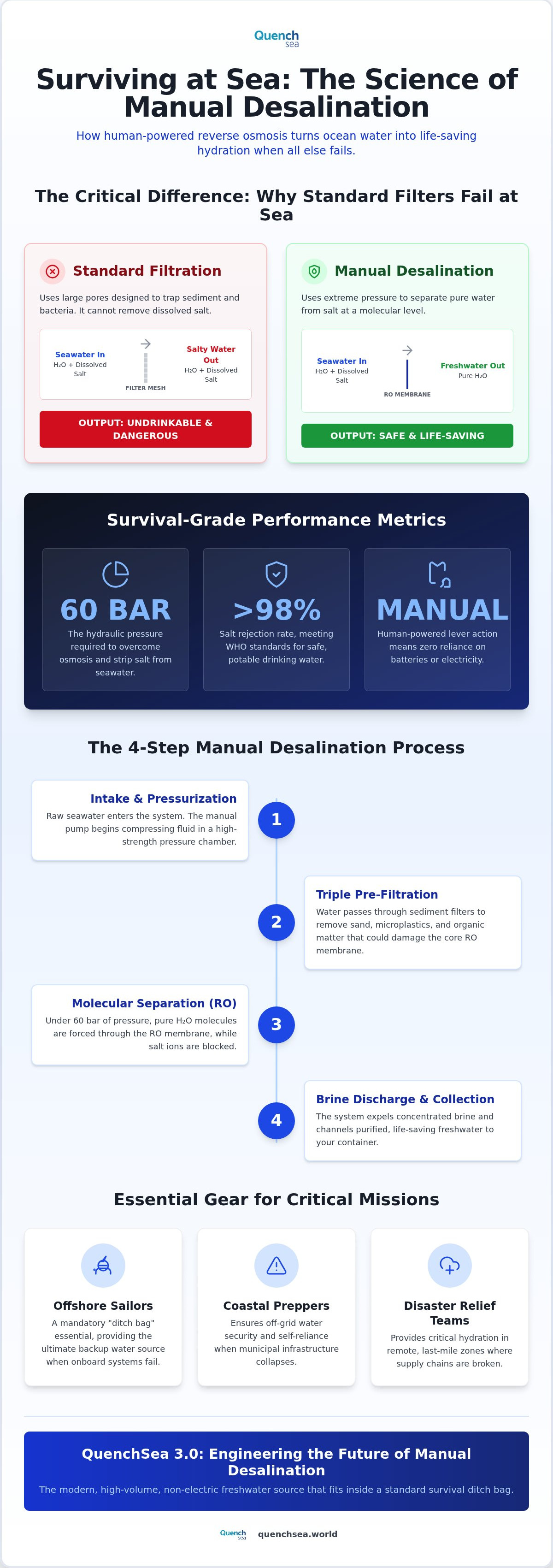
The distinction between filtration and purification is life-critical. Standard carbon or ceramic filters utilize pore sizes measured in microns to catch pathogens. However, salt molecules are significantly smaller than the gaps in these filters. Using a freshwater straw on the ocean is useless. The salt passes through the mesh entirely, leaving the water just as toxic as it was before.
Drinking untreated seawater is a death sentence. It triggers a biological crisis where the body attempts to flush out excess salt by pulling moisture from its own cells. You can read more about why is drinking sea water dangerous to understand this physiological collapse. While some suggest boiling seawater, distillation is almost impossible in a life raft. It requires massive energy and creates heat that increases perspiration. A manual purifier solves this by using cold, mechanical pressure to achieve the same result with zero fuel.
Who Needs a Manual Seawater Purifier?
Reliability is the primary requirement for anyone operating in extreme environments. This hardware is built for those who cannot afford a power failure. Three main groups rely on this technology:
- Offshore Sailors: A manual desalinator is a mandatory "ditch bag" essential. If the boat's primary watermaker or electrical system fails, this becomes the sole source of hydration.
- Coastal Preppers: Survivalists located near the coast prioritize these devices for off-grid security. They provide a predictable water supply when municipal infrastructure collapses.
- Disaster Relief Teams: Humanitarian and defense units use manual purifiers in last-mile zones. They are often the only way to provide water when logistics chains are broken.
A hand operated water purifier for seawater eliminates the "single point of failure" risk. It transforms a hostile environment into a sustainable one through pure mechanical advantage.
The Mechanics of Manual Reverse Osmosis (MROD)
Desalination is a mechanical victory over the laws of nature. To move water against its natural gradient, you must apply force that exceeds its osmotic pressure. For standard seawater, this threshold is approximately 60 bar (6,000 kPa). A hand operated water purifier for seawater achieves this through a sophisticated hydraulic system that translates human motion into immense internal pressure. This level of mechanical precision is comparable to the specialized separation technologies developed by Sacor Engineering for large-scale industrial use. Without this specific mechanical advantage, the RO membrane remains a wall rather than a gateway. It's a calculated engineering solution for a high-stakes environment.
Modern manual desalinators follow a precise, linear progression to ensure water safety and system longevity. Each step is critical to the final output:
- Step 1: Intake and hydraulic pressurization. Raw seawater enters the system through a suction hose. The manual pump begins the process of compressing this fluid within a specialized pressure chamber.
- Step 2: Pre-filtration. Before reaching the RO membrane, water passes through a series of sediment filters. These remove microplastics, sand, and parasites that would otherwise cause membrane fouling.
- Step 3: Molecular separation. Under 60 bar of pressure, pure H2O molecules are forced through the microscopic pores of the semi-permeable membrane. Dissolved salts and contaminants are left behind.
- Step 4: Brine discharge and freshwater collection. The system separates the streams. Concentrated brine is expelled back into the ocean, while life-saving freshwater is diverted to your collection vessel.
Engineering the Manual Lever
Manual reverse osmosis is the process of using mechanical pressure to overcome the osmotic pressure of seawater. Engineering a device to perform this task requires a deep understanding of leverage and ergonomics. By optimizing the lever length and pivot points, engineers allow a user to generate 60 bar of internal pressure using roughly 10kg of downward force. This mechanical multiplication is what makes survival possible for a single person in a life raft without relying on external power.
Physical fatigue is the primary enemy during long-term survival. High-performance devices often incorporate energy recovery systems to mitigate this. These systems capture the high-pressure energy from the rejected brine and use it to assist the next pumping stroke. This innovation significantly reduces the physical effort required to maintain a steady flow. When evaluating Performance Realities: Salt Rejection and Flow Rates, it's clear that energy recovery is the difference between sustainable hydration and physical exhaustion.
Reliability depends on this mechanical integrity. If you're building a ditch bag or prepping for off-grid coastal living, choosing a device like the QuenchSea 3.0 ensures you have a tool designed specifically for these high-pressure demands. It’s about having a predictable outcome when every other system fails.
Performance Realities: Salt Rejection and Flow Rates
Survival hydration is a calculation of energy ROI. When you're adrift, every calorie you expend must yield a measurable return in hydration. The primary metric for success is Total Dissolved Solids (TDS). Average seawater contains roughly 35,000 parts per million (ppm) of dissolved salts. To make this water potable, a hand operated water purifier for seawater must reduce that concentration to below 1,000 ppm. This isn't a suggestion; it's a physiological requirement to prevent kidney failure and dehydration.
The 98% salt rejection benchmark is the engineering gold standard for manual desalination. Meeting World Health Organization (WHO) standards means the device effectively strips away the mineral load that makes ocean water toxic. Modern membranes achieve this by acting as a molecular sieve. They allow water molecules to pass while rejecting the larger sodium and chloride ions. If a device can't hit this 98% threshold, it's a filter, not a survival-grade desalinator.
Yield vs. Effort: The Survival Equation
Production volume is where engineering meets human endurance. A high-performance manual desalinator should produce between 5 and 8 liters of freshwater per hour. This is the "survival sweet spot." While an average adult needs 2 to 3 liters of water daily to maintain basic function, extreme marine environments often double that requirement due to heat and exertion.
Efficiency matters. In a real-world scenario, you can expect to pump for approximately 15 to 20 minutes to produce one liter of water. This physical investment has a secondary psychological benefit. It provides a structured, life-sustaining task that combats the mental fatigue of being lost at sea. You aren't just waiting for rescue; you're actively securing your survival through mechanical work.
Water Quality Standards
Potability in 2026 is defined by more than just salt levels. Maritime regulations and health standards require that drinking water be free of biological threats. A high-quality RO membrane doesn't just stop salt. Its pore size is so small that it also blocks viruses, bacteria, and cysts. This creates a sterile hydration source even in contaminated coastal waters.
For a deeper look at the technical specs required for emergency use, see our guide on the survival desalination device. This resource breaks down the specific hydration requirements for various ocean conditions. When you're choosing hardware, don't settle for "good enough." Look for a device that delivers consistent, laboratory-verified results under manual power. Your life depends on the integrity of that membrane and the efficiency of the pump.
Critical Selection Criteria for Survival Purifiers
Selecting survival hardware isn't about comparing features. It's about identifying failure points. In a marine environment, saltwater is the primary antagonist. It destroys standard hardware through rapid corrosion and mineral buildup. You need a hand operated water purifier for seawater built with a "no-fail" mindset. This requires a strategic mix of marine-grade stainless steel for high-pressure components and high-grade polymers for the chassis to minimize weight without sacrificing structural integrity.
Field-serviceability is another non-negotiable factor. If a device requires specialized tools for maintenance, it's a liability in a ditch bag. Survival-grade engineering prioritizes a "no extra parts to lose" design. You should be able to flush the system, inspect the seals, and replace the pre-filters by hand in a moving life raft. Reliability is the only metric that matters when help is days away.
Pre-Filtration: The Membrane’s Bodyguard
The RO membrane is the most delicate and expensive component of any desalinator. In 2026, ocean water is increasingly contaminated with microplastics, organic silt, and parasites. These contaminants act as membrane killers by causing rapid fouling. A single-stage filter isn't enough to protect your investment or your life.
Look for a device that utilizes triple pre-filtration. This stage must include ultra-filtration and micro-filtration to catch suspended solids before they reach the high-pressure chamber. By stripping out these particles early, you extend the life of the RO membrane and ensure a consistent flow of freshwater. Effective pre-filtration is the difference between a tool that works for an hour and one that works for a month.
Portability and Storage
If a device is too heavy to carry, it's not a survival tool. While some heavy-duty units weigh over 6kg, the ideal weight for a civilian emergency kit is significantly lower. A compact device allows it to fit into a bug out bag water desalination kit without compromising space for medical supplies or rations. Every gram counts when you're moving toward safety.
Storage requirements are equally critical for long-term readiness. RO membranes must remain moist to maintain their molecular structure. High-quality purifiers feature integrated sealing caps that prevent the membrane from drying out during long periods of storage. Furthermore, in high-stress disaster relief water supply operations, pictorial instructions are essential. Language-independent guidance ensures that any operator, regardless of their background or stress level, can produce life-saving water immediately.
Invest in hardware that meets these rigorous engineering standards. For a reliable, high-volume solution that fits in any ditch bag, consider the QuenchSea 3.0.
QuenchSea 3.0: Engineering the Future of Manual Desalination
Historically, manual desalination was reserved for military budgets or high-end yachting kits. The QuenchSea 3.0 eliminates this "cost vs. performance" barrier. It provides professional-grade technology at a fraction of the traditional price point. This hand operated water purifier for seawater delivers a consistent output of 5-8 liters per hour with a 98% salt rejection rate. It's not just a backup; it's a primary survival tool designed for the harshest marine environments. By optimizing the hydraulic architecture, we've created the definitive manual reverse osmosis seawater solution.
Engineering for survival means stripping away complexity. Every added component is a potential failure point. The QuenchSea 3.0 relies on pure mechanical force. It requires no batteries, no fuel, and no electronics to function. This makes it an essential asset for offshore sailors, coastal preppers, and humanitarian teams who operate where power is non-existent. It’s a hardware-focused answer to a biological necessity.
Robust Design for Extreme Conditions
Survival gear must survive the environment it's intended to solve. We build the QuenchSea 3.0 using high-impact materials specifically selected for life raft conditions. It resists UV degradation and withstands the corrosive effects of constant salt spray. The device is compact enough for a ditch bag but powerful enough for sustained use. The QuenchSea 3.0 is a survival-grade tool that provides up to 192 liters of water per day in ideal conditions. This volume ensures that even a small group can maintain hydration levels during a multi-day emergency at sea.
Global Impact and Accessibility
Our vision extends beyond individual preparedness. We're actively redefining life raft water supply standards on a global scale. Access to clean water is a human right, yet millions live in coastal areas with limited freshwater infrastructure. By providing a low-cost, high-volume hand operated water purifier for seawater, we're empowering communities to face disaster with confidence.
The mission is ambitious. We've partnered with international relief organizations to distribute 100 million devices by 2035. This initiative focuses on last-mile survival in disaster zones where traditional aid cannot reach. Reliability shouldn't be a luxury. It should be a standard piece of equipment for anyone near the ocean. Order the QuenchSea 3.0 for your emergency kit today.
Mastering Maritime Autonomy
Survival at sea is a matter of mechanical certainty. Relying on fragile electrical systems or inadequate freshwater filters is a risk you can't afford in extreme environments. A high-engineered hand operated water purifier for seawater transforms the ocean from a threat into a life-sustaining resource. By utilizing manual reverse osmosis, you bypass the need for batteries or fuel. This ensures that hydration remains within your control regardless of power failure.
The QuenchSea 3.0 represents the pinnacle of this survival-grade engineering. It delivers 98% salt rejection and produces 5-8 liters per hour of potable water. This device meets the highest safety standards while requiring absolutely no electricity to function. It's an essential fail-safe for offshore sailors, coastal preppers, and humanitarian teams operating in disaster zones. Don't leave your hydration to chance when you can secure it with calculated, mission-driven hardware.
Secure your freshwater supply with QuenchSea 3.0 and empower your emergency preparedness today. True safety starts with a reliable, non-electric source of life.
Frequently Asked Questions
Can I use a standard water filter straw for seawater?
No, standard filter straws are useless for ocean survival. They are engineered to trap biological pathogens like bacteria and protozoa but cannot stop dissolved salt ions. Salt molecules are significantly smaller than the pore size of a standard hollow fiber membrane. Using a freshwater filter on seawater will result in salt poisoning and accelerated dehydration. You must use a dedicated hand operated water purifier for seawater to remove the mineral load.
How much physical effort is required to operate a manual desalinator?
Operating a manual desalinator requires consistent physical exertion but is designed for a single user. To reach the 60 bar pressure threshold, the QuenchSea 3.0 utilizes a long-handle lever that reduces the required input to approximately 10kg of force. While pumping for 15 to 20 minutes to produce one liter of water is physically demanding, it remains the most efficient energy ROI available in a non-electric survival scenario.
How long does the RO membrane last in a hand-operated purifier?
Membrane longevity depends on water quality and maintenance frequency. In ideal conditions, a well-maintained RO membrane can process thousands of liters. However, organic fouling from silt or microplastics is the primary cause of failure. Utilizing triple pre-filtration is essential to protect the membrane's surface. Users should flush the system with freshwater after use and store the device with sealed caps to prevent the membrane from drying out or growing mold.
Does the QuenchSea 3.0 remove microplastics and bacteria?
Yes, the QuenchSea 3.0 provides comprehensive purification. The system uses a triple-stage filtration process that targets various contaminants. The initial pre-filters remove larger sediment and microplastics; meanwhile, the reverse osmosis membrane acts as a molecular shield against bacteria, viruses, and parasites. This ensures the output isn't just desalinated but is also biologically sterile and safe for immediate consumption in emergency maritime or coastal environments.
Can I store a manual desalinator in a hot life raft for years?
You can store these devices for extended periods if they are prepared correctly. The QuenchSea 3.0 is built with high-impact, UV-resistant polymers and marine-grade stainless steel to withstand extreme temperatures. To ensure the device works after years of storage, the RO membrane must remain moist. Integrated sealing caps prevent evaporation and maintain the membrane's integrity. Periodic inspection of seals and moving parts is recommended for any ditch bag equipment.
Is the water produced by manual RO safe for long-term consumption?
Water produced by a high-quality hand operated water purifier for seawater is safe for consumption. The QuenchSea 3.0 achieves a 98% salt rejection rate, bringing Total Dissolved Solids (TDS) well below the WHO limit of 1,000 mg/L. While RO water is low in minerals, it's life-saving in survival situations. For long-term use beyond an emergency, users can supplement their diet with minerals, but the output remains a clean hydration source.
What happens if the intake of the purifier gets clogged with seaweed?
If the intake becomes obstructed, the system's flow rate will drop or stop entirely. The QuenchSea 3.0 features an external intake strainer and internal pre-filters specifically designed to catch seaweed, sand, and organic debris. If a clog occurs, you can typically clear the intake hose by hand or by back-flushing the system. This field-serviceable design ensures that you can maintain water production even in turbid coastal waters without needing specialized tools.
Why is manual reverse osmosis better than solar distillation for survival?
Manual reverse osmosis is superior because it provides a higher volume of water in a shorter timeframe. Solar stills rely on evaporation, which is slow, weather-dependent, and produces negligible amounts of water at night or in overcast conditions. A manual desalinator like the QuenchSea 3.0 produces 5 to 8 liters per hour regardless of the sun. It offers a predictable, high-yield hydration source that doesn't leave your survival to the mercy of the weather.