

Your high-tech Faraday cage won't help if your survival plan relies on a circuit board you forgot to shield. Most preppers spend years hardening their electronics, yet they overlook the most critical point of failure: the water system. In a grid-down scenario, coastal freshwater sources are the first to be contaminated or exhausted. If your plan depends on an electric pump or a solar-powered desalinator, you're one pulse away from a hydration crisis. You need a truly EMP proof water source that functions when every transistor on the coast has fried.
It's a reality that many of us fear. Electronic failure in life-critical systems isn't just a possibility; it's a strategic certainty in a high-altitude electromagnetic pulse event. This article shows you why mechanical desalination is the only way to guarantee coastal survival without relying on fragile technology. We'll explore the engineering of manual reverse osmosis and explain how to maintain a consistent supply of potable water without batteries, circuits, or solar panels. You'll learn how to secure your bug-out location with equipment that never requires a Faraday cage or a power grid to function.
Key Takeaways
- Understand how an EMP cripples municipal infrastructure by targeting electrical SCADA systems.
- Transition from finite water storage to infinite production by utilizing coastal seawater reservoirs.
- Identify why manual reverse osmosis serves as the only 100% EMP proof water source for long-term survival.
- Audit your current kit for hidden electronic vulnerabilities like timers and digital monitors.
- Deploy the QuenchSea 3.0 to secure a manual water supply that functions without batteries or Faraday protection.
Why an EMP Disables Your Water Supply
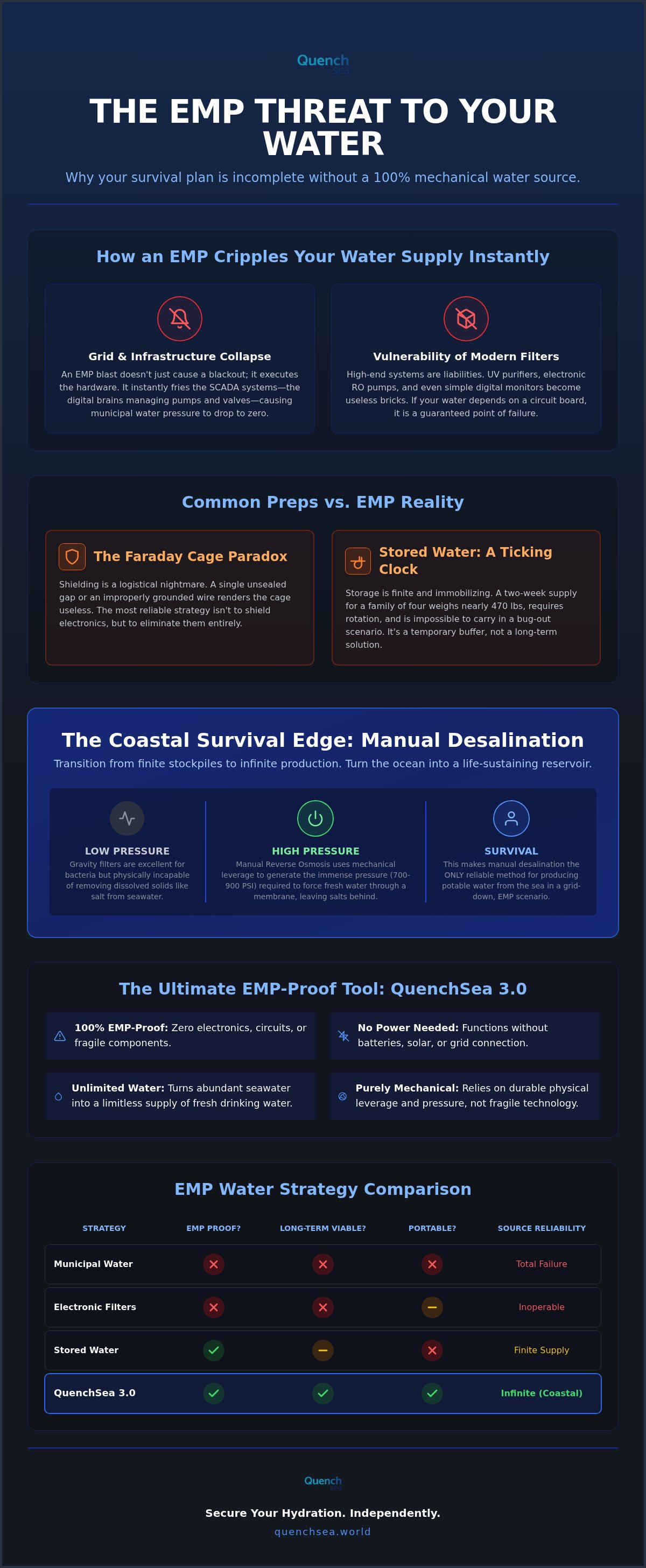
An Electromagnetic pulse (EMP) is a burst of electromagnetic radiation that couples with electrical and electronic systems to produce damaging current and voltage surges. It doesn't just cut the power. It destroys the hardware. In a grid-down scenario, the loss of water isn't a secondary effect; it's an immediate consequence of SCADA (Supervisory Control and Data Acquisition) system failure. These digital brains manage the pumps, valves, and treatment plants that keep municipal water flowing. When they fry, the pressure drops. The taps go dry.
A standard blackout is a temporary pause. An EMP is a permanent hardware execution. It induces a massive electrical surge that melts microchips and fuses circuits instantly. Traditional repairs won't work because the spare parts in the warehouse are likely destroyed too. This reality makes finding an EMP proof water source a life-critical priority for coastal survival. You cannot rely on a system that requires a functional power grid or local utility infrastructure.
The Vulnerability of Modern Filtration
Most high-end home filtration systems are liabilities in this environment. UV purifiers rely on delicate ballasts and mercury lamps that cannot survive a surge. Electronic reverse osmosis units use automated pumps and digital flow meters that become useless bricks. Even a simple automated shut-off valve can fail in the closed position, locking you out of your own supply. If your water depends on a circuit board, it's a point of failure. True survival requires stripping away these electronic choke points in favor of manual, mechanical integrity.
The Faraday Cage Paradox
Shielding a whole-house water system is a logistical nightmare. A Faraday cage must be perfectly sealed and correctly grounded to work. Even a small gap or a poorly connected ground wire can allow high-frequency energy to penetrate. Many "shielded" electronics fail because the cables leading into the cage act as antennas, bringing the pulse directly to the device. The most reliable strategy is to eliminate the need for shielding entirely. This is the mechanical advantage. Tools like the QuenchSea 3.0 require no Faraday cage because they contain zero electronics. They rely on physical leverage and pressure, making them inherently immune to electromagnetic interference. By choosing a manual EMP proof water source, you bypass the complexity of electrical shielding and ensure hydration security regardless of atmospheric conditions.
Evaluating EMP-Proof Water Sources: Storage vs. Production
Static water storage is a ticking clock. While the standard recommendation of one gallon per person per day provides a temporary buffer, it creates a logistics bottleneck. A family of four requires 56 gallons for a mere two-week supply. This equates to nearly 470 pounds of dead weight that requires semi-annual rotation and chemical stabilization. In a grid-down scenario, your mobility is your primary defense. Carrying a hundred pounds of water is impossible; carrying a one-pound EMP proof water source that produces water on demand is a strategic advantage.
Mechanical production shifts your survival strategy from a finite stockpile to an infinite harvest. By utilizing a nearby raw water source, you eliminate the shelf-life issues and contamination risks associated with long-term plastic storage. For those in coastal regions, a manual desalination device represents the most efficient weight-to-water ratio available in modern survival gear. It turns the ocean from a barrier into a life-sustaining reservoir.
Manual Well Pumps vs. Manual Desalinators
Inland survivors often look to manual well pumps. These are effective tools, but they are geographically tethered and limited by the static water level of the aquifer. If the water table drops below the pump's lift capacity, the system fails. Desalinators solve a different problem for the 40% of the population living near coastlines. While a well pump focuses on vertical lift, a desalinator focuses on salt rejection. In a coastal bug-out scenario, you aren't looking for a deep-earth vein; you are processing the abundant surface water at your feet.
Gravity Filters vs. Pressure-Driven Systems
Gravity filters are excellent for removing biological pathogens like bacteria and protozoa. However, they are physically incapable of removing dissolved solids or heavy minerals. The physics of reverse osmosis require significant pressure to force water molecules through a semi-permeable membrane while leaving salts behind. Gravity alone cannot generate the 700 to 900 psi needed for seawater desalination. A pressure-driven EMP proof water source uses mechanical leverage to achieve this molecular filtration. Manual levers provide a level of durability and force that plastic gravity bags cannot match. In a high-stakes environment, the ability to generate high-pressure filtration through physical work is the only way to ensure potable water from a saltwater source.
The Coastal Survival Edge: Manual Reverse Osmosis
Seawater represents the ultimate "EMP-Proof" reservoir. While inland preppers worry about falling water tables or contaminated streams, coastal survivalists face a different reality. The ocean is an infinite resource that requires no electricity to exist and no municipal infrastructure to maintain. The challenge isn't finding the water; it's the molecular separation of salt from the liquid. This is where manual reverse osmosis provides a tactical edge. It allows you to harvest life-sustaining hydration from the very environment that others view as a wasteland. For a deeper look at the technology, consult our Survival Desalination Device Guide.
Instead of digging deep wells or hauling heavy barrels, you leverage the physics of pressure. Manual RO converts physical exertion into 50+ bar of hydraulic force. This pressure drives seawater through a semi-permeable membrane, stripping away 98% of dissolved salts. Because this process relies on mechanical leverage rather than electrical induction, it's inherently an EMP proof water source. It doesn't matter how large the pulse is; it cannot melt a stainless steel handle or a high-pressure seal.
How Manual RO Bypasses the Grid
The grid provides the energy to move water. In a total blackout, you become the power plant. By using a manual lever, you generate the necessary 50+ bar (approx. 725 psi) required to overcome osmotic pressure. This energy conversion is direct and efficient. The semi-permeable membrane acts as a molecular gatekeeper. It allows tiny water molecules to pass while blocking larger salt ions and pathogens. This mechanical barrier requires zero software to operate. Since there are no copper coils or microchips to catch an induced current, the system remains operational when every other pump in the city has failed.
Coastal Bug-Out Bag Essentials
Mobility is survival. A manual desalinator is the centerpiece of any serious bug out bag water desalination strategy. Traditional filtration kits weigh very little but offer zero protection against salt. Conversely, carrying a week's worth of freshwater adds over 50 pounds to your load. A manual RO device bridges this gap. It provides the security of an EMP proof water source at a fraction of the weight of stored water. For the mobile survivalist, this is the difference between being tethered to a static cache and having the freedom to move along the coastline indefinitely.
How to Build an EMP-Resilient Water Strategy
Resilience is a deliberate engineering choice. It's the transition from hoping your electronics survive to knowing your hardware will function. Developing an EMP proof water source requires a systematic shift from digital convenience to mechanical reliability. A plan is only as strong as its weakest circuit; if your hydration depends on a single transistor, you don't have a survival plan. You have a countdown to failure.
Follow this five-step framework to harden your water security:
- Step 1: Identify Raw Water Sources. Map your primary and secondary sources. For coastal residents, the ocean is the primary reservoir, but identify brackish marshes or estuaries as secondary options for varied salinity processing.
- Step 2: Audit for Hidden Electronics. Inspect every piece of gear. Look for LEDs, digital displays, and internal timers. If it has a battery or a microchip, it's a liability.
- Step 3: Implement Manual Backups. Replace electric pumps with hand-operated levers. Ensure your primary filtration doesn't require a power source to initiate the flow.
- Step 4: Conduct a No-Power Field Test. Turn off your main breaker. Attempt to produce three days' worth of water using only your manual kit. Identify the physical bottlenecks before the grid fails.
- Step 5: Secure Mechanical Spares. Stockpile high-pressure O-rings and RO membranes. A manual RO membrane typically processes between 1,000 and 2,000 liters before performance degrades; ensure you have enough units to last several years.
To secure your primary mechanical backup and ensure long-term hydration, invest in the QuenchSea 3.0 today.
The Audit: Finding the Circuits
Modern "smart" filters are the enemy of EMP resilience. Many current systems use electronic flow meters to "remind" users to change filters. In an EMP event, these circuits can fail in a way that restricts flow or provides false readings. Solar-powered pumps are equally risky; without a manual handle, they become useless when the inverter fries. A mechanical override is a survival requirement, serving as the physical bypass that ensures a system remains functional when its digital logic is destroyed.
Maintenance Without the Internet
When the grid goes down, your access to digital tutorials vanishes. You must learn to service your gear without YouTube or cloud-based manuals. Print hard-copy documentation for every piece of survival equipment you own. Focus on tools that use basic mechanical seals and standard fasteners. If a device requires a proprietary digital diagnostic tool for repair, it has no place in an EMP-resilient kit. Standardizing on rugged, hardware-focused tools ensures you can maintain your EMP proof water source using only basic hand tools and physical intuition.
QuenchSea 3.0: The Ultimate EMP-Proof Desalination Device
The QuenchSea 3.0 is a 100% mechanical survival tool. It represents the pinnacle of "no-fail" engineering. In a world where digital systems collapse, this device remains operational. It's built from industrial-grade stainless steel and reinforced polymers. It handles the 50+ bar of pressure required for reverse osmosis without flinching. Most importantly, it's a "No-Faraday-Required" asset. You don't need to bury it in a copper-mesh box. You don't need to ground it. It sits in your kit, immune to the atmospheric surge, ready to provide an EMP proof water source the moment you reach the shoreline.
This device is designed for high-stress, grid-down environments where technical failure equals a death sentence. It eliminates the "Electronic Choke Points" found in modern filtration. There are no digital flow meters to fry. No automated valves to seize. Just a direct, mechanical connection between your physical work and life-sustaining hydration. It turns a catastrophic grid failure into a manageable mechanical challenge.
Engineered for the Worst Case
The design focuses on long-duration survival. The manual lever is optimized for ergonomics and maximum leverage. This allows a single operator to produce between 5 and 8 liters of fresh water per hour. This isn't a single-stage filter. It uses a sophisticated triple-filtration process. First, a pre-filter removes sediment and organic matter. Second, the high-pressure RO membrane achieves a 98% salt rejection rate. Finally, a carbon finish polishes the water for taste and clarity. For a complete technical breakdown and performance specs, read our QuenchSea 3.0 Buyer’s Guide.
Versatility Across Scenarios
This isn't just for coastal preppers. It's an essential standard for life rafts, marine vessels, and isolated bug-out shelters. When the grid fails, the "last mile" of survival is always water. This is why the device is a preferred choice for Disaster Relief Water Supply. It bridges the gap between raw seawater and potable hydration in environments where electricity is a memory. It strips away the unnecessary. No batteries to charge. No circuits to shield. No reliance on the sun. Just rugged, hardware-focused reality. Secure your mechanical water future today and ensure your survival isn't dependent on a circuit board.
Master Your Survival Hydration
Survival in a post-grid world depends on the reliability of your most basic tools. An electromagnetic pulse doesn't just interrupt your day; it permanently disables the electronic infrastructure you rely on for life. You've learned that municipal pressure and smart filters are liabilities in this scenario. True security comes from stripping away the circuits and embracing mechanical integrity. When the digital world fails, your physical preparation determines your outcome.
Coastal survivalists have a tactical advantage: the ocean. By using manual reverse osmosis, you transform an infinite saltwater reservoir into a dependable EMP proof water source. This technology, proven in extreme environments and trusted by marine and defense professionals, requires zero batteries or electronics. It's a hardware solution for a hardware problem. By focusing on manual production over finite storage, you ensure your bug-out location remains viable for the long term.
Don't leave your hydration to chance or fragile circuit boards. Secure your future with a system that works every time you pull the lever. Secure your EMP-proof water source with the QuenchSea 3.0 today. You have the power to stay hydrated when the grid goes dark.
Frequently Asked Questions
Is a manual water maker completely EMP proof?
A manual water maker like the QuenchSea 3.0 is inherently an EMP proof water source because it contains zero electronic components. Electromagnetic pulses damage microchips and circuits by inducing high-voltage currents. Since this device uses purely mechanical leverage to drive reverse osmosis, there are no conductive paths for the pulse to exploit. It remains fully operational regardless of atmospheric electrical activity or total grid failure.
Can I use QuenchSea 3.0 on brackish water or just seawater?
You can use the QuenchSea 3.0 on both brackish water and seawater. While specifically engineered to handle the high osmotic pressure of the ocean, it easily processes lower salinity sources found in estuaries or coastal marshes. The reverse osmosis membrane effectively rejects salts and dissolved solids across various concentrations. This versatility makes it a critical tool for diverse coastal survival scenarios where raw water quality varies by location.
Does the RO membrane need to be stored in a Faraday cage?
No, the RO membrane doesn't require storage in a Faraday cage. These membranes are made of synthetic polymers and composite materials that are non-conductive and immune to electromagnetic interference. Faraday cages are only necessary for protecting sensitive microelectronics and circuit boards from induced current. Since the QuenchSea 3.0 is a 100% mechanical system, it can be stored anywhere without risk of EMP-induced degradation or failure.
How much water can a person realistically produce manually per day?
A single operator can realistically produce 5 to 8 liters of fresh water per hour using the QuenchSea 3.0. In a survival situation, a person might pump for two to three hours daily to meet the hydration needs of a small group. This equates to 10 to 24 liters per day. The production rate depends on the operator's physical stamina and the water temperature, as warmer water typically processes more efficiently.
What is the shelf life of a manual desalination device?
The mechanical components of the device have an indefinite shelf life when stored in a dry, stable environment. However, the RO membrane is a consumable part. A standard manual membrane can process between 1,000 and 2,000 liters before its salt rejection performance begins to degrade. To ensure long-term readiness, survivalists should stockpile replacement membranes and O-rings. These spare parts are also immune to EMP damage and require no special shielding.
Are there any electronic parts in the QuenchSea 3.0?
There are absolutely no electronic parts, batteries, or circuits in the QuenchSea 3.0. It's a purely mechanical device that utilizes hand-powered hydraulic pressure to achieve reverse osmosis. This lack of complexity is a deliberate engineering choice to ensure reliability in extreme environments. By removing electronic sensors and automated pumps, we've created a tool that functions independently of the power grid and remains immune to solar flares or electromagnetic pulses.
How does an EMP affect municipal water treatment plants?
An EMP cripples municipal water systems by destroying the SCADA systems that manage treatment and distribution. High-voltage surges melt the microchips in pump controllers and automated valves. Even if the physical pipes remain intact, the lack of electronic logic and grid power stops the flow of water. This collapse makes a personal EMP proof water source essential for anyone relying on municipal infrastructure for survival in a crisis. For more on the specialty chemicals and industrial solutions used in large-scale water treatment, check out JAS Global Industries.
Reverse osmosis technology is highly effective at removing a wide range of dissolved solids and particulate matter, including many types of radioactive isotopes. While not specifically marketed as a radiation filter, the molecular-level filtration of the RO membrane rejects 98% of contaminants. This provides a significant layer of protection against fallout particles that may have settled in seawater. However, users should always prioritize the cleanest available raw water source to extend membrane life.