

In the middle of the Atlantic, your electrical system isn't a guarantee; it's a liability waiting to happen. You've spent months calculating every gram of weight and every watt of power. You know that a single blown fuse or a fouled membrane can turn a record-breaking pace into a desperate survival situation. Selecting the right transatlantic rowing watermaker is the most critical technical decision you'll make before leaving the dock. It’s the difference between focused rowing and frantic troubleshooting when you're thousands of miles from the nearest coastline.
This guide will help you master the technical requirements of ocean rowing desalination and show you why manual redundancy is the difference between a successful crossing and a mid-Atlantic rescue. We'll explore how to build a fail-safe hydration strategy, meet mandatory equipment requirements for 2026, and use the QuenchSea 3.0 to minimize dead weight in your cabins. You’ll learn to protect your membrane from fouling and ensure your crew has a reliable water source regardless of your battery levels. Preparation starts with hardware that doesn't quit when the power goes out.
Key Takeaways
- Understand the "Rule of 3" and why water production is your most critical life-support system during a 3,000-mile ocean crossing.
- Learn the technical framework for selecting a transatlantic rowing watermaker that balances high-output electrical units with essential manual redundancy.
- Discover how manual reverse osmosis technology functions without power and the role of pre-filtration in protecting your equipment from membrane fouling.
- Prepare for 2026 race scrutineering by meeting mandatory equipment requirements for manual backup desalination systems.
- Evaluate the QuenchSea 3.0 as a lightweight, zero-energy solution to minimize cabin weight and secure your hydration strategy.
The Critical Role of a Transatlantic Rowing Watermaker
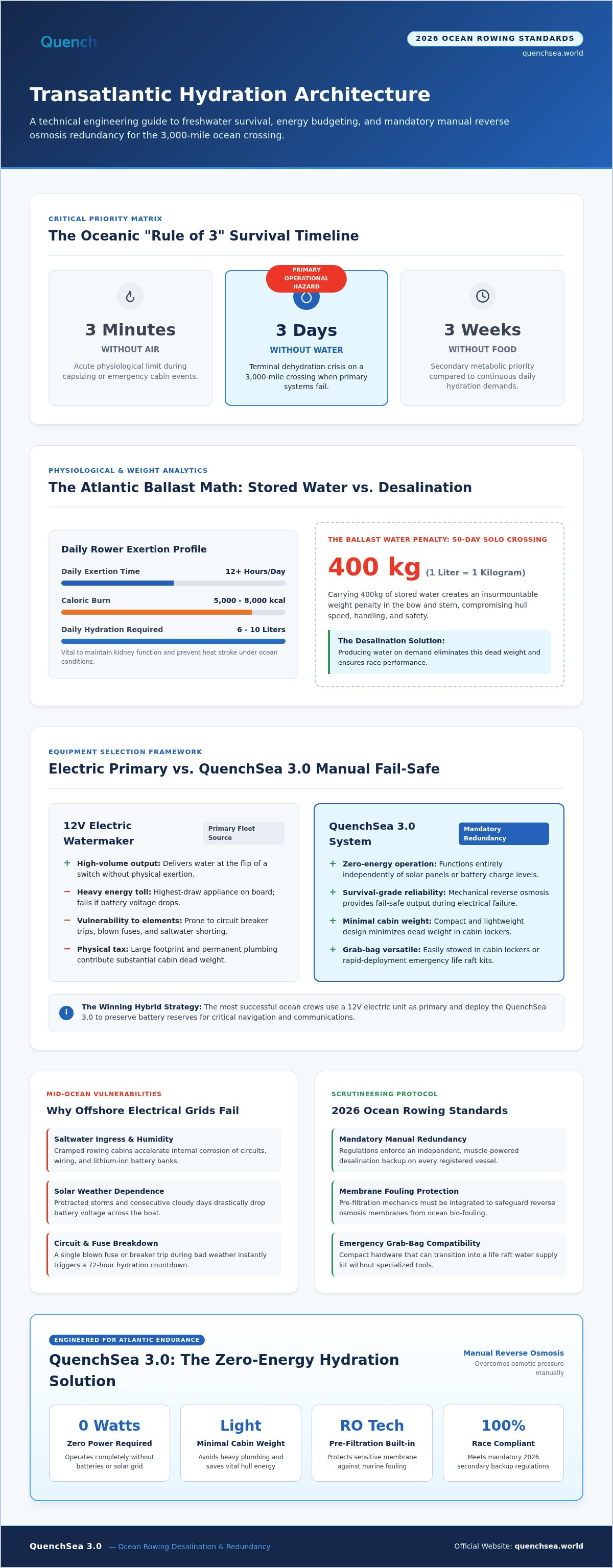
Survival in the mid-Atlantic follows a brutal timeline. Most ocean rowers are familiar with the "Rule of 3": three minutes without air, three days without water, and three weeks without food. On a 3,000-mile crossing, your water supply is your most volatile risk factor. A transatlantic rowing watermaker acts as a portable desalination engine, converting high-salinity seawater into life-sustaining freshwater through reverse osmosis filtration mechanics. Relying on a single electric desalination unit isn't just an oversight; it's a tactical error that assumes your boat's electrical grid is invincible. When the horizon is nothing but salt and sun, your ability to produce water manually is the only thing standing between a record-breaking pace and a Mayday call.
The Reality of Electrical Failure at Sea
The ocean environment is inherently hostile to electronics. Saltwater ingress and high-humidity air quickly degrade electrical components, wiring, and lithium-ion marine batteries. Even the most robust systems face internal corrosion in the cramped, damp confines of a rowing cabin. If your primary electric watermaker shorts or a circuit breaker fails during a storm, you're less than 72 hours away from a critical health crisis. This vulnerability is why 2026 race standards for major events mandate a secondary manual backup. Reliability requires a mechanical solution that functions independently of your battery bank. A manual system like the QuenchSea 3.0 provides this survival-grade redundancy, ensuring that power loss doesn't result in terminal dehydration.
Hydration Metrics: Calculating Your Daily Needs
Rowing for 12 or more hours a day consumes immense physiological resources. An average rower burning between 5,000 and 8,000 calories requires six to ten liters of freshwater daily to maintain kidney function and prevent heat stroke. Carrying this volume as "ballast" water is mathematically impossible for a performance-focused boat. One liter of water weighs exactly one kilogram. A 50-day crossing for a solo rower would require 400kg of stored water, a weight penalty that would compromise the boat's speed and safety. Producing water on-demand is the only viable strategy for modern ocean rowing. For those planning emergency contingencies, understanding your life raft water supply requirements is equally vital. Every drop produced by your transatlantic rowing watermaker reduces the dead weight in your bow and stern, allowing for a more efficient and faster crossing.
Manual vs. Electric: The Transatlantic Selection Framework
Choosing a transatlantic rowing watermaker requires a cold analysis of your boat's limitations. Electric units are the workhorses of the fleet. They provide high-volume output with the flip of a switch, but they demand a heavy toll in energy and weight. Manual watermakers offer the opposite: zero energy draw, minimal weight, and nearly absolute reliability. The most successful crews adopt a hybrid approach. They use a 12V electric unit as the primary source and a manual device as the critical fail-safe. According to the USGS guide to desalination, removing salts from seawater requires overcoming significant osmotic pressure. Whether you use electricity or muscle to generate that pressure, your selection determines your survival margin when systems inevitably face the stress of the deep ocean.
Energy Budgeting in an Ocean Rowing Boat
Solar panels are your only source of power. Their efficiency is entirely dependent on the weather. During a storm or consecutive cloudy days, your battery bank's voltage will drop. A 12V watermaker is usually the highest-draw appliance on board. If your batteries fail, your water production stops. Manual pumping does cost physical calories, but it ensures you aren't left thirsty when the sun doesn't shine. It's a strategic trade. You spend effort to preserve your electrical reserves for vital navigation and communication gear. Integrating a QuenchSea 3.0 into your kit ensures your hydration isn't tied to a battery's charge state.
Weight and Space: The Rower's Tax
Every kilogram you add to the boat is a kilogram you must row across the Atlantic. Fixed electric RO units have a large physical footprint and require permanent plumbing. A portable transatlantic rowing watermaker is compact and versatile. You can stow it in a cabin locker or a dedicated grab bag. This portability is vital during a capsize. If your main cabin floods or becomes inaccessible, your manual unit must be reachable. Selecting a manual water maker for boat use allows you to trim your boat more effectively by placing weight where it's needed most. It provides a lightweight insurance policy that doesn't compromise your hull's performance.
Maintenance is the final factor in the selection framework. Membranes in the mid-Atlantic are prone to biofouling and salt crystallization. While electric systems often have automated flush cycles, they are prone to mechanical valve failure. Manual units are simpler. They allow for direct, mechanical flushing that is easier to manage in heavy seas. Keeping your membrane clear is a daily discipline that prevents a mid-ocean equipment crisis.
Reverse Osmosis Mechanics: Engineering for Survival
A transatlantic rowing watermaker is a precision instrument designed to overcome a fundamental law of thermodynamics. Seawater typically contains 35,000 parts per million (ppm) of dissolved salts. To make this potable, you must apply enough pressure to overcome osmotic resistance. Without a reliable desalination system, the physiological consequences of drinking untreated seawater are catastrophic. Your kidneys cannot process the salt, leading to rapid dehydration and eventual renal failure. In the extreme isolation of the mid-Atlantic, your survival depends on the integrity of a few square centimeters of semi-permeable membrane.
The Science of Hand-Powered Desalination
Manual reverse osmosis (RO) relies on human-generated hydraulic pressure rather than an electric motor. By pumping a lever, you force saltwater through a membrane that blocks salt molecules while allowing pure H2O to pass. Mechanical simplicity is a feature in these environments. It eliminates the risk of short circuits or motor burnout. The QuenchSea 3.0 utilizes a manual lever-action pump to generate the high hydraulic pressure required to force seawater through a semi-permeable membrane. This process reduces TDS (Total Dissolved Solids) from 35,000 ppm to less than 1,000 ppm, making it safe for long-term consumption. Survival-grade materials like reinforced polymers and corrosion-resistant alloys ensure the device survives the constant salt spray and physical impacts of a 60-day crossing.
Managing Membrane Fouling and Salt Build-up
Membrane health is your primary maintenance concern. Biofouling occurs when microscopic organisms settle on the membrane surface, a common issue during slow-moving rowing crossings. This creates a biological film that restricts flow and increases the effort required to pump. Salt crystallization is another threat. If the system sits idle without being flushed, salt deposits can tear the delicate membrane fibers. You must implement a strict flushing protocol every 24 hours. Use a portion of your produced freshwater to rinse the system. This prevents mineral build-up and ensures your transatlantic rowing watermaker remains operational for the duration of the 3,000-mile journey. Watch for these signs of failure:
- Increased resistance during the pumping stroke.
- A sudden drop in water output per stroke.
- Cloudy or brackish-tasting output.
- A significant rise in TDS levels measured by your handheld meter.
Pre-filters play a vital role here. They trap larger particles like silt and plankton before they reach the main membrane. Replacing these pre-filters regularly is the cheapest insurance policy you can buy for your hydration strategy. Reliability isn't just about the membrane; it's about the entire filtration chain working in sequence.
Race Readiness: Meeting 2026 Ocean Rowing Standards
Scrutineering is the final hurdle before the starting gun in La Gomera. For 2026, race organizers have tightened requirements for desalination redundancy. You must demonstrate that your transatlantic rowing watermaker can produce sufficient volume under manual power alone. It isn't enough to carry the device in its original packaging. Scrutineers often demand a live demonstration of your backup system's output to verify mechanical integrity and ease of deployment. If you can't produce water while fatigued and tossed by a swell, your system fails the test. Reliability is the only metric that matters when you're 1,500 miles from land.
The 2026 Mandatory Equipment Checklist
Most major ocean races require a manual backup capable of producing at least two liters of potable water per hour. This isn't a suggestion; it's a hard benchmark for safety. You need to provide documentation or proof of performance for your survival desalination device during the registration phase. This ensures every boat has a viable "Plan B" if the primary 12V unit goes offline. Verify the specific gear list for the World's Toughest Row or similar events to ensure your model meets the latest pressure-rating standards. Failure to meet these benchmarks can result in disqualification before you even leave the dock.
Tactical Water Storage and Rationing
Races also mandate a minimum volume of emergency ballast water, typically between 20 and 40 liters, which must remain sealed unless a total system failure occurs. Your transatlantic rowing watermaker should be integrated into your primary "Grab Bag" or stored near the companionway for rapid access. Transitioning from electric to manual mid-row is a mental challenge as much as a physical one. Pumping for an hour after a two-hour shift requires discipline and grit. Training with your gear before departure builds the muscle memory needed to handle this workload under pressure. It's better to discover a stowage issue or a hose fitting problem in calm coastal waters than in a force 7 gale.
Before you reach the starting line, secure your manual backup watermaker to ensure your boat passes 2026 scrutineering without delays. Early integration into your training routine allows you to calculate the exact caloric cost of manual desalination. This data is vital for your overall nutrition and hydration strategy. Don't leave your survival to chance; make manual redundancy a core part of your race preparation.
QuenchSea 3.0: The Transatlantic Rower's Redundancy Solution
Reliability in the mid-Atlantic is measured by what works when everything else fails. The QuenchSea 3.0 was engineered specifically to address the vulnerabilities of ocean rowing. It provides a pure mechanical solution to a life-critical need. This transatlantic rowing watermaker operates independently of your boat's electrical grid, eliminating the risk of total hydration failure due to battery depletion or circuit corrosion. It’s a survival-grade tool designed for the harshest marine environments on Earth. When your primary electric unit goes dark, the QuenchSea 3.0 ensures your crossing continues without a Mayday call.
Rowing cabins are high-density storage environments. Every piece of gear must earn its place. The QuenchSea 3.0 features a compact, portable design that fits easily into a cabin locker or an emergency grab bag. Its lightweight construction minimizes the weight penalty in your bow or stern, a crucial factor for performance-focused crews. Operating the device is straightforward, even when you're battling extreme fatigue or heavy seas. The manual lever-action pump is designed for efficiency, allowing you to produce freshwater with a predictable physical effort that doesn't drain your remaining energy reserves.
Survival-Grade Engineering for 2026
The QuenchSea 3.0 utilizes robust, corrosion-resistant materials to withstand constant salt spray and physical impact. It’s built to endure the 60-day grind of a transatlantic crossing. The device delivers practical freshwater volumes, making it an ideal transatlantic rowing watermaker for both solo adventurers and multi-person teams. Beyond technical specs, the QuenchSea mission is rooted in global responsibility. We provide affordable, portable water solutions to the global ocean community, ensuring that survival-grade technology is accessible to those who venture into extreme environments. This commitment to reliability ensures your hardware won't quit before you do.
Next Steps: Securing Your Crossing
Your preparation defines your success. Don't wait for a mid-ocean crisis to understand your backup systems. Add the QuenchSea 3.0 to your mandatory equipment list early in your campaign. Integrate the device into your training rows to calculate your manual production rates and calibrate your hydration strategy. Testing your gear in coastal waters builds the confidence you’ll need when the nearest land is two miles straight down. It’s time to finalize your redundancy plan and protect your crew. Equip your boat with QuenchSea 3.0 to ensure you have a fail-safe path to the finish line.
Finalizing Your 2026 Ocean Strategy
Crossing 3,000 miles of salt water requires more than just physical grit. It demands a hardware-focused reality where your hydration isn't tethered to a lithium-ion battery. You've learned that electrical failure is a statistical likelihood, not a remote possibility. Integrating a manual transatlantic rowing watermaker into your kit ensures that your freshwater production remains constant, even when the sun disappears or your wiring corrodes. Meeting the 2026 mandatory gear standards is the first step toward the starting line; proving your manual redundancy is the final step toward survival.
Reliability is built into the QuenchSea 3.0. It requires no electricity or batteries. It's a compact, survival-grade tool trusted for emergency marine safety. Don't leave your hydration to chance when you can control it with pure mechanical force. Secure Your Transatlantic Hydration with QuenchSea 3.0 and ensure your boat is equipped for the extremes of the mid-Atlantic. Your record-breaking crossing depends on the gear that won't quit. See you on the other side.
Frequently Asked Questions
Do I really need a manual watermaker if I have a high-end electric one?
Yes, redundancy is a non-negotiable safety requirement for ocean crossings. Electric systems are prone to failure from saltwater ingress, battery depletion, or circuit damage in high-humidity environments. Most 2026 race regulations mandate a manual backup regardless of your primary system's quality. Carrying a manual transatlantic rowing watermaker provides a critical fail-safe when your electrical grid is compromised. It’s the only way to guarantee hydration during a power outage.
How much water can a manual watermaker like QuenchSea 3.0 produce per hour?
The QuenchSea 3.0 is designed to produce practical volumes of freshwater for survival. While output varies based on pumping rhythm and water temperature, it is engineered to meet the two liters per hour benchmark required by major race scrutineers. This output ensures a solo rower or small crew can maintain baseline hydration levels. Consistent operation produces enough water to support your physiological needs without requiring excessive hours of manual labor.
Is the water produced by a manual desalinator safe to drink long-term?
Water produced via manual reverse osmosis is safe for long-term consumption if the system is maintained. The process effectively removes salts, bacteria, and viruses from seawater. It reduces Total Dissolved Solids from roughly 35,000 ppm down to safe drinking levels under 1,000 ppm. You should use a handheld TDS meter to verify the membrane's integrity daily. This ensures your drinking water remains within safe parameters throughout your entire 3,000-mile journey.
How much physical effort is required to operate a transatlantic rowing watermaker?
Operating a manual watermaker requires consistent physical effort but is designed for maximum efficiency. The QuenchSea 3.0 uses a lever-action pump to generate the high hydraulic pressure needed for desalination. While it demands more calories than an electric unit, the mechanical advantage reduces the strain on your arms and shoulders. It is a manageable task for a fit rower, even when you are dealing with the fatigue of a 12-hour shift.
Can a manual watermaker be used as the primary water source for a solo rower?
A manual unit can serve as a primary source, but it significantly increases your daily physical workload. A solo rower needs 6 to 10 liters of water every day. Producing this volume manually requires several hours of dedicated pumping. Most rowers prefer to use the manual system as a secondary unit to preserve battery power for navigation. It remains the most reliable primary source for those looking to minimize electrical complexity on board.
What maintenance does a manual watermaker require during a 60-day crossing?
Maintenance involves daily freshwater flushing and regular pre-filter inspections. Flushing the system prevents salt crystallization and biofouling, which can tear the delicate membrane fibers. You must also ensure the intake hose remains clear of debris. During a 60-day crossing, these simple steps preserve the flow rate and extend the life of your transatlantic rowing watermaker. Neglecting these protocols can lead to a significant drop in production efficiency when you need it most.
How does the QuenchSea 3.0 handle high-salinity Atlantic water?
The QuenchSea 3.0 is specifically engineered to process high-salinity Atlantic water. Its industrial-grade reverse osmosis membrane is designed to overcome the intense osmotic pressure of 35,000 ppm seawater. The device uses reinforced polymers and corrosion-resistant alloys to maintain performance in the harsh, salty conditions of the open ocean. This robust construction ensures that the desalination process remains effective even after weeks of exposure to salt spray and high-salinity intake.
Does the QuenchSea 3.0 fit in a standard ocean rowing grab bag?
Yes, the device features a compact and portable design that fits into standard ocean rowing grab bags. Portability is a vital safety feature. It ensures you can quickly move your desalination equipment to a life raft or secondary cabin during an emergency. The device's small footprint allows for easy stowage in high-density storage lockers without taking up excessive space. It is a lightweight insurance policy that stays accessible when you need it.