

The ocean is a desert with a different name when your engines die and your batteries go flat. Imagine you're fifty miles out; the sun is relentless, and your water supply is a ticking clock. This is the reality of offshore fishing survival water. It's a finite resource that dictates your lifespan. Most anglers rely on bulky jugs that consume critical deck space and add massive weight to the hull. It's a logistical burden that becomes a liability the moment you're forced into a life raft.
You already understand that gear failure isn't a matter of if, but when. You carry the EPIRB and the flares, yet water remains your most significant vulnerability. We'll help you master the logistics of offshore hydration and explain why manual desalination is the critical bridge between finite rations and long-term survival. This article previews a foolproof hydration plan for your ditch bag and explores compact gear like the QuenchSea 3.0 that functions without boat power. You'll learn to turn the surrounding salt water into a life-saving asset, providing the confidence to survive any offshore emergency.
Key Takeaways
- Understand why the "Rule of 3s" is optimistic in a harsh marine environment. Identify the specific environmental stressors like wind and salt spray that accelerate dehydration for offshore anglers.
- Don't rely on finite storage alone. Master the logistics of offshore fishing survival water by bridging the gap between emergency rations and renewable production.
- Discover why manual reverse osmosis is the most reliable technology for ditch bags. Mechanical simplicity ensures you can produce drinkable water even after total electrical failure.
- Implement tactical hydration strategies like the 24-hour rule. Know exactly when to start pumping to preserve your physical strength and mental clarity during an emergency.
- Evaluate the QuenchSea 3.0 as a mission-critical backup for offshore vessels. This survival-grade device operates without fuel or batteries, turning the ocean into a renewable resource.
The Critical Logistics of Offshore Fishing Survival Water
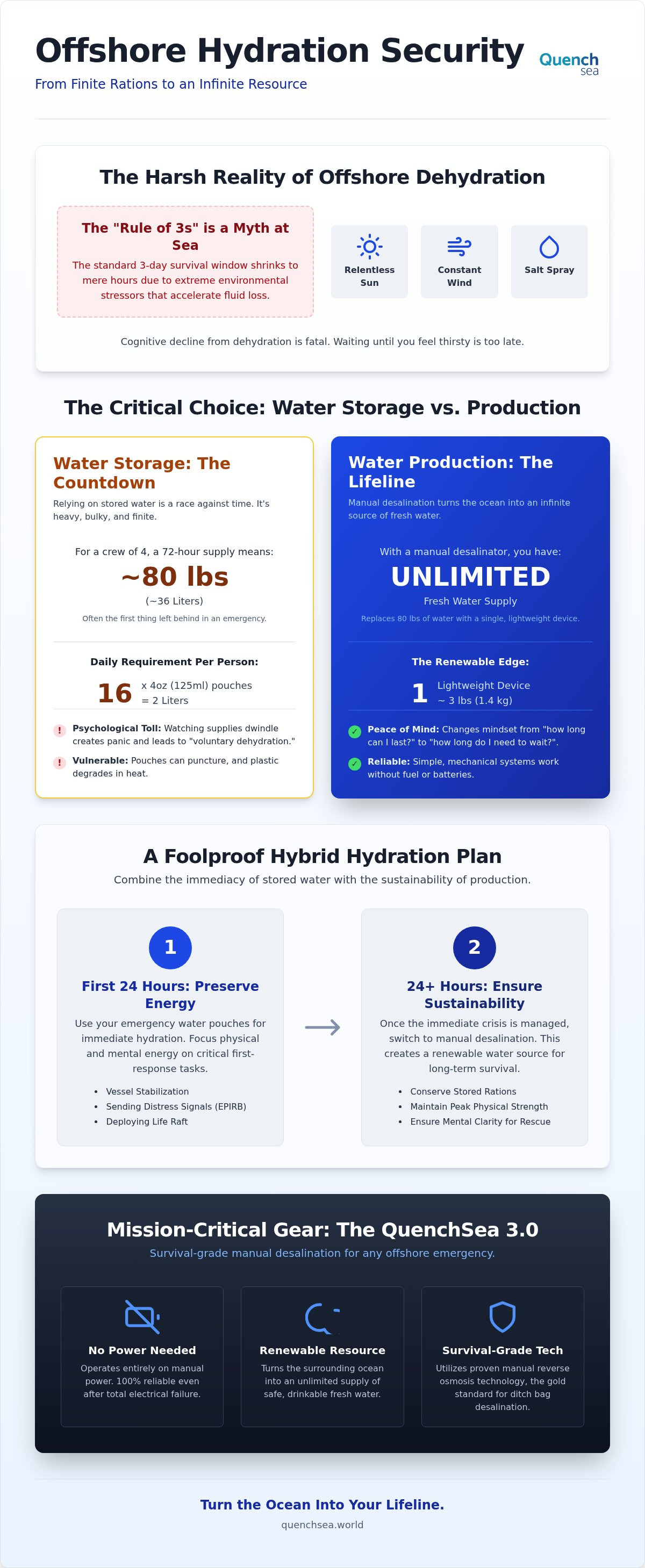
Survival math changes when you leave the sight of land. The standard "Rule of 3s" suggests three days of life without hydration. On the open ocean, that's a dangerous oversimplification. You are operating in a high-stress environment that accelerates fluid loss through wind, salt spray, and physical exertion. In the sun, your survival window may be measured in hours, not days. You don't just need water; you need it at a rate that matches your body's accelerated depletion. Waiting until you feel thirsty means you're already behind the curve.
The "Hydration Gap" is the difference between the rations you can physically carry and what your body demands to stay functional. While the U.S. Coast Guard mandates safety gear like flares and life jackets, federal requirements for survival water volume on recreational boats are non-existent. Relying on "legal minimums" is a recipe for disaster. If you're stranded, your body is your most vital piece of equipment. It fails rapidly without offshore fishing survival water. You must plan for the reality of the environment, not just the requirements of a checklist.
Dehydration: The Silent Threat in the Canyon
Saltwater exposure is a biological tax on your system. Constant mist on your skin and in your lungs forces your kidneys to work harder, sapping your internal reserves. Dehydration triggers mental fog. In a survival situation, cognitive decline is fatal. You miss radio cues or forget to secure gear. Recognizing early signs like dark urine or a persistent headache while still on the vessel is your last chance to course-correct. Once you're in the raft, every drop of sweat counts against your remaining time.
The Weight of Survival: Rations vs. Realities
The logistics of water storage are brutal. A crew of four requires at least 36 liters for a 72-hour survival window. Water weighs roughly 8.3 pounds per gallon. That is nearly 80 pounds of weight added to your ditch bag. In a high-stakes emergency, heavy containers are often the first items left behind or lost overboard. Mastering your offshore fishing survival water strategy through the desalination process is critical. It turns the ocean into a resource and eliminates the weight penalty of static rations. By integrating a device like the QuenchSea 3.0, you replace a finite, heavy countdown with a lightweight, renewable supply.
Beyond the Pouch: Water Production vs. Water Storage
Static storage is a timer. Every sip brings you closer to zero. Renewable production reverses this math. To master your offshore fishing survival water strategy, you must understand the trade-off between immediate access and long-term endurance. Consumables like pouches provide instant hydration but offer no path to sustainability. Mechanical tools require physical input but offer an infinite resource. This shift in perspective is the foundation of a modern offshore fishing survival water plan.
The Limits of Emergency Water Pouches
Standard 4oz (125ml) pouches are the industry baseline. They are sterile and require zero preparation. However, the volume required for survival is staggering. A single adult requires approximately 2 liters of water daily to maintain basic organ function in high-heat environments. That equals 16 pouches per person, every 24 hours. For a crew of four, you need 64 pouches daily.
Storage becomes a logistical nightmare. Pouches are heavy and vulnerable to puncture. Plastic packaging degrades under the intense heat cycles found in marine deck boxes. There is also a severe psychological cost. Watching your stack of pouches disappear creates a sense of impending doom. This often leads to "voluntary dehydration," where survivors ration water too strictly, causing the cognitive decline that leads to fatal errors.
The Renewable Edge of Manual Desalination
Manual desalination removes the ceiling on your survival timeline. It converts the surrounding ocean into a 24/7 freshwater resource. This capability changes your mindset from "how long can I last" to "how long do I need to stay here." It eliminates the panic that often accompanies minor vessel failures. If your engines die but your hydration is secure, you can wait for the right weather window or a slow-moving tow.
A hybrid strategy is the most effective approach. Use your pouches for the first 24 hours of an emergency. This preserves your energy while you focus on vessel stabilization, signaling, or deploying a life raft. Once the immediate crisis is managed, transition to your production device. While consumables have a finite shelf life, mechanical tools offer long-term integrity. Investing in a QuenchSea 3.0 ensures you have the hardware to outlast your rations. It provides a survival-grade solution that functions independently of your boat's failing electrical systems.
Manual Reverse Osmosis: Tactical Water for Anglers
Reverse osmosis (RO) is not a simple filtration process. It is a molecular separation driven by pressure. In a survival scenario, you must force seawater against a semi-permeable membrane that allows water molecules through while blocking salts, minerals, and pathogens. This requires immense force. Large vessels use high-draw electric pumps to achieve this. For the offshore angler in a ditch bag scenario, electricity is a luxury you cannot assume. Manual power is the only reliable alternative. It relies on your own biomechanics rather than a failing battery or a corroded circuit board.
Total independence from boat power systems is the primary advantage of manual RO. If your vessel is taking on water, your electrical system is likely the first thing to fail. A hand-powered unit ensures that your access to offshore fishing survival water remains intact regardless of the boat's condition. Survival gear must be ruggedized to handle the transition from a deck box to a life raft. It needs to be drop-proof and resistant to the relentless corrosion of salt air. Mechanical simplicity ensures that the device is ready for immediate deployment after months of standby storage.
Engineering the Hand-Powered Desalinator
Leverage is the key to effective manual desalination. An exhausted survivor cannot sustain high-effort pumping for long periods. Engineering a device with optimized ergonomics allows you to produce water using your larger muscle groups, reducing fatigue. Pre-filtration is equally critical. It acts as a shield for the sensitive RO membrane, stripping out sediment and organic matter before they can cause a blockage. A well-designed system like the QuenchSea 3.0 is built to produce 6 to 8 liters of water per hour, providing a significant volume for a crew in distress without requiring superhuman effort.
Total Dissolved Solids (TDS) and Safety
The difference between "potable" and "survivable" water is measured in Total Dissolved Solids. Raw seawater typically contains around 35,000 milligrams of dissolved solids per liter. To meet World Health Organization (WHO) standards, a desalinator must reject over 97% of these salts, bringing the TDS below 1,000 mg/L. High-efficiency membranes are non-negotiable. Relying on DIY solar stills is a gamble in high-humidity marine environments, as cloud cover and moisture saturation often stall the evaporation process. The QuenchSea 3.0 uses a manual pump to force seawater through an RO membrane, removing up to 98% of salts to provide safe offshore fishing survival water. This mechanical certainty is the only way to ensure your hydration meets biological safety standards during a long-term survival event.
Tactical Hydration Strategies for Offshore Survival
Tactical hydration is a discipline. It requires a workflow that begins before the first alarm sounds. In a marine emergency, your priority is securing your ability to generate offshore fishing survival water before the vessel is lost. Once you transition to a raft, your tactical plan must account for energy conservation and logistical efficiency. Integrating your production tools with your existing life raft water supply ensures that your hydration strategy is redundant and resilient. This isn't about comfort; it is about maintaining the biological integrity of your crew.
The 24-Hour Rule is a critical tactical benchmark. Use your pre-packaged rations during the initial phase of an emergency. This allows you to focus on immediate survival tasks like signaling, vessel stabilization, or managing injuries. Once the first 24 hours pass and the situation stabilizes, transition to manual production. This sequence preserves your physical strength for the most high-stakes moments of the crisis. It ensures you aren't expending precious calories on pumping while you should be coordinating a rescue.
The Ditch Bag Workflow
Packing order determines survival speed. Your desalinator must sit at the top of the ditch bag. It is a primary survival tool, not a secondary accessory. You cannot afford to dig through flares and blankets to find your water source while the boat is listing. Secure the device to your person or the raft using a high-strength lanyard. Rough seas will claim unsecured gear in seconds. If it isn't tethered, it doesn't exist.
Training is equally vital. Every soul onboard must understand how to deploy the intake hose and operate the pump. In a crisis, the person who knows the gear might be the one who is incapacitated. Conduct "dry runs" during calm weather. Familiarity breeds the calm, technical confidence required to operate mechanical gear under extreme stress. Every crew member should be able to produce offshore fishing survival water in total darkness.
Rationing vs. Production Mindset
The traditional survival mindset focuses on rationing. This is a mistake when you have production capability. Never ration your last drop of water. Drink it to maintain your cognitive function, then produce more. Maintaining your hydration levels is more efficient than trying to recover from dehydration. If you are thirsty, you are already losing the battle. Mental fog is a precursor to fatal mistakes.
Manage your energy expenditure by pumping during the cool of the night or early morning. Direct sunlight increases sweat loss and physical fatigue. By producing water in the darkness, you keep your core temperature lower and your output higher. Rotate the pumping duty among the crew every fifteen minutes. This prevents muscle failure and keeps the production steady. Produced water also serves critical secondary roles. Use it to clean salt from wounds to prevent infection or to dampen a cloth for evaporative cooling. This proactive approach turns a survival situation into a managed event. To secure your position in the canyon, you should get the QuenchSea 3.0 as your primary tactical hydration tool.
The QuenchSea 3.0: Survival-Grade Desalination
The QuenchSea 3.0 represents a fundamental shift in emergency preparedness. It is not a gadget. It is a mission-critical tool built for the specific, harsh reality of the offshore angler. When you are 50 miles out and your vessel's electrical system terminates, your reliance on technology must shift from the complex to the mechanical. This device provides total independence from boat power systems. It requires no fuel, no batteries, and no complex wiring. If you have the physical ability to operate a manual pump, you have an infinite supply of offshore fishing survival water.
High-volume output is the core engineering requirement for a survival-grade desalinator. The QuenchSea 3.0 is designed to produce 6 to 8 liters (1.6 to 2 gallons) of drinking water per hour. This rate provides more than enough freshwater for an entire crew to maintain hydration and cognitive function. Despite this high performance, the unit maintains a compact footprint. It fits easily into a standard 20L ditch bag, leaving ample room for your EPIRB, medical kit, and rations. It replaces the bulk of heavy water jugs with a single, lightweight hardware solution.
Why QuenchSea 3.0 is the Offshore Choice
Simplicity is the ultimate form of reliability. In a survival situation, complexity is a failure point. The QuenchSea 3.0 utilizes a streamlined design with fewer moving parts, ensuring it remains operational when conditions are at their worst. Every component is constructed from corrosion-resistant materials designed to withstand the relentless salt air of the open ocean. When compared to a traditional manual water maker for boat use, this device offers a superior balance of durability and ease of use. It is engineered to sit in a standby state for months and function perfectly the moment it is deployed.
From Survival to Peace of Mind
The psychological benefit of a renewable water source is immeasurable. Knowing that you cannot "run out" of water changes your internal narrative from panic to management. This mental clarity allows you to make better tactical decisions during a crisis. The technology behind the QuenchSea 3.0 isn't just for recreational use. It is built to meet the same rigorous field-tested standards used in defense and humanitarian operations. The reverse osmosis membrane produces water that meets World Health Organization (WHO) standards, ensuring your offshore fishing survival water is safe from both salt and pathogens. Do not leave your hydration to chance. Equip your ditch bag with the QuenchSea 3.0 and secure the ultimate insurance policy for your next canyon run.
Mastering the Open Ocean Hydration Strategy
You've seen the math. Bulky jugs and finite pouches are stop-gap measures that eventually fail. True preparedness requires a shift from storage to production. By mastering tactical hydration and understanding the mechanics of reverse osmosis, you transform the ocean from a threat into a resource. It's the difference between a ticking clock and a renewable tap. Relying on static rations alone leaves your crew vulnerable to the unpredictable nature of the canyon.
The QuenchSea 3.0 provides the technical bridge needed for long-term endurance. It is a compact, survival-grade tool that ensures offshore fishing survival water is always available. It relies on hand-powered RO technology; it functions perfectly without batteries or fuel. This mechanical simplicity is your ultimate insurance policy when boat power systems fail and the sun begins to sap your strength. Don't leave your life-support logistics to chance.
Secure your crew's hydration with the QuenchSea 3.0. Ensure you have a renewable freshwater tap for every canyon run. Stay prepared, stay hydrated, and keep your focus on the horizon.
Frequently Asked Questions
Can you drink salt water if you are desperate?
No, you cannot drink salt water under any circumstances. Seawater contains a salt concentration far higher than what the human kidney can process. To dilute and flush out this excess salt, your body must pull water from its own cells, leading to a net loss of hydration. This accelerates the dehydration process and triggers rapid organ failure. Always prioritize mechanical desalination to secure safe offshore fishing survival water.
How much water does a manual desalinator produce per hour?
The QuenchSea 3.0 is engineered to produce 6 to 8 liters (1.6 to 2 gallons) of drinking water per hour. This output ensures a crew of four can meet their biological requirements with just a few hours of manual input. Production rates depend on the effort of the operator and the temperature of the seawater, but the mechanical leverage makes this volume achievable for most survivors in a crisis.
Is a manual water maker better than emergency water pouches?
A manual water maker is a renewable resource, whereas pouches are finite rations. While pouches provide immediate hydration without physical effort, they eventually run out. A device like the QuenchSea 3.0 turns the surrounding ocean into an asset rather than a threat. The most effective survival strategy uses pouches for the first 24 hours of an emergency and transitions to manual production for long-term endurance and peace of mind.
Does the QuenchSea 3.0 require special storage conditions?
No special climate control is required, but you should store the device in a dry, accessible location like a ditch bag. The QuenchSea 3.0 is built with survival-grade, corrosion-resistant materials to withstand harsh salt air. Ensure the intake and discharge hoses are coiled without kinks. Regular inspection of the seals every few months ensures the unit remains in a standby state, ready for immediate deployment when an emergency occurs.
Can children or elderly survivors operate a hand-powered desalinator?
Yes, the ergonomic design allows most individuals to operate the pump. While it requires consistent physical effort, the leverage system is engineered to reduce fatigue. Survivors can use their larger muscle groups to maintain offshore fishing survival water production. In a crew scenario, rotation is the key to preventing exhaustion. Even those with limited strength can contribute to the group's hydration by pumping in shorter, consistent intervals throughout the day.
What happens if the RO membrane gets clogged with sediment?
Integrated pre-filtration systems prevent sediment from reaching the sensitive RO membrane. If the intake source is particularly turbid, the primary filters may require cleaning to maintain flow. The QuenchSea 3.0 is designed for the open ocean where sediment is minimal. If the membrane eventually reaches its 300-liter estimated lifespan, replacement parts are available to restore the unit to full operational capacity, ensuring you are prepared for future offshore runs.
How do I know if the water produced is safe to drink?
The QuenchSea 3.0 produces water that meets World Health Organization (WHO) standards. It removes up to 98% of total dissolved solids (TDS), bringing salt levels below 1,000 mg/L. The reverse osmosis process also acts as a barrier against bacteria and viruses. While the taste may differ from bottled water due to the lack of minerals, the output is biologically safe and effective for maintaining cognitive function and physical strength.
Is manual desalination legal for USCG offshore requirements?
Manual desalination is a legal and recommended supplement to safety gear, but there are no specific USCG federal regulations mandating survival water quantities. The Coast Guard focuses on life-saving devices like PFDs, flares, and EPIRBs. Carrying a desalinator exceeds these minimum requirements, providing an additional layer of self-sufficiency. It's the ultimate insurance policy for anglers who realize that being legal on paper doesn't always guarantee survival in the canyon.