

Electronics fail. Batteries die. In a marine emergency, mechanical simplicity is the ultimate form of redundancy. You already understand that when your primary water maker cuts out, the ocean becomes a desert. The fear of dehydration isn't just a thought; it's a physiological countdown. Relying on bulky, finite water rations is a gamble you can't afford to lose when you're miles from the coast.
A high-performance handheld seawater desalinator turns the surrounding ocean into a renewable resource. You're about to master the technology, reliability, and critical selection criteria for these survival tools. We'll show you how to maintain a life-saving freshwater supply using human-powered hydraulic systems that ignore the limits of electricity.
This 2026 guide breaks down the engineering behind 98% salt rejection and the physical reality of manual pumping. We'll examine how units like the QuenchSea 3.0 provide a lightweight, fail-safe backup for yachts and life rafts. By the end, you'll know exactly how to choose a device that delivers hydration when every other system fails.
Key Takeaways
- Understand why a Personal Desalination Unit (PDU) is the essential mechanical fail-safe for any maritime emergency or life raft kit.
- Learn the engineering behind manual reverse osmosis and how it achieves 98% salt rejection using only human power.
- Compare manual, solar, and electric units to select the most reliable handheld seawater desalinator for off-grid survival.
- Master operational best practices, including optimal pumping cadence and membrane protection, to ensure a consistent freshwater supply.
- Discover how the QuenchSea 3.0 sets a new standard with its 5-8 liters per hour output and award-winning hydraulic design.
What is a Personal Desalination Unit and Why is it Essential?
A personal desalination unit (PDU) is a compact, man-portable device engineered to convert raw seawater into life-sustaining freshwater. It's the ultimate insurance policy for anyone operating on the ocean. While fixed ship-board systems are efficient, they're vulnerable to electrical failure and mechanical breakdown. The PDU provides a decentralized solution. It's a handheld seawater desalinator that fits in a grab bag, ensuring that your water supply isn't tied to your vessel's battery bank.
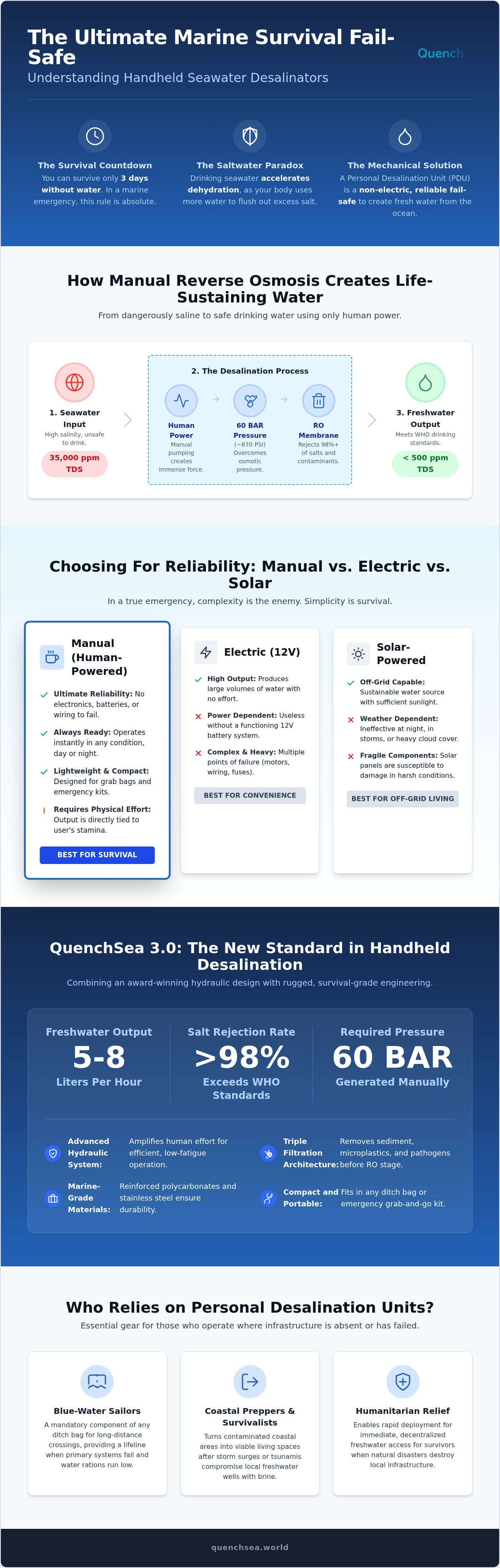
Survival at sea is governed by the Rule of 3. You can survive three minutes without air, but only three days without water. In a marine environment, the presence of water is a cruel irony. Drinking sea water is dangerous because its high salinity forces your kidneys to use more water to flush out the salt than you actually consume. This leads to rapid, fatal dehydration. A PDU halts this biological countdown by using high-pressure membranes to strip salt molecules from the water, providing a renewable source of hydration in a life raft or coastal bug-out scenario.
The Survival-Grade Mandate: Reliability Over Convenience
True survival gear must function in the absence of infrastructure. If your water maker requires a 12V battery or a solar panel to operate, it's a convenience, not a fail-safe. Handheld units prioritize mechanical integrity. There is a clear distinction between 'portable' devices that you can operate with one hand and 'luggable' electric units that weigh 20 pounds and need a power cord. In a high-stress emergency, you need simplicity. A manual handheld seawater desalinator removes the points of failure associated with electronics, fuses, and wiring. It relies on human power, which is the only fuel source you're guaranteed to have.
Key User Groups for Portable Desalination
For blue-water sailors, a manual PDU is a mandatory component of a ditch bag. During long-distance crossings, the risk of a total power loss is real. Having a non-electric backup means you aren't dependent on finite water rations. Tactical survivalists and coastal preppers also integrate these units into their kits. In many coastal regions, storm surges or rising tides can contaminate local wells with brine. A PDU turns a contaminated environment into a viable living space. Additionally, humanitarian relief organizations use these for rapid deployment. When a tsunami or hurricane destroys local infrastructure, these units provide immediate, decentralized water access to survivors before heavy machinery can arrive.
How Manual Reverse Osmosis Works: The Engineering of Survival
Reverse osmosis is the process of forcing seawater through a semi-permeable membrane to isolate pure H2O. To achieve this, a handheld seawater desalinator must overcome the natural osmotic pressure of the ocean. Seawater typically contains approximately 35,000 parts per million (ppm) of Total Dissolved Solids (TDS). To meet the 2026 World Health Organization (WHO) drinking water standards, this concentration must drop below 500 ppm. High-performance membranes achieve this by rejecting 98% of dissolved salts, but the membrane alone isn't enough. It requires a sophisticated triple-filtration architecture to remove sediment, microplastics, and pathogens before the water even reaches the RO stage. This multi-stage process ensures the output is not just salt-free, but biologically safe for long-term consumption.
The Hydraulic Challenge: Building 60 Bar Pressure
Building 60 bar (approximately 870 PSI) of pressure is the baseline requirement for effective desalination. Generating this pressure manually is a significant engineering feat. Modern units use specialized hydraulic levers to amplify human effort, allowing a survivor to produce water without immediate physical exhaustion. Advanced designs incorporate energy recovery systems that capture and reuse the internal pressure of the brine discharge. This reduces the physical workload significantly, making the device usable for hours if necessary. To withstand these extreme internal stresses, the device housing must utilize marine-grade stainless steel and reinforced polycarbonates. These materials ensure the unit won't burst or deform under the repeated strain of survival-grade operation in harsh environments.
Filtration Beyond Salt: Pathogens and Microplastics
Salt isn't the only threat in coastal waters. Modern survival-grade devices utilize ultra-filtration (UF) and micro-filtration (MF) to eliminate biological hazards. These pre-filters catch bacteria, cysts, and viruses that are often found in murky or stagnant coastal environments where survival situations often unfold. Beyond safety, pre-filtration is essential for the longevity of the RO membrane. Silt, algae, and microplastics can clog the microscopic pores of the membrane, leading to "fouling" and total device failure. By stripping these contaminants out first, you preserve the core technology of the QuenchSea 3.0, ensuring it remains operational throughout a long-term emergency. This design philosophy prioritizes mechanical integrity and user safety. It makes the handheld seawater desalinator a dependable tool when your life depends on every drop.
Manual vs. Electric vs. Solar: Choosing for Reliability
Reliability in a marine environment follows a strict hierarchy. When you're forced to abandon ship, the power source of your water supply dictates your survival window. Electric units (12V or 24V) offer high output but require a functioning battery bank. Solar-powered units rely on photovoltaic panels, which are bulky and weather-dependent. A manual handheld seawater desalinator removes these external dependencies entirely. It's a tool designed for the worst-case scenario where infrastructure has failed. You need a device that works regardless of the state of your vessel's electrical grid.
The Failure Point Analysis
Electronic units are sophisticated but fragile. Salt-air corrosion is a relentless enemy of circuitry. If a fuse blows or a wire corrodes in a life raft, your electric water maker becomes dead weight. Solar units face similar risks. They require clear skies and intact panels to function. In a storm or at night, they're useless. Manual units eliminate these vulnerabilities. By making the user the engine, you ensure that as long as you can move a lever, you can produce water. This mechanical simplicity is the only true fail-safe in a high-stakes environment. It's a calculated choice for those who prioritize survival over luxury.
Output vs. Portability Trade-offs
Fixed water makers are excellent for daily yachting life. They produce hundreds of liters, but they have zero portability. If you need to transition to a life raft water supply, those systems stay behind. Portable units like the QuenchSea 3.0 bridge this gap. Producing 5 to 8 liters per hour, a single unit can meet the hydration needs of a 4-person crew. It's compact enough to fit in a standard grab bag without sacrificing the volume required for survival. You don't need a massive footprint to secure your hydration when the hardware is engineered for efficiency.
Maintenance is another critical factor. Batteries have a finite shelf life and lose charge over time. They require regular monitoring and replacement. Mechanical units require only basic membrane preservation to remain ready for years. This makes manual boat water makers the ultimate redundancy for any blue-water vessel. The cost-to-benefit analysis is clear. The initial investment in a manual handheld seawater desalinator is minimal compared to the life-saving potential it offers when your primary systems go dark. It's not just a backup. It's the core of your survival strategy.
Operational Best Practices: Maximizing Your Water Output
Operating a handheld seawater desalinator requires more than just physical effort; it requires a tactical approach to energy management. To maintain the 60 bar pressure needed for reverse osmosis, you must establish a steady, rhythmic pumping cadence. Rapid, jerky movements lead to early muscle fatigue and uneven pressure across the membrane. Instead, use long, deliberate strokes. This consistency ensures you maximize the 5 to 8 liters per hour output while minimizing the physical toll on your body. In a survival situation, your physical energy is a finite resource. Efficient pumping is the difference between sustainable hydration and total exhaustion.
Source water selection is your first line of defense for the device's internal components. Avoid drawing water from areas with visible oil slicks, heavy silt, or thick kelp beds. These contaminants can bypass pre-filters and foul the RO membrane, rendering the unit useless. If you're in a life raft, try to draw water from at least a foot below the surface to avoid floating debris and surface oils. This simple step preserves the integrity of your equipment and ensures the water you produce remains within WHO safety standards.
Understanding your 'Hydration ROI' is vital. Manual desalination burns calories and causes fluid loss through perspiration. However, because a high-efficiency unit produces significantly more water than you lose during the process, the math favors the survivor. In a 4-person crew, rotating the pumping task every 15 to 20 minutes prevents any single individual from reaching a state of metabolic deficit. This rotation keeps the device running at peak pressure while maintaining the crew's collective strength.
Maintenance and Membrane Care
Membrane longevity depends on post-use protocols. After every session, you must flush the system with a small amount of the freshwater you just produced. This prevents salt crystallization, which can tear the microscopic pores of the membrane as it dries. For long-term storage in a coastal bug-out bag, use a dedicated pickling solution or preservative. This prevents biological growth and mold from compromising the unit while it sits in standby. If you encounter a sudden drop in pressure, check for air locks in the intake hose or sediment buildup in the micro-filters before attempting to disassemble the high-pressure housing.
Tactical Deployment in Emergency Situations
The most dangerous mistake in a marine emergency is waiting until you are thirsty to begin production. Dehydration impairs cognitive function and physical strength, making the 60 bar pressure harder to achieve. Start producing water as soon as you are clear of immediate danger. Prioritize production over rationing. Having a surplus of freshwater provides a psychological boost and a physical safety net. Integrating a survival desalination device into your standard safety drills ensures every crew member can operate it under duress. To secure your vessel's backup supply, you can order the QuenchSea 3.0 today and ensure your ditch bag is truly mission-ready.
QuenchSea 3.0: The New Standard for Handheld Desalination
QuenchSea 3.0 isn't just another backup; it's a fundamental shift in survival engineering. It represents the most accessible manual RO technology available in 2026. This handheld seawater desalinator produces 5 to 8 liters of freshwater per hour, exceeding the daily hydration needs of small crews or families. With a 98% salt rejection rate, it transforms undrinkable brine into water that meets strict safety standards. The housing, built from reinforced polycarbonates, earned the Red Dot Award for its ability to survive the corrosive, high-pressure reality of marine environments. It's designed to be the one piece of gear that doesn't break when everything else does.
Beyond yachting, our mission is humanitarian. We aim to provide a lifeline for 100 million people by 2035 through low-cost, scalable innovation. This isn't a luxury gadget; it's a tool for global resilience. We focus on mechanical integrity to solve the water crisis in areas where power grids are non-existent or destroyed. By stripping away the need for batteries and fuel, we've created a device that empowers individuals in the most extreme environments on Earth.
Why QuenchSea 3.0 Leads the 2026 Market
Legacy manual units were often physically punishing and prone to seal failure. The QuenchSea 3.0 utilizes improved hydraulics to achieve 60 bar pressure with significantly lower physical effort than previous generations. This efficiency is critical in a survival scenario where calories are scarce. Its triple-filtration system, including ultra and micro-filtration, handles murky coastal water where other devices would clog instantly. High-stress situations don't allow for complex manuals. The device features simple pictorial instructions directly on the housing, ensuring anyone can produce water regardless of their language or technical background.
Integrating QuenchSea into Your Safety Protocol
Integrating this device into your safety kit is a strategic necessity. It's the essential addition to any bug out bag water desalination setup for coastal dwellers. Reliability is the only metric that matters when infrastructure collapses. This hardware currently supports humanitarian and defense missions worldwide, providing a disaster relief water supply in the most challenging "last mile" scenarios. Whether you are on a yacht or in a disaster zone, the requirement for water is absolute. Don't wait for the next system failure to test your preparedness. Secure your QuenchSea 3.0 Desalination Device today.
Secure Your Maritime Autonomy
In the open ocean, your water supply is your timeline. We've analyzed why mechanical simplicity beats electronic complexity every time. A handheld seawater desalinator is no longer just an accessory; it's a critical component of a survival-grade safety protocol. By prioritizing human-powered hydraulics over fragile battery systems, you eliminate the single points of failure that compromise most emergency gear. This shift from passive rationing to active production is the ultimate strategic advantage for any crew operating in high-stakes environments.
The QuenchSea 3.0 represents the pinnacle of this engineering philosophy. As a Red Dot Design Award winner used by marine professionals and NGOs worldwide, it delivers a guaranteed 98% salt rejection rate. It turns the ocean from a biological threat into a sustainable resource. Whether you're outfitting a yacht or a coastal bug-out bag, focus on hardware that works when the power goes out. Take command of your hydration and ensure you're never left at the mercy of the elements. Reliability isn't a luxury; it's a requirement.
Equip your life raft with the QuenchSea 3.0 today.
Frequently Asked Questions
Can I drink the water produced by a personal desalination unit immediately?
Yes, you can drink the water immediately once the system is primed and flushed. A high-quality handheld seawater desalinator produces water that meets WHO drinking standards by rejecting 98% of dissolved salts. If you're using a new unit or one that's been in storage, you must pump the first few liters to waste. This clears out any food-grade preservatives or stagnant water. Once the TDS levels drop, the output is safe for direct consumption.
How much physical effort is required to operate a manual water maker?
Operating a manual water maker requires consistent physical effort to maintain 60 bar of pressure. While older units were exhausting, the QuenchSea 3.0 utilizes an advanced hydraulic system to amplify human force. You should expect a steady workout rather than a sprint. Maintaining a rhythmic cadence of long strokes is the most efficient method. This prevents early muscle fatigue and ensures a stable flow of 5 to 8 liters per hour during an emergency.
How long does the RO membrane last in a portable desalination device?
A reverse osmosis membrane's lifespan depends entirely on water quality and maintenance. Under optimal conditions, a membrane can process thousands of liters. However, silt, oil, and salt crystallization are the primary killers of these components. You must flush the unit with freshwater after every use to prevent salt buildup. If the membrane is kept moist and protected from contaminants, it remains a reliable survival tool for multiple years of intermittent use.
Does a personal desalination unit remove bacteria and viruses?
Yes, the triple-filtration system effectively removes biological threats. While the reverse osmosis membrane rejects salts, the integrated ultra and micro-filtration stages trap bacteria, cysts, and viruses. The pores in an RO membrane are significantly smaller than any known pathogen, providing a final barrier against contamination. This makes the device essential for coastal survival where water may be tainted by runoff, sewage, or organic decay following a major storm.
Is it possible to desalinate water using only solar power without filters?
Research into filterless solar desalination, such as Ion Concentration Polarization, is advancing, but it isn't yet a standard for handheld survival gear. Current solar-powered units still typically rely on filters or membranes to achieve potable water quality. For a reliable handheld seawater desalinator in 2026, manual reverse osmosis remains the gold standard. It provides immediate results without the complexity, weight, or weather-dependency of experimental electronic or filterless solar systems.
What happens if I use a personal desalination unit in very cold or very salty water?
Temperature and salinity directly affect performance. Cold water is more viscous, which increases the resistance during pumping and may slightly reduce the flow rate. Extremely high salinity increases the osmotic pressure you must overcome. While the device is engineered for standard ocean salinity of 35,000 ppm, pumping will feel significantly harder in hypersaline environments. In near-freezing conditions, ensure the internal components don't freeze, as expanding ice will rupture the RO membrane.
Can I use a personal desalination unit for brackish water or lake water?
You can use the device for brackish or lake water, but pre-filtration becomes even more critical. Brackish water has lower salinity, which actually makes pumping easier and increases your water output. However, lake and river water often contain high levels of organic matter, algae, and fine sediment. These particles can clog the micro-filters rapidly. Always use the cleanest source water available and monitor the intake filters to prevent the system from seizing.
How do I store my desalination unit when not in use for long periods?
Long-term storage requires a dedicated preservation protocol. Never store the unit with salt water inside; the resulting crystallization will destroy the membrane. Flush the system thoroughly with freshwater, then circulate a food-grade pickling solution or preservative through the pump. This prevents the growth of mold and bacteria while keeping the membrane moist. Seal the intake and discharge ports to prevent evaporation, ensuring the unit is mission-ready when you pull it from your bug-out bag.