

Your batteries are dead. The solar panels are shadowed. The nearest land is 1,000 miles away. In this high-stakes environment, your life depends on mechanical simplicity. Relying solely on complex, power-hungry systems is a risk you can't afford. A reliable manual watermaker for sailboat applications transforms from a backup tool into your most critical piece of survival hardware. It's the difference between a controlled situation and a true emergency.
You understand that true freedom on the water requires total energy independence. This guide explores how to secure a failsafe freshwater supply using manual reverse osmosis technology that requires zero electricity. We'll examine the 2026 landscape of hand-powered desalinators, focusing on the current standard, the QuenchSea 3.0. You'll learn how to integrate compact, high-output gear into your vessel's safety protocol. It's time to prioritize reliability over luxury and ensure peace of mind during every offshore crossing.
Key Takeaways
- Understand why redundancy is a core sailing principle and how energy-independent systems eliminate the risk of freshwater loss during catastrophic electrical failure.
- Learn the technical requirements for overcoming osmotic pressure and how mechanical leverage allows manual operation at the necessary 800-1000 psi threshold.
- Compare the maintenance and storage benefits of a manual watermaker for sailboat use, specifically regarding the simplicity of long-term preservation and "pickling."
- Identify the critical durability factors, such as corrosion-resistant materials and compact dimensions, required for emergency grab-bag and locker storage.
- Discover the specific engineering advantages of the QuenchSea 3.0, including its optimized output-to-effort ratio designed for extreme marine environments.
Why a Manual Watermaker is Essential for Modern Sailboats
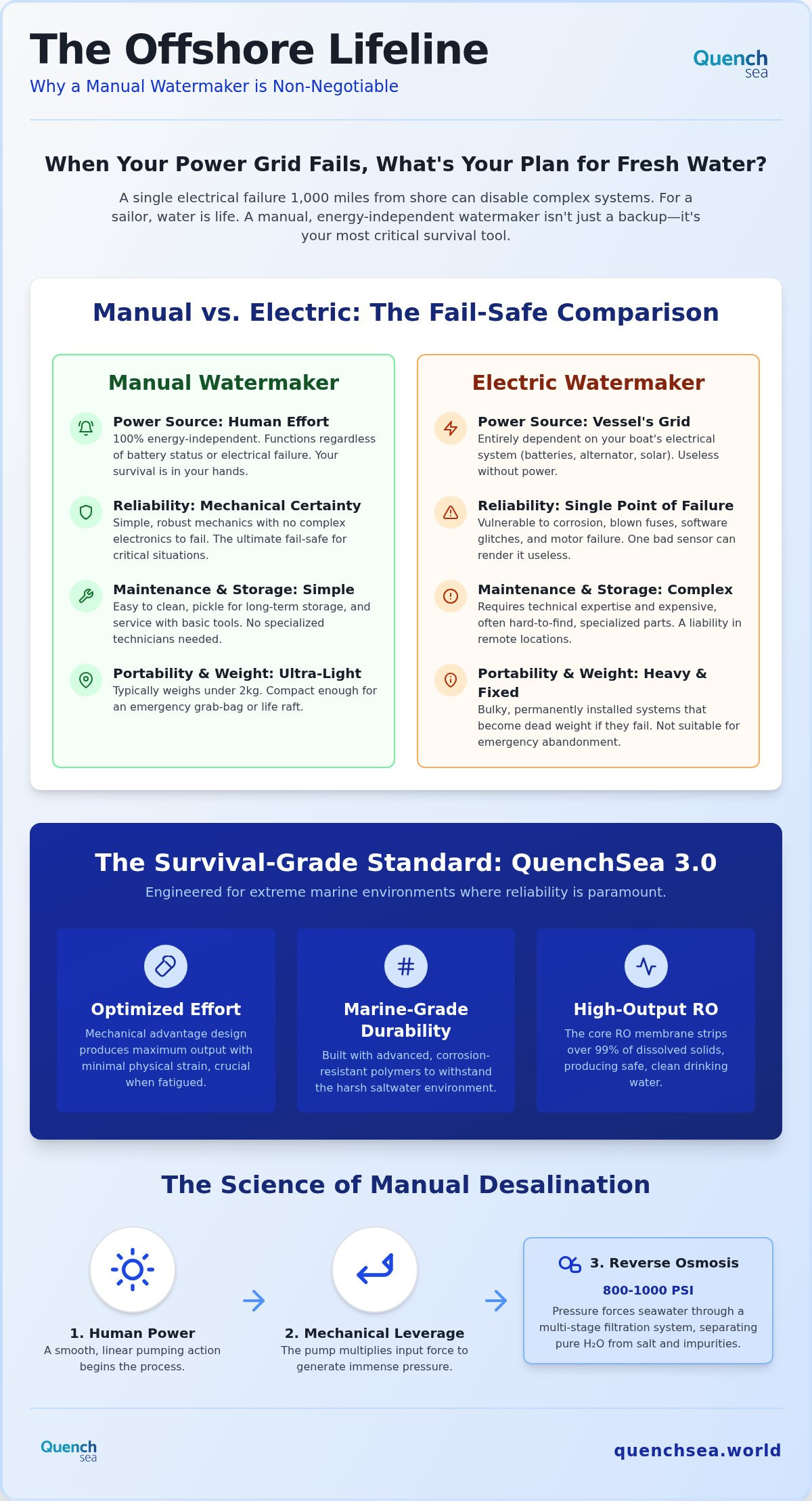
Modern yachting relies heavily on complex electrical grids. Lithium banks, high-output alternators, and sophisticated sensors manage your life support. But salt water is the ultimate solvent. It corrodes connections, swells seals, and shorts out circuit boards. When your primary desalinator stops due to a software glitch or a blown motor, your countdown begins. A manual watermaker for sailboat use eliminates this reliance on the grid. It is a mechanical certainty in a digital world. You don't need a voltmeter to check if your arms still work; you just need the tool and the effort.
Redundancy is the core of blue-water safety. You carry spare sails, secondary anchors, and redundant GPS units. Water requires the same discipline. While some cruisers still rely on heavy plastic jerry cans, these are inefficient and dangerous in heavy weather. Consider the logistical differences:
- Jerry Cans: A single 20-liter can weighs 20kg, offers a finite supply, and shifts the vessel's center of gravity.
- Manual Watermaker: Weighs less than 2kg, provides an infinite stream, and fits in a small emergency locker.
This shift toward total energy independence is the defining trend of the 2026 sailing community. Sailors are moving away from convenience-only systems toward reliability-first configurations that function regardless of the boat's power status.
The "Single Point of Failure" Risk
A single failed pressure sensor can brick a $10,000 electric system. Without power, that system is just dead weight taking up valuable locker space. Manual backups provide the psychological security needed for high-stakes passages. If the main pump dies, the mission continues without panic. This level of preparedness is vital, especially when considering a Life Raft Water Supply Guide for worst-case scenarios. Reliability isn't a luxury; it's a tactical requirement that empowers the skipper to make better decisions under pressure.
Cost-Effective Preparedness
Choosing a manual watermaker for sailboat applications is a strategic decision for any serious cruiser. Maintenance on electric units is expensive and technically demanding. Often, specialized parts aren't available in remote ports, leaving you stranded or forced to buy bottled water. A manual unit offers a superior return on investment by serving as both an emergency tool and a daily supplement for coastal cruisers. Understanding The Engineering of Manual Reverse Osmosis reveals why these systems are so robust. They use simple mechanical advantage to produce results without the need for complex control boards. Non-electric gear ensures that your survival is never tethered to a battery's charge state or a temperamental fuse.
The Engineering of Manual Reverse Osmosis
Reverse osmosis is a battle against thermodynamics. To force salt water through a semi-permeable membrane, you must exceed the osmotic pressure threshold. For seawater, this requires approximately 800 to 1,000 psi. In an electric system, a high-torque motor handles this load. In a manual watermaker for sailboat use, your muscles provide the energy. Engineering makes this possible through mechanical advantage. Long-stroke levers or high-ratio gears multiply your physical input. This allows a human operator to generate the immense pressure needed to strip 99% of dissolved solids from the ocean.
The RO membrane is the heart of the system. It's a delicate, microscopic mesh. Without pre-filtration, marine debris and microscopic silt would shred the membrane within minutes. Effective manual units utilize a multi-stage approach. First, a sediment filter catches larger particulates. This protection ensures that only pressurized brine reaches the RO stage. When considering a manual watermaker for your boat, look for systems that prioritize this shield layer. Maintaining membrane integrity is the only way to guarantee a long-term water supply.
The Mechanics of the Hand Pump
Efficiency is paramount when you're the power source. Linear pumping actions are standard because they align with natural human movement. Modern 2026 materials, including advanced polymers and ceramic-coated pistons, have drastically reduced internal friction. This means more of your effort goes into water production rather than overcoming mechanical resistance. Consistent pressure is vital. Jerky movements can cause pressure spikes that fatigue the membrane. A smooth, rhythmic stroke maintains the 800-1000 psi sweet spot for optimal desalination.
Filtration Stages in Portable Units
Filtration isn't just about salt. Portable units often include activated carbon stages. While the RO membrane removes the salt, carbon removes residual tastes and organic odors. This produces water that isn't just safe, but palatable. Sediment filters act as the first line of defense, preventing clogging and extending the life of the more expensive RO core. Reverse osmosis remains the gold standard for survival hydration because it provides a physical barrier against viruses, bacteria, and minerals. If you need a tool that handles these complexities with simple mechanics, explore how the QuenchSea 3.0 optimizes every stage of this process.
Manual vs. Electric Watermakers: The Fail-Safe Comparison
Electric watermakers offer undeniable convenience. They produce high volumes of freshwater at the push of a button. However, this convenience comes with a heavy energy toll. These systems require high-amperage draws and complex battery management. A manual watermaker for sailboat use trades high-volume output for absolute certainty. It occupies the tactical "sweet spot" where physical effort meets critical hydration. You aren't filling a tank for a hot shower; you're securing your life support. In the harsh salt environment of a blue-water passage, simplicity is a form of sophistication that electronics cannot match.
Maintenance requirements highlight another stark contrast. Electric systems are temperamental. They require regular "pickling" with specialized chemicals to prevent biological growth on the membranes. This process often relies on automated timers and sensors that can fail. Manual units are inherently simpler to maintain. They are easier to flush, preserve, and store in a dry locker for extended periods. When the primary system fails, a manual unit is ready for immediate deployment. It doesn't need a software update or a steady 12V supply to function.
Reliability in Extreme Conditions
Consider the reality of a knockdown or a major leak. Saltwater submersion destroys proprietary circuit boards and electrical motors instantly. A mechanical device remains unaffected by water in the bilge. You can disassemble, clean, and reassemble a manual pump using basic hand tools. This mechanical transparency is the core of Manual Boat Water Makers: 2026 Non-Electric Desalination. It provides a level of autonomy that no digital system can replicate. If your grid goes dark, your water supply shouldn't go with it.
Physical Effort and Output
Set realistic expectations for manual desalination. A human operator can realistically produce between 2 and 4 liters of freshwater per hour. Modern 2026 designs have optimized lever lengths and utilized low-friction seals to reduce user fatigue. Compare the "energy cost" involved. Running a diesel generator to power an electric unit involves fuel, noise, and mechanical wear. Pumping a manual watermaker for sailboat survival involves only human calories. In a crisis, your physical effort is the most renewable resource on the boat. Most professional sailors now adopt a hybrid approach. They use electric units for daily comfort but rely on manual gear for their ultimate fail-safe.
Choosing the Best Manual Watermaker for Your Boat
Selecting a manual watermaker for sailboat applications demands a cold assessment of hardware. You aren't buying a luxury accessory. You are investing in a life-critical tool. Size and weight are non-negotiable. If the device is too bulky for your emergency locker or too heavy for a grab-bag, it stays behind. Every gram counts when you're abandoning ship. Prioritize units that utilize high-impact, corrosion-resistant plastics and 316 stainless steel. These materials withstand the relentless salt spray and UV exposure of the marine environment without seizing.
Operational simplicity is the next metric. A desalinator must be functional even if the sailor is injured, cold, or fatigued. High-torque requirements are a failure point. Search for designs with optimized mechanical advantage. Membrane replaceability is equally vital. Avoid proprietary, sealed-unit designs that force you to replace the entire device after the membrane expires. A modular system allows for field repairs and long-term utility. Reliability is built on serviceability.
Grab-Bag Integration
A manual watermaker should be the foundational item in your offshore survival kit. It provides an infinite supply of water, unlike finite plastic pouches. Secure the unit in a high-visibility, waterproof bag near the companionway. Consider mounting options that allow for quick detachment. For a deeper dive into tactical deployment, review the Survival Desalination Device Guide. Preparedness is about reducing the time between a crisis and a solution.
Maintenance and Storage
The membrane is a living component. If left stagnant, bacteria will colonize the pores and ruin the unit. The "pickling" process involves circulating a preservative solution through the system during months of non-use. This is a five-minute task that ensures your gear works when it's life-critical. Regular flushing with freshwater after each use prevents salt crystallization. A well-maintained manual RO membrane typically lasts between three and five years before requiring replacement. Reliability requires discipline. To secure a unit designed for these exact marine protocols, get the QuenchSea 3.0 for your vessel.
The QuenchSea 3.0: A Survival-Grade Solution for Sailors
The QuenchSea 3.0 represents the pinnacle of mission-driven engineering. Developed by Hydro Wind Energy, this device is the result of years spent perfecting a manual watermaker for sailboat survival. It isn't just a piece of gear. It is a calculated response to the harsh realities of the offshore environment. While legacy brands often lock reliable desalination behind prohibitive costs, the QuenchSea 3.0 breaks that barrier. It makes survival-grade technology accessible to every sailor, from weekend cruisers to solo circumnavigators. This affordability doesn't sacrifice quality. The device features a ruggedized external housing designed to withstand the crushing forces and corrosive nature of the open ocean. It's built to be a permanent, dependable part of your vessel’s inventory.
Engineered for the Ocean
Offshore sailing involves high-salinity water and unpredictable conditions. The QuenchSea 3.0 handles these variables with a user-centric design. It functions efficiently even in a rolling sea where stability is a luxury. The internal mechanics are optimized for a high output-to-effort ratio. This ensures that you produce maximum freshwater with minimal physical fatigue during a crisis. For a detailed technical breakdown, consult QuenchSea 3.0: The Ultimate Portable Desalination Device. This tool is built specifically for remote offshore areas where traditional support is non-existent and every drop of water is a victory.
Becoming a Self-Sufficient Sailor
In 2026, self-sufficiency is the standard for modern yacht safety protocols. Sailors are moving away from bulky, expensive legacy brands in favor of agile, high-performance tools. The QuenchSea 3.0 fits seamlessly into this mindset. It bridges the gap between humanitarian relief technology and professional marine safety. Its portable nature means it transitions easily from the cabin to the life raft in seconds. This versatility is why it has become the preferred choice for sailors prioritizing reliability over brand name history. Don't wait for a total electrical failure to realize the value of independence. Secure your freshwater supply before your next passage. True preparedness starts with a manual watermaker for sailboat applications that you can trust when the grid goes dark and the horizon is empty.
Securing Your Off-Grid Independence
True maritime safety rests on the principle of absolute redundancy. Relying solely on sophisticated electrical desalination introduces a single point of failure that can compromise an offshore passage. A manual watermaker for sailboat use provides the mechanical certainty required when the grid goes dark. It's the guarantee that your life-critical hydration is never tethered to a battery's charge or a complex circuit board's integrity. By prioritizing compact, survival-grade engineering, you transform a potential catastrophe into a manageable tactical challenge.
The QuenchSea 3.0 is engineered for this exact mission. It requires zero electricity or fuel and is trusted by marine professionals and global disaster relief teams to perform in extreme conditions. This gear represents a commitment to total self-sufficiency in the world's most challenging environments. Equip your sailboat with the QuenchSea 3.0 today and take full command of your vessel's water security. Navigate with authority, knowing your freshwater supply is secured for every nautical mile ahead.
Frequently Asked Questions
How much water can a manual watermaker produce per hour?
Output varies based on operator effort and water temperature. Most manual units, like the QuenchSea 3.0, produce between 2 and 4 liters of freshwater every hour. This rate is sufficient for emergency hydration and basic survival needs on a vessel. Cold water or high salinity can slightly reduce this volume. It's a reliable, independent stream that doesn't depend on your boat's power grid or fuel reserves.
Is the water from a manual desalinator safe to drink immediately?
Yes. Freshwater produced by a functioning manual watermaker for sailboat use is safe for immediate consumption. The reverse osmosis process filters out 99% of dissolved solids and salts. If the membrane is maintained and the system is flushed correctly, the output meets high safety standards. Always ensure your pre-filters are clean to prevent any organic particulates from reaching your storage container or glass.
How long does a manual watermaker membrane last?
A well-maintained RO membrane typically lasts between three and five years. Longevity depends entirely on your maintenance discipline. If you allow salt water to sit stagnant in the unit, crystals will tear the membrane. Regular freshwater flushes and chemical "pickling" during long storage periods prevent biological growth. Modular designs allow you to swap the membrane without replacing the entire pump assembly.
Can I use a manual watermaker for my daily needs on a sailboat?
You can use it daily, but realize the physical commitment involved. Producing 20 liters of water requires several hours of manual pumping. Most sailors use these devices as a primary backup or for small-scale hydration needs while at anchor. It's an excellent way to supplement your tanks without running a generator. For long-distance passages, it remains your most critical fail-safe survival tool.
Do manual watermakers work in very salty water like the Mediterranean?
Yes. Manual reverse osmosis systems function in high-salinity environments like the Mediterranean or the Red Sea. You'll notice that pumping requires slightly more physical effort to overcome the higher osmotic pressure. The QuenchSea 3.0 handles these conditions by utilizing superior mechanical advantage in its lever design. It continues to strip salt effectively even when the concentration of dissolved solids is significantly higher than the ocean average.
What maintenance does a manual watermaker require when not in use?
Maintenance is centered on membrane preservation. If you don't plan to use the unit for more than a week, you must flush it with freshwater. For long-term storage, you need to "pickle" the system using a preservative solution. This prevents bacteria and mold from colonizing the microscopic pores of the membrane. Always store the unit in a dry, cool locker away from direct sunlight and extreme heat.
Is it physically difficult to pump a manual watermaker?
It requires steady, rhythmic physical effort. You must generate 800 to 1,000 psi to force water through the membrane. Modern manual watermaker for sailboat designs use long-stroke levers to reduce the perceived load on the operator. While it's a workout, it's designed to be manageable for an average adult. Consistency is more important than raw strength. A smooth pace ensures a steady flow and protects the internal seals from pressure spikes.
Can a manual watermaker remove viruses and bacteria from seawater?
Yes. The reverse osmosis membrane acts as a physical barrier against microscopic pathogens. The pores are significantly smaller than viruses and bacteria, effectively stripping them from the water stream. This makes the device an essential survival tool for offshore crossings. Beyond salt removal, you're getting a high level of biological filtration. It ensures that your emergency water supply is biologically safe to drink without further boiling or chemical treatment.