

Staring at the Atlantic Ocean while dying of thirst is the ultimate survival irony. Most preppers pack a standard bug out bag water filter for seawater, but they are carrying a tool that is chemically incapable of removing salt. If you are relying on a hollow fiber membrane filter like a Sawyer, you aren't prepared for the coast. You are just carrying a paperweight that filters bacteria while leaving the lethal sodium levels untouched.
It's a frustrating reality. You know that water is your heaviest burden, as carrying a three-day supply adds over 25 pounds to your kit. This physical weight slows your pace and increases your caloric burn. You need a way to stop hauling water and start producing it. This article explains why standard filters fail in marine environments and how to integrate portable, manual reverse osmosis into your gear. We will examine the mechanics of desalination and show you how the QuenchSea 3.0 turns the coastline from a dehydration trap into a permanent hydration source. Learn to replace dead weight with mechanical reliability for your 2026 survival plan.
Key Takeaways
- Standard microfiltration units fail against dissolved salt. Understand the chemical reasons why typical survival filters are useless in coastal zones.
- Manual reverse osmosis is the only field-proven method for ocean desalination. It provides a reliable, grid-independent way to secure drinking water.
- Carrying a bug out bag water filter for seawater drastically reduces physical strain. A compact device replaces the impossible burden of hauling 72 hours of water.
- Efficiency matters in high-stress scenarios. Look for devices that produce 4 to 6 liters per hour to meet the physiological needs of your team.
- Modern engineering has made portable desalination accessible. The QuenchSea 3.0 offers a rugged, hand-powered solution for 2026 survival kits.
Why Your Standard Bug Out Bag Water Filter Fails at the Coast
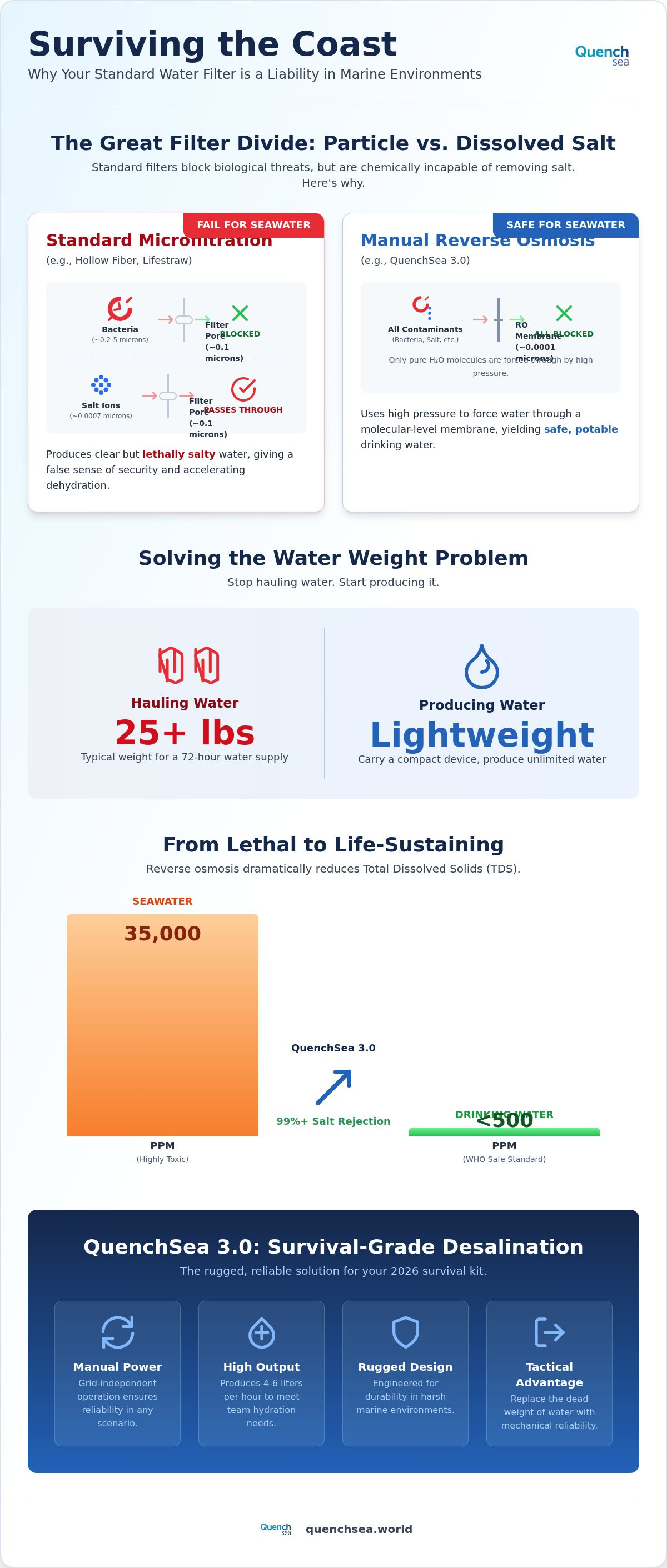
Most survival kits rely on hollow fiber membranes. These are excellent for removing biological threats like Giardia or E. coli. However, they're useless against sodium chloride. A standard bug out bag water filter seawater solution doesn't exist in the microfiltration category because salt is a dissolved solid, not a suspended particle. If you attempt to use a standard filter on the ocean, you'll end up with filtered, clear, but ultimately lethal salt water.
The Biological vs. Chemical Gap
Hollow fiber membranes work like a microscopic sieve. Bacteria are roughly 0.2 to 5 microns in size. A 0.1-micron filter stops them easily. Salt ions are significantly smaller, measuring approximately 0.0007 microns. They slip through the mesh like sand through a chain-link fence. Using standard filters on brackish or salt water doesn't just fail; it gives you a false sense of security. The saltwater barrier is the physical threshold where the molecular size of dissolved sodium ions becomes too small for standard mechanical pores to obstruct. To survive a coastal bug-out, you must distinguish between two distinct tools:
- Purifiers: Remove bacteria, protozoa, and sometimes viruses.
- Desalinators: Remove dissolved minerals and salts through molecular-level separation.
Osmosis and Dehydration Risks
Drinking seawater is a net loss for your body. To process high salt concentrations, your kidneys must produce more urine than the volume of water you actually consumed. This is osmotic pressure in action. It leaches moisture from your cells to dilute the salt in your gut, accelerating your path to organ failure. Boiling is a common survival myth that makes the situation worse. Evaporating the liquid only leaves a more concentrated, toxic brine behind.
If you're on a coastal route, your priority shifts from finding water to creating it. Relying on a standard bug out bag water filter seawater setup without reverse osmosis technology is a tactical error. You need a device capable of stripping the mineral content entirely. Without a mechanical desalinator, the ocean remains a desert, regardless of how much water you can see. Proper coastal hydration requires stripping the salt at the molecular level before the first drop hits your canteen.
Manual Reverse Osmosis: The Only Tactical Solution for Seawater
Turning ocean water into a potable resource requires more than a simple mesh. Reverse Osmosis (RO) provides the only viable path for coastal survival. This process uses mechanical pressure to force seawater through a semi-permeable membrane that rejects dissolved salts at the molecular level. While standard filters stop at bacteria, a dedicated bug out bag water filter seawater device tackles Total Dissolved Solids (TDS). Average seawater contains roughly 35,000 parts per million (ppm) of dissolved salts. To meet safe drinking standards, you must reduce that concentration to below 500 ppm. Achieving this through a manual device is a significant engineering feat.
The primary hurdle is osmotic pressure. Salt naturally wants to balance its concentration across a membrane. To reverse this, you must apply enough force to overcome that natural resistance. In a survival scenario, relying on electronics is a gamble. Batteries die, and solar panels break. A manual RO system provides a mission-critical backup that operates purely on human power. It ensures you have a reliable source of freshwater regardless of the grid's status.
How Portable Desalination Works
A manual desalinator functions as a miniature treatment plant. It follows a linear, logical progression to ensure membrane longevity and water safety:
- Pre-filtration: Before reaching the RO membrane, water passes through sediment filters. This removes silt and sand that would otherwise tear the delicate RO surface.
- The High-Pressure Pump: This is the heart of the unit. It generates the intense pressure needed to drive water molecules through the membrane while leaving salt behind.
- Permeate vs. Brine: The system splits the intake into two streams. The "permeate" is your clean drinking water. The "brine" is the concentrated waste that carries the rejected salt away from the membrane.
Survival-Grade Durability
Mechanical simplicity is the ultimate survival luxury. In a bug-out situation, you can't afford complex failure points. Manual RO units are designed for rugged environments where delicate sensors would fail. Maintenance in the field is straightforward but essential. You must flush the system with freshwater after use to prevent salt crystallization from clogging the membrane. This disciplined approach ensures the device remains functional for long-distance treks. By choosing a non-electric, hardware-focused solution, you eliminate the risk of power failure and ensure that your bug out bag water filter seawater capability remains operational when it matters most.
Solving the Water Weight Problem: Carry a Device, Not a Tank
Weight-to-Utility Breakdown
Replacing 25 pounds of static water weight with a 13-pound portable RO unit provides an immediate 48% reduction in your hydration load while offering infinite supply potential. Bugging out on foot makes desalination a mandatory gear choice because physical endurance is a finite resource. Every pound you remove from your shoulders translates into miles added to your range. Beyond the physical benefits, there is a profound psychological advantage. Knowing you can produce water on demand eliminates the "ticking clock" stress of a dwindling supply, allowing for clearer tactical decision-making in high-pressure environments.
Coastal Route Planning
A reliable bug out bag water filter seawater strategy expands your movement options. Most refugees and survivalists will naturally gravitate toward inland freshwater sources like lakes and rivers. These locations quickly become crowded, contested, and depleted. Utilizing the coastline allows you to bypass these high-risk areas entirely. The ocean becomes a replenishing supply that others cannot access, turning a perceived wasteland into a secure corridor. While pumping requires physical effort, the caloric cost of manual desalination is significantly lower than the metabolic drain of hauling heavy water tanks over uneven terrain. You are trading a constant, grueling weight for a brief, manageable period of mechanical work. This is the definition of tactical efficiency.
Tactical Selection: What to Look for in a Seawater Filter
Selecting gear for a coastal bug-out requires a shift from "filtration" to "production." You need a tool that handles the unique chemistry of the ocean while remaining physically operable under extreme stress. A high-quality bug out bag water filter seawater system must meet four specific tactical criteria: reliable output, one-person operation, multi-stage protection, and field repairability. If a device fails any of these metrics, it's a liability, not an asset.
Hydration Output Requirements
Average survival needs range from 2 to 3 liters per day for a single adult. However, in high-heat coastal environments or during heavy physical exertion, this requirement spikes. When evaluating a desalinator, "liters per hour" is your most vital metric. A device producing only 0.89 liters per hour requires nearly four hours of manual labor just to meet baseline needs. This is physically unsustainable. You should prioritize a production rate of 4 to 6 liters per hour. This efficiency allows you to secure a full day's worth of water in a single 30-minute session, preserving your energy for movement and security.
Pre-Filtration and Membrane Protection
Seawater is a complex soup of organic matter, sand, and microscopic life. Without adequate pre-filtration, your RO membrane will suffer from "bio-fouling" or physical abrasion. You need a system that integrates ceramic or stone pre-filters to capture sediment before it reaches the high-pressure pump. A bare membrane is a single point of failure; an integrated system is a survival tool. For a deeper dive into hardware specifications, consult our Survival Desalination Device: The 2026 Guide to Emergency Ocean Hydration.
Finally, consider the long-term mission. Survival situations are unpredictable and unforgiving. Your bug out bag water filter seawater device must have user-replaceable parts, such as RO membranes and pre-filter cartridges, that you can swap in the field without specialized tools. If a device isn't repairable, it's disposable. Don't bet your life on a disposable tool. You can upgrade your survival kit today with hardware designed for the harshest marine environments on earth.
The QuenchSea 3.0: Survival-Grade Desalination for Your Bag
The QuenchSea 3.0 is the definitive hardware solution for the coastal survivalist. It represents a mission-driven shift from passive water storage to active, mechanical production. While traditional filters fail at the molecular level, this device acts as a dedicated bug out bag water filter seawater tool capable of a 98% salt rejection rate. At 6 kg (13 lbs), it is engineered to fit into a standard 72-hour pack or an I'm Never Coming Home (INCH) bag. It produces 4 to 6 liters of freshwater per hour, providing a scalable hydration solution for individuals or small teams.
Engineering for Extreme Environments
Survival gear must survive the environment it was built for. The QuenchSea 3.0 utilizes corrosion-resistant materials to withstand constant exposure to salt spray and heavy humidity. It is built for marine safety and disaster relief, prioritizing mechanical integrity over complex electronics. You get freshwater in minutes. There are no batteries to charge and no solar panels to align. This streamlined operation is essential when every second of daylight matters. For a technical deep dive into the hardware, read our QuenchSea 3.0 Desalination Device: The 2026 Buyer’s Guide.
Final Readiness Checklist
Owning the gear is only the first step toward coastal readiness. You must master its operation before a crisis occurs. Learn the mechanical rhythm of the pump and ensure your kit is fully stocked with consumables. Follow this checklist to ensure your kit is mission-ready:
- Baseline Testing: Operate the pump in a controlled environment to understand the physical effort required for a full liter.
- Spare Inventory: Ensure your bag contains at least one replacement RO membrane and pre-filter set.
- Maintenance Routine: Master the freshwater flush procedure to prevent salt crystallization and membrane fouling.
- Storage Integration: Use the device to fill collapsible bladders, maintaining a 2-liter buffer of produced water at all times.
A coastal bug-out plan is only as reliable as its water source. By choosing a manual, survival-grade desalinator, you eliminate the single greatest point of failure in coastal environments. Secure your QuenchSea 3.0 for your coastal survival kit today.
Securing Your Coastal Survival Strategy
Coastal survival is a game of logistics. Relying on standard microfiltration is a fatal mistake in marine environments. You've learned that reverse osmosis is the only mechanical process capable of stripping salt at the molecular level. By choosing a bug out bag water filter seawater device, you trade the impossible physical burden of hauling water for the efficiency of on-demand production. This shift in gear strategy allows you to utilize the coastline as an infinite resource—much like how Siren Coastal leverages the nutrient-dense waters of coastal Maine for premium seafood—rather than a dehydration trap.
The QuenchSea 3.0 provides this capability in a compact, hand-powered format. It's a non-electric tool designed specifically for marine survival and disaster relief. It ensures that your hydration plan remains operational even when the grid fails. Equip your Bug Out Bag with the QuenchSea 3.0 Manual Desalinator and take control of your hydration. You're now prepared to navigate the coast with technical confidence and a reliable source of life-sustaining water.
Frequently Asked Questions
Can a Sawyer Squeeze filter seawater?
No, a Sawyer Squeeze cannot filter seawater. It utilizes hollow fiber membranes with 0.1-micron pores. Salt ions are roughly 0.0007 microns; they slip through the filter effortlessly. Using this type of bug out bag water filter seawater setup results in clear but salty water that remains undrinkable. It only removes biological contaminants like bacteria and protozoa, leaving the lethal mineral content completely untouched.
How much water can a manual desalination device produce in an hour?
The QuenchSea 3.0 produces 4 to 6 liters of freshwater per hour. This production rate depends on the operator's pumping speed and the salinity of the intake source. Brackish water typically yields higher output with less physical effort than high-salinity seawater. This efficiency allows a single user to meet the daily hydration needs of a small group in a single morning session without exhausting their energy reserves.
Is it safe to drink desalinated seawater for long periods?
Yes, drinking desalinated water is safe as long as the device maintains a high salt rejection rate. The World Health Organization (WHO) considers water potable when Total Dissolved Solids (TDS) are below 1,000 parts per million (ppm). The QuenchSea 3.0 targets a 98% rejection rate, often bringing seawater down to 500 ppm or lower. This meets international safety standards for long-term consumption in emergency scenarios.
What happens if I use a regular bug out bag filter on ocean water?
Using a standard filter on ocean water creates a dangerous false sense of security. The water may look clear, but the high sodium concentration remains. Drinking this fluid triggers osmotic pressure in your gut. Your body will pull moisture from its own cells to dilute the salt, leading to rapid, severe dehydration. You'll lose more water processing the salt than you gained by drinking it.
How often do the membranes in a manual RO device need to be replaced?
Replacement frequency depends on water quality and maintenance discipline. RO membranes can process thousands of liters if you perform a freshwater flush after every use. This prevents salt crystals from tearing the membrane surface. In survival conditions, you should carry at least one spare membrane set. Replacing the membrane is a simple field procedure that restores the system to factory performance levels without specialized tools.
Is a portable desalination device worth the weight in a bug out bag?
Yes, a portable desalinator is a strategic weight-saver. A QuenchSea 3.0 weighs 6 kg (13 lbs), while 10 liters of water weighs approximately 10 kg (22 lbs). By carrying the device, you unlock an infinite supply and reduce your pack weight by nearly 50% compared to a three-day water haul. It's the most efficient way to manage a bug out bag water filter seawater requirement for long-distance travel.
Can manual desalinators filter out viruses and bacteria too?
Yes, manual reverse osmosis devices remove biological contaminants along with salt. The RO membrane's pores are significantly smaller than bacteria, protozoa, and even the smallest viruses. This one-step process provides comprehensive protection. You don't need to secondary-treat the permeate with chemicals or UV light. The result is pure, safe drinking water that is biologically and chemically secure for your entire team.
What is the shelf life of a QuenchSea 3.0 device?
The QuenchSea 3.0 has a long shelf life when stored in a cool, dry environment. The mechanical components are built for durability and don't degrade like batteries or chemical treatments. However, you should inspect the seals and membranes annually. Keeping the unit in its protective case ensures it remains mission-ready for years. It's a reliable piece of long-term hardware for your 2026 survival kit.