

Your survival-grade water filter is likely useless the moment it touches the ocean. Most remote property owners believe their standard filtration setup can handle any source, but a typical off grid cabin seawater filter only removes sediment and pathogens. It leaves the lethal salt content untouched. Relying on traditional filters for coastal survival isn't just ineffective; it's a critical safety gap that could leave you dehydrated during a drought or equipment failure.
You understand that true independence means moving beyond the grid. However, high-end desalination systems often demand massive power draws and expensive solar arrays that aren't practical for every site. This guide promises a different path. You'll discover how to transform seawater into life-sustaining freshwater using nothing but manual mechanical pressure. We'll explain the engineering behind reverse osmosis, compare manual devices to power-hungry alternatives, and show you how to secure a reliable, non-electric backup for your coastal cabin. By the end, you'll have a clear blueprint for 2026 coastal resilience that doesn't require a single battery or fuel source.
Key Takeaways
- Learn the fundamental engineering difference between biological filtration and chemical desalination to avoid critical hydration failures.
- Compare reverse osmosis and distillation to identify the most energy-efficient water production method for remote environments.
- Discover why a manual off grid cabin seawater filter serves as the indispensable "Plan B" for total independence from the power grid.
- Master the "pickling" maintenance process and TDS monitoring to ensure your survival-grade equipment remains ready for long-term storage.
- Identify how the QuenchSea 3.0 provides a portable, non-electric solution for transforming seawater into freshwater without relying on fuel.
Why Standard Off-Grid Filters Fail at the Coast
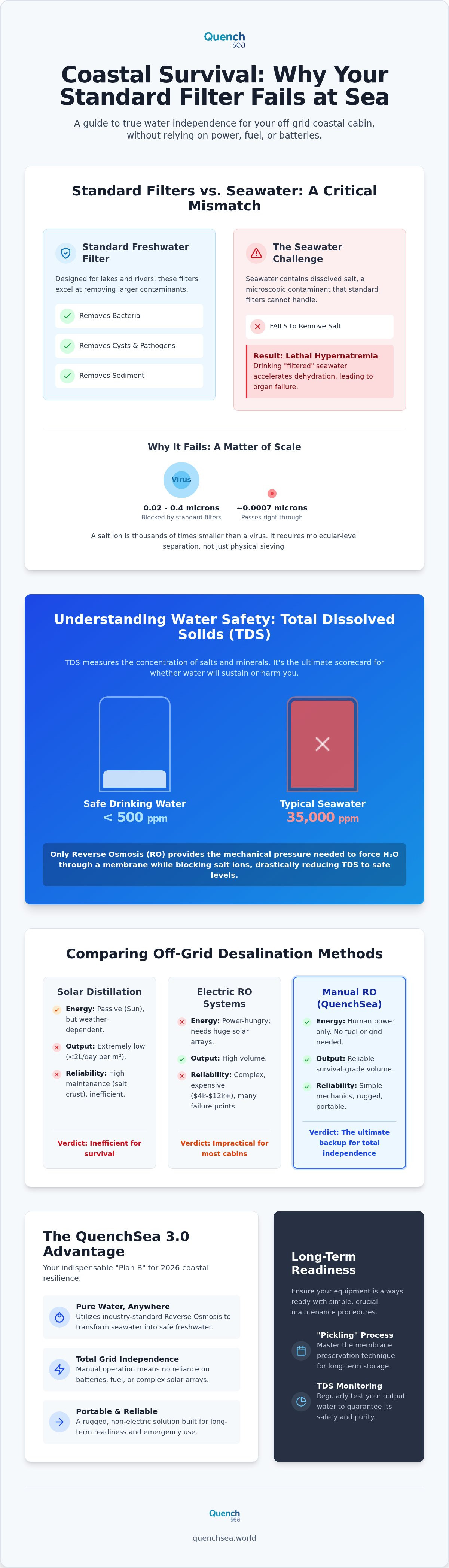
Standard off-grid filters are designed for freshwater environments. They excel at removing bacteria, cysts, and sediment from lakes or rivers. However, they are fundamentally incapable of removing dissolved salt. Using a ceramic or carbon filter on the ocean is a recipe for disaster. These devices rely on physical sieving. Salt is not a physical particle in the same way; it is a dissolved mineral that requires molecular-level separation. Understanding desalination technologies is the first step toward coastal self-sufficiency.
Drinking seawater that has only been "filtered" through a standard unit leads to hypernatremia. Your body uses more water to flush out the excess salt than you actually consumed. This accelerates dehydration and can lead to organ failure. It doesn't matter how clear the water looks. If the salt remains, it is toxic. To survive at the shoreline, you must move beyond biological filtration and utilize a dedicated off grid cabin seawater filter based on reverse osmosis.
The Myth of the Gravity Filter for Seawater
Gravity filters are the standard for inland cabins. They use micro-pores to trap pathogens. A typical virus is roughly 0.02 to 0.4 microns. A salt ion is significantly smaller, measuring approximately 0.0007 microns. The salt passes through these filters like air through a screen door. Separating salt from water requires immense pressure to overcome osmotic force. Gravity alone cannot generate the energy needed to force water molecules through a desalination membrane. In a coastal context, "purified" water is still lethal if it hasn't been desalinated.
Total Dissolved Solids (TDS) Explained
TDS measures the concentration of dissolved substances in water, including salts, minerals, and metals. For an off grid cabin seawater filter to be effective, it must reduce these levels drastically. Seawater typically measures around 35,000 parts per million (ppm). For context, safe drinking water should ideally stay below 500 ppm. TDS acts as the definitive scorecard for your hydration safety, indicating whether your water will sustain or deplete your body. Without a way to lower TDS, your water source remains a liability rather than an asset.
Reverse Osmosis (RO) stands as the only viable off-grid solution. It uses mechanical pressure to push water through a semi-permeable membrane that blocks salt ions while allowing H2O to pass. This process is the gold standard for survival-grade water production, and technical resources from Great Water Filters can help you understand how these systems maintain such high purity standards.
Comparing Off-Grid Seawater Desalination Methods
Coastal survival requires a reliable water source. The process is called 'desalination', and it comes in two primary forms: thermal distillation and membrane-based reverse osmosis (RO). Thermal systems use heat to evaporate water. RO uses pressure to push water through a membrane. For an off-grid cabin, the choice depends on energy availability and required volume. While distillation is simple in theory, it is often impractical for high-stakes survival scenarios.
Solar Distillation: A Slow Burn
Solar stills are a common DIY recommendation. They are simple but inefficient. A typical solar still produces less than two liters of water per day per square meter of surface area. This yield rarely meets basic survival needs. You also face a significant maintenance burden. Salt crust builds up rapidly on the evaporation surfaces. It requires constant scrubbing to maintain efficiency. Compared to a manual off grid cabin seawater filter, solar stills take up too much space for too little output. They are passive systems that leave you vulnerable to weather conditions.
The Power Struggle of Electric Water Makers
Electric RO systems are standard on large yachts but often fail the cabin test. These units are expensive, with capital costs for small-scale remote systems typically ranging from $4,000 to $12,000. They are power-hungry. Research indicates that electricity accounts for 35% to 50% of total operating expenses for small-scale seawater reverse osmosis. Most off-grid cabins don't have the excess solar capacity to run these high-pressure pumps daily. Every additional wire and sensor is a potential failure point in a corrosive salt environment.
Manual RO systems offer the tactical advantage. They strip away the complexity. You trade human effort for mechanical reliability. By using a hand-powered device, you eliminate the need for batteries, fuel, or complex wiring. This makes it the ideal primary tool or a rugged backup. If your main system fails during a drought, a portable hand-powered desalination device ensures you never go thirsty. It provides a lightweight, survival-grade solution that works regardless of your cabin's power status. This mechanical independence is the cornerstone of true coastal resilience.
Integrating a Seawater Filter into Your Cabin Strategy
Redundancy is the difference between a crisis and a routine. Most coastal properties rely on rainwater harvesting or shallow wells. This works until a drought hits or a cistern develops a leak. An off grid cabin seawater filter transforms the ocean into a reliable backup. It is your insurance policy against thirst. Integrating this tool requires a tactical mindset that prioritizes mechanical reliability over electronic convenience. True coastal resilience means having a way to produce water when the power is out and the tanks are empty.
Mapping Your Coastal Water Sources
Intake location determines the lifespan of your equipment. Do not pump from stagnant tide pools or areas near agricultural runoff. These zones contain high levels of organic matter and chemicals that can foul a membrane rapidly. Position your intake in clear, moving water beyond the low-tide line. Pre-filtration is your first line of defense. By removing suspended solids before they reach your survival desalination device, you ensure maximum efficiency.
Follow these steps to create a simple cabin pre-filter:
- Perforate the base of a 5-gallon bucket with small drainage holes.
- Layer 4 inches of coarse gravel at the bottom to provide structure.
- Add 8 inches of clean, fine silica sand as the primary filtering medium.
- Place a fine mesh screen on top to catch seaweed and large debris.
- Pour raw seawater through the bucket and collect the clarified output for desalination.
Emergency Rationing vs. Daily Production
Hydration is a non-negotiable metric for survival. Every adult resident requires approximately 3 liters of water per day for drinking and basic food preparation. In high-heat coastal environments, this requirement can climb. Manual desalination converts physical effort into a life-critical resource. This work provides a significant psychological boost during a crisis. You aren't a victim of the environment; you're a technician managing it.
Dedicate 45 to 60 minutes each morning to water production. This integrates the task into your daily off-grid chore routine, similar to hauling wood or checking solar levels. Once your water supply is secured, you can reward yourself with a specialty brew from Urban Sailor Coffee® to start your morning. Store the finished product in food-grade, opaque containers. Keep these tanks in a cool, dark location to prevent bacterial growth or algal blooms. A well-managed off grid cabin seawater filter strategy ensures that your freshwater supply remains as infinite as the ocean itself.
Maintenance and Longevity of Manual RO Systems
The survival of your off grid cabin seawater filter depends on disciplined maintenance. Salt is corrosive. Bio-fouling is persistent. If you neglect your device, it will fail when you need it most. Longevity in extreme environments requires a structured cleaning and storage protocol that treats the hardware as a life-critical asset. A well-maintained manual system can provide years of reliable service without the need for professional intervention.
Preserving the Reverse Osmosis Membrane
Fresh-water flushing is the most critical post-operational step. After producing drinking water, you must purge the system of concentrated brine. Residual salt crystals can tear the delicate membrane surface or seize the pump mechanism. Always use a portion of your desalinated product water to flush the internal components before storage. Never use chlorinated tap water, as chlorine permanently damages the RO membrane structure.
The pickling process preserves the system for long-term readiness. If the device sits idle for more than a few days, bacteria will colonize the damp membrane. This biological fouling is often irreversible. Using a food-grade preservative solution prevents this growth, ensuring your backup system remains functional during a sudden drought or infrastructure collapse. Store your membranes in a cool, stable environment to prevent degradation from extreme temperature fluctuations.
Mechanical Integrity: The Pump and Seals
Lubricate the pump seals regularly with food-grade silicone grease. High-salinity environments dry out rubber components, leading to pressure leaks. A drop in pumping resistance often signals a failing seal or a breach in the high-pressure circuit. Inspect all connections for salt spray or weeping water. Fixing a minor leak today prevents a catastrophic failure tomorrow. Mechanical simplicity is the ultimate off-grid luxury because it replaces complex failure points with user-serviceable hardware.
Monitor your output with a TDS pen. This tool provides an objective measurement of membrane health. If the total dissolved solids in your drinking water begin to climb, the membrane is likely compromised. Regular testing allows you to identify issues before they become life-threatening. Maintain a spare parts inventory that includes replacement membranes, pre-filters, and O-ring kits. These components are the lifeblood of your water security. You can find essential survival-grade desalination parts and accessories to keep your system operational for years of off-grid use.
The QuenchSea 3.0 Advantage for Off-Grid Living
The QuenchSea 3.0 is the definitive hardware choice for coastal property owners who refuse to compromise on water security. While previous sections highlighted the technical failures of standard filters and the prohibitive costs of electric systems, this device offers a calculated, mechanical alternative. It is engineered for the extreme. It doesn't just filter; it desalinates using manual pressure. This makes it the most reliable off grid cabin seawater filter available for 2026.
Portability is a primary design objective. Unlike fixed industrial systems, you can move this unit from your cabin kitchen to a bug-out bag or emergency vessel in seconds. It weighs a fraction of an electric pump and battery bank. This agility ensures your water production isn't tethered to a single room or structure. If the cabin is compromised, your water source remains with you. You maintain the ability to produce freshwater wherever the shoreline takes you.
No Fuel, No Batteries, No Excuses
Blackouts are a recurring reality in remote coastal living. Solar arrays fail. Batteries degrade. In these high-stakes moments, your survival depends on mechanical integrity. The QuenchSea 3.0 Desalination Device eliminates the dead battery risk entirely. You are the power source. By leveraging hand-powered reverse osmosis, you maintain total independence from the grid. This approach also reinforces long-term sustainability. You produce life-sustaining water without a carbon footprint or the need for fossil fuels. It is a clean, quiet, and unstoppable solution.
From Survival to Sustainability
Water security isn't just about crisis management. It's about enhancing your off-grid lifestyle. The QuenchSea 3.0 can serve as a supplemental source for small-scale coastal gardening or rinsing salt-sensitive equipment. It provides the peace of mind that comes from mission-driven engineering. You aren't buying a gadget; you're investing in a dependable tool. We've stripped away the unnecessary to focus on what truly works in the harsh natural world. Secure your water future and empower your coastal independence with the QuenchSea 3.0.
Securing Your Coastal Independence
True resilience at the shoreline requires moving beyond the limitations of standard filtration. You've learned that salt molecules bypass ceramic and carbon filters effortlessly, making a specialized off grid cabin seawater filter an essential component of your survival strategy. By prioritizing manual reverse osmosis over complex, power-hungry electric systems, you eliminate the risk of dead batteries or solar failure during a crisis. Reliability isn't a luxury; it's a mechanical requirement for those living on the edge of the map.
The QuenchSea 3.0 represents the pinnacle of this "Plan B" philosophy. It is 100% human-powered and engineered for the harshest coastal environments, providing a dependable water source when traditional infrastructure fails. This technology is trusted by marine and defense professionals worldwide to deliver life-sustaining freshwater in extreme situations. Don't leave your hydration to chance or unpredictable weather patterns. Secure your off-grid water supply with the QuenchSea 3.0 today. You have the tools and the knowledge to master your environment; now is the time to ensure your cabin remains a fortress of self-sufficiency.
Frequently Asked Questions
Can I use a Berkey or Sawyer filter for seawater at my cabin?
You cannot use standard gravity or squeeze filters like Berkey or Sawyer for desalination. These devices remove biological contaminants such as bacteria and protozoa but lack the membrane density to stop dissolved salt ions. Drinking seawater from these units leads to rapid dehydration and hypernatremia. For coastal safety, only a dedicated off grid cabin seawater filter using reverse osmosis technology can provide drinkable water from the ocean.
How much water can a manual seawater filter produce per hour?
Production rates vary based on operator effort and water temperature. A manual reverse osmosis device typically produces between 2 to 4 liters of freshwater per hour. This volume comfortably meets the daily hydration requirements for one to two adults. Consistency is key. Integrating a 60-minute pumping session into your daily off-grid chores ensures a steady supply without exhausting the operator or the hardware.
Is the water produced by QuenchSea 3.0 safe for long-term consumption?
Yes, the output is safe for long-term use provided the system is maintained correctly. The QuenchSea 3.0 utilizes survival-grade reverse osmosis membranes to strip away salts, pathogens, and dissolved solids. Regular testing with a TDS pen confirms the water remains within safe drinking limits. Always follow the recommended pre-filtration and flushing protocols to prevent membrane degradation and ensure consistent water quality for your cabin residents.
How long does the reverse osmosis membrane last in an off-grid setting?
A membrane’s lifespan depends heavily on water quality and maintenance discipline. Under typical off-grid conditions with proper pre-filtration and freshwater flushing, a membrane can process several thousand liters. However, organic fouling or salt crystallization will shorten this window significantly. Cabin owners should keep replacement membranes in their inventory to ensure uninterrupted water security. Monitoring TDS levels is the only reliable way to verify when a membrane needs replacement.
Does a manual seawater filter require a lot of physical strength to operate?
Operating a manual desalination unit requires moderate, steady physical effort rather than explosive strength. The design leverages mechanical advantage to overcome osmotic pressure. Most adults can maintain the necessary rhythm for 20 to 30 minutes at a time. The process is a functional trade-off. You provide the mechanical energy in exchange for total independence from the power grid and expensive solar infrastructure. It's a manageable task for daily coastal living.
What happens if I use the filter on brackish water instead of seawater?
Using a seawater-rated RO system on brackish water is highly effective and requires less physical effort. Brackish water has a lower concentration of dissolved solids, meaning there's less osmotic pressure to overcome. This results in a higher flow rate and less wear on the internal seals. It's a versatile tool for coastal cabins situated near estuaries or tidal marshes where salinity levels fluctuate based on the tide and season.
Can I store my desalination device in a cold cabin over winter?
You can store the device in a cold cabin, but you must prevent the internal membrane from freezing. Residual water inside the membrane fibers will expand when frozen, causing irreparable structural damage. If the cabin drops below freezing, store the unit in a temperature-controlled environment or use a food-grade preservative solution. Proper "pickling" and drainage are essential steps for protecting your off grid cabin seawater filter during the off-season.
How do I know when the filter membrane needs to be replaced?
Use a TDS meter to measure the salt content of your output water. If the parts per million (ppm) count begins to climb steadily above 500 ppm, the membrane is failing. You may also notice a significant increase in pumping resistance or a visible drop in flow rate. These mechanical cues indicate the membrane is fouled or compromised. Don't guess your water safety; rely on objective data and physical performance indicators to trigger a replacement.