

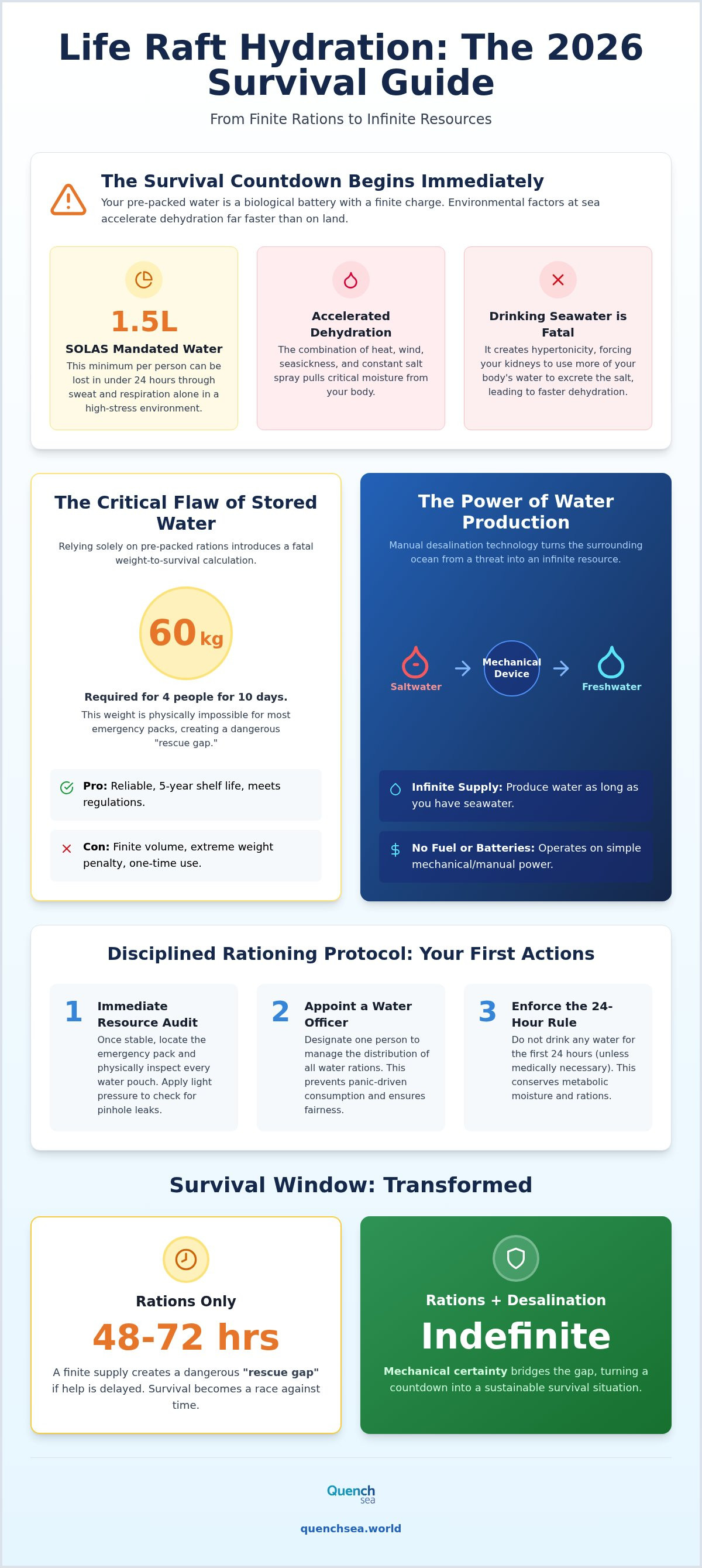
Your life raft water supply isn't a long-term survival strategy. It is a countdown. While SOLAS regulations mandate 1.5 liters of fresh water per person, this volume serves only as a bridge to rescue, not a permanent solution. Most offshore professionals understand the gut-wrenching math of a slow rescue. You worry about the weight of extra gear and the confusion of conflicting USCG requirements. You know that once the pre-packed pouches run dry, the ocean becomes a threat rather than a resource.
It is time to replace fear with mechanical certainty. This 2026 guide empowers you to master the critical science of hydration in extreme environments. We will provide a clear water rationing plan and demonstrate how to supplement static rations with manual desalination technology. You will learn the tactical difference between storage and production. We explore the engineering behind reverse osmosis and why hardware-focused reality is your best ally when the grid fails.
Key Takeaways
- Understand the physiological limits of maritime hydration and why the first 24 hours are critical for conserving metabolic moisture.
- Learn how to immediately audit your life raft water supply to identify damaged rations or leaks before they compromise your survival window.
- Implement a disciplined rationing protocol, including the appointment of a Water Officer to manage distribution and enforce the 24-hour "no-drink" rule.
- Evaluate the weight-to-survival ratio of stored water versus manual desalination devices to extend your endurance during a slow rescue.
- Master the transition from finite emergency pouches to infinite water production using mechanical reverse osmosis technology that requires no fuel or batteries.
The Biology of Survival: Understanding Life Raft Hydration
Survival at sea is a race against metabolic failure. Your life raft water supply is more than a collection of plastic pouches; it is a finite biological battery. In a maritime environment, the "Rule of 3s" shifts. While you might survive three days without water on land, the combination of heat, wind, and salt spray often accelerates this timeline. Once your body loses 15% of its fluid volume, you reach a point of no return. Organ failure follows rapidly. You don't just feel thirsty. Your blood thickens, your heart rate spikes, and your cognitive functions collapse.
Seasickness is your first enemy. It isn't just uncomfortable; it's a physiological crisis. Every instance of vomiting ejects critical fluids and electrolytes that you can't easily replace. Simultaneously, salt spray dries on your skin, creating an osmotic draw that pulls moisture from your pores. This constant stripping of hydration happens even if you remain still. To survive, you must view your water supply as a combination of these initial rations and the supplemental sourcing you implement through mechanical means.
The Physiological Impact of Saltwater Exposure
Drinking seawater is a fatal error. It creates a state of hypertonicity where the salt concentration in your gut exceeds that of your blood. To process this, your kidneys must pull water from your cells to dilute the salt for excretion. You end up losing more water than you ingested. Even without drinking it, you face "insensible water loss." This occurs through your breath and skin. While humid ocean air feels damp, the constant wind stripping moisture from your body leads to rapid dehydration. Desalination remains the only viable way to convert the surrounding threat into a life-saving resource when your stored inventory runs dry.
Standard Emergency Water Allocations (SOLAS vs. USCG)
Regulations provide a baseline, not a guarantee. The International Convention for the Safety of Life at Sea (SOLAS) requires a life raft water supply of 1.5 liters per person for offshore rafts. As of August 2026, SOLAS LSA Code standards confirm this 1.5-liter minimum must be maintained in approved packaging, typically 125ml pouches, with a five-year shelf life.
However, 1.5 liters is a rationing minimum, not a comfort level. An active adult in a high-stress, high-heat environment can lose that entire volume in less than 24 hours through sweat and respiration alone. USCG requirements for coastal rafts are often even lower, sometimes providing only 0.5 liters or no water at all, assuming a faster rescue. Relying solely on these pre-packed rations creates a "rescue gap" if help doesn't arrive within 48 to 72 hours. You must view these pouches as a bridge to a more sustainable, mechanical hydration strategy.
Inventory and Assessment: What is Inside Your Raft?
Boarding a life raft is a chaotic, high-stress event. Once you've stabilized the craft and accounted for all survivors, your immediate priority is a resource audit. Your life raft water supply is typically found in the emergency pack, which is either secured to the floor or stowed in a dedicated internal pocket. Don't assume the contents are intact. The violent inflation of the raft or the impact of boarding can compromise the integrity of the packaging. Locate the pack immediately and perform a physical inspection of every pouch.
Survivors must differentiate between "Emergency Rations" and "Supplemental Supply" from the first hour. Your rations are the pre-packed pouches provided by the manufacturer. These are finite. Supplemental supply includes any water you can harvest from the environment or produce yourself. Understanding Common Offshore Survival Techniques requires you to treat your rations as a secondary backup while prioritizing renewable sources from the start. Check for leaks by applying light pressure to each pouch; even a pinhole leak can lead to contamination by seawater or loss of the entire volume.
Pre-Packed Water Pouches: Pros and Cons
Most SOLAS-approved rafts contain 125 ml pouches protected by multi-layered laminate packaging. This material is engineered to withstand extreme temperature fluctuations and rough handling. The primary advantage is reliability. These pouches won't break easily and have a verified five-year shelf life. However, the limitation is fixed volume. Once a pouch is consumed, that portion of your life raft water supply is gone forever. The logistics are also problematic. Carrying enough water for a ten-day survival window for four people would require nearly 60 kg of weight, which is physically impossible for most emergency packs. This weight-to-volume ratio makes stored water an inefficient long-term strategy.
Environmental Sourcing: Rain and Dew Collection
Modern offshore rafts feature a canopy designed to act as a collection tool. Most have an integrated gutter system that funnels rainwater into a collection point inside the raft. You must follow the "first flush" rule. Salt spray accumulates on the canopy during dry periods, making the initial runoff toxic. Wait for the rain to wash the salt off the material before you begin collecting. For dew collection, use a clean sponge or cloth to wipe the interior and exterior of the canopy during the cool night and early morning cycles. This moisture can be wrung out into a container, providing a small but steady supplement to your rations. To ensure you never rely solely on unpredictable weather, consider adding a manual reverse osmosis device to your ditch bag to provide a limitless supply of fresh water regardless of the forecast.
The Calculation of Scarcity: Why Storage Alone Fails
Relying on a static life raft water supply assumes a best-case scenario for rescue. In 2026, while satellite positioning is near-instant, the physical "Rescue Gap" remains a lethal variable. In remote maritime corridors like the Southern Ocean or Central Pacific, weather patterns and vessel proximity can push rescue times beyond a week. You cannot predict the duration of your drift. A finite supply of water pouches creates a psychological expiration date for your crew. Morale collapses when the last visible resource is consumed. This anxiety is often as dangerous as dehydration itself, leading to poor decision-making and conflict.
Volume vs. Weight: The Maritime Engineer’s Dilemma
Consider the physics of survival. To sustain four people for 30 days at a minimum metabolic rate, you would need 180 liters of water. This equates to 180 kg (nearly 400 lbs) of dead weight. For a small survival craft, this mass is catastrophic. It lowers the center of gravity excessively, reduces buoyancy, and makes the raft nearly impossible to maneuver or row toward land. Contrast this with a 1 kg desalination device like the QuenchSea 3.0. You replace 180 kg of static weight with a single kilogram of mechanical capability. This shifts your strategy from "storing" to "producing," which is the hallmark of Advanced Sea Survival training. Dynamic production ensures that your craft remains light and responsive to ocean conditions.
The Failure Points of Static Water Supplies
Static supplies are also physically vulnerable. If the raft hull is breached or contaminated by fuel or seawater, your entire inventory is at risk. Rationing small 4 oz pouches among multiple survivors is a logistical nightmare. It is difficult to ensure equitable distribution when everyone is operating under extreme stress. Desperate survivors often consider mixing their limited fresh water with ocean water to "stretch" the supply. This is a critical error. Even when diluted, drinking sea water is dangerous because it forces the kidneys into overdrive. It accelerates the very dehydration you are trying to prevent. Mechanical reverse osmosis removes this temptation by providing high-purity water on demand.
Implementing a Life Raft Water Rationing Strategy
Discipline is the difference between survival and catastrophe. Once the raft is stable, you must implement a strict management plan for your life raft water supply. Appoint one person as the "Water Officer." This individual holds the responsibility of guarding the rations, tracking consumption, and preventing unauthorized access. They must also monitor the physical condition of all survivors. If you don't have a designated leader, resource management will collapse under the weight of fear and thirst.
Prioritize the injured first. Survivors with significant blood loss, burns, or heat stroke require more fluid than healthy individuals. Their bodies work harder to repair tissue or regulate temperature. Additionally, understand the biological link between nutrition and hydration. Digestion is a water-heavy process. If you have no water, do not eat. Consuming protein or dry rations without adequate fluid draws moisture from your vital organs and accelerates your collapse.
Phase 1: The First 24 Hours
The "24-Hour Rule" is a survival standard. Do not consume any water during the first day of your ordeal. Your body has sufficient fluid reserves to survive this initial period. Use this time to focus on raft stabilization, signaling, and shelter. You will experience a powerful psychological urge to drink. Salt air and stress create a dry mouth sensation that mimics extreme thirst. Ignore it. Use sponges or cloths soaked in seawater to cool your skin and the raft floor. Lowering your core temperature reduces sweat-induced water loss and preserves your internal hydration for the days ahead.
Phase 2: The Daily Rationing Cycle
After the first 24 hours, begin a daily ration of 500ml per person. This is the baseline required to maintain basic kidney function and prevent delirium. Do not gulp your water. Use the "sip and swish" technique. Hold each mouthful of water for 30 to 60 seconds before swallowing. This allows the membranes in your mouth to absorb moisture directly and provides a psychological boost. It tricks the brain into feeling more satisfied with the limited volume.
Monitor your health using objective data. Urine color is your most reliable indicator of hydration status:
- Pale Yellow: Hydration is stable.
- Dark Amber: Severe dehydration; increase intake if production allows.
- Brown or Red: Critical state; organ failure is imminent.
Strict rationing is a bridge, but it isn't a permanent solution. To ensure you never face a "zero-water" scenario, consider adding a QuenchSea 3.0 Desalination Device to your emergency kit for unlimited freshwater production.
Manual Desalination: The Ultimate Life Raft Safety Net
Transitioning from a state of rationing to a state of production is the only way to eliminate the variable of time. While your initial life raft water supply acts as a buffer, a survival desalination device provides the security of a renewable resource. In a life raft environment, mechanical reliability is paramount. Electric water makers are often too heavy, require vulnerable battery systems, and are prone to circuit failure in saltwater conditions. A manual device removes these failure points, relying solely on human effort to generate hydration.
Integrating a portable desalinator into your emergency ditch bag ensures that you are prepared for the "Rescue Gap" discussed earlier. It effectively resets your survival clock every time you operate the handle. This is a proactive defensive measure that turns the surrounding ocean from a dehydrating threat into a sustainable source. You shift from a passive victim of your environment to an active manager of your own biological needs.
How Manual Reverse Osmosis Works at Sea
Reverse osmosis (RO) is a mechanical filtration process that overcomes osmotic pressure. By using a manual pump, you force seawater through a semi-permeable membrane at high pressure. This membrane acts as a molecular sieve. It removes 99.9% of salts, viruses, and bacteria, leaving behind high-purity freshwater. This process doesn't require heat or chemicals. It is "human-powered" engineering designed for high-stress scenarios where simplicity equals survival. If the pump moves, the water flows. There are no complex electronics to troubleshoot while adrift.
The QuenchSea 3.0 Advantage
The QuenchSea 3.0 is a rugged, survival-grade tool built specifically for maritime abuse. Its non-electric design ensures it remains functional after months in a damp locker or years in a vacuum-sealed pack. This device allows you to produce multiple liters of water per hour through steady manual effort, providing a significant volume increase over standard life raft water supply rations. It is a core component of any professional yacht safety water maker checklist. By prioritizing mechanical integrity over electronic complexity, you gain a dependable partner for the most challenging environments.
Don't leave your hydration to chance or unpredictable weather patterns. Ensure your survival with the QuenchSea 3.0 Desalination Device and secure your path to rescue.
Securing Your Maritime Hydration Strategy
Survival is a calculated mechanical challenge. You now understand that a static life raft water supply is a finite resource with a clear expiration date. Effective management requires more than just rationing pouches; it demands a transition to active water production. By mastering the biology of hydration and implementing a disciplined rationing protocol, you bridge the gap between emergency deployment and eventual rescue. The most reliable strategy involves removing the variable of scarcity entirely.
The QuenchSea 3.0 provides this certainty. It uses manual reverse osmosis technology to remove 99.9% of salts, viruses, and bacteria without needing batteries or fuel. This lightweight, portable device integrates seamlessly into any ditch bag, ensuring you produce liters of fresh water per hour through simple human effort. Don't leave your endurance to chance or unmaintained rations. Secure your life raft water supply with the QuenchSea 3.0 and take command of your survival environment. You have the tools to overcome the ocean's harshest conditions. Stay prepared.
Frequently Asked Questions
How much water is required in a SOLAS life raft?
SOLAS regulations require 1.5 liters of fresh water for each person the life raft is permitted to carry. You can partially substitute this volume with desalination technology to reduce weight. For instance, 1 liter per person can be replaced by a manually powered reverse osmosis desalinator capable of producing the equivalent volume in two days. This ensures your life raft water supply remains compliant while significantly increasing your long-term survival capacity.
Can I drink rain water collected from a life raft canopy?
You can drink rainwater collected from a canopy, but you must discard the initial runoff. Salt spray and dried residue accumulate on the canopy material during dry periods. This "first flush" is often too salty for consumption and will accelerate dehydration. Wait until the rain has thoroughly rinsed the canopy surface before you begin funneling water into storage containers or your mouth.
How long can a human survive on a life raft without water?
A human typically survives between three and five days without water under normal conditions. In a life raft, extreme exposure to wind, heat, and salt spray accelerates dehydration, potentially shortening this window. Maintaining a disciplined life raft water supply strategy is the only way to prevent the rapid onset of dizziness and irritability that occurs after a 10% loss of body fluid.
Why is a manual water maker better than an electric one for emergencies?
Manual water makers provide a higher degree of reliability because they don't rely on batteries, fuel, or complex circuitry. In a maritime emergency, electrical systems often fail due to saltwater intrusion or lack of power. Mechanical devices like the QuenchSea 3.0 ensure you can produce fresh water through physical effort alone, regardless of the raft’s power status or the condition of your batteries.
Do I need to ration water if I have a desalination device?
You should still maintain a rationing protocol even with a functional desalination device. Manual desalination requires physical exertion, which increases your metabolic rate and internal water loss. Use your produced water to maintain baseline hydration but keep your pre-packed pouches as a final reserve. This protects you against mechanical damage, membrane fouling, or periods of extreme physical fatigue during your survival ordeal.
What happens if I drink small amounts of seawater to stay hydrated?
Drinking even small amounts of seawater is a leading cause of death in survival situations. Seawater has a salt content of approximately 3.5%, which is much higher than the human body’s salinity. Your kidneys must use more fresh water to flush out that salt than you actually ingested. This creates a net loss of hydration and leads to rapid organ failure and cognitive collapse.
How much weight does a 30-day water supply add to a life raft?
A 30-day water supply for four survivors adds roughly 180 kg of dead weight to the craft. This calculation is based on a minimal 1.5 liter daily ration per person. Such significant mass lowers the raft’s buoyancy and makes it significantly harder to maneuver in heavy seas. Replacing this weight with a 1 kg manual desalinator provides a more efficient and limitless hydration solution for long-term survival.
Is it possible to desalinate water using a solar still in a raft?
Solar stills can desalinate water, but they are often too slow and fragile for high-stress life raft environments. They rely on evaporation and condensation, which produce very small volumes of water and require perfect weather conditions. Manual reverse osmosis is superior because it produces liters of water per hour regardless of cloud cover, sun position, or the motion of the raft in rough water.