

In a mid-ocean emergency, your most valuable asset isn't a battery; it's a lever. Survival hydration in 2026 has shifted from a test of physical endurance to a challenge of mechanical engineering. You've likely felt that cold knot of anxiety when considering an electrical failure during a blue-water crossing. When the primary water maker dies, mastering manual seawater desalination for life rafts becomes the difference between a controlled recovery and a desperate situation. You shouldn't have to rely on luck or dwindling plastic bottles to survive.
We understand that reliability is the only metric that matters when you're adrift. This guide will help you master technical requirements to ensure you have a fail-safe water supply. You'll learn how to evaluate hardware based on salt rejection rates and output efficiency. We'll preview the essential criteria for selecting lightweight, high-output tools that provide technical confidence and physical sustainability. It's time to build a hydration plan that works when everything else fails.
Key Takeaways
- Shift from fixed water rations to active production to eliminate reliance on vulnerable yacht batteries during a sinking scenario.
- Understand how manual seawater desalination for life rafts utilizes reverse osmosis to reject 98% of dissolved solids using human power alone.
- Contrast legacy 0.5L/hour hardware with modern high-flow devices that prioritize water volume while minimizing physical muscle fatigue.
- Follow a technical framework to calculate crew hydration requirements and verify hardware performance for your emergency grab bag.
- Identify the engineering benefits of the QuenchSea 3.0 as a robust, high-output backup for extreme offshore environments.
Why Manual Desalination is a Non-Negotiable for Life Rafts
The ocean is a desert of salt. While it surrounds you, drinking it is a death sentence. Seawater typically contains a Total Dissolved Solids (TDS) concentration of 35,000 parts per million. Your kidneys can only process a fraction of that level. Consuming even small amounts of raw seawater forces your body to use existing cellular moisture to flush the excess sodium. This accelerates dehydration and leads to rapid organ failure. Manual seawater desalination for life rafts isn't a luxury; it's the only way to bypass this biological wall.
Panic is the primary killer in marine disasters. It clouds judgment and leads to fatal errors. This psychological spiral often begins when the "last" of a resource is consumed. Having the ability to produce water on demand changes the survival mindset from one of scarcity to one of sustainability. It provides a task-oriented focus that keeps the mind sharp and the body active. In extreme environments, reliability becomes your most effective sedative.
The Failure of Electrical Systems in Marine Emergencies
Yacht batteries are a liability in a sinking scenario. They represent the ultimate single point of failure. Saltwater intrusion causes immediate short circuits, rendering high-capacity electric water makers useless exactly when they're needed most. This is why emergency watermakers must be hand-powered. A mechanical device ignores flooding, fire, and rigging failure. It relies on leverage and physical seals rather than circuit boards. A truly fail-safe survival kit assumes the yacht's power grid is already gone.
Rationing vs. Production: A Tactical Shift
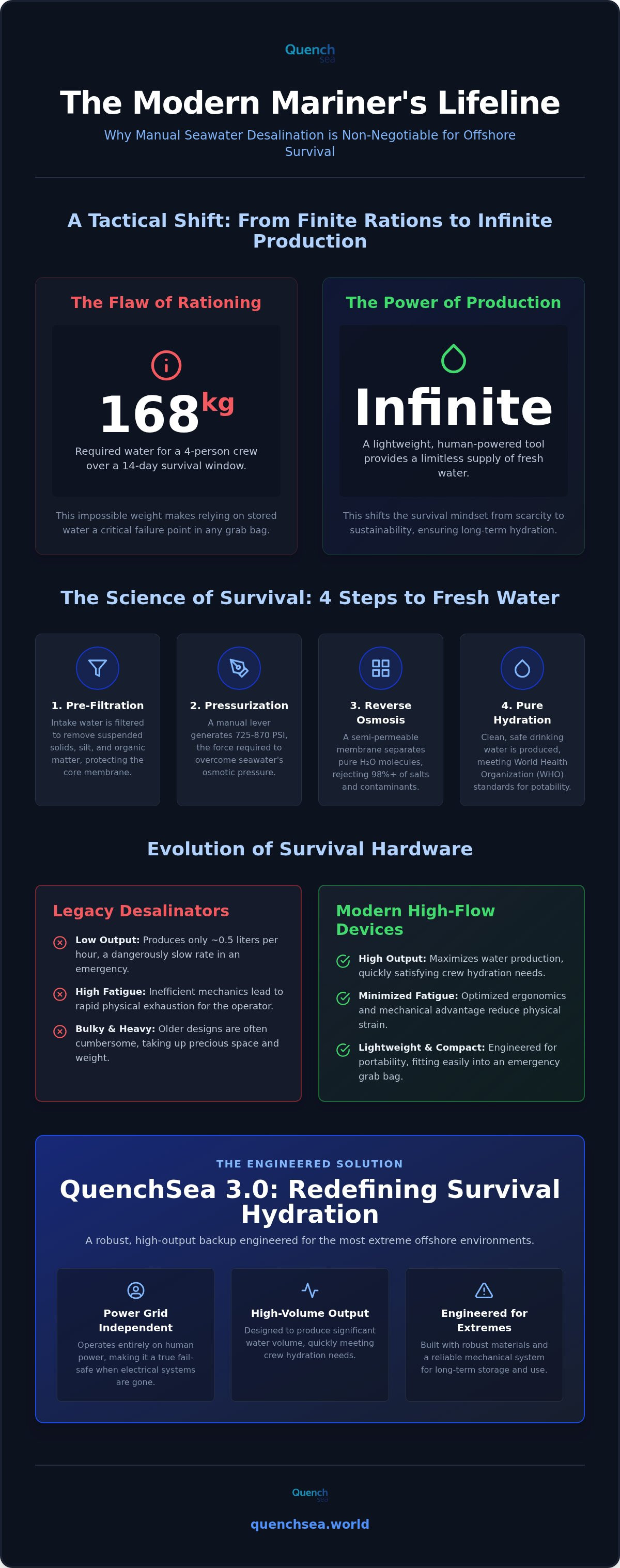
Traditional survival kits relied on heavy, bulky cans of water. This approach is mathematically flawed for offshore crossings. One liter of water weighs exactly one kilogram. A four-person crew would need 168kg of water to cover a 14-day survival window. That's impossible to transport in a standard grab bag. Modern life raft water supply standards now favor production over storage. By replacing two-thirds of required rations with a manual device, you cut weight and gain security. Manual seawater desalination for life rafts allows you to carry a lightweight tool that produces liters of fresh water per hour, outperforming any static storage plan.
The Mechanics of Hand-Powered Reverse Osmosis
Manual reverse osmosis is the process of forcing seawater through a membrane using mechanical leverage. Unlike simple ceramic filters that trap debris, this technology works at a molecular level. It separates pure H2O from dissolved salts, viruses, and bacteria. Manual seawater desalination for life rafts utilizes this high-pressure method to ensure every drop produced meets safety standards. It's a mechanical solution to a biological problem.
The system relies on a multi-stage process. First, intake water passes through a pre-filter. This removes suspended solids, silt, and organic matter. Without this step, the delicate reverse osmosis membrane would clog within minutes. Once pre-filtered, the water enters the high-pressure chamber. Here, mechanical force pushes the water against the semi-permeable membrane, leaving 98% or more of the salt behind.
Overcoming Osmotic Pressure Manually
Physics dictates the effort required. Seawater naturally exerts osmotic pressure that resists purification. To reverse this flow, a device must generate between 50 and 60 bar (725 to 870 PSI). Modern engineering achieves this through optimized piston designs and lever-action handles. These mechanisms reduce the perceived pumping resistance. They allow a survivor to maintain production without immediate physical collapse. This mechanical advantage is what makes innovative desalination hardware a viable backup for offshore sailors.
Membrane Science and Salt Rejection Rates
The industry standard for safe drinking water is a salt rejection rate of 98% or higher. Seawater typically contains 35,000 ppm of salt. A high-efficiency membrane reduces this to below 500 ppm, meeting World Health Organization standards. Performance fluctuates based on several environmental variables:
- Water Temperature: Cold water is more viscous, increasing the physical effort needed to pump.
- Salinity Levels: Higher salt concentrations require greater pressure to overcome osmotic resistance.
- Membrane Condition: Proper storage prevents bacterial fouling, ensuring the unit works after years in a bag.
Reliability depends on preservation. Survival membranes are engineered for long-term storage in harsh marine environments. They're often vacuum-sealed or treated with food-grade preservatives to prevent bacterial fouling while sitting in a grab bag. This ensures the device is ready for immediate deployment after months or years of dormancy. Maintaining this membrane integrity is the core of manual seawater desalination for life rafts.
Comparing Legacy Desalinators to Modern 2026 Standards
Legacy designs were built on a philosophy of minimal survival. They were often small enough to fit in a pocket but required thousands of manual strokes to produce a single cup of water. Modern standards for manual seawater desalination for life rafts have evolved. We now prioritize high-volume output and mechanical efficiency. A dehydrated survivor cannot afford to burn 500 calories to produce 500 milliliters of water. This metabolic deficit is a hidden killer in survival scenarios.
Legacy units typically produce roughly 0.9 liters per hour. In contrast, modern high-flow devices like the QuenchSea 3.0 deliver between 5 and 8 liters per hour. This leap in performance changes the tactical reality on a life raft. It turns water production from a full-time job into a manageable daily task. High-output hardware allows one person to hydrate an entire crew, leaving others free to focus on signaling, navigation, or raft maintenance.
The Ergonomics of Survival
Pumping a desalinator shouldn't feel like a high-intensity workout. Legacy models relied on direct linear pressure, which quickly leads to bicep and shoulder fatigue. Modern manual boat water makers utilize optimized leverage. By using a longer handle and a pivot point, the device multiplies human force without increasing muscle strain. This mechanical advantage is critical in the confined, unstable environment of a life raft. You need a tool that remains stable on an inflated floor and provides a secure grip even when your hands are wet or cold.
Weight and Volume in the Grab Bag
Every gram in a grab bag must earn its place. Legacy hardware often used heavy bronze or complex metal alloys that added unnecessary weight. Modern survival-grade devices utilize high-performance polymers and marine-grade stainless steel. These materials offer superior corrosion resistance and high mechanical integrity without the bulk. They withstand the crushing forces of a packed bag and the corrosive environment of a life raft locker.
The QuenchSea 3.0 balances ruggedness with a lightweight profile. It fits into a standard emergency kit without displacing other essentials like flares or medical supplies. When analyzing the total footprint, consider the intake and discharge hoses. Modern systems use streamlined, kink-resistant tubing that deploys instantly. This focus on simplicity ensures the unit is field-serviceable. If a seal needs attention mid-voyage, the design allows for basic maintenance without specialized tools. Reliability is born from simplicity, not complexity.
How to Evaluate Water Makers for Your Emergency Grab Bag
Evaluating hardware for manual seawater desalination for life rafts requires a disciplined, step-by-step audit. Don't buy based on marketing gloss. Start with your crew's biological reality. Step one: Calculate your crew size and daily minimum hydration needs; assume a minimum of 1.5 liters per person per day. Step two: Verify the salt rejection rate. Aim for 98% or higher to ensure the output remains below the 500 ppm Total Dissolved Solids (TDS) threshold. Step three: Test the ergonomics. Can a smaller or weaker crew member operate the device for twenty minutes? Survival is a team effort. Step four: Inspect the pre-filtration system. It must handle murky or plankton-rich water without immediate fouling. Step five: Check for SOLAS or USCG compliance if your vessel type mandates specific certifications for 2026. Current regulations permit desalinators to replace up to two-thirds of the required water rations in a life raft, making compliance a weight-saving strategy.
Output Metrics That Matter
Liters per hour is a standard benchmark, but it can be a misleading stat in a crisis. It often reflects ideal conditions rather than high-stress operation. Focus instead on burst output. How much water can you make in a 10-minute window? This is critical for immediate relief when a survivor is first brought aboard a raft. Sustained production is the second pillar. Ensure the device can run for hours without seal failure or overheating. Reliability under constant use is what defines a professional-grade survival desalination device.
Grab Bag Integration and Maintenance
A desalinator is useless if it's buried at the bottom of a heavy pack. Place the unit near the top for rapid deployment. Your 2026 maintenance checklist should include annual inspections of all mechanical components. Look for cracks in the housing and degradation in the intake valves. Lubricate seals according to the manufacturer's spec to prevent drying. If you haven't cycled the unit in twelve months, the membrane may need flushing to remove stagnant preservatives. You should invest in high-output survival hardware that simplifies this maintenance cycle while ensuring peak performance when the yacht goes down. Proper preservation ensures the device is ready for immediate deployment after years of dormancy.
QuenchSea 3.0: Redefining Marine Survival Hydration
The QuenchSea 3.0 represents a fundamental shift in how we approach offshore emergency preparedness. It provides a high-output solution for manual seawater desalination for life rafts without the prohibitive complexity of legacy systems. This device is a no-nonsense tool. It's engineered specifically for the person who needs water immediately in a high-stress environment. By prioritizing mechanical integrity over decorative features, it has become the primary choice for 2026 marine safety audits. It's a rugged, dependable backup that eliminates the single point of failure inherent in electrical water makers.
Designers focused on a compact footprint to ensure the unit fits into even the most crowded grab bags. Its intuitive operation requires no specialized training, which is critical when panic and fatigue set in. While legacy hardware often focused on being as small as possible at the expense of output, the QuenchSea 3.0 balances portability with a high-flow rate. It delivers a sustainable hydration source that can support an entire crew, moving survival strategy from desperate rationing to active production.
Technical Excellence and Salt Rejection
The 3.0 model achieves a salt rejection rate of over 98% by utilizing optimized hydraulic pressure. This ensures that the output remains well below the 500 ppm threshold for safe drinking water. The internal reverse osmosis membrane is engineered for durability during long-term marine storage. It utilizes specialized seals and materials that resist bacterial fouling while the device sits dormant in a locker. This field-proven reliability has been tested in yachts and offshore racing scenarios where failure isn't an option. It provides technical confidence that the hardware will perform the moment it's deployed.
Empowering the Survivor
Survival is a race against biological limits. The "Rule of 3" reminds us that while we can survive weeks without food, we only have days without water. The QuenchSea 3.0 reduces the physical barrier to hydration through superior mechanical leverage. Its handle design allows any crew member to produce 5 to 8 liters of fresh water per hour. This volume is significantly higher than older designs that required more effort for less reward. By making water production physically sustainable, the device preserves the survivor's energy for other critical tasks like signaling and raft maintenance. It's more than a tool; it's a fail-safe hydration plan. Equip your grab bag with the QuenchSea 3.0 today.
Securing Your Offshore Hydration Future
Survival at sea is a matter of engineering, not just endurance. You've learned that electrical failure is a near-certainty in sinking scenarios, making mechanical reliability your most critical asset. Transitioning from finite water rations to active production using manual seawater desalination for life rafts ensures your crew stays hydrated without the metabolic debt of legacy hardware. By prioritizing high-output manual reverse osmosis technology, you effectively eliminate the single point of failure inherent in battery-dependent systems.
The QuenchSea 3.0 delivers a 98% salt rejection rate without requiring a single watt of electricity. It's a rugged, mission-driven tool designed for the harshest marine environments. Don't leave your safety to chance or the weight of static rations. Proper preparation today defines your outcome tomorrow. You now have the technical framework to evaluate your gear and the hardware to execute a fail-safe hydration plan.
Secure your fail-safe water source with QuenchSea 3.0
You're ready to master the ocean.
Frequently Asked Questions
How much water can a manual desalinator produce in a day?
A high-output device like the QuenchSea 3.0 produces between 5 and 8 liters of freshwater per hour. If a crew rotates pumping duties throughout a 24-hour period, the system can technically generate over 120 liters. For a solo survivor, producing 20 to 30 liters a day is physically sustainable without extreme exhaustion. This output significantly exceeds the minimum survival requirement of 1.5 liters per person per day.
Is the water produced by a hand-powered RO device safe to drink immediately?
Yes, the freshwater produced is safe for immediate consumption. Modern manual seawater desalination for life rafts utilizes reverse osmosis membranes that reject 98% of dissolved solids. This process doesn't just remove salt; it also filters out bacteria, viruses, and other pathogens. As long as the device is functioning correctly and the pre-filter is clear, the resulting permeate meets World Health Organization drinking water standards.
Can I use a manual seawater desalinator for brackish water?
You can use these devices for brackish water found in estuaries or coastal lagoons. In fact, brackish water has a lower salt concentration than open ocean seawater, which typically sits at 35,000 ppm. This lower salinity reduces the osmotic pressure the membrane must overcome. Consequently, the physical effort required to pump the device decreases, and the volume of freshwater produced per hour usually increases.
How long do the membranes last in an emergency water maker?
Emergency membranes are designed for long-term dormancy. When stored in a vacuum-sealed environment with food-grade preservatives, a membrane can remain viable for several years in a grab bag. Once deployed, its lifespan depends on the turbidity of the intake water. Heavy silt or plankton blooms can foul the membrane over time. Regular flushing with freshwater after use is the best way to extend its operational life.
Do I need special tools to maintain my QuenchSea 3.0?
No specialized tools are required to maintain the QuenchSea 3.0. The device is engineered for rugged simplicity and field-serviceability in high-stress marine environments. Most maintenance involves simple inspections of the intake valves and lubricating the internal seals with manufacturer-approved grease. This no-nonsense design ensures that a survivor can keep the unit operational without access to a workshop or a complex toolkit during an emergency.
What happens if I drink ocean water without desalinating it?
Drinking untreated ocean water triggers a biological process called osmotic diuresis. Because seawater has a salt concentration far higher than human blood, your kidneys must use more water than you consumed to flush the excess sodium out of your system. This leads to rapid cellular dehydration, organ failure, and eventual death. Desalination is the only way to make the surrounding ocean a viable source of hydration.
Is manual desalination approved by the Coast Guard for life rafts?
Manual desalination is recognized under the International Life-Saving Appliance (LSA) Code. Regulations permit these units to replace up to two-thirds of the required water rations in a life raft. Specifically, 2 liters of the 3-liter requirement per person can be substituted with a manual desalinator. This makes manual seawater desalination for life rafts a critical weight-saving strategy for offshore yachts and commercial vessels following 2026 standards.
How hard is it to pump a manual desalinator when dehydrated?
Pumping requires generating 50 to 60 bar of pressure, which is physically demanding. However, modern engineering has optimized the leverage and handle design to make this sustainable. While a dehydrated survivor will feel the effort, the goal is to produce water without burning more calories than the hydration provides. High-efficiency piston designs ensure that even a weakened individual can produce enough water to stabilize their condition.