

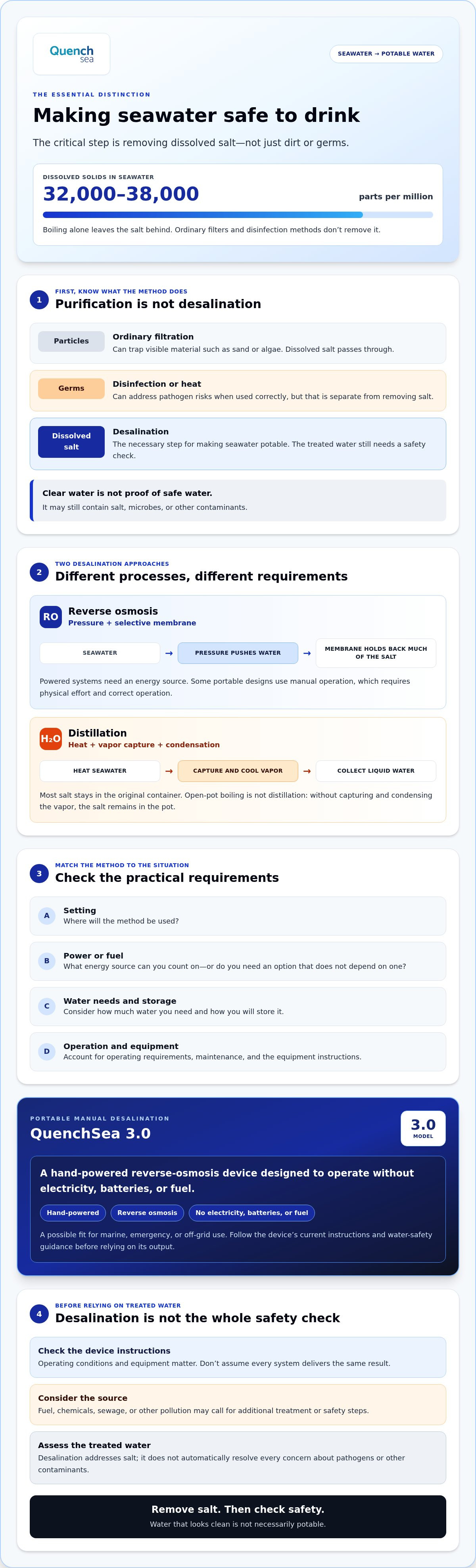
Could boiling seawater make it safe to drink? Not by itself. If you’re looking for how to make seawater potable, the critical step is removing dissolved salt, not just dirt or germs. Seawater contains roughly 32,000 to 38,000 parts per million of dissolved solids. Boiling alone leaves that salt behind, and ordinary filters or disinfection methods don’t remove it.
In an emergency, it’s easy to confuse purification with desalination. Choosing the wrong method can leave water unsafe to drink, even when it looks clear. The right approach depends on your setting, available power or fuel, and how much water you need.
This guide explains how desalination works and compares methods that remove salt, including distillation and reverse osmosis. You’ll learn what each method can and can’t do, what to check before relying on the water, and when a purpose-built portable desalination device may fit your needs. The aim is to help you judge whether a method produces potable water, not just water that looks clean.
Key Takeaways
- Learn how to make seawater potable by comparing desalination methods and matching one to your setting.
- See how reverse osmosis and distillation separate salt from water, and what each approach requires.
- Use power, fuel, storage, and operating requirements to narrow your options before choosing a method.
- Check the device instructions and treated water before relying on the output.
- Understand when a portable, hand-powered desalination device may suit marine, emergency, or off-grid use.
How to make seawater potable: what has to be removed?
Water made from seawater becomes potable only after effective desalination removes dissolved salts. A filter that traps sand, algae, or other visible particles does not remove salt. Safe drinking water also requires a separate check for pathogens and other contaminants that may come from the source or from handling.
Desalination removes dissolved salts; ordinary filtration traps particles. That distinction is central to how to make seawater potable. Untreated seawater contains enough dissolved salt to make it unsuitable for drinking. The method must reduce the salt, and the resulting water must still meet applicable drinking-water safety requirements.
What does potable mean when treating seawater?
Potable means suitable for drinking under relevant safety requirements. Appearance alone proves little: clear water can still contain dissolved salts, microbes, or other contaminants. Desalination addresses salt, but it doesn’t automatically resolve every water-quality concern. If the source may be affected by fuel, chemicals, sewage, or other pollution, assess that risk and determine whether additional treatment is needed before drinking.
Why ordinary filters and boiling are not enough
Common particle filters can remove suspended material, but dissolved salt passes through them. Boiling seawater in an open pot also leaves the salt behind as water evaporates. Heat can reduce pathogen risks when used correctly, but that is separate from desalination.
Boiling can desalinate only when the water vapor is captured, cooled, and collected as liquid, leaving much of the salt in the original container. This process is distillation. The Desalination overview explains this and other approaches, including reverse osmosis. Even after treatment, check the equipment instructions and consider whether the source requires additional safety steps.
How seawater desalination works: reverse osmosis and distillation
Two established methods separate freshwater from dissolved salts: reverse osmosis and distillation. Both can desalinate seawater, but they work differently and place different demands on energy, equipment, and the operator. The broader process is called desalination, as the U.S. Geological Survey explains. Knowing how each method works helps you judge what fits your situation and what the output still needs.
How reverse osmosis separates salt from water
Pressure pushes seawater against a selective membrane. Water molecules pass through, while the membrane holds back much of the dissolved salt and other material. Reverse osmosis separates freshwater from dissolved salts by forcing water through a selective membrane under pressure. The pressure source, membrane, and operating conditions matter, so follow the device instructions rather than assuming every system delivers the same result.
Powered systems use equipment to create pressure; some portable designs rely on manual operation. The practical trade-off is straightforward: powered equipment needs a suitable energy source, while hand-operated equipment requires physical effort and correct operation. Neither approach should be treated as a complete answer to every possible source contaminant.
How distillation collects freshwater
Distillation heats seawater until water evaporates, then cools and collects the vapor as liquid. Most salt stays behind in the original container. Boiling alone is not enough: unless the vapor is captured and condensed separately, it escapes and the salt remains in the pot.
Distillation requires a heat source, a way to manage vapor, and a clean collection path. Improvised materials can introduce contaminants or fail to collect water safely. A homemade setup isn’t automatically reliable just because it produces clear condensate. Check that the equipment is suitable for the task, and assess whether the source may contain substances that could carry over with vapor.
In general, reverse osmosis uses pressure and a membrane, while distillation depends on heat and condensation. Their portability and operating requirements vary by design. If you need an option for marine, emergency, or off-grid use that does not depend on electricity or fuel, QuenchSea 3.0 is a portable, hand-powered reverse-osmosis device designed to operate without electricity, batteries, or fuel. Review the device’s current instructions and water-safety guidance before relying on it. Explore portable seawater desalination as one purpose-built approach.
Which seawater desalination method fits your situation?
The right method depends on where you are, what resources you can count on, and whether you can operate and maintain the equipment correctly. This comparison shows why boiling seawater or using a standard camping filter won’t, on its own, make it potable.
| Method | Removes dissolved salt? | Power or fuel | Portability and safety checks |
|---|---|---|---|
| Reverse osmosis | Yes, when the system is designed and operated for seawater | Requires pressure, supplied by the system; designs vary | Ranges from fixed equipment to portable devices. Follow instructions and assess other source contaminants. |
| Distillation | Yes, if vapor is captured and condensed | Needs heat and equipment to collect and cool vapor | Can be cumbersome to set up. Check materials, collection hygiene, and source risks. |
| Ordinary filtration | No, not with a standard particle filter | Depends on the filter; boiling uses heat | May reduce particles or pathogens, depending on the method, but doesn’t desalinate seawater. |
What works for boats, remote coasts, and emergencies?
Start with the conditions you’ll actually face. A boat with reliable power may be able to run a powered reverse-osmosis system, while a remote shoreline or emergency kit may need an option that doesn’t depend on electricity or fuel. Consider more than the water-making step: account for storage, setup, maintenance, and whether you can operate the equipment when tired or under stress. A manual boat water makers guide can help you compare non-electric approaches. QuenchSea 3.0 is one portable, hand-powered reverse-osmosis option designed to operate without electricity, batteries, or fuel. Check its current manufacturer instructions before use.
Can an improvised method provide dependable drinking water?
An improvised still may demonstrate how evaporation and condensation separate freshwater from salt, but that doesn’t establish it as a dependable drinking-water process. Output can be uncertain, and unsuitable materials, dirty collection surfaces, or contamination at the source can compromise safety. Don’t treat clear water as proof that it’s potable. For context on the risks of drinking untreated seawater, read why drinking seawater is dangerous.
To make seawater potable, match the method to the setting, then verify the equipment’s intended use and follow its operating and maintenance instructions. Desalination addresses salt; it doesn’t automatically resolve every water-quality concern.
How to make seawater potable more safely: a practical decision process
A reliable process starts before treatment. Decide how the water will be used, what resources you can count on, and whether the source may contain contaminants beyond salt. Then choose equipment designed for seawater desalination, operate it as directed, and check the output using the manufacturer’s specified steps.
Do not judge treated water by taste or clarity alone. Clear, pleasant-tasting water can still have safety issues that your senses can’t detect. Desalination is a critical step, not a substitute for checking source risks or following applicable water-safety advice.
What to check before treating seawater
Use this checklist to turn how to make seawater potable into a practical decision:
- Assess the setting: Identify the intended use, likely water demand, and source conditions. Consider whether fuel, chemicals, sewage, or other pollution could affect the water.
- Check your resources: Confirm available power or fuel, storage capacity, and whether you can operate and maintain the equipment as required.
- Select the right system: Verify that it is designed to desalinate seawater. A freshwater filter or standard camping filter may not remove dissolved salt.
- Review the instructions: Check setup, operation, maintenance, limitations, and any stated output-verification steps before relying on the equipment.
A system’s suitability depends on its design and condition. Don’t assume that a device intended for one water source or use case will work safely in another.
How to assess treated water without guessing
Follow the equipment maker’s full operating procedure, including any steps for checking or handling the product water. Taste, smell, and appearance can reveal some problems, but they can’t confirm every safety parameter. A simple measurement may also answer only the question it was designed to test, not whether the water is free of pathogens or other contaminants.
If the source is suspect, the instructions are unclear, or water quality remains uncertain, seek appropriate testing or advice from a qualified water-safety professional or relevant local authority. Keep treated water in a clean, suitable container to avoid contaminating it after processing.
For a manual reverse-osmosis option designed to operate without electricity, batteries, or fuel, explore the QuenchSea 3.0 desalination device. Review its current manufacturer guidance and assess whether it fits your setting before relying on it.
When a portable manual desalination device makes sense
A portable manual desalination device may suit marine users, emergency planners, and people working or living off-grid near the coast. It can be relevant when access to electricity, batteries, or fuel is limited. The trade-off is direct: manual operation avoids dependence on those external power sources, but you still need to operate, maintain, and store the equipment as instructed.
What a hand-powered reverse-osmosis device can offer
In a hand-powered reverse-osmosis device, the user supplies the pressure that pushes seawater through a selective membrane. The membrane separates freshwater from much of the dissolved salt. This design can be useful in remote or power-constrained settings where a powered system may not fit the plan. It doesn’t remove every possible contaminant or eliminate the need to assess the source and treated water.
QuenchSea 3.0 is a portable, hand-powered reverse-osmosis desalination device designed to operate without electricity, batteries, or fuel. If this approach may fit your needs, explore the QuenchSea 3.0 portable desalination device and review its current manufacturer guidance before relying on it.
What to verify before relying on equipment
Check current instructions for operating requirements, setup, cleaning, maintenance, and stated limitations. Confirm that the device suits your intended environment and preparedness plan, including how you’ll store treated water and what you’ll do if the equipment can’t be operated as directed. Don’t assume a portable device can provide a continuous or large-scale supply.
Desalination addresses dissolved salt, but it doesn’t automatically settle every question about water quality. Follow the manufacturer’s specified checks and seek appropriate testing or expert advice if the source or output is uncertain. For broader planning context, read this survival desalination device guide.
Choosing how to make seawater potable means matching the method to the setting, then checking its limits. A manual device can reduce dependence on external power, but it should be one part of a prepared water-safety plan, not a substitute for instructions or verification.
Build a seawater plan you can rely on
Knowing how to make seawater potable starts with one essential distinction: desalination removes dissolved salt, while pathogen control and other water-safety checks address separate risks. Reverse osmosis and distillation can desalinate seawater, but the right choice depends on your setting, available resources, equipment, and ability to follow its instructions.
Don’t rely on clear appearance or taste to confirm treated water is safe. Check the source, use equipment designed for seawater, follow current manufacturer guidance, and seek appropriate testing or expert advice if water quality is uncertain.
For marine use or emergency preparedness, QuenchSea 3.0 offers hand-powered reverse osmosis without dependence on electricity, batteries, or fuel. It’s a purpose-built option to assess as part of a broader water-safety plan, not a replacement for checking the device’s instructions and limitations.
Explore QuenchSea 3.0 for portable seawater desalination and take a practical step toward preparedness. With the right method and careful checks, you can make more informed decisions when freshwater access is limited.
Frequently Asked Questions
Can you make seawater potable by boiling it?
No. Boiling seawater by itself doesn’t remove dissolved salt; the salt remains in the vessel as water evaporates. Distillation can produce freshwater if you capture the vapor and condense it separately, but that requires a suitable setup and careful handling. Don’t assume boiled seawater is drinkable. To understand how to make seawater potable, use a desalination method designed for the purpose and follow its safety instructions.
Does a water filter make seawater safe to drink?
Most ordinary filters don’t remove dissolved salt, so they can’t desalinate seawater. They may target particles, improve taste, or reduce certain contaminants, depending on their design. Check the filter’s label and intended use to confirm whether it’s specifically designed for seawater desalination. Additional treatment or water-quality checks may also be needed. Clear water from a standard camping filter isn’t proof that seawater is safe to drink.
How does reverse osmosis make seawater potable?
Reverse osmosis uses pressure to push seawater through a selective membrane that separates freshwater from much of the dissolved salt. A seawater system must be designed for that task and operated and maintained according to its instructions. Don’t assume the process removes every possible contaminant. Clear appearance alone can’t confirm safety, so follow the manufacturer’s verification steps and assess whether the source water presents other risks.
Is distilled seawater safe to drink?
Distillation separates water vapor from much of the salt, then collects the vapor as condensed liquid. Whether the result is safe depends on the source water, equipment, handling, and any other contaminants present. Use clean, appropriate equipment and follow reliable safety guidance. Appearance alone can’t confirm potability. Treat improvised setups as unverified, not as validated drinking-water systems, especially if you can’t assess the collection materials or the condition of the source.
What happens if you drink untreated seawater?
Untreated seawater contains more salt than drinking water should, and drinking it can worsen dehydration as the body processes and excretes the excess salt. Don’t use seawater as a drinking-water source. In a survival situation, prioritize finding an appropriate freshwater supply and use a method designed to desalinate seawater. If someone has consumed seawater and has medical concerns, seek qualified emergency guidance as soon as possible.
Can you make seawater potable without electricity or fuel?
Yes, some desalination methods work without grid electricity, but they still require effort and suitable equipment. Distillation needs heat and a way to capture and condense vapor. Manual reverse-osmosis equipment uses human effort to create pressure. QuenchSea 3.0 is a hand-powered reverse-osmosis device designed to operate without electricity, batteries, or fuel. Check current manufacturer instructions to confirm its operating requirements and suitability for your setting.