

Can you separate salt from seawater without an industrial plant? In a high-stakes marine emergency, understanding how to make ocean water drinkable is the hard line between offshore survival and acute kidney failure. Many mariners mistakenly believe boiling saltwater makes it safe to consume. In reality, boiling without capturing the steam merely yields a lethal, hyper-concentrated brine, while standard hollow-fiber survival filters let dissolved sodium chloride pass straight through. Drinking that raw salinity forces your kidneys to dump critical bodily fluids, rapidly accelerating life-threatening dehydration.
True desalination isn't an insurmountable thermodynamic barrier; it's a straightforward mechanical pressure challenge. You'll discover the mechanical and thermal processes that convert raw ocean water into safe drinking water, stripping away dangerous survival myths along the way. We'll examine the physiological hazards of saltwater ingestion, evaluate thermal distillation versus modern reverse osmosis, and pinpoint reliable, non-electric field gear built to produce dependable potable water when offshore power fails.
Key Takeaways
- Understand the physiological limits of human kidneys and why raw ocean salinity accelerates fatal cellular dehydration.
- Discover the mechanical and thermal processes behind how to make ocean water drinkable without reliance on industrial infrastructure.
- Dismantle lethal offshore myths, including why uncaptured boiling and standard trail filters fail to separate dissolved sodium chloride.
- Learn how reverse osmosis overcomes extreme osmotic pressures above 800 psi to strip microscopic mineral ions from seawater.
- Identify rugged, non-electric desalination hardware engineered to supply reliable drinking water when vessel power fails.
The Science of Desalination: Why Ocean Water Is Undrinkable
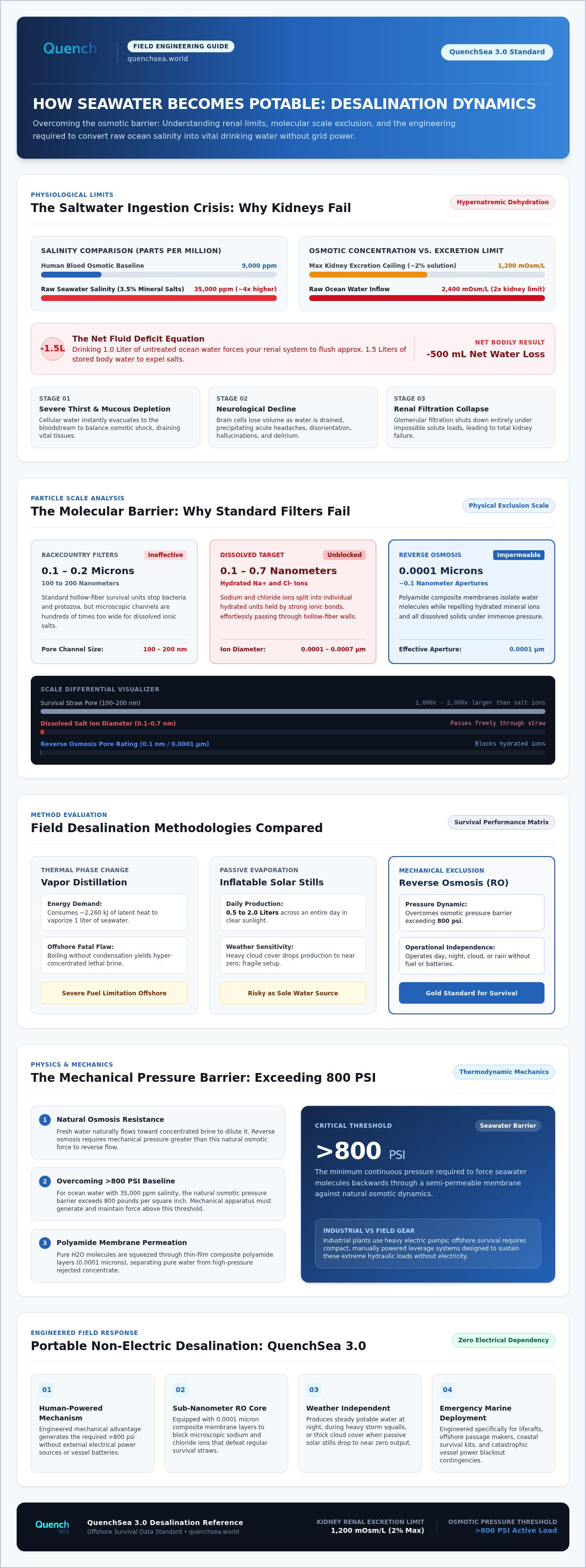
Raw seawater holds an average salinity of 35,000 parts per million (ppm), roughly 3.5% dissolved mineral salts. In contrast, healthy human blood sits at approximately 9,000 ppm. Your body functions within strict osmotic thresholds. When you introduce a fluid nearly four times saltier than your internal baseline, your physiology runs into an immediate chemical wall. Understanding seawater desalination processes begins with recognizing that the challenge isn't just about removing visible debris. It's about breaking microscopic ionic bonds under demanding conditions.
The Biological Toll of Drinking Saline Water
Drinking untreated seawater reverses basic cellular hydration. Human kidneys cannot excrete urine at a concentration higher than about 1,200 mOsm/L, roughly equivalent to a 2% salt solution. Because seawater averages 2,400 mOsm/L, the renal system must pull stored water out of healthy cells to dilute the incoming influx. Ingesting one liter of raw ocean water forces your kidneys to generate approximately 1.5 liters of urine to expel the excess salt. This triggers rapid hypernatremic dehydration, cellular shrinkage, and severe circulatory collapse.
This dynamic illustrates exactly why is drinking sea water dangerous for offshore sailors caught without freshwater reserves. The physical breakdown follows a brutal, predictable sequence:
- Extreme thirst and dry mucous membranes: Cellular water dumps directly into the bloodstream to offset osmotic shock.
- Neurological decline: Brain cells lose volume, resulting in severe headaches, disorientation, hallucinations, and delirium.
- Acute renal shutdown: Glomerular filtration fails under extreme solute loads, shutting down organ function within days.
Total Dissolved Solids and the Molecular Challenge
The primary barrier to making ocean water safe is Total Dissolved Solids (TDS). In seawater, sodium chloride splits into individual hydrated sodium ($Na^+$) and chloride ($Cl^-$) ions held together by powerful ionic attractions to surrounding $H_2O$ molecules. These ions measure roughly 0.1 to 0.7 nanometers across.
This molecular scale exposes why conventional backcountry filters fail offshore. Standard hollow-fiber membrane survival straws (such as LifeStraw or Sawyer units) feature pore ratings between 0.1 and 0.2 microns. That's 100 to 200 nanometers wide. Salt ions are hundreds of times smaller than those microscopic channels; they bypass hollow-fiber walls without any resistance. Surviving offshore requires true mechanical barrier technology capable of isolating water molecules at the sub-nanometer scale, which forms the scientific foundation of how to make ocean water drinkable in true emergencies.
Core Methods for Desalinating Seawater: Comparing the Technologies
Separating dissolved ions from ocean water requires changing the physical state of the water or driving it through a molecular barrier. While government organizations like the U.S. Geological Survey document varied industrial methods for desalinating saline water, field survival narrows your options. Industrial electrodialysis uses electrical currents to draw ions through charged polymer membranes, but its dependence on steady electrical grids makes it useless in remote waters. For emergency off-grid operations, the realistic technical paths narrow to thermal phase changes and membrane displacement.
Thermal Distillation and Solar Stills
Thermal distillation leverages phase change. Heat converts liquid water into pure vapor, leaving dissolved salts behind in the boiling chamber. When that vapor touches a cooler surface, it condenses into drinkable distillate. The challenge is energy density. Vaporizing water demands substantial fuel; boiling away a single liter consumes roughly 2,260 kilojoules of latent heat.
Inflatable emergency solar stills eliminate the fuel problem by trapping solar radiation to evaporate thin films of seawater. However, production is exceptionally slow. Under direct, cloudless sunlight, an emergency still produces only 0.5 to 2.0 liters across an entire day. Heavy cloud cover drops production to near zero, making thermal solar setups risky as a sole primary water source.
Membrane-Based Separation (Reverse Osmosis)
Reverse osmosis (RO) relies on physical exclusion rather than heat. Seawater is forced against a thin-film composite polyamide membrane with effective pore sizes down to 0.0001 microns. These microscopic gaps allow water molecules to permeate while turning back hydrated sodium and chloride ions.
To avoid immediate surface clogging, marine RO utilizes cross-flow filtration. Pressurized feed water sweeps across the membrane face; pure water permeates through the center core, while rejected brine flushes continuously overboard. Instead of waiting hours for thermal condensation, pressurized systems deliver multiple liters per hour. Preparing your vessel with rugged manual hardware from QuenchSea provides an immediate, hand-powered mechanical defense when shipboard electrical systems cut out.
Chemical and Ion-Exchange Limitations
Chemical additives cannot desalinate ocean water. Chlorine dioxide tablets, iodine crystals, and flocculants neutralize living biological pathogens, but they exert zero effect on dissolved mineral salts. Similarly, ion-exchange resins swap dissolved ions for hydrogen and hydroxyl molecules, yet seawater's massive mineral load saturates and depletes portable resin beds within seconds. Mechanical separation remains the only viable field pathway for anyone solving how to make ocean water drinkable without an industrial plant.
Common Myths: What Actually Works in an Ocean Emergency?
Offshore survival myths waste precious hours and accelerate physical decline. Relying on folklore during a vessel abandonment scenario creates catastrophic outcomes. If you don't grasp the physical laws behind how to make ocean water drinkable, improvised shortcuts will rapidly deplete your body's remaining moisture reserves. As detailed in this U.S. Geological Survey overview of desalination, separating dissolved mineral salts requires dedicated physical phases or immense hydraulic drive, neither of which can be replaced by quick outdoor hacks.
Consider three widespread survival fallacies that routinely fail offshore:
- Fractional freezing: Freezing seawater does not cleanly isolate fresh ice. Fast-forming sea ice forms dendritic crystals that trap hyper-saline brine pockets within the ice matrix. Melting and drinking this ice still introduces dangerous mineral loads.
- Diluting seawater with fresh supplies: Cutting fresh stores 50/50 with raw ocean water does not stretch your rations. It elevates overall solute intake, forcing kidneys to work harder and speeding systemic dehydration.
- Consuming raw marine fluids: Extracting fluids from raw fish flesh or organs yields negligible water volume while introducing bacteria and demanding metabolic energy that accelerates thirst.
The Boiling Water Fallacy Explained
Boiling seawater kills living microorganisms like bacteria and protozoa. It does nothing to eliminate dissolved salt. As water boils, pure $H_2O$ escapes as gaseous steam, leaving the mineral ions behind in the pot. The remaining liquid turns into a hyper-concentrated brine far deadlier than raw seawater.
To produce drinkable water through boiling, you must capture, redirect, and condense the resulting steam using an airtight distillation apparatus. That hardware is rarely present in an emergency ditch kit. Even if you carry a condensing arm, fuel constraints stop you. Producing just one liter of condensed distillate demands immense thermal energy, burning through boat fuel or propane reserves within days.
Field Improvised Solar Stills
Improvising a solar still from a plastic tarp and a collection cup sounds effective in survival manuals. In open ocean conditions, it consistently fails. Marine survival demands at least 1,000 to 1,500 mL of water daily just to replace basal metabolic losses. Improvised stills rarely yield more than 200 to 500 mL per day.
Movement destroys output. Ocean chop rocks life rafts violently, splashing corrosive raw brine directly into your central catchment container and ruining hours of condensation. Sunlight also degrades clear plastic films, reducing transparency and thermal absorption. Improvised condensation is a gamble with high failure rates, proving that only dedicated, non-thermal mechanical separation provides dependable fresh water offshore.
How Reverse Osmosis Makes Ocean Water Safe to Drink
Natural osmosis drives freshwater toward salinity. When a semipermeable membrane separates fresh water from saltwater, water naturally migrates across to equalize solute concentrations. Reverse osmosis (RO) forces that natural thermodynamic cycle in reverse. By driving pressurized seawater against an engineered barrier, mechanical energy strips away dissolved minerals, pathogens, and contaminants, delivering clean permeate on the other side.
Overcoming Natural Osmotic Pressure
Typical seawater has an inherent osmotic pressure between 24 and 27 bar (350 to 390 psi). To reverse flow, a pump must generate pressure far higher than this baseline. Field and marine RO systems operate between 50 and 80 bar (800 to 1,200 psi) to overcome that resistance and drive permeation.
Operating below this mechanical threshold produces zero fresh water. Once the pump clears this barrier, water molecules pass through the membrane leaves into a central core tube. Simultaneously, high-velocity rejection channels flush concentrated brine overboard, preventing salt crystals from choking the active surface.
Membrane Architecture and Pore Selectivity
The core of modern desalination is the thin-film composite (TFC) polyamide membrane. These sheets feature an ultra-dense barrier layer supported by porous polysulfone substrates. The active layer contains microscopic pores measuring 0.1 to 1.0 nanometers across (0.0001 to 0.001 microns).
Water molecules measure roughly 0.28 nanometers, allowing them to slip through under hydraulic pressure. Hydrated sodium and chloride ions, along with heavy metals, microplastics, and bacteria, are physically rejected by their size and ionic charge. This molecular sieving proves that learning how to make ocean water drinkable doesn't require heat; it requires uncompromising mechanical leverage.
Pre-Filtration and System Longevity
Polyamide membranes deliver exceptional rejection rates, but suspended solids degrade them quickly. Sand, silt, plankton, and organic sludge can scour or blind the delicate membrane layer under high pressure. Reliable systems utilize micro-sediment pre-filters to capture suspended matter before it hits the high-pressure chamber.
Consistent pre-filtration maintains flow rates and extends the working lifespan of the system. For offshore vessels and life rafts where electrical auxiliary pumps cannot run, order the QuenchSea 3.0 Desalination Device to secure manual hydraulic filtration designed for high-salinity marine survival.
Portable Desalination: Non-Electric Solutions for Coastal Survival
Offshore survival gear must operate without dependency on fuel reserves or battery banks. When a marine vessel loses auxiliary power or crew members abandon ship into a life raft, complex electrical watermakers go dark. Solving how to make ocean water drinkable under these high-stakes conditions requires stripped-down mechanical engineering that functions purely through human effort.
Manual Reverse Osmosis in Marine Emergencies
A hand-operated desalinator forms the backbone of a life raft water supply protocol. Hand pumps provide vital redundancy when central desalinators flood, short-circuit, or lose power. Pushing seawater through a polyamide membrane manually requires high internal pressures, but purpose-built mechanical leverage bridges the gap.
Instead of requiring exhausting direct force, modern survival units incorporate long-stroke levers or geared pump heads. Survivors can maintain steady output during physical fatigue, turning repetitive hand movements into life-saving hydration without running down their own caloric reserves.
The Engineering of QuenchSea 3.0
The QuenchSea 3.0 Desalination Device was engineered directly around this need for grid-independent reliability. It functions as a rugged, portable survival desalinator that converts raw ocean water into fresh drinking water using manual hydraulic leverage alone. It does not require fuel canisters, external electrical lines, or batteries.
Designed specifically for marine craft, ditch kits, and disaster relief operations, the device houses a durable reverse osmosis membrane within an impact-resistant body. Its mechanical drive allows operators to generate necessary osmotic pressures by hand, giving isolated coastal travelers and mariners a repeatable way to produce clean permeate on demand.
Essential Preparedness for Coastal and Marine Sourcing
Hardware durability must match operational discipline. When operating a manual device offshore, the quality of your feed water dictates membrane lifespan. Sourcing water requires following clear operational rules:
- Draw clean surface water: Avoid muddy shorelines, diesel slicks, and river mouths carrying heavy silt loads that rapidly blind pre-filters.
- Drop intake lines deep: In a life raft, submerge the weighted intake hose below surface foam and floating debris to pull clearer water.
- Perform freshwater flushes: After deployment, flush the unit with clean water before storage to prevent salt crystallization on internal seals.
Integrating the QuenchSea 3.0 Desalination Device into your offshore ditch bag ensures that when shipboard power cuts out, your water security remains intact.
Securing Your Potable Water Supply at Sea
Surviving an ocean emergency demands physical certainty over improvised folklore. Raw salinity rapidly overwhelms renal filtration, while shortcuts like uncaptured boiling or trail filters fail against dissolved ionic bonds. Reliable hydration requires true mechanical separation. Mastering how to make ocean water drinkable shifts your situation from high-stakes panic to calculated execution.
When shipboard auxiliary circuits flood and battery power isn't an option, survival comes down to manual leverage. Equip your vessel or grab bag with the QuenchSea 3.0 Desalination Device for reliable, non-electric freshwater production. Engineered to produce safe drinking water without electricity, batteries, or fuel, it utilizes advanced reverse osmosis membrane technology built specifically for harsh marine environments. Pack dependable hardware, master the mechanics of desalination, and head offshore with total confidence in your water security.
Frequently Asked Questions
Can you make ocean water drinkable simply by boiling it?
No. Boiling seawater only kills pathogens while vaporizing pure water into the surrounding air, leaving behind a hyper-concentrated brine that is far deadlier to consume. To make boiled ocean water potable, you must capture, direct, and condense the escaping steam using a sealed distillation apparatus. Without a dedicated condenser and substantial fuel reserves, boiling ocean water in an open container won't produce drinkable water.
How does reverse osmosis remove microscopic salt molecules from seawater?
Reverse osmosis uses mechanical pressure to drive saline water against a specialized semipermeable barrier. The microscopic channels inside thin-film composite polyamide membranes measure under one nanometer, allowing small water molecules to pass while rejecting larger hydrated sodium and chloride ions. By generating internal hydraulic pressures above 800 psi, the system separates incoming feed water into pure permeate while continuously flushing concentrated brine out the rejection port.
Can regular survival backpacking filters make ocean water safe to drink?
No, standard backpacking microfilters cannot separate dissolved mineral salts from water. Hollow-fiber filters utilize pore ratings around 0.1 to 0.2 microns (100 to 200 nanometers), engineered strictly to trap bacteria, cysts, and protozoa. Dissolved sodium and chloride ions measure less than a single nanometer, meaning they slip directly through standard filter walls. Relying on a trail filter won't solve how to make ocean water drinkable; the output remains completely saline.
Is drinking water from a solar still viable during offshore emergencies?
Solar stills provide limited survival redundancy, but they shouldn't serve as your sole defense. Passive emergency stills produce only 0.5 to 2.0 liters of water across an entire cloudless day, which barely covers baseline metabolic losses. Rough ocean swells can splash raw brine into the central catchment reservoir, while heavy cloud cover stops production entirely. They work as auxiliary backups rather than dependable primary supplies.
How much physical effort is required to operate a manual desalination device?
Manual desalinators require steady physical work, but mechanical leverage keeps the effort sustainable. Overcoming seawater's natural osmotic threshold demands significant internal pressure. Emergency units like the QuenchSea 3.0 Desalination Device incorporate mechanical leverage to multiply user force, allowing survivors to maintain an efficient pumping cadence without exhausting their caloric reserves. Pumping in shifts or during cooler evening hours helps conserve hydration while maintaining output.
Does desalted ocean water require chemical treatment before drinking?
Water produced through high-pressure reverse osmosis requires no subsequent chemical disinfection. The ultra-dense polyamide membranes feature sub-nanometer pores that physically block biological pathogens, including marine bacteria, viruses, parasites, and microplastics alongside dissolved mineral salts. The permeate flowing from the freshwater discharge hose is mechanically purified and safe for immediate consumption, provided your collection vessels are clean and free of surface contamination.
Can you drink ocean water if you dilute it with fresh water?
No, you should never mix seawater into your clean freshwater supplies. Ingesting any ocean salinity elevates your body's overall solute load, forcing your kidneys to draw water from healthy cells to excrete the additional salts. This accelerates systemic dehydration and triggers acute renal strain faster than rationing plain freshwater. When learning how to make ocean water drinkable, total mechanical separation of salt remains the only safe approach.