

Survival isn't about hope. It's about mechanical advantage. In a high-stakes environment, your life depends on hardware that doesn't quit when the batteries die or the fuel runs dry. Finding the best hand pump water desalinator means looking past the marketing fluff to the raw engineering. Most legacy units are either prohibitively expensive or physically exhausting to operate. You need a device that works as hard as you do.
You recognize that a tool is only as good as its reliability in a crisis. It's frustrating to see traditional reverse osmosis units priced like luxury items while offering low-efficiency output. This guide provides the technical criteria for selecting a manual desalinator that provides life-saving hydration without any external power. We'll show you how to secure a reliable freshwater supply of 4+ liters per hour that meets WHO drinking water standards. Discover the rugged, lightweight hardware that fits in a bug-out bag and delivers 60 bar of hydraulic pressure through pure human effort.
Key Takeaways
- Understand the critical vulnerability of electric water makers and why manual redundancy is essential for offshore survival.
- Evaluate the technical benchmarks for the best hand pump water desalinator, focusing on the 98% salt rejection rate required for WHO-standard potability.
- Analyze the tactical advantages of "Zero-Point" mechanical systems over complex, battery-dependent electric units.
- Master operational techniques to maintain steady 60 bar pressure while minimizing physical exertion and protecting the RO membrane.
- Examine how modern engineering breakthroughs allow for 4-6 liters of freshwater production per hour in a portable, rugged frame.
The Critical Need for Manual Desalination in 2026 Marine Safety
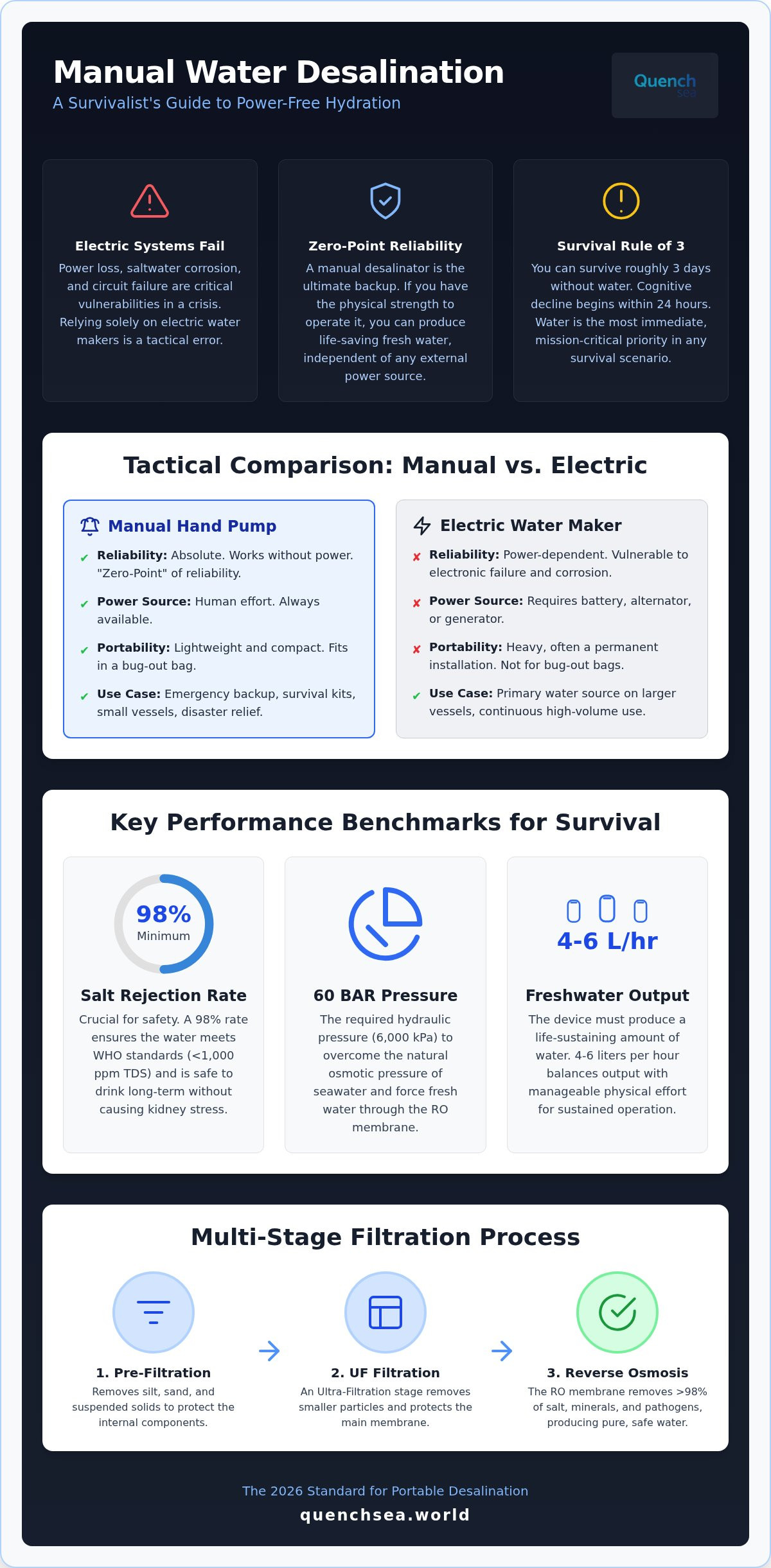
Electric water makers are sophisticated tools, but they are also fragile. In a catastrophic marine scenario, power systems are often the first to fail. Batteries drain. Circuitry shorts. Saltwater is a relentless corrosive agent that targets electronics. For offshore racing and long-distance cruising, relying solely on an electric unit is a tactical error. A manual backup is a mandatory requirement for serious mariners. It represents the "Zero-Point" of reliability; if you can move your arm, you can make water. Finding the best hand pump water desalinator ensures that your survival doesn't depend on a functioning alternator or a dry battery bank.
The "Rule of 3" dictates survival priorities. You have roughly three days without water before the body shuts down. However, the clock starts much earlier. Cognitive decline and physical lethargy begin within 24 hours of dehydration. You lose the ability to navigate, signal for help, or maintain morale. Water production is the mission-critical priority immediately following initial stabilization. Portable RO devices are now essential for disaster relief and last-mile humanitarian efforts, providing clean water where infrastructure has been obliterated.
Beyond the Life Raft: Modern Survival Use Cases
Manual desalination isn't just for lifeboats. It's a core component of coastal bug-out kits. If a storm surge or infrastructure failure compromises the local supply, you need a way to tap the ocean directly. Modern portable water purification systems provide this bridge. They support tactical water sourcing for defense and remote operations where carrying bulk water is impossible. For small yachts, where space and power are at a premium, a manual RO unit provides essential redundancy without the maintenance overhead of electric models.
The Biological Reality of Seawater Consumption
Ocean water is toxic to human biology. High salinity levels lead to hypernatremia, which aggressively pulls moisture from your internal organs to process the excess salt. Understanding why is drinking sea water dangerous is the first step in survival training. You cannot "tough it out" or adapt to salt intake. Reverse osmosis is the mechanical separation of salt from water molecules. By utilizing a best hand pump water desalinator to reach 60 bar of pressure, you force water through a microscopic barrier. This process strips away lethal minerals and pathogens, turning a toxic environment into a sustainable resource.
Selection Criteria: What Makes a Desalinator the Best?
Selecting the best hand pump water desalinator requires a shift from consumer-grade thinking to survival-grade engineering. It's not just about making water; it's about the efficiency of the conversion. In a survival scenario, every calorie you burn pumping must be offset by the hydration you gain. If the device is too heavy or the output is too low, it becomes a liability rather than an asset. You need a tool that balances output with physical cost.
Salt rejection is your primary metric for safety. A 98% rejection rate is the industry benchmark for safe potability. This ensures the output stays below the World Health Organization's Total Dissolved Solids (TDS) limit of 1,000 ppm. Anything less risks long-term kidney stress during extended use. High-quality membranes must also demonstrate resistance to fouling from silt and oil, which are common in coastal waters and disaster zones.
Pressure Efficiency and Human Effort
The desalination process is governed by physics. To force water through a semi-permeable membrane, you must exceed the osmotic pressure of seawater. This requires a constant 60 bar (6,000 kPa). Without advanced hydraulic leverage, the physical toll on the operator is immense. The best hand pump water desalinator designs utilize energy recovery or unique hydraulic systems to reduce the force required per stroke. This allows for sustained operation without reaching the point of physical exhaustion, which is critical when your energy reserves are low.
Filtration Stages and Water Quality
Modern oceans contain more than just salt. A high-quality survival desalination device must employ triple filtration to protect both the user and the equipment. This multi-stage approach ensures the RO membrane doesn't clog prematurely.
- Pre-filtration: Removes suspended solids and silt that would otherwise foul the sensitive RO membrane.
- Micro-filtration: Targets parasites, bacteria, and microplastics that are increasingly prevalent in marine environments.
- Reverse Osmosis: The final stage that handles dissolved salts and chemical contaminants.
Membrane durability is equally critical. You need hardware that resists fouling and allows for straightforward field maintenance. If you're looking for a tool that meets these technical demands, check out the QuenchSea 3.0, which is built for these exact specifications. Portability also matters. A survival tool is useless if it's too bulky for a bug-out bag or a standard life raft. The ideal unit is lightweight, rugged, and ready to deploy in seconds.
Manual vs. Electric Water Makers: Tactical Comparison
Electric water makers offer convenience. They produce high volumes with a flip of a switch. However, convenience introduces complexity. In a tactical survival scenario, complexity is a risk. Manual systems provide a "Zero-Point" failure advantage. They don't require power, fuel, or software. If the hardware is intact, it works. This mechanical certainty is why a manual unit remains the best hand pump water desalinator for high-stakes environments. It eliminates the reliance on a functioning alternator or a healthy battery bank.
Maintenance requirements differ significantly between the two. Electric RO units utilize high-pressure pumps, sensors, and intricate wiring. These components are vulnerable to vibration and corrosion. In contrast, manual devices use streamlined mechanical parts that are easier to service in the field. Detailed research into a manually operated reverse osmosis system highlights how mechanical leverage can replace energy-intensive electric motors without sacrificing safety. You swap electronic troubleshooting for simple physical input.
The Backup Strategy for Sailors
Modern yachts often carry electric water makers as primary systems. These units are efficient but prone to failure during the exact moments you need them, such as during electrical storms, engine failure, or battery depletion. Integrating a manual water maker for boat protocols ensures a continuous supply of freshwater regardless of the vessel’s power status. It's the ultimate redundancy. Relying on a single point of failure at sea is a gamble most experienced captains won't take.
Price and ROI for Emergency Preparedness
Historically, manual desalination was a luxury. Legacy units often cost upwards of $1,000, making them inaccessible for many preppers. The market has shifted. Modern engineering has introduced high-performance alternatives that are significantly more affordable. When evaluating the return on investment, consider the logistical cost of storing and rotating hundreds of gallons of bottled water. A manual desalinator provides indefinite water security for a fraction of the cost and weight of traditional storage methods.
Weight is the final deciding factor for mobile survival. A manual unit fits in a bug-out bag. An electric unit requires a support system that is too heavy for foot travel. For a low-cost, high-output solution that bridges the gap between legacy hardware and modern needs, explore the QuenchSea 3.0. It delivers 4 to 6 liters per hour without the weight of a battery bank or the risk of a blown fuse.
How to Operate a Hand Pump Desalinator Efficiently
Operating the best hand pump water desalinator is a test of mechanical discipline. Strength alone is insufficient; you need a sustainable rhythm. Efficiency is the difference between hydration and physical collapse. To produce 4 to 6 liters of water per hour, you must maintain a constant 60 bar of pressure. Fluctuations in pressure reduce the salt rejection rate and increase the physical cost of every drop. Consistency is the primary goal.
Pre-filtration is your first line of defense. The reverse osmosis membrane is a precision instrument. Silt, algae, and suspended solids will foul the membrane surface, leading to permanent damage. Always use a secondary pre-filter to capture larger particles before they reach the high-pressure chamber. After production, verify your results. Use a TDS meter to ensure the output remains below the WHO standard of 1,000 ppm. If the TDS levels rise, it's a sign of membrane fatigue or seal failure.
Step-by-Step Operation Guide
Success begins with proper setup. Follow these tactical steps to maximize output and minimize physical strain:
- Hose Placement: Secure the intake hose in clear, deep water. Ensure the brine discharge hose is positioned downcurrent to avoid recycling high-salinity waste back into the intake.
- Priming: Cycle the pump slowly to remove air from the hydraulic lines. Air pockets cause spongy resistance and significantly reduce the efficiency of the stroke.
- Mechanical Technique: Engage your core and large muscle groups. Don't isolate your arms. Use a long, steady stroke to maintain pressure throughout the entire cycle.
- Freshwater Flush: Salt crystallization is the primary cause of pump failure. Always flush the system with fresh water before long-term storage to preserve the integrity of the RO membrane.
Environmental Factors Affecting Output
The ocean isn't a uniform environment. Water temperature significantly impacts membrane performance; colder water is more viscous and requires more force to process. Similarly, high-salinity zones like the Mediterranean or the Red Sea increase osmotic pressure. In these environments, your physical input must increase to maintain the same freshwater flow. Understanding these variables is essential for managing your life raft water supply effectively.
If you need a device engineered to handle these variables with minimal fatigue, order the QuenchSea 3.0 today to secure your hydration needs in any environment.
QuenchSea 3.0: The 2026 Standard for Portable Desalination
The QuenchSea 3.0 represents a fundamental shift in survival technology. Engineering breakthroughs have replaced high-cost, low-output legacy hardware with a streamlined mechanical solution. While traditional manual units often produce less than one liter per hour, the QuenchSea 3.0 delivers a consistent 4 to 6 liters. This performance is the result of a unique hydraulic system designed to maintain 60 bar of pressure with minimal physical input. It's the best hand pump water desalinator for anyone who demands professional-grade reliability without the high price of older technology.
Durability is a core requirement for survival-grade gear. This device utilizes rugged, corrosion-resistant materials to withstand the harsh conditions of marine and defense operations. It's not just a commercial product; it's a humanitarian tool. The mission to provide 100 million devices by 2035 drives every design choice. Real-world feedback from defense professionals and blue-water sailors confirms that the QuenchSea 3.0 performs when infrastructure fails. It has been tested in extreme salinity environments, maintaining its 98% salt rejection rate where other filters might fail or clog.
Why QuenchSea 3.0 Leads the Market
The secret lies in the hydraulic leverage. By optimizing the stroke-to-pressure ratio, the device allows an operator to process seawater without the rapid onset of muscle fatigue. Legacy units are often heavy and mechanically complex. In contrast, the QuenchSea 3.0 is lightweight enough for a bug-out bag and simple enough for high-stress deployment. Pictorial guidance is integrated directly into the design. This ensures that even an exhausted or untrained user can produce freshwater in minutes without consulting a manual. The triple filtration stage further protects the RO membrane, ensuring that silt and microplastics don't compromise the device during a crisis.
Securing Your Water Supply
Manual reverse osmosis is the ultimate survival tool because it removes the variable of power. If you have the QuenchSea 3.0, you have a freshwater factory that fits in your hand. This QuenchSea 3.0 Desalination Device provides the 98% salt rejection required to meet WHO standards indefinitely. It's the logical choice for sailors, preppers, and humanitarian workers who need a "Zero-Point" failure solution.
Don't leave your hydration to chance or aging batteries. Order your QuenchSea 3.0 today and ensure your survival at sea.
Master Your Ocean Survival Strategy
Survival at sea is a game of mechanical certainty. Relying on complex electric systems is a gamble. It leaves you vulnerable to power failure and corrosion. You need a "Zero-Point" solution. It must function as long as you can move the pump. The best hand pump water desalinator provides this essential redundancy. It ensures that 98% salt rejection and life-saving hydration are always within reach, regardless of your vessel's power status.
Engineering has finally solved the trade-off between weight and output. You can now deploy hardware that produces 4-6 liters of freshwater per hour without any external power source. This technology transforms the ocean from a threat into a sustainable asset for your bug-out bag. Secure your emergency water supply with QuenchSea 3.0 today. Take command of your environment. Preparedness is the only true security in high-stakes marine environments.
Frequently Asked Questions
How much water can a hand pump desalinator realistically produce?
Most portable desalinators produce between 0.8 and 6 liters per hour. The QuenchSea 3.0 sits at the top of this range, yielding 4 to 6 liters of freshwater under standard conditions. Output depends on your pumping rhythm and the salinity of the source water. Maintaining a steady 60 bar of pressure is essential for hitting these targets. This volume sustains multiple people in an emergency.
Is the water from a manual desalinator safe to drink long-term?
Yes, provided the device maintains a 98% salt rejection rate. This level of filtration ensures the product water stays below the WHO limit of 1,000 ppm for total dissolved solids. Drinking water with higher salinity over long periods can strain the kidneys. Using the best hand pump water desalinator with a high-quality RO membrane ensures that the water remains potable for extended survival durations without health risks.
How hard is it to pump a manual desalinator for an hour?
Desalination requires significant physical input to overcome osmotic pressure. However, modern hydraulic systems reduce the force needed for each stroke. Pumping for an hour is a moderate physical task, comparable to light rowing. You should use your core and legs rather than just your arms to prevent fatigue. Proper technique allows a single operator to maintain production without reaching the point of physical exhaustion.
Can a hand pump desalinator filter out bacteria and viruses?
Reverse osmosis membranes are highly effective at removing biological contaminants. The microscopic pores are too small for bacteria, viruses, and parasites to pass through. Additionally, triple filtration systems capture larger pathogens and microplastics before they reach the membrane. This multi-stage process ensures the output is biologically safe. It provides a level of purification that standard survival filters cannot achieve when you're dealing with raw seawater.
How long does the RO membrane last in a manual device?
A well-maintained RO membrane can process thousands of liters before requiring replacement. Longevity depends heavily on pre-filtration and post-use care. Salt crystallization is the primary enemy of the membrane surface. You must flush the system with fresh water after every use to prevent salt from hardening. In a survival context, the membrane is designed to remain functional for the entire duration of the emergency.
What is the difference between a water filter and a desalinator?
Standard water filters remove suspended solids, bacteria, and protozoa but cannot remove dissolved salts. A desalinator uses reverse osmosis to strip salt molecules from the water. This requires high pressure to force water through a semi-permeable membrane. While a filter is suitable for lakes and rivers, only a desalinator can turn the ocean into a viable source of hydration during a marine crisis.
Can I use a manual desalinator on brackish water or just seawater?
You can use a manual desalinator on both brackish and seawater. Brackish water has a lower salt concentration, which actually makes the desalination process easier on the mechanical hardware. It requires less osmotic pressure to extract freshwater. This can lead to higher output volumes with less physical effort. The best hand pump water desalinator is a versatile tool for any environment where salt or mineral contamination exists.
Does QuenchSea 3.0 require any replacement parts or chemicals?
The QuenchSea 3.0 doesn't require batteries, fuel, or chemicals to operate. It is a purely mechanical system. The only consumables are the pre-filters and the RO membranes, which are easily replaced. Pre-filters capture silt and debris, while the RO membrane handles the salt rejection. Replacing these components according to the manufacturer's guidelines ensures the device continues to meet safety standards during long-term field use.