

A survival kit is only as strong as its weakest link. For offshore sailors and coastal explorers, that link is often freshwater security. You shouldn't have to choose between a $3,000 military unit and a device that barely produces a cup of water per hour. Finding the best hand pump desalinator is about balancing mechanical efficiency with long-term reliability when every drop counts.
It's exhausting to think about pumping for hours just to stay hydrated. We understand the physical toll and the high stakes of marine emergencies. This guide identifies hardware that actually works. We'll examine high-output manual RO devices like the QuenchSea 3.0, which delivers up to 8 liters per hour with 98% salt rejection. You'll learn how to evaluate filtration layers and portable designs that fit inside a standard ditch bag. We'll provide a clear blueprint for maintaining freshwater independence without relying on a failing battery or an over-engineered electric system.
Key Takeaways
- Prioritize high-volume output and 98% salt rejection as the primary metrics for reliable survival-grade hydration.
- Understand how hydraulic lever systems overcome the 60 bar pressure requirement to maximize water production while minimizing operator fatigue.
- Select the best hand pump desalinator by balancing freshwater production speed with the portability required for a marine ditch bag.
- Establish a non-negotiable manual backup to ensure freshwater security for small groups when primary electric water makers fail.
- Learn how modern engineering allows for 5 to 8 liters of hourly output, making high-volume desalination accessible for coastal and marine emergencies.
Critical Criteria for Selecting a Manual Desalinator
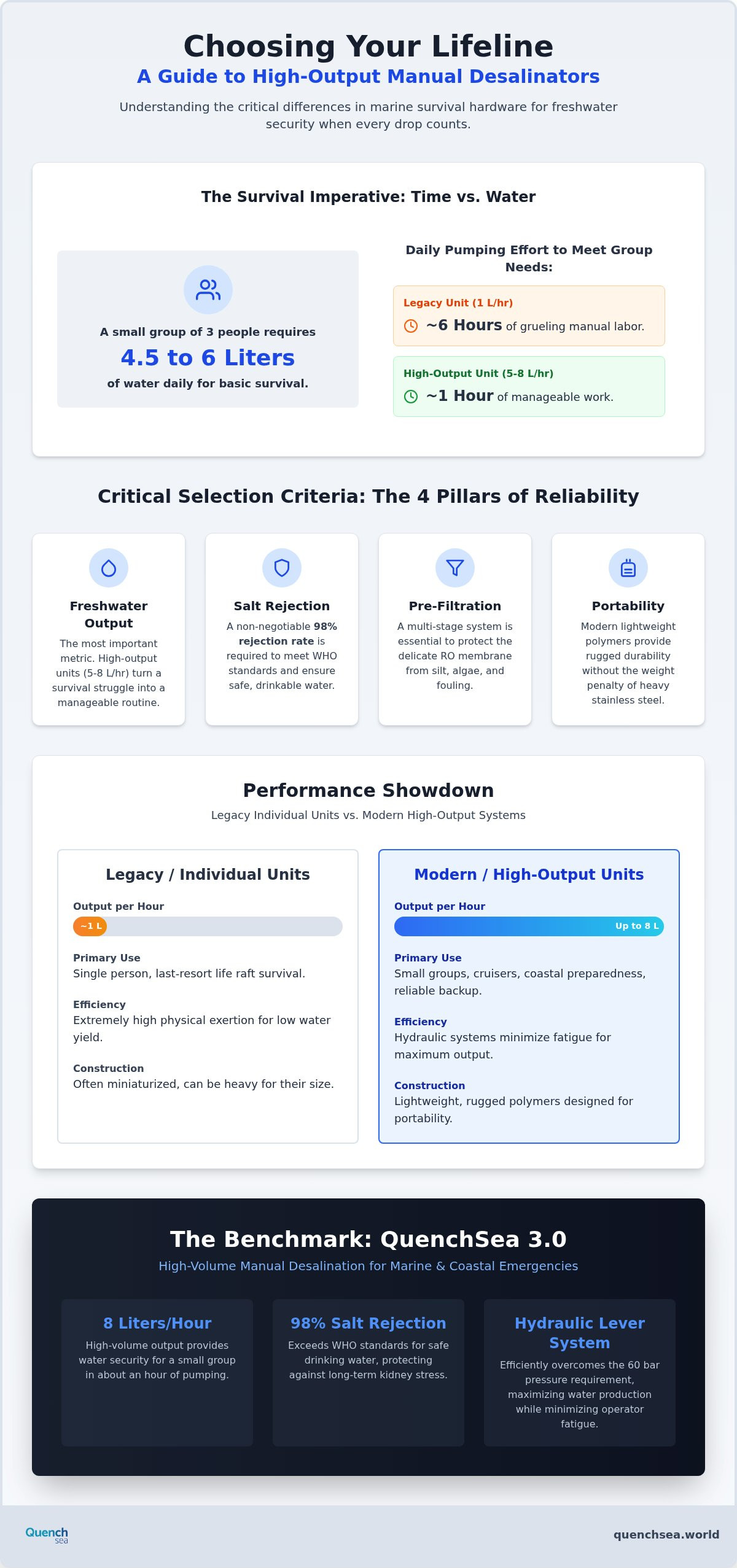
Survival in a marine environment is a race against dehydration. When selecting the best hand pump desalinator, your primary focus must be freshwater output measured in liters per hour (L/hr). Many legacy devices produce less than one liter per hour. This is often insufficient because the physical exertion required to pump can cause the operator to lose more fluid through perspiration than the device recovers. High-output units capable of 5 to 8 liters per hour change the survival math; they turn a desperate struggle into a manageable routine.
Salt rejection is the second non-negotiable metric. To meet World Health Organization (WHO) standards, a device should achieve a 98% rejection rate. Anything less risks long-term kidney stress or "saltwater creep," where the water remains slightly brackish. While some competitors prioritize heavy stainless steel construction, this often adds unnecessary weight to a ditch bag. Modern engineering favors rugged, lightweight polymers that offer durability without the mobility penalty.
The Reality of Daily Water Requirements
Calculating hydration needs isn't just about individual survival; it's about group logistics. Standard emergency advice often cites the Rule of 3 survival priorities, where water becomes a critical failure point within 72 hours. In a life raft, a small group of three people requires roughly 4.5 to 6 liters of water daily just to maintain basic physiological functions. A device producing only 1 liter per hour would require six hours of grueling manual labor every day. Moving to a high-volume system reduces this work to a single hour, preserving the group's physical energy for rescue signaling and navigation.
Filtration Beyond Salt
Modern survival water makers must handle more than just sodium. The reverse osmosis process is incredibly effective but also delicate. If silt, algae, or microplastics reach the RO membrane, they can cause irreversible fouling and total system failure. This is why triple pre-filtration is essential. A robust system uses multiple layers to strip out parasites and suspended solids before the water reaches the high-pressure stage. This multi-stage approach protects the expensive RO membrane and ensures the device remains functional throughout a long-term emergency. It's the difference between a tool that works once and a tool that works for weeks.
Top Manual Desalinators of 2026: Performance Comparison
Legacy military hardware once set the standard for emergency water makers. These units, such as the Katadyn Survivor 06, prioritized extreme miniaturization. However, they often produce less than one liter of water per hour. While this might keep a single person alive in a life raft, it's insufficient for active survival or group scenarios. Modern engineering has shifted the focus toward high-volume production. The best hand pump desalinator in 2026 must support a small group, not just an individual. Understanding desalination basics reveals that moving larger volumes through a membrane requires consistent, high pressure. Modern hydraulic systems now handle this requirement more efficiently than older, direct-drive gear.
The trade-off between price and speed is a critical factor for 2026 buyers. Legacy units often carry a "military premium," costing thousands of dollars for low output. Newer innovations, like the QuenchSea 3.0, provide 5 to 8 liters per hour at a fraction of that cost. This makes high-volume desalination accessible for coastal preparedness and recreational sailing. High-salinity environments like the open ocean demand rugged construction. Devices must resist corrosion from salt spray while maintaining mechanical integrity under 60 bar of internal pressure.
High-Output vs. Individual Survival Units
Individual survival units are designed for one person in a life raft. They are compact but slow. In contrast, high-output manual devices are built for coastal bug-out scenarios or as primary backups for cruisers. When comparing these to traditional manual boat water makers, the primary difference is the effort-to-output ratio. A high-volume unit allows you to produce a full day's worth of water in about an hour. This efficiency is vital when physical energy is a limited resource. If you need a reliable, high-volume tool for your emergency kit, consider the QuenchSea 3.0 for its balance of speed and portability.
Operational Lifespan and Membrane Replacement
Durability depends on membrane health and pre-filtration. A single RO membrane can produce thousands of liters if you maintain it properly. Salt and silt eventually degrade performance, leading to a higher cost-per-liter over time. Field-serviceable parts are a hallmark of modern 2026 designs. You can swap filters and membranes in minutes without specialized tools. For long-term preparedness, store your device with a preservative solution to prevent biological growth. This ensures your hardware is ready the moment an emergency strikes. Avoid systems that require factory-only repairs, as they become useless if they fail during a real-world crisis.
The Engineering of Effort: How Hydraulic Systems Save Energy
Desalination is a battle against osmotic pressure. To force seawater through a semi-permeable membrane, a system must generate at least 60 bar (6,000 kPa) of force. In older designs, this required a vertical piston pump that relied on raw downward strength. It was inefficient and exhausting. The best hand pump desalinator in 2026 utilizes a hydraulic circuit to bridge the gap between human capability and physical requirements. By trading distance for force, these systems allow a user to reach high pressures through a controlled, mechanical sweep rather than a frantic struggle.
Minimizing Physical Fatigue
Efficiency isn't just about the machine; it's about the operator. Ergonomic lever systems allow for longer pumping sessions by utilizing the power of the back and core muscles. This is a significant upgrade over shoulder-dependent piston designs. A stable mounting system or a wide, non-slip base is equally vital. Without stability, energy is wasted on correcting the unit's position. Hydraulic leverage transforms high-pressure RO into a manageable task, ensuring that even a survivor in a calorie-restricted state can maintain hydration. This focus on user-centric engineering is a primary reason for the high ratings found in this QuenchSea Portable Desalinator Review.
The Science of Manual Reverse Osmosis
The hydraulic system acts as a force multiplier. As the operator moves the lever, the internal piston drives water through the RO membrane. High-performance units often include an energy recovery device. This component captures the high-pressure energy from the concentrated brine that would otherwise be wasted. It redirects that pressure to assist the next intake stroke, effectively cutting the required physical effort by nearly a third. It's a sophisticated way to recycle human energy that would otherwise be lost to the ocean.
Many skeptics believe manual RO is too difficult for anyone who isn't a trained athlete. This is a misconception rooted in outdated gear. Modern best hand pump desalinator models are designed for the average user. The secret lies in the rhythm. A steady, full-stroke motion allows the hydraulic valves to cycle efficiently. This keeps the internal pressure at the optimal 60 bar level without requiring explosive strength. By focusing on mechanical leverage and energy recycling, these devices turn a complex industrial process into a simple, repeatable survival task.
Strategic Integration: Adding a Hand Pump to Your Safety Kit
Every yacht equipped with an electric water maker needs a mechanical failsafe. Marine environments are hostile to electronics. Batteries fail; circuits corrode; solar panels shatter. The best hand pump desalinator acts as your final line of defense against dehydration. It's the only tool that guarantees freshwater security when the grid goes dark. When planning your life raft water supply, don't rely solely on stored bottles. Canned water is heavy and finite. A manual device provides a renewable resource that extends your survival window indefinitely.
Drills are essential for effective deployment. Every crew member must be able to operate the pump under stress. Training ensures that muscle memory takes over when panic sets in. Practice priming the system and maintaining a consistent stroke rhythm. This preparation turns a piece of emergency hardware into a functional lifeline.
Marine Ditch Bag Essentials
A ditch bag is a curated collection of high-stakes gear. Position your desalinator alongside calorie-dense rations and signaling equipment. It must be at the top of the bag for immediate access. Protect the unit from mechanical impact and saltwater corrosion during storage. Use a dedicated, padded waterproof case to ensure the seals and levers remain intact. This level of preparedness isn't just for sailors. Coastal survivalists are increasingly adopting bug out bag water desalination strategies to utilize brackish water sources during land-based emergencies. If you're building a kit for 2026, secure a QuenchSea 3.0 unit to anchor your freshwater strategy.
Group Survival Logistics
Survival is a team effort. To maintain a high output of 5 to 8 liters per hour, rotate pump duties every 15 to 20 minutes. This prevents the physical exhaustion that can compromise a group's morale. A fresh operator maintains a better rhythm and higher pressure. Managing the intake hose is equally critical. Keep the strainer submerged at least 30 centimeters to avoid surface oil, fuel spills, or floating debris. These contaminants can foul the pre-filters and shorten the life of the RO membrane. Produce water during daylight hours and store it in sterile, food-grade containers. Labeling each container helps track consumption rates and ensures the group stays within their hydration budget.
QuenchSea 3.0: The 2026 Benchmark for High-Volume Desalination
Historically, high-volume desalination was reserved for military budgets or luxury yacht installations. The QuenchSea 3.0 disrupts this hierarchy. It provides professional-grade freshwater production without the prohibitive cost associated with legacy brands. This makes it the best hand pump desalinator for those who refuse to compromise on safety. The 5 to 8 liters per hour output represents a critical safety feature. It allows a single operator to provide for a small group, transforming manual desalination from a desperate struggle into a sustainable survival routine.
The device utilizes a sophisticated triple-filtration architecture designed for extreme reliability. It starts with a micro-filtration stage to remove larger sediment and silt. An ultra-filtration membrane then strips out bacteria and parasites. Finally, the reverse osmosis stage removes 98% of dissolved salts. This layered approach doesn't just produce clean water; it protects the core RO membrane from premature fouling. It's mission-driven engineering designed for the harsh reality of humanitarian crises and maritime emergencies.
Technical Specifications for Professionals
Reliability is the primary design metric for the QuenchSea 3.0. The unit achieves 98% salt rejection, consistently bringing Total Dissolved Solids (TDS) levels below the 1,000 ppm threshold required for safe long-term consumption. The construction is intentionally robust. There are no extra parts to lose or delicate components to snap during a high-stress deployment. QuenchSea 3.0 is a survival-grade tool that produces up to 192 liters a day. This volume provides a massive safety margin for teams or families in coastal environments where water sources are compromised.
Why QuenchSea Wins the 2026 Selection
Weight is a critical constraint for any ditch bag or bug-out kit. Weighing under 1kg, this device offers a power-to-weight ratio that legacy military units simply can't match. It delivers high-volume output in a form factor that fits easily alongside other essential gear. The user interface is equally optimized for crisis scenarios. Simple pictorial instructions guide the operator, ensuring that even non-technical users can produce freshwater under duress without confusion. It's a calculated, mechanical solution for a world where water security is no longer guaranteed. Equip your kit with the QuenchSea 3.0 Desalinator to ensure your team maintains freshwater independence in any environment.
Secure Your Freshwater Independence
Freshwater security in a marine environment is no longer a luxury reserved for those with massive budgets. The evolution of manual desalination has proven that high-volume production is the only viable strategy for group survival. By prioritizing a device with a 5-8 liters per hour output and 98% salt rejection, you ensure that hydration remains a manageable task rather than an exhausting struggle. The integration of hydraulic leverage and triple filtration has redefined the standard for what the best hand pump desalinator can achieve in a crisis.
Relying on electric systems alone is a risk you can't afford. A rugged, manual backup provides the ultimate off-grid reliability when every other system fails. It's time to transition from passive hope to active preparedness. Order the QuenchSea 3.0 Desalination Device today to equip your kit with hardware used by marine professionals worldwide. Take control of your coastal security and ensure your team has the water they need to survive any emergency. Stay prepared, stay hydrated, and stay empowered.
Frequently Asked Questions
How much water can a hand pump desalinator actually produce?
Output depends entirely on the device's engineering. Legacy individual survival units often produce less than 1 liter per hour, which barely meets a single person's needs. The QuenchSea 3.0, widely regarded as the best hand pump desalinator for volume, delivers 5 to 8 liters per hour. This high-output capacity allows a single operator to provide enough freshwater for a small group in a short period, significantly improving survival logistics.
Is it physically difficult to pump a manual desalinator for a long time?
Pumping requires overcoming 60 bar of osmotic pressure. Older vertical piston designs were notoriously exhausting; modern units utilize hydraulic lever systems to reduce the physical load. By using a long lever and back muscles rather than just arms, the effort becomes manageable. Rotating duties among group members every 15 to 20 minutes prevents fatigue. The mechanical advantage of modern hydraulics makes long-term operation sustainable for most adults in survival situations.
Can I use a hand pump desalinator on brackish water or just seawater?
You can use these devices on both brackish and seawater. Brackish water has lower salinity, which actually reduces the osmotic pressure required for filtration. This means the pump is easier to operate and produces water faster. However, the pre-filtration system must still be used to remove silt and pathogens. Always ensure the intake hose is clear of debris to protect the delicate reverse osmosis membrane from clogging during extended use in coastal areas.
How long does the RO membrane last in a manual desalinator?
A standard reverse osmosis membrane can process thousands of liters if maintained correctly. Lifespan is largely determined by the quality of pre-filtration and the salinity of the source water. Silt and algae are the primary causes of membrane failure. Using a triple-filtration system helps shield the RO stage from damage. When the salt rejection rate drops below 98%, it's time to replace the membrane to ensure the produced water remains safe for consumption.
Does manual desalination remove bacteria and viruses?
Yes, high-quality units utilize multi-stage filtration to address biological threats. The QuenchSea 3.0 features an ultra-filtration stage that physically blocks parasites and bacteria. The reverse osmosis membrane itself has pores so small that even viruses are effectively filtered out. This process ensures the output meets WHO drinking standards. While salt removal is the primary goal, the secondary biological filtration is essential for preventing waterborne illnesses in emergency scenarios where water quality is unknown.
What happens if I drink ocean water without desalinating it first?
Drinking untreated seawater leads to rapid dehydration and organ failure. The human kidney can only produce urine that is less salty than the ocean. To flush out the excess salt, your body must use more water than you consumed. This creates a net loss of fluids, leading to a dangerous cycle of thirst and physiological stress. Desalination is the only way to transform high-salinity water into a hydration source that supports life in marine environments.
Is a hand pump desalinator better than a solar still for survival?
A hand pump desalinator is significantly more efficient than a solar still. Solar stills rely on evaporation and condensation, which are slow processes dependent on clear skies and high temperatures. They typically produce very small amounts of water. A manual RO device provides high-volume output on demand, regardless of the weather. For active survival where liters-per-hour matter, the best hand pump desalinator is the superior choice for reliable hydration and group security.
How do I maintain my desalinator when not in use?
Proper storage is vital for long-term reliability. After use, flush the system with freshwater to remove salt crystals that can damage the seals. If storing the unit for more than a few days, use a preservative solution to prevent biological growth inside the membrane. Store the device in a cool, dry place away from direct sunlight. Regularly check the pre-filters and seals to ensure the hardware is ready for immediate deployment when an emergency occurs.