

Most survival manuals suggest building a solar still, but in a real maritime crisis, that DIY plastic sheet is often a death sentence. It's a slow, inefficient process that fails when you need hydration most. If you're stranded on a coast or adrift at sea, the best way to desalinate seawater in an emergency isn't waiting for the sun. It requires reliable, high-pressure mechanical filtration. You need a solution that works as hard as you do.
We understand the stakes. You're likely worried about the physical exhaustion of manual pumping or the terrifying reality of high-salinity environments. This 2026 guide replaces that fear with technical confidence. You'll discover how to transform lethal saltwater into a steady stream of 5 to 8 liters of freshwater per hour. We'll explore the engineering of 98% salt rejection and the portable hardware that fits inside a standard bug-out bag. From triple filtration systems to the physics of reverse osmosis, this is your blueprint for survival. It's time to master the mechanics of hydration and secure your water supply without relying on batteries or fuel.
Key Takeaways
- Stop relying on passive solar stills that produce insufficient volume for real-world survival.
- Understand why manual reverse osmosis is the best way to desalinate seawater in an emergency by achieving 98% salt rejection without electricity.
- Master the five-step technical process to prime and operate a manual desalination system in high-salinity environments.
- Discover how 2026 engineering allows a single person to produce 5 to 8 liters of life-saving water every hour using the QuenchSea 3.0.
The Biological Reality of Seawater Emergencies
Survival is a math problem. The "Rule of 3" dictates that you can last three hours without shelter in extreme conditions, but only three days without water. In a coastal or maritime crisis, you're surrounded by a liquid that actually accelerates your demise. Emergency desalination is the mechanical or thermal desalination process used to extract salt from water to prevent hypernatremia. This condition occurs when blood sodium levels spike, triggering a rapid, lethal exit of water from your cells. To maintain basic metabolic function and cognitive clarity, 2 liters of freshwater is the absolute daily floor for survival.
The danger of "Survival Thirst" is its deceptive nature. In the heat of a maritime crisis, the urge to drink anything is overwhelming. However, even a few ounces of seawater triggers a chain reaction. It draws water out of your cells via osmosis, thickening your blood and forcing your heart to work harder. This isn't just thirst; it's a systemic collapse. You cannot drink your way out of a hydration crisis using the ocean.
Why is Drinking Sea Water Dangerous?
Drinking seawater is a physiological trap. Your kidneys act as a biological filter, but they can only produce urine that is less salty than the ocean. To flush the salt from one liter of seawater, your body must expend approximately 1.5 liters of its own internal stores. This creates an immediate hydration deficit. As dehydration worsens, symptoms escalate from extreme thirst to cognitive decline, muscle spasms, and hallucinations. Eventually, organ failure occurs. For a deeper look at these physiological mechanics, read about why is drinking sea water dangerous.
The Speed vs. Survival Ratio
Identifying the best way to desalinate seawater in an emergency requires looking at the net-gain. Many passive methods, like solar stills, produce less than 0.5 liters of water per day. If you spend three hours in the sun building a still, you'll sweat out more fluid than the device will ever return. This is a net-loss. A survival-grade output must provide at least 1 liter of freshwater per hour of physical effort. High-salinity environments demand efficiency. You can't afford to trade calories and sweat for droplets. Modern manual systems focus on maximizing this ratio, ensuring that every pump translates into immediate, life-sustaining volume.
Comparing Emergency Desalination Methods: Distillation vs. Filtration
Survival requires choosing between two fundamental technologies: thermal distillation or mechanical filtration. Thermal methods use heat to evaporate water, leaving salt behind. Mechanical methods, specifically Reverse Osmosis, use pressure to push water through a barrier. While boiling is a common "backyard" recommendation, it's often the worst way to desalinate seawater in an emergency due to the fuel trap. As the U.S. Geological Survey on desalination highlights, these processes are energy-intensive. In a high-stakes environment, every joule of energy must be calculated.
Thermal Distillation: The Fuel Trap
The math of boiling seawater is brutal. It takes approximately 2,260 kilojoules of energy to evaporate just one kilogram of water. If you're on a life raft or a barren coast, you don't have the fuel to sustain this level of output. Open-fire setups are notoriously inefficient; they often lose up to 40% of potential yield to the ambient air. DIY solar stills offer a zero-fuel alternative but fail the volume test. They typically produce less than 0.5 liters per day, which is far below the biological floor for survival.
Thermal setups also face the "salt creep" problem. As water evaporates, salt crusts form on the edges of your containers. These crystals eventually migrate into your freshwater collection area, ruining the batch. Improvised stills made from non-food-grade plastics present another danger. They can leach endocrine disruptors or toxic fumes when exposed to high heat. You're trading long-term dehydration for immediate chemical poisoning.
Reverse Osmosis: The Mechanical Edge
Mechanical filtration, or Reverse Osmosis (RO), is the superior alternative. This process uses a high-pressure pump to force seawater against a semi-permeable membrane. The membrane's pores are so small they reject 98% of salt and minerals at a molecular level. It's a physical separation, not a state change. This is why RO is now the standard for a life raft water supply. It provides immediate results without the complexity of phase changes.
The 2026 engineering shift has made RO portable and accessible. We've replaced heavy electric pumps with efficient manual levers. These devices allow a survivor to generate the 50 to 60 bar of pressure required for desalination using only arm strength. For most survivors, manual reverse osmosis is the best way to desalinate seawater in an emergency because it converts physical energy directly into hydration. To ensure your bug-out bag is truly prepared, consider integrating a manual desalination tool into your primary gear list. It eliminates the "fuel debt" of fire and the inefficiency of solar waiting periods.
Why Manual Reverse Osmosis is the Gold Standard for 2026
A common misconception in survival circles is that reverse osmosis (RO) requires massive electrical input or heavy industrial machinery. While traditional systems are energy-intensive, 2026 engineering has shattered this "Energy Myth." It's now possible to generate the 60 bar (870 PSI) of pressure required for desalination using only human power. This mechanical efficiency makes manual RO the best way to desalinate seawater in an emergency. According to the UN Climate Technology Centre & Network on Desalination Methods, membrane-based systems provide a more streamlined alternative to thermal processes, especially when portability is a priority.
Reliability in salt-air environments is non-negotiable. Electronics fail. Batteries corrode. Solar panels shatter. A manual RO device relies on simple, rugged mechanical integrity. Weighing roughly 1kg, these units offer a significant tactical advantage for bug out bag water desalination. Comparing a 1kg hand-held device to a 10kg solar still setup reveals a clear winner for mobile survivors. You get more water, more quickly, with less weight on your back.
The Mechanics of a Manual Water Maker
The heart of the system is a high-pressure pump paired with a semi-permeable membrane. Modern survival-grade units utilize energy recovery valves. These valves capture the hydraulic energy of the rejected brine and recycle it back into the pumping cycle. This innovation reduces the physical force required from the user by up to 40%, allowing for sustained operation without exhaustion. Reverse osmosis uses mechanical pressure to force water through a membrane that blocks 98% of dissolved salts. This process ensures the output meets strict safety thresholds even in high-salinity maritime environments.
Filtration Beyond Salt: Pathogens and Microplastics
Seawater isn't just salty; it's often contaminated with pathogens, silt, and microplastics. Manual RO devices use a triple filtration sequence to protect the sensitive RO membrane from clogging. This isn't just about salt rejection; it's about comprehensive biological safety. The filtration process removes bacteria, viruses, and parasites that would pass through a simple cloth filter or a poorly constructed solar still. By achieving 98% salt rejection, these devices produce water that aligns with WHO drinking water standards. You aren't just getting "wet" water; you're getting lab-grade hydration in a field environment. This level of purity is vital for preventing secondary illnesses like dysentery, which can be just as lethal as dehydration in a crisis.
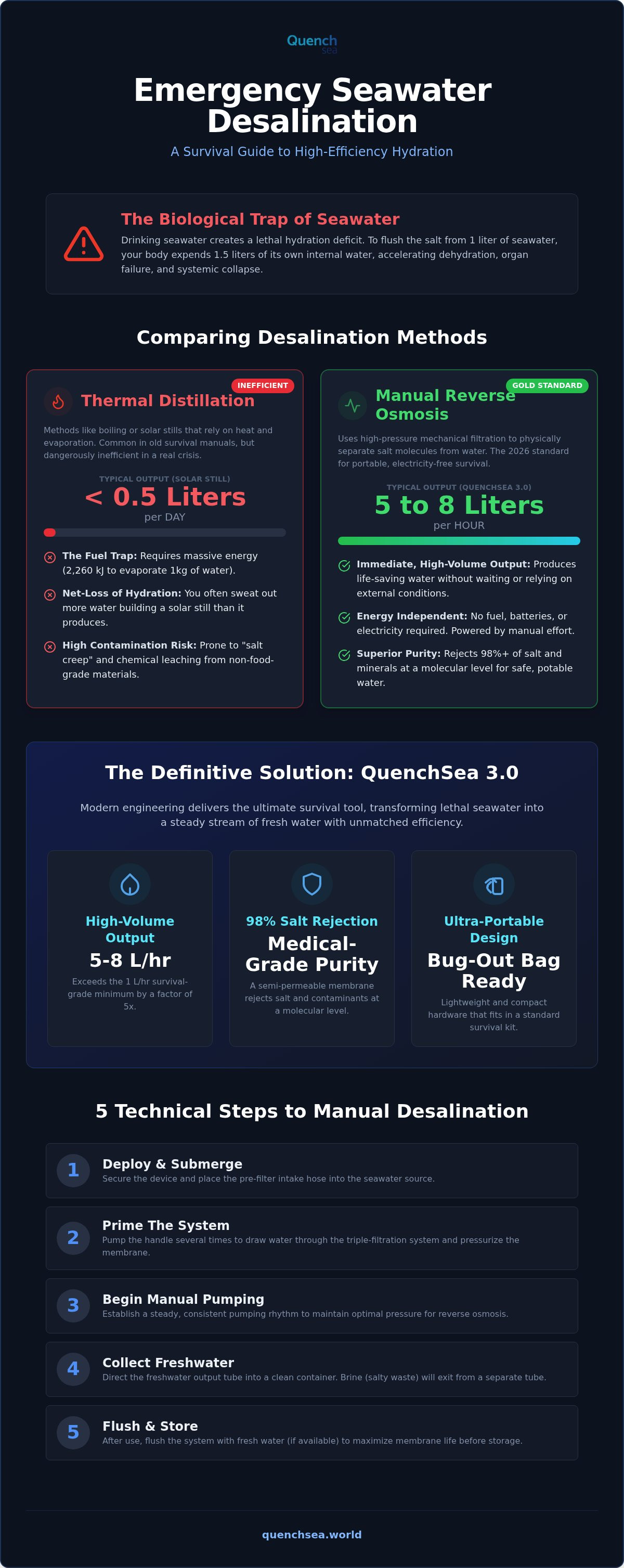
How to Desalinate Seawater Manually: 5 Technical Steps
Mastering the best way to desalinate seawater in an emergency requires more than just owning the right hardware; it demands a disciplined technical process. In high-stress maritime environments, following a specific sequence ensures your equipment stays functional and your water remains safe. Survival is a matter of procedure. If you skip a step, you risk membrane failure or physical exhaustion when you can least afford it.
- Step 1: Sourcing. Move away from the surf zone. Shoreline water is a "soup" of sand, organic debris, and oils that will clog your pre-filters in minutes.
- Step 2: Priming. Displace all air from the internal chambers. Manual reverse osmosis requires a solid column of water to reach the 50 to 60 bar of pressure needed for salt rejection.
- Step 3: Pumping. Establish a steady, rhythmic stroke. Consistent pressure maintains optimal flux across the membrane and prevents hydraulic spikes that could damage internal seals.
- Step 4: Monitoring. Track your output. A sudden increase in flow often indicates a membrane breach, while a significant drop suggests your pre-filters need immediate attention.
- Step 5: Maintenance. Flush the system with fresh water after use. Salt crystals act like sandpaper on membranes if allowed to dry and harden inside the device.
Sourcing and Pre-filtration
To extend the life of your survival desalination device, you must protect the RO membrane at all costs. Avoid "shoreline soup" by swimming out or using a bucket to let sediment settle for 20 minutes before intake. If you're on a life raft, look for clear blue water away from any oil slicks or heavy algae blooms. Using a simple cloth as a primary strainer before the water even enters the device adds an extra layer of protection against larger particulates.
Operating Under Stress
Manual pumping is physically demanding. To avoid muscle fatigue, use your body weight rather than just your arm strength. In a group scenario, establish a "hydration rotation" where each person pumps for 15 to 20 minutes before swapping. This keeps the water flowing without burning out a single survivor. If the water begins to taste slightly brackish or the pump becomes nearly impossible to move, it's a clear signal the membrane needs cleaning or replacement. Effective hydration management is the best way to desalinate seawater in an emergency while preserving your team's energy. To secure your water supply for any maritime journey, order the QuenchSea 3.0 today and train your crew on these essential steps.
QuenchSea 3.0: The Definitive Emergency Water Solution
The QuenchSea 3.0 represents the best way to desalinate seawater in an emergency through refined mechanical engineering. It's the world's most accessible manual desalinator. While previous generations proved the concept, the 3.0 model delivers survival-grade performance for families and small crews. It produces 5 to 8 liters of freshwater every hour. This output exceeds the baseline biological requirement for hydration, even in high-heat maritime environments. It operates entirely on human power, removing the risk of battery failure or fuel depletion.
Durability is the core of the design. We've engineered the device using corrosion-resistant materials specifically for long-term marine exposure. Salt air and seawater destroy standard gear, but the QuenchSea 3.0 maintains its hydraulic integrity. This reliability is why the device is a cornerstone of our social mission. Every unit produced helps scale our global disaster relief water supply efforts. We provide tactical hydration solutions where traditional infrastructure has collapsed.
Field-Proven Reliability
The QuenchSea 3.0 isn't just a prototype; it's a field-proven tool. It has earned its place in defense sectors, humanitarian missions, and the yachting community. Professionals recognize it as the peak of manual boat water makers. In long-term disaster scenarios, the "no-battery" advantage is decisive. You don't need a charging port or a clear sky for solar panels. You only need the device and the strength to operate the lever. This mechanical simplicity ensures that freshwater is available 24/7, regardless of weather or power grid status.
Integration Into Your Survival Plan
Effective survival planning requires rapid deployment. Store the QuenchSea 3.0 in your primary life raft, coastal go-bag, or emergency vehicle. Its compact footprint makes it a superior alternative to carrying heavy water canisters. A cost-benefit analysis reveals its true value. Compare the one-time acquisition of a desalinator to the logistical nightmare of storing and rotating hundreds of liters of bottled water. The device provides water independence. It turns the ocean from a threat into a resource. Don't wait for a crisis to secure your supply. Secure your water independence with QuenchSea 3.0 and ensure your team has a reliable path to hydration.
Master Your Maritime Hydration Strategy
Survival in the ocean is a calculation of volume and efficiency. You've seen why solar stills fall short and why boiling seawater is a fuel-intensive trap. High-pressure manual filtration is the only reliable method to produce enough water for a group while preserving your energy. By mastering the five technical steps of sourcing and operation, you turn a lethal environment into a sustainable resource. Identifying the best way to desalinate seawater in an emergency is the first step toward true coastal independence.
The QuenchSea 3.0 is the hardware that bridges the gap between crisis and survival. It's already trusted by marine professionals and NGOs worldwide to provide life-saving hydration in extreme conditions. With a 98% salt rejection rate that exceeds WHO standards, it can produce up to 192 liters of freshwater per day. You don't need batteries or fuel; you only need the right tool in your kit. Take control of your safety and prepare for the unpredictable. Order the QuenchSea 3.0 Emergency Water Maker Now. You have the knowledge and the technology to survive.
Frequently Asked Questions
Can you drink desalinated water for a long period?
Yes, you can drink it, but it's essentially distilled water. It lacks the minerals found in groundwater. In a survival scenario, this is a secondary concern compared to the lethal threat of hypernatremia. The 98% salt rejection rate ensures the water meets WHO standards for safety. Long term users should supplement with electrolytes if available, but for emergency hydration, it is completely safe and effective.
Is it possible to desalinate seawater by boiling it?
Boiling alone does not remove salt; it only concentrates it by evaporating the freshwater. To desalinate via heat, you must capture the steam and condense it back into liquid, a process called distillation. This requires significant fuel and specialized equipment. As established, manual reverse osmosis is the best way to desalinate seawater in an emergency because it avoids the massive energy debt and complexity associated with thermal distillation.
How much water can a manual desalination device produce in an hour?
A high performance manual device like the QuenchSea 3.0 is the best way to desalinate seawater in an emergency, producing between 5 and 8 liters of freshwater per hour. This volume is sufficient to support a family or a small boat crew in a crisis. Unlike solar stills that yield less than a liter per day, this mechanical output provides a sustainable hydration buffer. Consistent, rhythmic pumping ensures peak hydraulic efficiency.
What happens if the reverse osmosis membrane gets clogged?
If the membrane clogs, you'll notice increased resistance in the pump handle and a sharp decline in water output. This is usually caused by "shoreline soup" or organic matter. To prevent this, always use the integrated triple filtration system. If clogging occurs in the field, you must flush the system with freshwater or replace the pre filters to restore the pressure balance and protect the RO membrane's mechanical integrity.
Can a manual desalinator remove viruses and bacteria?
Yes, the reverse osmosis process is highly effective at removing biological contaminants. RO membranes have pore sizes of approximately 0.0001 microns, which are significantly smaller than bacteria and most viruses. The triple filtration system acts as a defensive barrier, removing larger pathogens and sediment before they reach the membrane. This dual action approach provides lab grade water quality that is free from parasites and microplastics in any maritime environment.
Do I need any special training to use QuenchSea 3.0?
No specialized engineering background is required. The device is built for intuitive operation under extreme stress. Users should familiarize themselves with the five step technical process: sourcing, priming, pumping, monitoring, and maintenance. Practicing these steps once before a voyage ensures you can maintain a consistent rhythm and troubleshoot minor issues like air locks. The goal is mechanical simplicity that empowers any survivor to produce life saving water immediately.
How long does a QuenchSea 3.0 membrane last in an emergency?
A QuenchSea 3.0 membrane typically processes 1,000 to 2,000 liters of water before requiring replacement. This lifespan depends heavily on the quality of the intake water. Using clean, deep sea water and maintaining the pre filters every three to four weeks will maximize this duration. In a standard emergency, one membrane provides enough hydration for a single person for over a year, making it a highly reliable long term survival tool.
Can I desalinate water from a pool or a brackish lake?
The device is specifically engineered for seawater but can process other high salinity sources like swimming pools or brackish lakes. It uses the same high pressure reverse osmosis technology to reject dissolved solids and chemicals. However, you must ensure the water is free from heavy oils or industrial chemicals that could permanently damage the membrane. While designed for the ocean, its versatility makes it a critical tool for various coastal and urban flooding scenarios.