

In a life-critical marine emergency, your sophisticated electrical systems are often the first components to fail. When the power goes out and the backup batteries die, the ocean becomes a desert. You've likely felt the anxiety of relying on heavy, finite water tanks or complex electric water makers that struggle in harsh conditions. It's a dangerous dependency. This 2026 survival guide proves that manual pressure is the only 100% reliable power source for desalination when everything else breaks down. By integrating a portable emergency reverse osmosis system into your kit, you secure a lightweight, non-electric freshwater source that functions regardless of your vessel's power status.
We'll examine the technical evolution of the QuenchSea 3.0, which now produces 6 to 8 liters of drinking water per hour through pure mechanical leverage. You'll learn why manual RO technology is the definitive fail-safe for offshore sailors and off-grid professionals. This article breaks down the simple operation of these survival-grade tools and provides a step-by-step framework for maintaining your equipment in high-stress environments. Prepare to replace uncertainty with mechanical certainty.
Key Takeaways
- Prioritize water production over static storage to survive long-term emergencies where finite supplies eventually fail.
- Eliminate "single point of failure" risks by choosing manual desalination over electric systems; electronics often fail first in harsh marine environments.
- Understand how a portable emergency reverse osmosis system uses human-generated force to overcome osmotic pressure and strip salt from seawater.
- Learn the linear operational steps required to maintain membrane integrity and maximize freshwater output in high-stress scenarios.
- Discover why the QuenchSea 3.0 serves as the survival-grade benchmark for reliable, hand-powered desalination in 2026.
The Critical Role of Portable Emergency Reverse Osmosis Systems
A portable emergency reverse osmosis system is a survival-grade mechanical tool engineered to transform seawater into potable freshwater without external power. In extreme marine or coastal environments, this device acts as a definitive lifesaver. It functions as a high-pressure mechanical process that removes 99% of dissolved salts and contaminants. This technology empowers long-distance sailors, coastal preppers, and humanitarian agencies to operate in regions where infrastructure has collapsed. Reliability is the priority here. When electronics fail, manual leverage remains.
The "Rule of 3" dictates that a human can survive three minutes without air, three hours without shelter, and three days without water. In a survival scenario, water production always beats water storage. Stored water is a depleting asset. Once it's gone, your survival clock starts ticking. A manual RO system turns the surrounding ocean into an infinite reservoir. It shifts the survival strategy from rationing a finite supply to managing a sustainable resource.
Why Freshwater Access is the #1 Survival Priority
The ocean is deceptive. While it surrounds you, drinking sea water is a fatal mistake that accelerates dehydration through osmotic pull in the gut. Even mild dehydration impairs cognitive function. In high-stress marine environments, poor decision-making leads to catastrophic errors. You can't afford a clouded mind when navigating a storm or managing a vessel failure. Life-raft rations provide only a few days of relief. They are finite. A mechanical water maker provides the psychological and physiological endurance needed to reach safety.
The Limits of Stored Water and Standard Filters
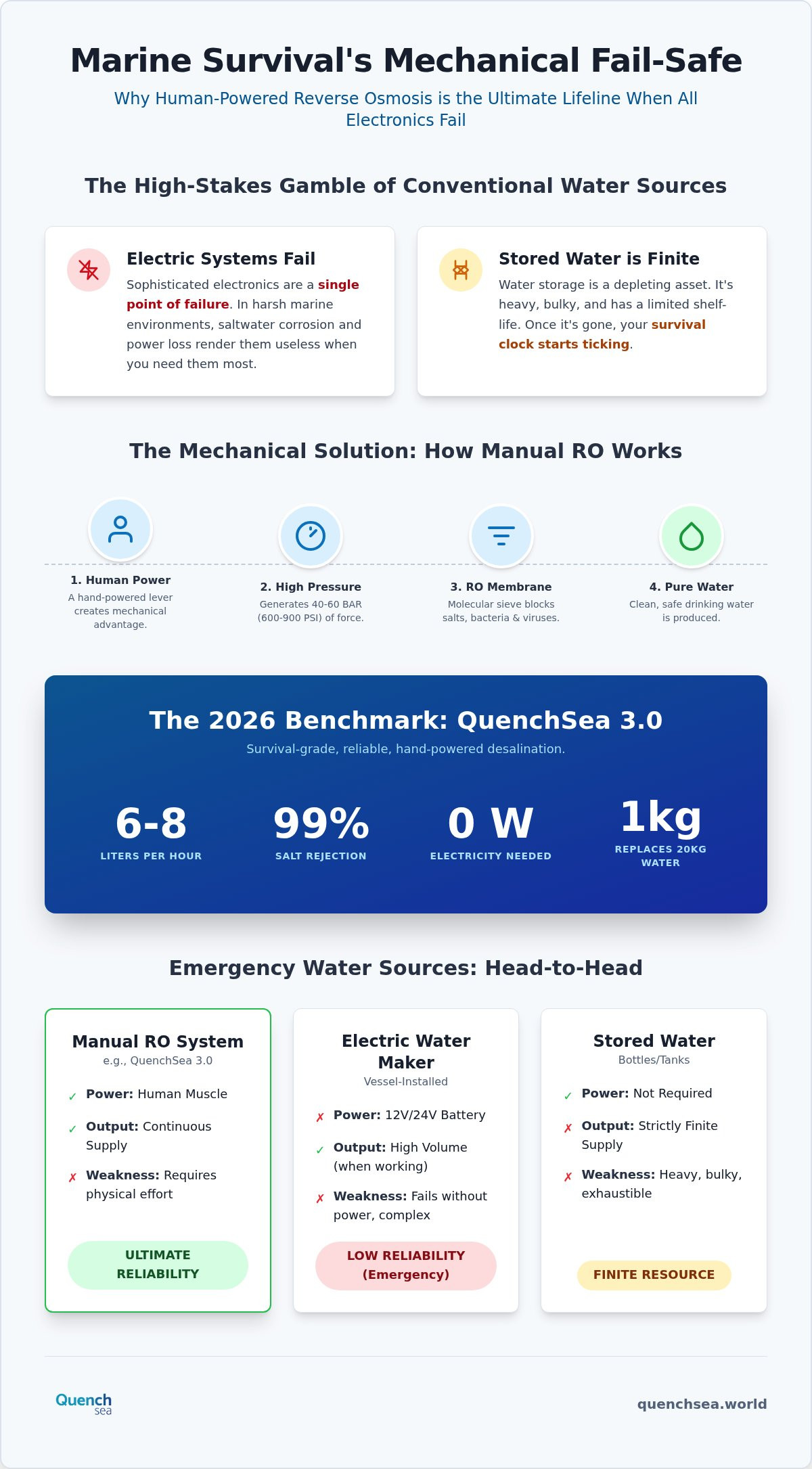
Standard carbon or ceramic filters are useless against salinity. They remove bacteria but leave dissolved ions untouched. Only a system following the principles of how reverse osmosis works can effectively strip salt at the molecular level. Logistics also favor mechanical systems. A 1kg device replaces the need to carry 20kg of stored water. This weight reduction is critical for weight-sensitive life rafts or bug-out bags. Stored water also suffers from shelf-life issues. In extreme heat, plastic containers can leach chemicals or harbor bacterial growth. A manual RO unit provides fresh, on-demand water that doesn't expire.
How Manual Reverse Osmosis Desalination Works Without Electricity
Manual desalination isn't magic; it's a battle against physics. To turn seawater into drinking water, you must overcome osmotic pressure through concentrated force. This requires a sustained pressure of approximately 40 to 60 bar (600 to 900 PSI). In a portable emergency reverse osmosis system, this pressure is generated through pure mechanical advantage. Instead of an electric motor, a hand-powered lever drive train compresses the water against a high-rejection membrane. This simplicity is its greatest strength. By removing the need for circuit boards or batteries, you eliminate the common failure points that plague electric water makers in corrosive salt air. Mechanical systems don't short circuit. They don't require software updates. They simply work when you apply force.
The Science of High-Pressure Membrane Filtration
The core of the system is the semi-permeable membrane. Think of it as a molecular sieve with pores so small that only water molecules can pass. Under high pressure, water is forced through these microscopic openings while larger sodium and chloride ions are rejected and flushed away as brine. This process effectively removes contaminants including parasites, bacteria, and viruses. Achieving a significant Total Dissolved Solids (TDS) reduction is essential for long-term survival. Seawater is significantly more complex than brackish water. It contains roughly 35,000 parts per million of salt. Reducing that to under 500 ppm requires sustained, high-intensity pressure that only a precision-engineered membrane can handle.
Engineering for Human-Powered Operation
Generating 50 bar of pressure by hand sounds daunting, but engineering makes it manageable for the average user. Modern systems utilize long-stroke lever arms to maximize mechanical advantage and distribute the workload across larger muscle groups. This ergonomic design minimizes user fatigue during the extended pumping sessions required to meet daily hydration needs. The materials used are equally critical for survival gear. Every component in a manual reverse osmosis seawater device must resist the relentless corrosive nature of salt air and spray. Using high-grade, non-corrosive polymers and reinforced stainless steel ensures the device remains operational even after months of storage in a damp life raft locker.
This closed-loop system creates total energy independence. You don't need to worry about cloudy days affecting solar panels or dead batteries halting production in the middle of the night. As long as you can move the lever, you can produce water. It's a direct relationship between effort and survival. If you're looking for a tool that prioritizes this mechanical certainty, the QuenchSea 3.0 is built for exactly this purpose. It's a hardware-focused solution for a hardware-focused problem, designed to provide a fail-safe when every other system on your vessel has failed.
Comparing Emergency RO Systems: Manual vs. Electric vs. Solar
Choosing a desalination method requires evaluating the "Single Point of Failure." Electric systems offer convenience but remain fundamentally fragile. Solar units require clear skies and fragile photovoltaic panels that are easily damaged in a storm. A portable emergency reverse osmosis system relies on human mechanical force, making it the only truly energy-independent option. In a marine environment, moisture and salt are the enemies of circuitry. When your vessel's electrical grid fails, an electric water maker is just dead weight. Manual systems are the essential life raft water supply because they remove the middleman of energy conversion. Integrating a portable emergency reverse osmosis system into your primary gear ensures that your survival isn't tethered to a battery's health.
Reliability in High-Stakes Environments
Mechanical systems offer superior corrosion resistance compared to electronic counterparts. Circuit boards and connectors eventually succumb to the relentless salt air, even when "sealed." A manual RO unit uses reinforced polymers and stainless steel. These materials endure harsh conditions without short-circuiting. If a mechanical part sticks, you can often fix it with basic tools at sea. You can't field repair a fried microprocessor. Shelf life is another critical factor. Batteries in electric or solar units degrade over time, losing their charge or capacity. Manual units stay ready for years. They require minimal maintenance beyond occasional seal lubrication and membrane preservation.
Portability and Weight Constraints
The "Grab Bag" test is the ultimate metric for survival gear. Can you carry the device in one hand while abandoning ship? Fixed electric units are bolted to the hull. They stay with the boat. Even portable electric units often require bulky battery packs or solar arrays that complicate a rapid exit. The QuenchSea 3.0 has a significantly smaller footprint, designed for high-speed deployment. This makes it a primary choice for bug out bag water desalination in coastal regions. It fits into a standard backpack, providing a high-impact solution without the 10kg weight penalty of solar-integrated systems. Speed and agility save lives. When the situation deteriorates, a lightweight mechanical tool is your most valuable asset.
Operational Guide: Maximizing Survival Water Production
Deploying your portable emergency reverse osmosis system requires a disciplined, step-by-step approach. In a high-stakes environment, speed is secondary to precision. Rushing the setup often leads to membrane fouling or mechanical strain. Follow this linear progression to ensure maximum efficiency from the first stroke:
- Secure the unit: Mount the device to a stable surface to maximize leverage and reduce user fatigue.
- Deploy hoses: Position the intake hose in clean, deep water away from surface debris.
- Separate discharge: Ensure the brine outlet is down-current from the intake to avoid re-processing concentrated salt water.
- Prime the pump: Perform several slow, deliberate strokes to clear air from the lines before building pressure.
Pre-filtration and Membrane Protection
The RO membrane is a precision instrument. Suspended solids, silt, and organic matter will clog the microscopic pores if not intercepted. Use a dedicated pre-filter or a fine mesh cloth over the intake hose as a primary barrier. This simple step preserves the high-rejection capabilities of the system. Avoid operating the unit in areas with visible oil slicks or "red tide" algae blooms. These contaminants can permanently coat the membrane, rendering the device useless in minutes. Protecting the intake is the most effective way to extend the life of your portable emergency reverse osmosis system.
Pumping Techniques and Daily Rationing
Efficiency depends on cadence, not raw speed. For the QuenchSea 3.0, maintain a steady, rhythmic stroke to keep the pressure within the optimal 40 to 60 bar range. Rapid, jerky movements waste energy and increase wear on the seals. A consistent pace allows one person to produce 6 to 8 liters of drinking water per hour. Plan your production for the cooler hours of the night or early morning. This strategy reduces physical exertion and minimizes water loss through perspiration. Producing water when you aren't fighting the sun's heat is a fundamental rationing tactic that preserves your internal hydration levels.
A survival tool is only as good as its last maintenance check. Flush the system with fresh water after every use to prevent salt crystallization. If you're storing the unit for long periods, use a preservation solution to keep the membrane moist and inhibit bacterial growth. Check the seals for elasticity and apply food-grade lubricant if they appear dry. Master these protocols before the emergency hits. To ensure your gear is ready for the next mission, invest in a QuenchSea 3.0 today and build your survival water plan around mechanical certainty.
QuenchSea 3.0: The Benchmark for Hand-Powered Desalination
The QuenchSea 3.0 Desalination Device represents the current peak of survival engineering. It's not a luxury gadget. It's a utilitarian tool built for the harshest marine environments on Earth. As maritime risks increase in 2026, this portable emergency reverse osmosis system provides a calculated, mechanical answer to the threat of dehydration. Every design choice prioritizes functionality. We've stripped away the unnecessary to focus entirely on the core requirement: turning salt water into life-sustaining freshwater through manual force alone.
Survival-Grade Engineering and Build Quality
The 3.0 model features an impact-resistant housing designed to survive the shock of a rapid vessel abandonment. Its reinforced lever system converts human energy into high pressure with maximum efficiency. We've engineered the internals to handle the relentless abrasion of salt and sand. Long-term deployments require field-ready solutions. That's why we implemented a simple, tool-free membrane replacement system. You don't need a workshop to maintain this portable emergency reverse osmosis system. If a membrane reaches the end of its service life during a multi-week survival scenario, you can swap it out in minutes. This no-nonsense design philosophy ensures that every gram of weight in your grab bag serves a life-critical purpose.
Humanitarian and Individual Preparedness
Beyond individual survival, this technology addresses the global challenge of water scarcity. Over 2.2 billion people worldwide lack access to safely managed drinking water. QuenchSea is bridging the gap for coastal communities and NGOs by providing a low-cost disaster relief water supply. The system is highly scalable. While a single unit is a primary backup for a solo sailor, multiple devices can be deployed as survival desalination device kits for entire response teams. This versatility makes it an essential asset for both personal kits and large-scale humanitarian missions. Reliability shouldn't be a luxury. We've optimized the manufacturing process to ensure this high-performance hardware remains accessible to those who need it most.
Equipping your vessel or coastal bug-out kit with a fail-safe water source is a non-negotiable step in modern preparedness. Don't leave your survival to chance or battery life. Secure your autonomy and ensure your team has the freshwater they need to survive any crisis. Review the QuenchSea 3.0 Desalination Device specifications today to integrate this benchmark of survival technology into your emergency plan. Master your environment before it masters you.
Master Your Marine Survival Strategy
Survival in 2026 depends on mechanical reliability rather than electronic complexity. You've seen why water storage is a finite solution that eventually runs dry. True independence requires the ability to produce freshwater on demand regardless of your vessel's power status. By integrating a portable emergency reverse osmosis system into your kit, you eliminate the single point of failure inherent in battery-dependent devices. The QuenchSea 3.0 provides this fail-safe through rugged engineering that's already trusted for marine survival and global disaster relief. This hand-powered device ensures you aren't left vulnerable when sophisticated electronics succumb to salt air and corrosion.
Mastering your environment starts with choosing hardware that matches the harshness of the ocean. Don't leave your hydration to chance or a failing circuit board. Take control of your safety with a tool built for the extreme. Every gram of the 3.0 model serves a life-critical purpose. Secure your water independence with the QuenchSea 3.0. You now have the technical knowledge and the tactical framework to ensure you never run out of water at sea. Stay prepared and stay safe.
Frequently Asked Questions
Can a portable reverse osmosis system really turn seawater into drinking water?
Yes, a portable emergency reverse osmosis system is specifically engineered to turn seawater into potable drinking water. It uses mechanical pressure to force seawater through a semi-permeable membrane. This process rejects sodium and chloride ions while allowing pure water molecules to pass. Unlike standard filters that only remove bacteria, these systems achieve the high-rejection rates necessary to make high-salinity ocean water safe for human consumption in survival scenarios.
How much effort does it take to pump a manual desalination device?
Operating a manual desalination device requires consistent physical effort, but the QuenchSea 3.0 uses a long-stroke lever to maximize mechanical advantage. You need to maintain a steady, rhythmic pace to reach the 40 to 60 bar of pressure required for desalination. While it requires exertion, the ergonomic design minimizes fatigue. A user can produce 6 to 8 liters per hour by maintaining a disciplined pumping cadence during survival operations.
How long does the RO membrane last in an emergency system?
The lifespan of an RO membrane depends on the quality of intake water and post-use maintenance. Under typical emergency conditions, a membrane can process thousands of liters before performance degrades. However, fouling from silt or organic matter can shorten this duration. The QuenchSea 3.0 features a tool-free replacement system, allowing users to swap membranes in the field. Regular fresh-water flushing is essential to prevent salt crystallization and extend the component's operational life.
Is the water produced by QuenchSea 3.0 safe to drink immediately?
Yes, the freshwater produced by the QuenchSea 3.0 is safe for immediate consumption. The system is designed to meet World Health Organization (WHO) drinking water quality standards by reducing Total Dissolved Solids (TDS) to safe levels. The RO membrane acts as a molecular sieve, removing pathogens, parasites, and viruses alongside salts. This provides a reliable, on-demand water source that requires no additional boiling or chemical treatment before you drink it.
What happens if the intake water is contaminated with oil or chemicals?
Oil slicks, fuel, and certain industrial chemicals can permanently damage or clog the RO membrane. These contaminants coat the microscopic pores and inhibit the desalination process. You should always position your intake hose in the cleanest, deepest water available. If you suspect chemical contamination or see surface oil, avoid operation. Using a pre-filter or fine mesh cloth helps protect the system from suspended solids; however, it cannot stop dissolved chemical pollutants.
Does a manual RO system require any batteries or solar power to operate?
No, a manual RO system like the QuenchSea 3.0 requires zero batteries, fuel, or solar power. It relies entirely on human-generated mechanical force to drive the desalination process. This eliminates the "single point of failure" common in electronic water makers. Because it doesn't depend on external energy sources, the device remains fully operational during total power failures, cloudy weather, or at night. It's a completely autonomous survival tool.
Can I use an emergency RO system on a lake or river instead of the ocean?
You can use an emergency RO system on freshwater sources like lakes or rivers, but it's primarily engineered for the high osmotic pressure of the ocean. While it'll remove bacteria and contaminants from fresh water, the fine RO membrane may clog faster if the water is turbid or silty. In these environments, the system still provides safe drinking water, but you must prioritize pre-filtration to protect the membrane from suspended organic matter.
How should I store my portable RO device when it's not in use?
Proper storage is critical for keeping your device survival-ready. After use, flush the system with fresh water to remove residual salt and brine. For long-term storage, use a preservation solution to keep the membrane moist and prevent bacterial growth. Store the unit in a cool, dry place away from direct sunlight. Regularly inspect the seals and apply food-grade lubricant to maintain their elasticity, ensuring the device functions perfectly when an emergency occurs.