

Your 50-gallon water drum is a ticking clock, not a permanent solution. Relying solely on static storage for your hurricane preparedness water solution assumes the crisis will resolve before your last bottle runs dry. It’s a gamble that leaves you vulnerable to long-term utility failures and the physical exhaustion of managing hundreds of pounds of plastic. You know the stress of watching the local shelves go empty as a storm approaches. You understand the uncertainty of water safety once the floods arrive. It is time to stop hoarding and start producing.
This article promises to help you master the transition from finite, bulky storage to unlimited water production for total hurricane resilience. We will examine how to leverage manual reverse osmosis technology to secure a reliable source of hydration that requires zero electricity or batteries. You'll learn to replace space-consuming tanks with compact, mechanical hardware designed for extreme environments. We are moving beyond the limitations of bottled water to provide a calculated, engineering-focused approach to survival. By the end of this guide, you will have the confidence to face extended grid failures with a solution that never runs out.
Key Takeaways
- Learn why traditional water storage is a finite resource and how to evolve your hurricane preparedness water solution into a sustainable production system.
- Identify the critical failure points of standard gravity filters and why they cannot process brackish floodwater or saltwater intrusion.
- Master the tiered hydration strategy that integrates immediate bottled supplies with long-term, mechanical water recovery.
- Discover how manual reverse osmosis technology provides a survival-grade fail-safe that operates entirely without batteries or electrical grids.
- Transition from the physical burden of bulky storage tanks to compact, portable hardware capable of producing fresh water on demand.
Why Water Storage Isn’t a Complete Hurricane Preparedness Water Solution
Standard emergency advice focuses on hoarding. You are told to buy cases of plastic bottles and fill bathtubs. This is a finite strategy for an unpredictable crisis. The rule of 3 survival dictates that water is your most immediate biological priority after oxygen. You have roughly 72 hours before dehydration compromises your ability to think and act. While a 72-hour kit is the baseline, it's often insufficient for modern hurricane recovery. Major storms now disrupt supply chains and utility grids for 14 days or longer. A temporary stockpile is a starting point, but it's not a complete hurricane preparedness water solution.
The Math of Survival: Why Storage Fails
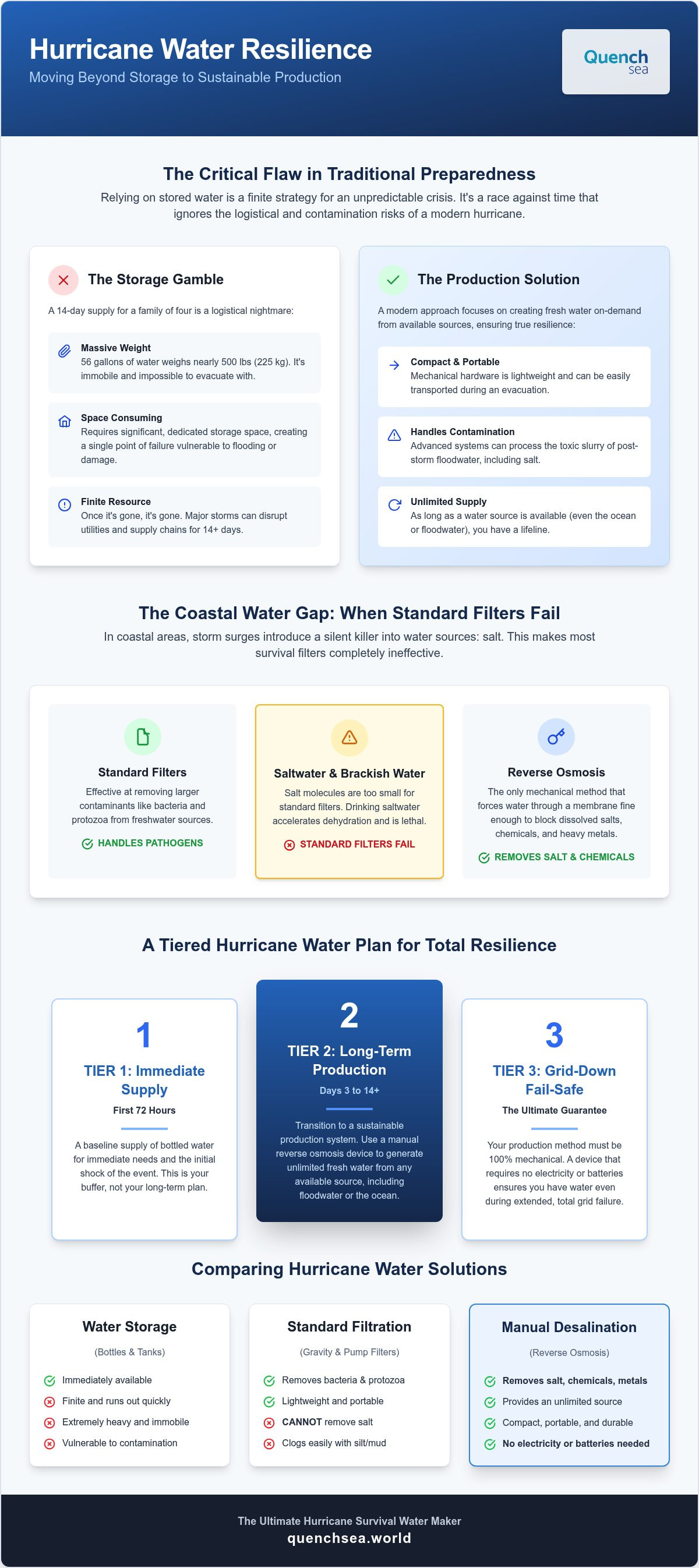
Storing water is a massive logistics challenge. Consider a family of four aiming for a 14-day supply. At the recommended one gallon per person per day, you'll need 56 gallons. Water weighs approximately 8.34 lbs per gallon. This means you are managing nearly 500 lbs of dead weight. It requires significant floor space and reinforced shelving. If you store this supply in a single location, like a garage or basement, you create a single point of failure. Rising floodwaters can sweep away plastic jugs or contaminate the caps. Structural shifts can crush storage tanks. When your static supply is compromised, you are left with zero options. You can't carry 500 lbs of water if you need to evacuate suddenly. Storage is heavy, immobile, and finite.
Contamination Risks Post-Storm
Post-storm environments are biologically and chemically toxic. Floodwaters are not just rain; they are a slurry of raw sewage, heavy metals, and industrial runoff. These contaminants can bypass the simple seals on consumer-grade water bottles. Even if the water inside remains clean, the exterior of the container becomes a biohazard. Relying on "boil water notices" is a dangerous gamble when the power is out and gas lines are severed. Many traditional portable water purification methods fail in these conditions. Basic filters clog instantly with silt. Chemical tablets don't neutralize heavy metals or salt. You need a mechanical solution that can handle the specific reality of urban flood zones. Without a way to produce clean water from contaminated sources, your survival depends entirely on the integrity of a plastic seal.
The Coastal Water Gap: When Standard Filtration Hits its Limit
Coastal residents face a unique threat that standard kits ignore: saltwater intrusion. When a storm surge hits, the massive pressure of the ocean forces seawater into low-lying municipal pipes and private wells. Your tap water might look clear, but it's fundamentally changed. This makes your hurricane preparedness water solution significantly more complex than simply filtering out mud or bacteria. Once the aquifer is breached by brine, traditional filtration becomes useless. Municipal treatment plants often shut down or become overwhelmed during surges. They cannot process the sudden influx of salt. You are left with a tap that provides poison instead of life. You must recognize that in a hurricane, "water" is not always freshwater.
The Chemistry of Saltwater Intrusion
Storm surges act like a hydraulic ram. They push salt into freshwater systems where it doesn't belong. This creates brackish water, a dangerous middle ground between fresh and salt. You cannot drink this. Salt forces your cells to release water to dilute the sodium in your bloodstream. Understanding why is drinking sea water dangerous is critical for coastal survival. Instead of hydrating you, brackish water accelerates your decline. While the EPA provides guidelines for the Emergency Disinfection of Drinking Water, these protocols focus on pathogens. They do not address dissolved salts. Chlorine and boiling do nothing to remove sodium. You need to recognize the signs early. A metallic or slightly salty taste in your tap water indicates a breached line. At that point, stop drinking it immediately.
The Failure of Conventional Filters
Most survivalists rely on hollow-fiber membrane filters. These are excellent for removing bacteria and protozoa. However, salt molecules are too small for these pores. A standard "survival straw" or gravity bag will let the salt pass straight through. You need a molecular-level solution. This is where a survival desalination device becomes a mandatory fail-safe. It uses reverse osmosis to strip away the salt that other filters ignore. If your primary source is a well or a coastal municipal line, you must prepare for the moment your "fresh" water turns saline. Standard filters are designed for mountain streams, not hurricane-flooded streets. For true resilience, you must invest in hardware that handles salt. Desalination is the only way to close the coastal water gap when standard filtration hits its limit. Reliance on freshwater filters in a saltwater zone is a high-stakes tactical error. Integrating desalination ensures your hurricane preparedness water solution remains functional when the environment turns hostile.
Comparing Hurricane Water Solutions: Storage, Purification, and Desalination
Selecting an effective hurricane preparedness water solution requires a tactical assessment of your environment. You must distinguish between storage, purification, and production. Storage is your immediate buffer. It works for the first 48 hours but remains a finite resource. Once the last bottle is empty, your options vanish. Purification methods like UV light, chemical drops, or standard filters handle biological pathogens in clear freshwater. They fail entirely when storm surges introduce salt or industrial heavy metals. Desalination via reverse osmosis is the only mechanical process capable of converting brackish floodwater or seawater into life-sustaining hydration. It turns a hostile environment into a functional resource.
The ROI of Water Production
Survival economics favor production over hoarding. Compare the logistics of volume versus output. A single bug out bag water desalination kit replaces approximately 50 cases of bottled water. You eliminate the constant cycle of buying, transporting, and rotating heavy inventory. Space efficiency is paramount during an evacuation. One portable device fits in a backpack; a two-week supply for a family takes up an entire closet. This isn't just about cost. It is about the peace of mind that comes from self-reliance. When help is delayed by destroyed infrastructure, your ability to produce water determines your survival window.
Manual vs. Electric Systems
Total grid failure is a standard outcome of a major hurricane. Electric water makers are high-maintenance liabilities in these scenarios. They require power sources that are often the first things to fail. Batteries deplete. Solar panels are vulnerable to wind-borne debris. Manual reverse osmosis systems provide mechanical certainty. They are engineered for durability in harsh, high-salinity environments. When choosing a unit, prioritize hardware with field-replaceable membranes and corrosion-resistant materials. Simplicity is a survival feature. A manual system works as long as you can operate the pump. It bypasses the vulnerabilities of the electrical grid entirely, providing a dependable fail-safe for long-term utility failures.
Building a Tiered Hurricane Water Plan for 2026
A single-layer plan is a failure point. Resilience requires redundancy. A comprehensive hurricane preparedness water solution integrates three distinct levels of response to ensure you never run out of potable liquid. This tiered approach allows you to match your water source to the severity of the infrastructure collapse. You move from immediate comfort to long-term mechanical production as the crisis evolves.
Tier 1 & 2: The Foundations
Tier 1 focuses on immediate tactical response. Follow FEMA guidelines and store a minimum of one gallon per person per day for the first 72 hours. This provides high-quality hydration during the peak of the storm impact. Tier 2 begins when the tap stops flowing. Identify secondary freshwater sources like rain barrels, swimming pools, or your home’s water heater. Use gravity filters or chemical disinfection to process this water. For a robust disaster relief water supply, keep unscented liquid bleach on hand. Use eight drops per gallon of clear water to neutralize biological threats. These foundations buy you time, but they rely on the availability of freshwater.
Tier 3: The Desalination Insurance Policy
Tier 3 is your ultimate insurance policy. Deploy your manual reverse osmosis (RO) device when freshwater sources are exhausted or contaminated by storm surges. This is where you adopt a life raft water supply mentality. Treat your home as a vessel and the surrounding floodwater as a resource. Manual RO hardware allows you to pull directly from brackish surge water or the ocean. It bypasses the need for municipal recovery entirely. This mechanical certainty ensures that even if help is weeks away, your family has an unlimited supply of drinking water.
Maintenance is as critical as the hardware itself. Rotate your Tier 1 bottled water every six months to prevent plastic degradation. Check the seals and O-rings on your Tier 2 and 3 devices before the season begins. Ensure reverse osmosis membranes are stored according to manufacturer specifications to prevent drying or fouling. A plan is only as good as the state of its equipment. Equip your household with a survival-grade desalination device to complete your tiered strategy and secure total water independence.
QuenchSea 3.0: The Ultimate Hurricane Survival Water Maker
Hoarding water is a defensive posture. Producing it is an offensive strategy. The QuenchSea 3.0 represents a fundamental shift in how you secure your family during a crisis. It is survival-grade hardware designed for the exact conditions of a hurricane surge. While standard filters clog and storage tanks fail, this manual reverse osmosis device provides a definitive hurricane preparedness water solution. It transforms the very floodwaters that threaten your home into a life-sustaining resource. You stop being a victim of supply chain failures and start being the architect of your own survival.
QuenchSea 3.0 Technical Advantages
Reverse osmosis requires immense pressure to separate salt molecules from water. The QuenchSea 3.0 achieves this through a high-leverage hand-pump mechanism. It generates the necessary PSI without the need for solar panels or external batteries. You are the power source. This eliminates the vulnerability of electrical failure or battery degradation over time. In one hour of operation, you can produce 4 to 6 liters of fresh drinking water. This capacity is sufficient to sustain a household through the most critical stages of a recovery effort. The system utilizes advanced RO membranes to strip away salt, pathogens, and viruses at a molecular level. It is engineered for operation under extreme stress. You don't need tools, specialized training, or a technical degree. You only need the hardware and the physical effort to operate it.
Why Coastal Preppers Choose QuenchSea
Coastal environments are notoriously unforgiving. Flood debris, high salinity, and humidity destroy delicate consumer-grade equipment. The QuenchSea 3.0 is built from rugged, corrosion-resistant materials designed to withstand these harsh realities. It fits easily into an emergency go-bag or a small storage locker, offering a level of portability that 50-gallon drums simply cannot match. This technology has already proven its worth in the maritime sector, serving as manual boat water makers for sailors facing the open ocean. Bringing that same level of 'no-fuel, no-battery' reliability to your home hurricane kit is the ultimate tactical upgrade. It ensures your survival does not depend on the stability of a municipal grid or the limited shelf life of a lithium battery. Secure your water independence with QuenchSea 3.0 and ensure your hurricane preparedness water solution is truly unlimited. This is the final piece of a resilient survival strategy.
Secure Your Water Independence Before the Next Surge
The shift from passive storage to active production is the only way to ensure total resilience. Static stockpiles eventually run dry, and standard filters fail when saltwater breaches your local supply. By implementing a tiered plan, you move from the physical burden of heavy drums to the mechanical certainty of a portable production system. This evolution turns your hurricane preparedness water solution into a truly unlimited resource. Don't leave your survival to chance when the infrastructure collapses.
Reliability in extreme environments requires hardware that functions when the grid is dead. The QuenchSea 3.0 provides this fail-safe through advanced RO technology that removes both salt and pathogens without needing a single battery. It's compact enough for any evacuation bag and rugged enough to survive the harshest storm debris. You have the power to protect your family from long-term utility failures. It's time to prioritize mechanical integrity over temporary hoarding.
Equip your hurricane kit with the QuenchSea 3.0 Desalination Device and master the transition to unlimited water production. You are now prepared to face the unpredictable with technical confidence. Stay ready and stay safe.
Frequently Asked Questions
How much water should I store for a hurricane in 2026?
FEMA recommends storing a minimum of one gallon per person per day for at least three days. However, modern recovery timelines often extend to 14 days. For a family of four, this requires 56 gallons of water. This volume weighs nearly 500 lbs and occupies significant storage space. Integrating a production-based hurricane preparedness water solution allows you to meet these needs without the physical burden of massive plastic stockpiles.
Can I use a standard water filter to drink seawater during a flood?
No, standard hollow-fiber filters like survival straws or gravity bags cannot process seawater. These devices are engineered to remove bacteria and protozoa, but the pores are too large to block dissolved salt molecules. Drinking salt or brackish water through a standard filter will lead to severe dehydration. Only reverse osmosis technology can mechanically separate salt from water to make it safe for human consumption during a storm surge.
How does a manual desalination device like QuenchSea 3.0 work?
The QuenchSea 3.0 utilizes a manual hand-pump to create the high pressure required for reverse osmosis. This mechanical force pushes contaminated water through a semi-permeable membrane. The membrane allows water molecules to pass while rejecting salts, pathogens, and industrial contaminants. Because it's hand-powered, the device remains fully functional when the electrical grid fails and batteries are depleted. It's a reliable, non-electric tool for extreme environments.
What happens if I drink brackish water from a flooded well?
Drinking brackish water triggers a biological process that accelerates dehydration. Your kidneys must use more water to flush out the excess salt than the amount you actually consumed. This leads to a net loss of hydration and can cause organ stress or failure. Coastal residents with flooded wells must treat their water as saline and use a desalination device rather than relying on boiling or standard chemical purification.
How long do the filters last in an emergency desalination device?
Filter longevity depends on the quality of the intake water and the maintenance of the pre-filtration system. While the RO membrane is designed for long-term use, sediment and silt from floodwaters can cause premature clogging. Using a pre-filter to remove larger particles is essential for protecting the primary membrane. Always rinse the system with fresh water after use and follow the manufacturer's storage protocols to ensure the hardware remains survival-ready.
Is it better to buy bottled water or a desalination device for hurricane prep?
A balanced strategy uses both. Bottled water is ideal for immediate hydration during the first 72 hours of an impact. A desalination device serves as your long-term insurance policy. It provides an unlimited supply of water without the logistical nightmare of storing hundreds of gallons. Choosing a production-grade hurricane preparedness water solution offers superior ROI and portability, especially if you need to evacuate your primary residence.
Can QuenchSea 3.0 remove bacteria and viruses from floodwater?
Yes, the reverse osmosis membrane in the QuenchSea 3.0 is capable of removing bacteria and viruses. The pores are significantly smaller than the size of most known pathogens. This technology provides a higher level of protection than standard filters, which often miss viruses. It acts as a comprehensive purifier that handles both the biological threats of floodwater and the chemical reality of saltwater intrusion in coastal zones.
What is the "Rule of 3" in hurricane survival?
The "Rule of 3" is a survival framework stating you can last three minutes without oxygen, three days without water, and three weeks without food. In a hurricane context, this highlights why water is your most critical resource once the storm passes. While you can endure hunger, dehydration quickly compromises your cognitive and physical abilities. This makes a reliable production system more valuable than any other item in your emergency kit.