

In a life-critical maritime emergency, your greatest threat isn't the ocean; it's the metabolic cost of staying hydrated. You must understand how to desalinate seawater manually without burning more energy than the water provides. Most traditional survival methods fail this basic math. Solar stills are too slow. Boiling is often impossible. If you don't have a mechanical solution that prioritizes volume-to-effort efficiency, you're just trading sweat for sips.
It's understandable to feel skeptical about manual pumping or confused by the technical jargon of portable filters. You've likely seen devices that promise much but deliver little more than a trickle. This guide changes that. We'll master the engineering behind manual reverse osmosis (RO) and distillation. You'll learn the exact operational steps to convert raw ocean water into safe, WHO-standard drinking water using human power alone. We'll compare the physics of different systems and show why the QuenchSea 3.0 is the reliable choice for extreme environments. By the end, you'll have the technical confidence to choose and operate a tool that actually saves lives.
Key Takeaways
- Prioritize mechanical reverse osmosis over solar distillation. Manual RO provides the high volume-to-effort ratio necessary for survival when calories are limited.
- Understand the physics of osmotic pressure. Reaching the 55-60 bar threshold is the critical breakthrough point required to force pure water through a desalination membrane.
- Master the 5-step technical process for how to desalinate seawater manually. Success depends on effective multi-stage pre-filtration and ensuring the hydraulic circuit is primed.
- Evaluate the QuenchSea 3.0 as a survival-grade standard. It delivers 4-6 liters per hour with 98% salt rejection, meeting WHO standards without batteries or fuel.
The Reality of Manual Desalination: Why You Can't Just Boiling Seawater
Manual desalination is the mechanical removal of dissolved salts from raw ocean water without relying on external fuel or electricity. In high-stakes maritime environments, it's a race against the Rule of 3. You can survive three weeks without food, but only three days without water. At sea, water production is your primary mission. Understanding Desalination processes provides the technical foundation for survival-grade hydration.
Drinking untreated seawater is a fatal mistake. The high salinity forces your kidneys to use more water to flush the salt out than you actually consumed. This leads to rapid, systemic dehydration and eventual organ failure. You must understand Why is Drinking Sea Water Dangerous? before attempting any improvised solution. If you're researching how to desalinate seawater manually, you need a method that provides enough volume to sustain life.
The Calorie-to-Water Ratio
Thermal desalination is calorie-prohibitive. Boiling water requires immense energy to reach the phase-change point. In a survival situation, you don't have the fuel for a fire or the metabolic calories to spare. Manual reverse osmosis (RO) is the most efficient use of human energy. It uses mechanical leverage to overcome osmotic pressure. Manual RO is a pressure-driven molecular separation process. By using a handle or pump, you convert arm movement into the high pressure needed to force pure water through a membrane. This mechanical approach produces significantly more water per calorie spent than any thermal method.
Common Manual Myths
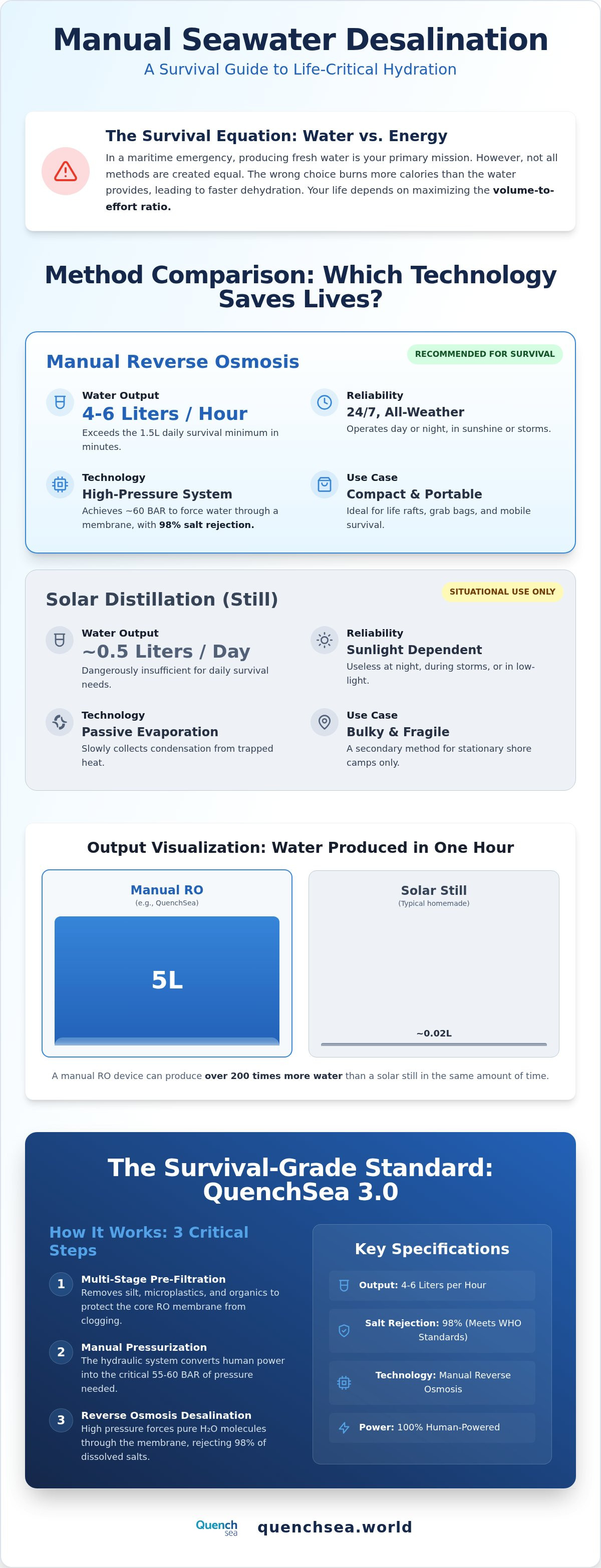
Many travelers rely on solar stills, but these are often insufficient. A standard solar still might produce 0.5 liters per day. Survival experts agree you need at least 1.5 liters daily to maintain cognitive and physical function. Solar stills also depend entirely on consistent sunlight, making them unreliable in storms or at night. Improvised filters are another trap. Sand, cloth, or charcoal filters remove suspended solids like silt and algae. They do nothing to remove dissolved salts. To survive, you need a dedicated system designed to handle the molecular scale of sodium chloride. Learning how to desalinate seawater manually means moving beyond these primitive myths.
Manual Reverse Osmosis vs. Solar Distillation
Comparing passive and active desalination processes reveals a massive performance gap. Solar distillation relies on a basic evaporation-condensation cycle. It uses a plastic cone or sheet to trap heat and collect droplets of fresh water. While simple, the output is dangerously low. A typical solar still produces roughly 0.5 liters per day. In contrast, manual reverse osmosis (RO) systems deliver 4 to 6 liters per hour. If you are learning how to desalinate seawater manually, this 100x difference in volume is the difference between survival and dehydration.
Reliability is the next critical factor. Solar units require clear skies and direct sunlight. They stop producing at night or during heavy overcast. Manual RO functions 24/7. It operates regardless of weather conditions. Portability also favors the mechanical approach. Solar cones are often bulky and fragile. Handheld RO devices are compact enough for a survival grab bag. Long-term health depends on salt rejection. Survival-grade RO systems achieve 98% salt rejection. This ensures the product water meets WHO standards and prevents the physiological damage caused by residual salinity.
The Mechanical Edge of Reverse Osmosis
Reverse osmosis is a technical solution to a biological problem. The system uses a semi-permeable membrane with pores so small they physically block sodium and chloride ions. Only pure water molecules pass through. The "secret sauce" here is pressure. You must generate approximately 60 bar (870 psi) to overcome the natural osmotic pressure of the ocean. This requires high-performance hydraulics. To protect this sensitive membrane from clogging, a triple pre-filtration system removes silt, microplastics, and organic matter. This ensures the device remains functional throughout a long-term emergency. It's the most efficient way to understand how to desalinate seawater manually while minimizing physical exhaustion.
The rigorous filtration principles used in survival gear are mirrored in the world of specialized fishkeeping. For example, CU Aquatics emphasizes the necessity of pristine water conditions for delicate species like Amano shrimp, illustrating how critical pure water is for sustaining life in any environment.
When to Use Each Method
Selection depends on your environment. Solar distillation is a viable secondary option for stationary, off-grid shore camps where time is abundant. For mobile survival or emergency life-raft scenarios, manual RO is the primary standard. The QuenchSea 3.0 is engineered specifically for these high-stakes moments. It provides a reliable 4 to 6 liters per hour without needing batteries or fuel. Understanding the Hand Operated Water Purifier for Saltwater helps you appreciate the engineering required to sustain life at sea. For those prepping a yacht or life raft, investing in a survival-grade manual desalinator is a calculated necessity for any emergency kit.
The Physics of Pressure: How Hand-Pumping Desalinates Water
Desalination is a battle against thermodynamics. To understand how to desalinate seawater manually, you must first understand osmotic pressure. In its natural state, water flows from low salt concentrations to high salt concentrations. To reverse this process, you must apply force that exceeds the ocean’s natural osmotic pressure. For standard seawater, this "break-through" point sits between 55 and 60 bar (approx. 800-870 psi). Without reaching this precise threshold, the semi-permeable membrane remains a total barrier. No fresh water will pass through.
Generating 60 bar of pressure with human muscle alone requires a sophisticated hydraulic system. A standard manual pump converts the sweeping motion of your arm into high-pressure thrust. By using a long lever arm and a small-diameter piston, the device multiplies your physical input. Precision engineering is mandatory. If the seals fail or the tolerances are off by a fraction of a millimeter, the system cannot maintain the internal pressure required for molecular separation. High-quality seals and rugged mechanical components are non-negotiable for any survival-grade manual desalinator.
Energy Recovery: Pumping Smarter, Not Harder
The primary challenge of manual reverse osmosis is physical exhaustion. Early manual pumps were "dead-end" systems that required constant, grueling force. Modern survival tools use Energy Recovery Devices (ERDs) to reduce this workload by up to 50%. ERDs capture pressure from the brine stream to assist the next stroke. Instead of venting the high-pressure waste water (brine) immediately, the system redirects that stored energy back into the hydraulic circuit. This creates a "cross-flow" filtration effect. This movement keeps the membrane surface clean by sweeping away salt ions, preventing the rapid clogging common in inferior DIY setups. It makes the process of how to desalinate seawater manually sustainable for hours rather than minutes.
Materials and Durability
Saltwater is one of the most corrosive environments on Earth. Any manual pump intended for ocean survival must be constructed from marine-grade plastics and high-tensile stainless steel. Cheap components degrade rapidly when exposed to high-pressure salt spray. Salt crystallization is another silent killer of mechanical pumps. As water evaporates inside a poorly designed unit, salt crystals form and act like sandpaper on internal seals. Professional-grade devices like the QuenchSea 3.0 use specialized polymers and corrosion-resistant alloys to ensure the device remains functional after weeks of storage in a damp life-raft locker. Reliability in these materials is the only way to guarantee a dependable water source when land is out of sight.
How to Desalinate Seawater Manually: 5 Technical Steps
Practical execution determines survival. You must follow a disciplined protocol to ensure the longevity of your equipment and the quality of your water. Understanding the mechanics is the first step, but knowing how to desalinate seawater manually in a high-stress environment requires a repeatable, five-step process.
- Step 1: Source and Pre-filter. Submerge the intake hose away from surface oils or floating debris. Use a multi-stage mesh or ultra-filter to remove suspended solids. This protects the RO membrane from immediate abrasion.
- Step 2: Priming the System. Air pockets are the enemy of pressure. Pump slowly at first to clear the hydraulic circuit of all air. A sputtering output indicates trapped air, which prevents the system from reaching the 60-bar threshold.
- Step 3: Establishing the Rhythm. Once primed, increase your speed to a steady cadence. This is the most critical phase of learning how to desalinate seawater manually. Aim for 30 to 40 strokes per minute to maintain optimal membrane efficiency.
- Step 4: Monitoring Output. Discard the first 500ml of permeate. This initial water often contains high Total Dissolved Solids (TDS) as the system stabilizes. Check for absolute clarity before collecting.
- Step 5: Maintenance and Flushing. After your session, flush the system with a small amount of fresh water if available. This prevents salt crystallization on the seals and membrane, extending the life of the unit.
Optimizing Your Pumping Technique
Efficiency is about body mechanics, not just arm strength. To sustain 30 to 40 strokes per minute, brace the device against a solid surface or use your legs and core to drive the movement. Switching arms every 10 minutes prevents localized muscle fatigue. Consistent pressure is vital; stopping and starting frequently leads to membrane fouling, where salt ions settle on the membrane surface and reduce flow. Maintain a smooth, circular rhythm to keep the cross-flow filtration active.
Testing for Potability
Never rely on a "taste test" to determine safety. Your tongue cannot accurately detect the difference between 500 ppm and 2,000 ppm of salt, but your kidneys can. Use a handheld TDS meter to confirm the salt rejection rate is above 98%. This ensures the water meets WHO standards for long-term consumption. If the TDS levels rise, it usually indicates a compromised membrane or a failing seal. For those who require the highest standard of reliability, the QuenchSea 3.0: The Ultimate Portable Desalination Device provides the engineering precision needed to maintain these standards in the field.
Ready to secure your hydration strategy? Equip your life raft with the QuenchSea 3.0 today.
Choosing Your Manual Desalinator: QuenchSea 3.0
Understanding how to desalinate seawater manually is only half the battle. You need hardware that translates that technical knowledge into a reliable water source. The QuenchSea 3.0 is the definitive benchmark for manual reverse osmosis in 2026. It bridges the gap between high-pressure physics and human-powered reality. This device isn't a luxury; it's a survival-grade tool engineered for the most unforgiving environments on the planet.
The primary differentiator for this unit is its 4 to 6 liters per hour output. This volume ensures you spend less time pumping and more time managing other survival tasks. Most manual systems require grueling effort for a fraction of that volume. The triple filtration system provides an additional layer of reliability. By removing sediment, microplastics, and organic matter before they reach the RO membrane, the device preserves its core components. This design ensures long-term operational integrity even when the intake water is far from pristine.
Every purchase supports a larger mission. The brand isn't just selling hardware; it's solving global water scarcity. A portion of the proceeds helps provide clean water access to communities in need. This turns a survival purchase into a tool for global responsibility. It's a mission-driven approach that prioritizes reliability for the individual and empowerment for the world.
QuenchSea 3.0 Technical Specifications
This device is engineered for "grab-bag" compatibility. It's compact and lightweight, fitting easily into yacht lockers or emergency survival kits. In a high-stress crisis, cognitive function drops and clarity becomes vital. The unit features a built-in pictorial instruction system. These visual guides lead users through the process of how to desalinate seawater manually without needing to consult a paper manual in the dark. The system achieves a 98% salt rejection rate. This ensures the output meets the stringent WHO standards for potable water, protecting your kidneys and long-term health during an extended stay at sea.
The Future of Off-Grid Water
Manual backups are a non-negotiable safety layer for any serious sailor. Even the most advanced yachts with high-capacity electric water makers face power failures or mechanical breakdowns. A manual desalinator provides absolute independence from batteries, fuel, or complex electronics. It's the ultimate fail-safe. The vision is ambitious: the brand aims to provide 100 million devices to those in need by 2035. This isn't just a gadget; it's a calculated mechanical solution to a fundamental human problem. It's the standard for anyone who understands that in a survival situation, hope is not a strategy, but engineering is.
Order the QuenchSea 3.0 for your emergency kit today.
Master Your Maritime Autonomy
Survival at sea depends on your ability to produce water faster than your body consumes it. You've learned that thermal methods and solar stills often fail to provide the volume required for long-term health. Mechanical reverse osmosis is the only technology that offers the efficiency needed in a high-stakes crisis. Mastering how to desalinate seawater manually isn't just a technical skill; it's a critical safety protocol that eliminates reliance on failing electronics or finite fuel supplies.
The QuenchSea 3.0 represents the pinnacle of this survival engineering. It produces 4 to 6 liters of fresh water per hour with a 98% salt rejection rate, ensuring your hydration meets WHO standards. Featured in WIRED, CNN, and Yahoo, it's the trusted standard for sailors who refuse to leave their safety to chance. Secure your freshwater supply with the QuenchSea 3.0 and ensure you're never at the mercy of the elements. With the right tools and technical knowledge, the ocean becomes a resource rather than a threat. Stay prepared and stay hydrated.
Frequently Asked Questions
How much water can you actually make manually in an hour?
A survival-grade device like the QuenchSea 3.0 produces 4 to 6 liters of fresh water per hour. This volume represents a massive improvement over passive solar stills, which often yield less than 1 liter per day. Maintaining this flow rate ensures you produce enough water to satisfy your metabolic needs without excessive calorie expenditure. It's the most efficient way to secure your hydration at sea.
Is manual desalination physically exhausting?
Manual desalination is a physical task, but it shouldn't be exhausting with the right equipment. The QuenchSea 3.0 incorporates an Energy Recovery Device (ERD) to reuse waste pressure. This mechanism reduces the physical workload by roughly 50%. By using your core muscles and a steady cadence, you can maintain production for extended periods without reaching total physical exhaustion.
How long does a manual reverse osmosis membrane last?
The lifespan of a manual RO membrane depends on the quality of the intake water and your maintenance routine. With a built-in triple pre-filtration system, the membrane stays protected from silt and microplastics. Flushing the system with fresh water after each session prevents salt crystals from damaging the internal seals. Under these conditions, a single membrane can provide thousands of liters of potable water.
Can I desalinate water manually using only household items?
Learning how to desalinate seawater manually using improvised household items is nearly impossible for reverse osmosis. RO requires a pressure-rated vessel and a semi-permeable membrane capable of withstanding 60 bar. While you can construct a primitive solar still with plastic and a container, the output is dangerously low. For reliable survival, you need a purpose-built mechanical device engineered for high-pressure separation.
What is the difference between a desalinator and a water purifier?
The primary difference is the ability to remove dissolved solids. A standard water purifier filters out biological threats like bacteria and protozoa but cannot remove salt. A desalinator uses high-pressure reverse osmosis to strip sodium and chloride ions from the water. Only a desalinator can make seawater safe for human consumption; a purifier alone will leave you dehydrated.
Does the QuenchSea 3.0 remove viruses and bacteria?
The QuenchSea 3.0 effectively removes viruses and bacteria. The reverse osmosis membrane acts as a molecular sieve with pores far smaller than any known pathogen. Combined with the triple pre-filtration stage, the device ensures the output is biologically safe and chemically pure. It meets the stringent WHO standards required for emergency drinking water in extreme environments.
What happens if I stop pumping mid-way through?
Stopping mid-way causes the system pressure to fall below the 60-bar threshold, halting water production immediately. Prolonged pauses can lead to membrane fouling as salt ions accumulate on the membrane surface. To prevent this, maintain a consistent stroke rhythm. If you must stop for an extended time, flush the unit with fresh water to keep the internal components clean and functional.
Is the water produced by manual RO safe for long-term consumption?
Yes, the permeate is safe for long-term consumption. The QuenchSea 3.0 delivers 98% salt rejection, ensuring the water is well within the limits defined by the World Health Organization. This high level of purity protects your kidneys from the stress of processing high-salinity fluids. It remains a dependable source for indefinite maritime survival when land is not an option.