

In a marine emergency, your stored water supply isn't just a resource; it's a countdown. While SOLAS regulations mandate three liters per person in lifeboats, that volume disappears rapidly under the physical stress of survival. Securing enough emergency drinking water at sea requires more than just a box of foil pouches. It demands a calculated strategy for rationing and production.
You likely recognize the high stakes of dehydration and the technical confusion surrounding manual versus electric desalination. It's a heavy burden to wonder if your gear will perform when the power fails. We're here to replace that uncertainty with mechanical confidence. This 2026 survival guide teaches you to manage existing rations and deploy modern desalination technology effectively.
We will detail exact rationing protocols, explain why manual reverse osmosis is your most reliable lifeline, and show you how to maintain an infinite water source without relying on batteries or fuel. You'll finish this guide with a concrete plan to stay hydrated until rescue arrives.
Key Takeaways
- Understand why drinking seawater accelerates cellular dehydration and why water is your immediate survival priority after air.
- Learn how to identify SOLAS-compliant rations and manage their five-year shelf life for maximum reliability.
- Master a disciplined schedule to preserve your emergency drinking water at sea, including the critical 24-hour waiting period.
- Discover the mechanical advantages of manual reverse osmosis over solar or electric systems in unpredictable marine environments.
- Transition from rationing a finite supply to generating an infinite freshwater source with human-powered desalination technology.
The Biological Reality of Freshwater Needs at Sea
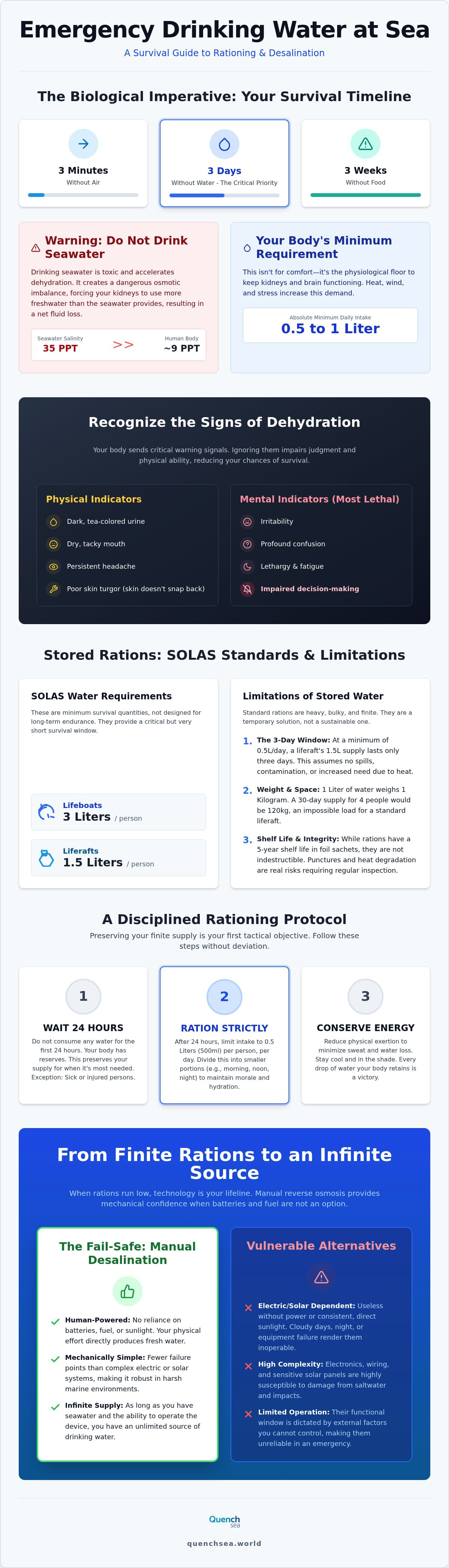
Survival at sea is a brutal exercise in biological math. The "Rule of 3" dictates your priorities. You can last three minutes without air. You can last three days without water. While you might last three weeks without food, your body's demand for hydration is immediate and non-negotiable. High heat, wind exposure, and salt spray accelerate the timeline of decline. Managing your emergency drinking water at sea becomes a mission-critical task the moment you leave the primary vessel.
To maintain basic metabolic function, an adult requires an absolute minimum of 0.5 to 1 liter of freshwater daily. This isn't a comfort standard. It's the physiological floor required to keep your kidneys functioning and your brain operational. Below this threshold, you face rapid collapse. Fatigue transitions into lethargy. Cognitive failure follows. You lose the capacity to perform the mechanical tasks required to stay alive. In a survival scenario, your brain is your most important tool, but it's also the first organ to suffer when fluids run low.
Why Seawater Dehydrates You Faster
Seawater is toxic to the human body in survival quantities. The average salinity of the ocean is roughly 35 parts per thousand. Human blood is significantly less saline. When you ingest seawater, you create a dangerous osmotic imbalance. Your kidneys attempt to process the excess sodium, but they require more freshwater to flush the salt than the seawater itself provides. This results in a net loss of fluid. It's a mathematical certainty of dehydration.
Consulting the biological effects of drinking seawater reveals that this process triggers cellular dehydration. The high salt concentration pulls water out of your cells and into the bloodstream to compensate for the sodium spike. Never attempt to "extend" your supply by diluting seawater with freshwater. This only speeds up the dehydration process by forcing your kidneys to work harder with a contaminated fuel source. It's better to drink nothing than to drink salt.
Recognizing Early Signs of Marine Dehydration
You must monitor yourself and your crew for physical indicators. Dark, tea-colored urine is the first warning sign. A dry, tacky mouth and a persistent headache follow. Check for skin turgor; if the skin on your knuckles doesn't snap back after a pinch, your fluid levels are dangerously low. These physical markers are your body's warning lights.
Mental symptoms are often the most lethal because they impair judgment. Dehydration causes irritability, lethargy, and profound confusion. In a life raft, poor decision-making is as dangerous as a hull breach. You might forget to secure gear or fail to spot a passing vessel because your focus has shifted to internal distress.
The biological tipping point occurs when your blood volume drops and sodium levels rise to a point where organ failure becomes inevitable without immediate clinical intervention.
Stored Water Rations: SOLAS Standards and Limitations
SOLAS (Safety of Life at Sea) regulations establish the baseline for survival. For lifeboats, the requirement is 3 liters of freshwater per person. For liferafts, the mandate drops to 1.5 liters. These figures represent the absolute minimum for survival. They aren't designed for long-term endurance or comfort. Most emergency drinking water at sea is packaged in 100ml or 125ml sachets. This specific volume facilitates strict rationing. Aluminum foil packaging is the technical standard. It provides a hermetic seal against UV light, salt air, and oxygen. This robust engineering allows for a five-year shelf life in extreme conditions.
Stored water presents a significant engineering challenge: the weight-to-volume ratio. One liter of water weighs one kilogram. Carrying a thirty-day supply for a crew of four would require 120kg of storage. This is physically impossible for standard liferafts. Space is a premium; weight is the enemy. You must regularly inspect your life raft water supply for seal integrity. Check for punctures or heat-induced degradation. Even "unconditional" shelf life claims are subject to the brutal reality of the marine environment.
Standard Rations vs. Survival Needs
Do the math. If a liferaft carries 1.5 liters per person and the biological minimum is 0.5 liters per day, you have a three-day window. This assumes zero spills and zero contamination. In reality, heat and physical stress increase your metabolic demand. Packaging is durable but not indestructible. Constant motion in a raft causes abrasive wear on foil sachets. Heat can leach chemicals from internal liners over time. Annual physical inspections are mandatory. Don't wait for a crisis to discover a leaking supply. Familiarize yourself with emergency water purification methods to understand how backup systems supplement these finite rations.
Storage Best Practices for Yacht Owners
Placement is critical for longevity. Store reserve rations in a cool, dark location. Avoid the engine room or areas with high temperature fluctuations. Use the First In, First Out (FIFO) rotation method. Mark expiration dates clearly on the exterior of your storage containers. This ensures you never rely on degraded stock during a primary vessel failure. Integrate these rations into your broader yacht safety water maker strategy. Stored water is your immediate bridge while you deploy more sustainable tools. For those seeking a permanent solution to the storage problem, a manual desalination device provides an infinite supply without the bulk of traditional rations.
How to Ration Emergency Drinking Water at Sea
Rationing is a psychological and physiological battle. It isn't merely about saving liquid. It's about managing a rapidly declining resource to extend your survival window. The most critical rule is the 24-hour moratorium. Unless you're injured or suffering from extreme heat exhaustion, don't drink anything during the first 24 hours after a wreck. Your body begins the survival journey with a reserve of internal fluids. Consuming emergency drinking water at sea too early wastes a finite supply before your metabolism has adjusted to the crisis.
Discipline is the difference between survival and collapse. Establish a strict schedule for consumption. Divide your daily allowance into three small portions: morning, noon, and sunset. This creates a psychological rhythm and prevents the urge to binge. You must also minimize physical water loss. Every drop of sweat is a survival asset lost forever. Stay under the raft canopy. Avoid unnecessary exertion. Breathe exclusively through your nose to prevent moisture loss from your mouth and throat. In a group setting, this requires collective discipline and absolute transparency.
The Step-by-Step Rationing Protocol
- Step 1: Inventory. Gather all available fluids. This includes SOLAS water pouches, rainwater collection gear, and the liquid from canned food.
- Step 2: Designate a Water Officer. One person must control the supply. This prevents panic-induced consumption and ensures the rationing plan is followed without exception.
- Step 3: Sip and Swish. When it's time to drink, don't gulp. Take a small amount into your mouth and swish it around for 30 seconds. This moistens the mucous membranes and provides maximum sensory relief before you swallow.
Maximizing Internal Hydration
Your diet directly impacts your hydration levels. Stop eating protein-heavy foods immediately. While you might typically buy red caviar online for its high nutritional value, digesting protein requires significant amounts of metabolic water, which will accelerate your dehydration in a survival scenario. If you have no water, don't eat. If you must eat, stick to small amounts of carbohydrates. Use the environment to your advantage. Soak your clothing in seawater, wring them out, and wear them. The evaporation process lowers your body temperature and significantly reduces the need to sweat.
Pacing your intake ensures a steady metabolic baseline, whereas saving your entire supply until the point of collapse leads to irreversible organ damage. Maintain a consistent, disciplined intake to keep your brain operational and your decision-making sharp.
Desalination: How to Produce Freshwater Manually
Stored rations are a finite bridge. Once they're exhausted, your survival depends entirely on production. Reverse Osmosis (RO) is the engineering gold standard for seawater filtration. It uses mechanical pressure to force saltwater through a semi-permeable membrane. This process strips away sodium, bacteria, and viruses at a molecular level. In a life raft environment, manual power is superior to electric or solar alternatives. Electronics are vulnerable to salt spray and battery failure. Solar systems require clear skies and specific angles. Your own physical energy is the only power source that doesn't rely on external variables. Using a survival desalination device transforms the ocean from a toxic threat into a renewable resource. Proper maintenance is vital. You must keep membranes clear of biofouling. Organic buildup can clog the system and compromise the seal integrity of the internal valves.
Manual Pump Operation Steps
- Step 1: Deploy the intake hose. Drop the hose into clean, deep water. Avoid the surface film where oil, fuel, and debris accumulate. Clean intake water extends membrane life.
- Step 2: Prime the system. Operate the pump slowly to purge air from the internal chambers. Air pockets disrupt the pressure required for emergency drinking water at sea production.
- Step 3: Maintain a steady cadence. RO requires consistent, high pressure to overcome the osmotic threshold. Don't rush. A rhythmic, disciplined stroke is more efficient than rapid, erratic pumping.
Comparing Manual vs. Solar Distillation
Solar stills are often featured in survival kits, but they're fundamentally flawed for high-seas emergencies. They are fragile and weather-dependent. A solar still might produce a few hundred milliliters of water on a clear day. This is a survival deficit. In contrast, manual water maker for boat systems operate 24/7, regardless of cloud cover or time of day. The efficiency gap is staggering. We're comparing milliliters per day to liters per hour. Mechanical reliability beats passive evaporation every time. You need a tool that responds to your effort, not the weather.
Secure your long-term hydration strategy by integrating a manual desalination device into your primary ditch bag. It's the only way to ensure your water supply doesn't have an expiration date.
Building a Fail-Safe Strategy with QuenchSea 3.0
Stored rations provide a vital bridge, but they eventually reach zero. To secure emergency drinking water at sea indefinitely, you must transition from a strategy of depletion to one of production. The QuenchSea 3.0 represents the pinnacle of manual desalination technology for 2026. It's lightweight, portable, and entirely human-powered. This device removes the dependency on external power grids or battery life. It shifts your survival mindset from "rationing to survive" to "producing to thrive." When you can generate 6 to 8 liters of freshwater per hour, the psychological burden of the survival countdown disappears.
Field-tested in extreme marine environments, the QuenchSea 3.0 is engineered for durability. It withstands the corrosive nature of salt spray and the physical impact of a high-stress ditching scenario. Integrating this device into your primary survival kit ensures that your freshwater supply is limited only by your ability to operate the pump. It's a mission-critical backup to SOLAS-mandated rations. You no longer have to fear the bottom of the water pouch.
QuenchSea 3.0 Technical Features
The core of the system is a high-pressure reverse osmosis membrane. This industrial-grade component removes 99% of salts and contaminants. The design philosophy follows a strict set of requirements. Rugged. Manual. Life-saving. We stripped away every unnecessary electronic component to ensure mechanical integrity. This focus on simplicity makes the device intuitive for non-technical users. In a high-stress situation, you don't need a manual; you need a tool that works. The pump handle is ergonomically designed to reduce fatigue, allowing for sustained water production even in challenging sea states.
Preparing Your Emergency Kit for 2026
A fail-safe strategy utilizes a hybrid approach. Combine 48 hours of SOLAS-approved water packets with a QuenchSea 3.0 device. The packets provide immediate hydration while you deploy the pump and establish a production rhythm. This is the same tactical logic used by disaster relief water supply professionals. They trust manual RO because it functions where infrastructure has failed. Before your next offshore passage, use this final checklist:
- Verify Membrane Integrity: Ensure your RO membrane is within its service life and free of biofouling.
- Inspect Pre-filters: Keep spare pre-filters in your ditch bag to manage water turbidity and protect the main membrane.
- Inventory Rations: Check seal integrity on all foil pouches to ensure no leaks have occurred during storage.
- Conduct a Dry Run: Familiarize yourself with the pump assembly and intake hose deployment before you're in a life raft.
Reliability isn't a luxury in the open ocean. It's a requirement. By combining disciplined rationing with the production power of the QuenchSea 3.0, you ensure your crew remains hydrated until rescue arrives.
Master Your Marine Survival Strategy
Survival isn't a matter of chance; it's the result of calculated preparation. You now understand that relying solely on stored rations creates a dangerous countdown. Effective management of emergency drinking water at sea requires a disciplined rationing protocol combined with the capacity to produce freshwater on demand. By prioritizing manual reverse osmosis over fragile electronic or solar systems, you ensure your survival isn't dependent on weather or battery life.
Marine professionals and disaster relief teams worldwide rely on this technology because it performs when everything else fails. The QuenchSea 3.0 requires no batteries or fuel. It converts raw seawater into high-quality drinking water in minutes. This mechanical reliability provides the ultimate fail-safe for any offshore passage or emergency kit. Transition from a state of scarcity to one of sustainable hydration.
Secure your lifeline with the QuenchSea 3.0 Desalination Device. Equip yourself with the tools to overcome the environment and bring your crew home safely.
Frequently Asked Questions
How long can a human survive on a life raft without water?
A human can typically survive for three days without water under standard conditions. This timeline shrinks in high-heat marine environments where sweating and wind exposure accelerate fluid loss. The "Rule of 3" is your baseline. Once you cross this threshold, organ failure and cognitive collapse become inevitable without clinical intervention.
Can you drink your own urine to survive at sea?
No, you should never drink your own urine to survive at sea. Urine is a concentrated waste product containing salts and toxins your body is trying to expel. Ingesting it forces your kidneys to work harder, which actually speeds up dehydration. It's a dangerous myth that will shorten your survival window.
How much water does a manual desalination device produce per hour?
A high-performance manual desalination device like the QuenchSea 3.0 produces 6 to 8 liters of freshwater per hour. This output depends on maintaining a steady pumping cadence to achieve the necessary osmotic pressure. This volume far exceeds the minimum requirements for emergency drinking water at sea, allowing you to move beyond mere survival.
Is it better to drink all your water at once or sip it slowly?
It's better to sip water slowly and follow a disciplined schedule. Gulping large amounts can lead to vomiting or inefficient absorption. Use the "Sip and Swish" technique to moisten mouth membranes. Divide your daily ration into morning, noon, and sunset portions to maintain a steady metabolic baseline and psychological focus.
What is the shelf life of emergency water packets in 2026?
SOLAS-compliant emergency water packets typically have a shelf life of five years. This longevity is achieved through multi-layer aluminum foil packaging that blocks UV light and prevents evaporation. You must inspect these sachets annually for punctures or seal failure caused by the abrasive motion of a life raft.
Does QuenchSea 3.0 require batteries or solar power?
The QuenchSea 3.0 doesn't require batteries, solar power, or fuel. It's a purely mechanical, hand-powered device. This eliminates the risk of electronic failure in salt-heavy environments. As long as you have the physical capacity to operate the pump, you have access to a renewable freshwater source.
Can I use a desalination device on brackish or dirty water?
Yes, you can use a manual desalination device on brackish or dirty water, but pre-filtration is critical. While the reverse osmosis membrane removes 99% of salts and pathogens, sediment or oil can clog the system. Always deploy the intake hose in the cleanest water possible to protect the internal hardware and maintain flow rates.
How do I keep an emergency water maker from breaking in storage?
Store your water maker in a cool, dark, and dry location to prevent seal degradation. For long-term storage, ensure the RO membrane is preserved according to the manufacturer’s instructions to prevent biofouling or drying out. Just as owners of specialized dive gear from ATMOS must follow specific maintenance protocols to protect their digital displays, regular inspections of your water maker's intake hoses and O-rings will ensure the device is mission-ready when needed.