

In a life-critical situation, the most advanced electronic system is often the first thing to fail. You understand that high-tech gear looks great on paper, but salt, sand, and moisture don't respect digital specifications. Relying on complex solar arrays or heavy battery banks in isolated locations creates a single point of failure that you simply cannot afford when your survival is on the line.
Secure a reliable freshwater source by choosing a manual desalination device for remote areas that functions without a single watt of power. This 2026 guide explores the critical shift toward survival-grade mechanical engineering and the latest portable technology designed for zero-fail performance. You'll learn how to eliminate dependency on external energy, reduce your pack weight, and produce safe, potable water in minutes. We will break down the hardware requirements for total hydration independence in the world's most demanding environments, focusing on tools that prioritize mechanical integrity over electronic complexity.
Key Takeaways
- Distinguish between standard filtration and a desalination device for remote areas designed to strip dissolved salts from seawater.
- Master the mechanics of manual reverse osmosis to secure potable water using only human power and mechanical pressure.
- Compare solar, manual, and fuel-powered units to identify the most reliable technology for tactical or emergency deployment.
- Assess environmental factors like salinity and turbidity to select a system that matches your specific mission profile.
- Discover why survival-grade, hand-powered devices like the QuenchSea 3.0 offer the only true zero-fail solution for isolated environments.
What is a Desalination Device for Remote Areas?
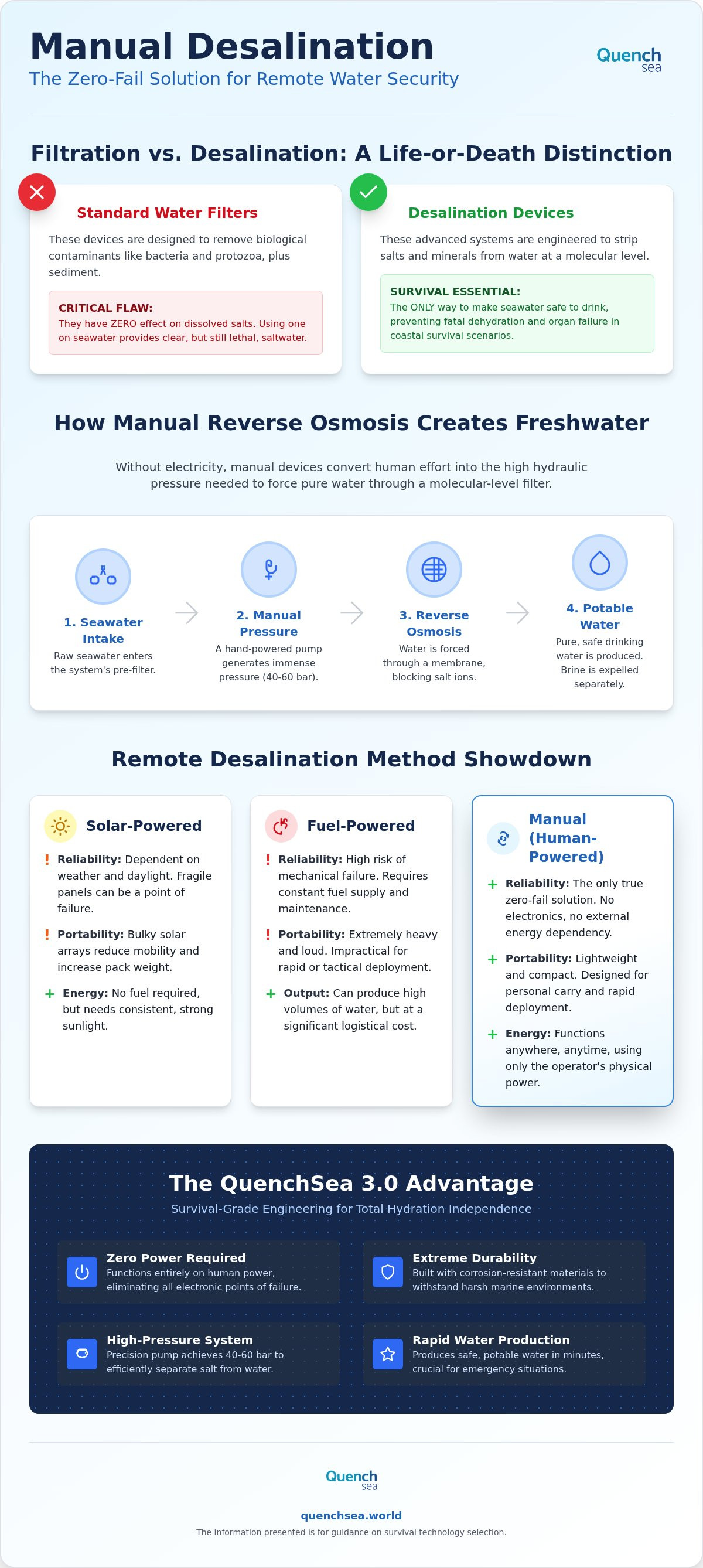
A desalination device for remote areas is a specialized engineering solution built to convert seawater into life-sustaining freshwater in environments stripped of infrastructure. It isn't a luxury. It's a survival-grade necessity for any mission profile where the local water source is high in salinity. While standard water filters target biological contaminants and sediment, these devices tackle the much harder task of removing dissolved salts and minerals. This distinction is the difference between hydration and fatal dehydration.
True water security in isolated environments requires a power-agnostic approach. You can't rely on a fragile power grid or heavy fuel supplies when you're miles from the nearest outpost. Modern desalination technology focuses on mechanical integrity and portability. This allows disaster relief teams, defense units, and coastal explorers to establish a reliable water source without bringing a generator or a solar farm. Whether it's a post-hurricane landscape or a tactical operation on a remote coastline, the goal remains the same: safe, potable water on demand.
The Core Technology: Reverse Osmosis vs. Distillation
Reverse osmosis (RO) is the gold standard for portable desalination. It works by forcing saltwater through a semi-permeable membrane at high pressure. This membrane acts as a molecular sieve. It blocks salt ions and larger molecules while allowing pure water molecules to pass through. It's incredibly efficient for field use because it doesn't require the massive thermal energy needed for distillation.
Distillation involves boiling water and collecting the steam. This process is effective but slow and energy-intensive. While Solar desalination technologies provide a viable path for stationary off-grid homes, they often lack the portability required for rapid deployment. RO systems provide a higher volume of water with a much smaller hardware footprint. This makes them the preferred choice for anyone who needs to move fast and stay hydrated.
Why Standard Filters Aren't Enough
The biological "Rule of 3" is unforgiving: you can survive three weeks without food, but only three days without water. In coastal environments, the ocean looks like a solution, but it's a trap. Drinking seawater causes your body to expel more water than it takes in to process the salt. This leads to rapid organ failure. Standard carbon, ceramic, or hollow-fiber filters are designed to catch bacteria and protozoa. They have zero effect on salt. They'll give you clear saltwater, but it will still kill you.
Desalination is the only way to break this cycle. You need a device capable of overcoming osmotic pressure to strip the salt from the liquid. If you don't understand the physiological risks, you're unprepared for the field. You can read more about the specific risks in our guide on Why is Drinking Sea Water Dangerous?. Relying on a simple hiking filter in a marine environment is a critical mistake that survival-grade hardware is designed to prevent.
How Remote Desalination Works Without Electricity
Electricity is a luxury you can't always afford. In the field, batteries die and solar panels break. A manual desalination device for remote areas eliminates these technical vulnerabilities by replacing circuitry with human effort. You provide the energy. The device provides the mechanical advantage. Manual reverse osmosis is a process of forcing water through a membrane using physical leverage. This method converts physical work directly into hydraulic pressure, bypassing the need for complex energy conversion.
Engineering for high-salinity intake requires extreme durability. Standard pumps fail because salt crystals and grit act like sandpaper on internal seals. Survival-grade units use reinforced mechanical pumps designed to handle the abrasive nature of raw seawater. Pre-filtration plays a critical role here. By stripping out sediment and organic matter before they reach the high-pressure stage, you extend the life of the RO membrane. It’s about protecting the core of the system to ensure long-term reliability off-grid in remote areas.
The Mechanics of a Hand-Powered Pump
Achieving the 40 to 60 bar of pressure required for reverse osmosis is a significant mechanical challenge. It demands precision engineering and high-ratio leverage. Without this pressure, the salt ions won't separate from the water molecules. Material science is equally vital. Every internal component must be made from corrosion-resistant materials like high-grade plastics or specialized alloys. Saltwater destroys inferior metals in days. For a deeper look at the technical requirements, consult our guide on Emergency Reverse Osmosis: A Survival Guide.
Maintenance in the Field
Reliability depends on consistent upkeep. In remote operations, you don't have access to a workshop. You need tool-free maintenance. Operators must be able to swap filters or inspect seals using only their hands. One critical task is "pickling" the membrane. This involves using a preservative solution to prevent biofouling when the device is idle. Without it, bacteria can grow inside the membrane and ruin it. Monitoring Total Dissolved Solids (TDS) levels ensures the output remains safe for long-term consumption. If you need a solution that works every time, consider adding a hand-powered water maker to your emergency kit.
Comparing Desalination Methods for Remote Deployment
Selecting a desalination device for remote areas requires a cold-eyed assessment of logistical reality. You have three primary categories of technology: solar-powered, fuel-driven, and manual. Each offers a different balance of output and independence. Fuel-powered units provide high volume but create a dangerous dependency on supply lines. If the gasoline or diesel runs out, your water production hits zero. Solar units offer renewable energy, but they rely on clear skies and complex circuitry that can fail in high-humidity or high-salinity environments. Manual units represent the baseline of survival engineering. They work whenever you do.
A "Failure Point" analysis is mandatory before any deployment. You must ask: what happens when the primary power source is lost? In a tactical or emergency scenario, the most expensive electronic unit becomes dead weight if its battery bank fails or a circuit board shorts. This is why the cheapest manual unit often proves more efficient in the field than a high-cost automated system. Reliability isn't just a feature; it's the primary metric for success in isolated environments where repair services don't exist.
Manual vs. Solar Desalination
Solar systems carry significant hidden bulk. You aren't just deploying a pump. You're managing fragile panels, charge controllers, and heavy battery banks. This weight adds up, making rapid movement difficult. Operational limits are also a factor. Solar efficiency drops to near zero during night-time or sub-optimal weather. A manual desalination device for remote areas remains operational 24/7, regardless of the forecast. Many professional teams now adopt a hybrid strategy. They use solar for high-volume production during the day but maintain manual units as a fail-safe backup for critical needs.
Logistics of Rapid Deployment
Rapid deployment demands hardware that fits in a standard pack or a suitcase-sized crate. Humanitarian aid groups prioritize "last-mile" survival where heavy infrastructure cannot reach. You can explore these specific requirements in our guide on Disaster Relief Water Supply: Tactical Solutions. Defense forces face similar challenges, requiring low-signature, high-durability tools that survive rough handling and extreme temperatures. For those operating in these high-stakes environments, we've detailed the latest Military Water Purification Portable solutions that prioritize mechanical integrity over electronic complexity.
Strategic Selection: Choosing Your Remote Water Solution
Selecting a desalination device for remote areas is a calculated decision based on four critical variables. You must first define your mission profile. An individual survivor has different requirements than a tactical team or a displaced community. A single operator needs portability; a group needs volume. Second, you must assess your environmental conditions. High salinity levels demand higher pressure, while high turbidity requires advanced pre-filtration to prevent membrane clogs. Third, evaluate your transport constraints. Weight limits and ruggedness requirements dictate whether you carry a manual unit or a larger, crated system. Finally, determine the potability standard required. Emergency survival allows for higher TDS levels than long-term humanitarian operations. The #1 selection factor for any remote water solution is the availability of a reliable power source.
If you lack a guaranteed fuel supply or consistent sunlight, your choice is already made. Mechanical simplicity becomes your only path to success. You cannot risk a mission on the hope that a battery will hold its charge or a circuit board won't corrode. Secure your water security by choosing hardware that relies on your own physical effort rather than external infrastructure. For those ready to deploy, you can order the QuenchSea 3.0 to ensure your team has a zero-fail water source in the field.
Assessing Water Volume Needs
Hydration requirements shift based on activity levels. Basic survival rations start at approximately two liters per day, but operational hydration for active teams in tropical environments can exceed six liters per person. You must calculate the man-hours of pumping required to meet these needs. If a manual device produces four liters of freshwater per hour, one operator can provide a full day's supply for a four-man team with roughly ninety minutes of physical effort. Managing brine discharge is also a factor in sensitive coastal areas. While portable units produce small volumes, you should always discharge brine back into moving water to minimize local environmental impact.
Durability and Environmental Resilience
Remote environments are hostile to hardware. Your device must withstand constant salt-spray, intense UV exposure, and high-impact handling. Survival-grade engineering avoids "off-the-shelf" components that aren't rated for marine use. No-battery designs excel here because they are immune to the capacity loss caused by extreme heat or the total failure caused by sub-zero temperatures. If your mission involves maritime travel, consult our Portable Water Maker Marine: The 2026 Guide for specific hardware recommendations tailored to open-water survival.
QuenchSea 3.0: The Zero-Fail Desalination Device
The QuenchSea 3.0 is the definitive solution for water security in environments where infrastructure is non-existent. It is a survival-grade tool built for one purpose: converting seawater into potable freshwater without the need for external power. While electronic systems fail due to salt corrosion or battery depletion, this 100% manual desalination device for remote areas relies entirely on mechanical leverage. It is a zero-fail asset for marine safety, defense operations, and disaster relief. You provide the physical effort, and the device provides the hydraulic pressure necessary for reverse osmosis. This eliminates the logistical nightmare of transporting heavy water rations or maintaining complex solar arrays.
Reliability is the only metric that matters when survival is at stake. The QuenchSea 3.0 delivers high-quality water at the lowest cost per liter by removing the need for fuel or electricity. It is engineered to perform in the harshest coastal conditions, providing a predictable and sustainable water source for individuals and tactical teams. By focusing on mechanical integrity rather than digital complexity, we've created a device that works in total isolation. It is not just a backup; it is a primary tool for autonomy in the field.
Engineered for Extreme Environments
The 3.0 model is the result of rigorous iterative design. We incorporated direct feedback from defense organizations and NGOs to refine every internal component. The result is a simplified, high-output system that produces freshwater in minutes. It features a compact footprint designed to fit into life rafts, tactical bags, and emergency kits without compromising on durability. Key features include:
- Hand-powered reverse osmosis: No batteries, solar panels, or fuel required.
- Simplified operation: Designed for non-technical users in high-stress situations.
- Robust construction: Reinforced housing built to withstand impact and salt spray.
- High-efficiency membranes: Optimized for maximum salt rejection and flow rate.
Integrating QuenchSea into Your Preparedness Plan
Every coastal survival kit or off-grid setup needs a manual RO backup. Electronic water makers are efficient until they short-circuit or lose power. The QuenchSea 3.0 provides the redundancy required for long-term survival. Beyond individual preparedness, this technology has a massive humanitarian impact. It offers an affordable way to provide clean water for the "last mile" of disaster relief where supply lines are broken. It empowers operators to produce water on-site, reducing dependency on external aid. This is the ultimate tool for those who prioritize readiness and mechanical certainty.
Secure your water independence with QuenchSea 3.0 and ensure you have a reliable freshwater source in any environment.
Establish Your Hydration Autonomy
Reliability in the field isn't an option; it's a requirement. You've seen why mechanical simplicity outperforms electronic complexity in harsh environments. By removing dependencies on solar panels, fuel, and batteries, you eliminate the most common points of failure. A manual desalination device for remote areas ensures that your water security remains entirely within your control. This shift toward survival-grade hardware provides the certainty needed for defense missions, disaster relief, and off-grid coastal survival.
The QuenchSea 3.0 represents this zero-fail philosophy. It uses manual RO technology that requires zero batteries and is already trusted by defense and humanitarian organizations worldwide. With survival-grade durability engineered for extreme coastal environments, it provides a predictable freshwater source wherever you deploy. Don't leave your hydration to chance or fragile circuitry. Focus on what works when everything else fails.
Equip your remote operation with QuenchSea 3.0 and take the first step toward total water independence. Stay prepared, stay hydrated, and stay operational.
Frequently Asked Questions
Can a desalination device for remote areas work without any electricity?
Yes. Manual desalination technology uses human-powered mechanical leverage to drive the reverse osmosis process. The QuenchSea 3.0 requires zero batteries, fuel, or solar input to function. This design eliminates the single point of failure common in electronic systems, ensuring you have a reliable water source even when the power grid is non-existent.
How much water can a manual desalination device produce per hour?
Output varies based on the operator's pumping rhythm and the water's temperature. A high-efficiency manual unit typically produces approximately 4 to 6 liters of freshwater per hour. This volume provides enough hydration to sustain a small tactical team or a family unit in a survival situation without requiring excessive physical exertion.
Is the water from a portable desalination unit safe to drink immediately?
The water is safe for immediate consumption if the device is functioning correctly. Reverse osmosis membranes are engineered to strip away over 99% of dissolved salts and biological contaminants. While the process is highly effective, professional operators often use a TDS meter to verify that the output meets safe drinking water standards before distribution.
How long does the reverse osmosis membrane last in a remote desalination device?
A membrane can process thousands of liters if it's maintained properly. Its lifespan depends heavily on the quality of the intake water and the consistency of pre-filtration. Using a desalination device for remote areas with a dedicated pre-filter prevents sediment from reaching the membrane, which is the primary way to extend the hardware's operational life.
Does a portable water maker work for brackish water or only seawater?
It functions effectively on both. Brackish water contains lower salt concentrations than seawater, which means it requires less osmotic pressure to desalinate. When you use the device on brackish sources, you'll notice a higher flow rate and significantly less resistance during the pumping cycle, making the process faster and easier.
What happens if the desalination device gets clogged with sand or debris?
Pumping resistance will increase and the flow of freshwater will slow down. Survival-grade units use replaceable pre-filters to catch sand and organic matter before they enter the high-pressure pump. If a clog occurs, tool-free maintenance allows you to swap the pre-filter or clear the intake line in the field without specialized equipment.
Is manual desalination too hard for a single person to operate in a survival situation?
It's designed for single-person operation. Engineering improvements in the 3.0 model focus on mechanical advantage and leverage ratios to ensure an adult can pump for extended periods. While it requires physical work, the effort is manageable even in high-stress environments, allowing one person to provide water for an entire group.
How do I store a desalination device when it's not being used in a remote area?
You must flush the system with freshwater and use a preservative solution to "pickle" the membrane. This prevents biofouling and keeps the membrane from drying out while idle. Proper storage in a cool, dry environment ensures the seals and mechanical components remain ready for immediate deployment when the next mission begins.