

Your trusted hollow-fiber backpacking filter will fail completely the moment it meets seawater. You already know the brutal reality of coastal survival: you can stand beside millions of gallons of water and still face lethal dehydration within days. Standard micro-filters only trap physical bacteria, letting dissolved salt pass directly through. Heavy electric water makers aren't the answer either, as they're far too fragile and power-hungry for an emergency pack. To overcome extreme salinity, you need a true survivalist ocean water filter that operates with zero reliance on batteries or the grid.
Can a manual emergency filter genuinely make ocean brine potable? Yes, if you leverage the correct hydraulic physics. This guide will show you how manual reverse osmosis works and help you select a dependable, non-electric seawater survival filter for your emergency kit. We'll examine the mechanical pressure required to separate salt ions, evaluate hardware against realistic physiological demands, and review field-ready systems engineered for worst-case survival logistics.
Key Takeaways
- Standard hollow-fiber survival filters fail against ocean salinity because dissolved sodium ions are hundreds of times smaller than microfiltration pores.
- Generating manual hydraulic pressure above 50 bar is mechanically essential to force seawater across a semi-permeable reverse osmosis membrane.
- Selecting an effective survivalist ocean water filter requires balancing hourly output against the user's physical exertion and caloric expenditure.
- Correct field deployment demands anchoring the pump body securely and keeping intake pre-filters clear of abrasive surf sand.
- Field-ready hardware like the QuenchSea 3.0 delivers reliable off-grid desalination without reliance on batteries, fuel, or solar power.
Why Standard Survival Filters Cannot Make Ocean Water Drinkable
Many outdoor enthusiasts pack standard hollow-fiber filters and assume they are ready for any coastal emergency. That assumption is fatal. Mainstream outdoor filters rely on physical microfiltration to strain contaminants out of freshwater. They excel at trapping biological threats, but they cannot alter salinity. Relying on a standard backpacking unit instead of a true survivalist ocean water filter leaves you holding pure, pathogen-free poison.
Pore Size Realities: Hollow Fiber vs. Reverse Osmosis
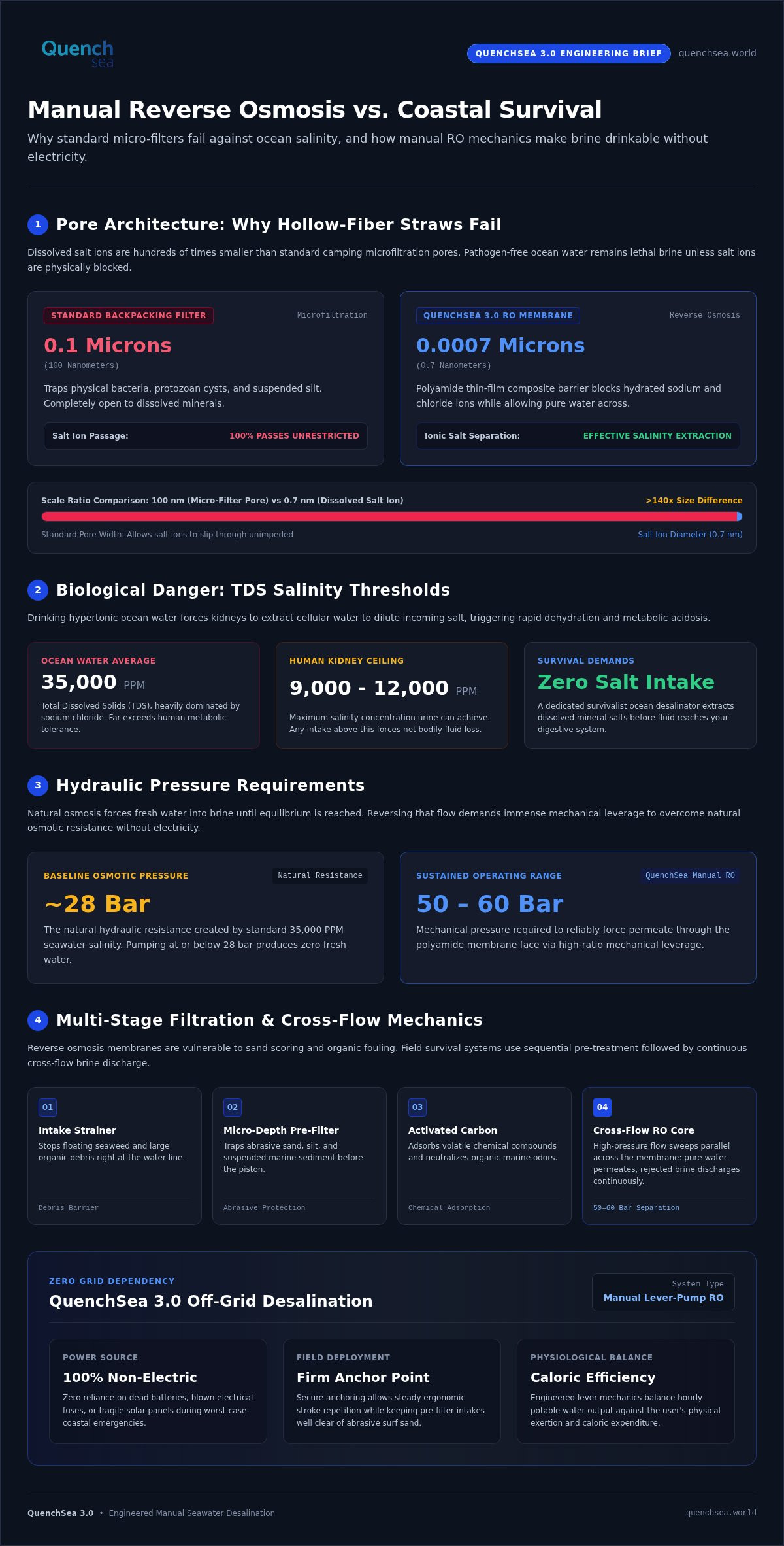
Pore architecture dictates what passes through a filter media. A typical camping filter uses hollow-fiber tubes with pores measuring approximately 0.1 microns (100 nanometers). That physical barrier easily traps bacteria, protozoan cysts, and suspended silt.
Dissolved minerals operate on an entirely different scale. Hydrated sodium and chloride ions measure roughly 0.0007 microns (0.7 nanometers). A 0.1-micron pore is more than one hundred times too large to stop dissolved salt ions. The brine passes straight through the fiber walls without restriction. Removing dissolved salt requires reverse osmosis. Rather than basic surface sieving, this process forces pressurized fluid across a dense polyamide thin-film composite membrane that blocks ionic minerals while allowing pure water molecules to cross.
The Fatal Biology of Drinking Saline Water
Straining sediment and microbes from seawater does not make it safe. Seawater averages 35,000 parts per million (ppm) of Total Dissolved Solids (TDS), dominated by sodium chloride. Human kidneys can only produce urine with a maximum salinity of roughly 9,000 to 12,000 ppm TDS.
Understanding why is drinking sea water dangerous comes down to basic cellular osmosis. When you drink hypertonic brine, your bloodstream salt concentration spikes. Your body must draw water directly out of your cells to dilute the salt load so your kidneys can flush it. You eliminate more fluid than you absorb. This triggers rapid cellular dehydration, metabolic acidosis, and rapid kidney failure. A functional survivalist ocean water filter prevents this lethal spiral by extracting dissolved minerals before the water enters your body.
How Manual Reverse Osmosis Works in Survival Desalinators
Converting raw ocean brine into drinkable water without an electrical grid is a demanding engineering challenge. As documented by the U.S. Geological Survey, desalination separates dissolved mineral salts from water molecules. In an off-grid crisis, a survivalist ocean water filter replaces motorized pumps with mechanical leverage to achieve this molecular separation.
Overcoming Seawater Osmotic Pressure Without Electricity
Natural osmosis forces diluted water toward higher salt concentrations until equilibrium is reached. Reversing that flow requires applying force that exceeds the baseline osmotic pressure of seawater. At standard ocean salinity (roughly 35,000 ppm TDS), that resistance starts near 28 bar. Generating consistent permeate output requires sustained mechanical pressure between 50 and 60 bar.
Manual desalinators achieve this extreme force through high-ratio mechanical levers. Long pump handles translate repetitive arm strokes into immense hydraulic pressure within a compact piston chamber. This non-electric architecture eliminates reliance on dead batteries, blown fuses, or fragile solar panels during a disaster.
The Role of Multi-Stage Sediment and Carbon Pre-Filtration
High-pressure reverse osmosis membranes are vulnerable to surface fouling. Ocean water carries sand, microplastics, and organic phytoplankton that can permanently score dense polymer barriers. Rugged survival systems deploy multi-stage pre-filters to stop this damage before the high-pressure chamber:
- Intake strainers: Stop floating seaweed and large debris at the water line.
- Micro-depth pre-filters: Trap abrasive sand, silt, and suspended marine sediment.
- Activated carbon: Adsorbs volatile chemical compounds and neutralizes organic marine odors.
Cross-Flow Membrane Filtration and Brine Discharge Mechanics
Unlike standard freshwater straw filters that trap contaminants inside dead-end chambers, manual RO systems operate via cross-flow filtration. Pressurized raw seawater sweeps parallel across the membrane face. A fraction of pure water molecules punches through the thin-film composite layers to exit as drinking permeate. The remaining fluid sweeps across the surface, carrying rejected salt crystals away through a continuous brine discharge valve.
This scouring action prevents immediate mineral scaling on the membrane surface. With salt rejection rates reaching 98%, these units slash 35,000 ppm marine brine down to less than 500 ppm TDS. If your emergency plan involves coastal bug-out routes, securing a dedicated manual desalination system provides complete hydrologic independence.
Selecting an Ocean Water Filter: Critical Survival Criteria
Surviving along a coastline requires calculated gear selection. While standard public health guidance on Making Water Safe in an Emergency focuses on boiling and disinfection to kill microbes, coastal survival demands hardware engineered specifically for ionic separation. A practical survivalist ocean water filter must balance mechanical output against human physiology.
Caloric Expenditure vs. Freshwater Hourly Output
Pumping against 50 bar of pressure demands physical work. In a high-stress coastal survival situation, every calorie burned accelerates sweat loss and dehydration. If an inefficient pump requires 400 calories of exertion to yield half a liter of freshwater, you enter a negative metabolic loop.
Target a unit with a long-throw lever and optimized hydraulic geometry. A functional baseline for an adult is two to three liters of potable water per day. Efficient mechanical stroke leverage ensures you reach that volume in under an hour of steady operation without causing severe muscle exhaustion or heat illness.
Packability, Weight, and Mobile Bug-Out Readiness
Field equipment must fit your actual transit plan. Preparing for bug out bag water desalination means cutting dead weight without sacrificing mechanical strength. Marine life-raft ditch kits and overland rucksacks cannot support bulky twenty-pound devices.
- Weight threshold: Keep the core device close to one kilogram, never exceeding three kilograms.
- Form factor: Prioritize slim, tubular profiles that slip into side pockets or lash directly to exterior pack webbing.
- Accessory footprint: Ensure intake lines, discharge tubes, and pre-filter housings pack inside a dedicated modular sheath.
Corrosion Resistance and Marine Hardware Integrity
Saltwater destroys cheap hardware. Within forty-eight hours of ocean exposure, inferior metals pit, seize, and crack under high internal pressure. Look for housings built from impact-modified, food-grade polymers that resist ultraviolet degradation and mechanical drops on rocky coastlines.
Moving internals must use marine-grade stainless hardware or composite materials immune to galvanic corrosion. Intake tubes must resist kinking when draped across sharp shoreline rocks, and the intake strainer must carry sufficient ballast to stay submerged beneath breaking surface froth. When hardware integrity fails in the surf zone, your survivalist ocean water filter becomes useless dead weight.
Field Deployment Protocol: Operating a Non-Electric Desalinator
Field success depends on discipline. Even the most robust survivalist ocean water filter will fail if you pump straight churning surf sand into its intake manifold. Operating manual reverse osmosis hardware demands methodical setup, steady pacing, and proactive membrane care.
Sourcing Seawater and Managing Surf-Zone Turbidity
Never drop your intake line directly into crashing beach breakers. Suspended quartz sand, micro-debris, and frothy surface scum will choke your pre-filters within minutes. Instead, locate calmer, deep water along rocky outcroppings or protected tidal pools.
When sandy shoreline access is your only option, use a settling container. Scoop seawater into an emergency dry bag, bucket, or deep container and let it rest undisturbed for ten to fifteen minutes. The heavy grit will drop to the bottom. Submerge your weighted intake strainer halfway into this settled reservoir, well above the sediment layer and below any surface oily film.
Pumping Cadence and Maintaining Operating Pressure
Rhythm is critical. To maintain the continuous hydraulic force needed to breach the osmotic threshold, establish a mechanical anchoring base first. Step firmly on the foot plate or brace the pump frame against stable rock or a life-raft thwart.
- Target cadence: Maintain a steady tempo of 30 to 40 full strokes per minute.
- Stroke depth: Complete full-length strokes to maximize fluid displacement across the membrane surface.
- Avoid erratic pauses: Pausing drops chamber pressure instantly below 50 bar, immediately stopping permeate production.
- Operator posture: Engage your core and lats rather than relying solely on your forearms to avoid joint strain and blisters.
Post-Use Flushing and Membrane Preservation Protocols
Stagnant saltwater is lethal to reverse osmosis elements. When seawater sits inside a dormant chamber, salt crystals precipitate onto the dense polymer sheets, cutting microscopic tears through the membrane layers. Anaerobic bacteria and organic marine matter will decompose rapidly, generating foul biofilms.
Always pump a few hundred milliliters of pure freshwater product through the housing as a final flush before packing the gear away. If you plan to store the unit inside an emergency cache for several months, flush the system with an approved biocidal storage solution to prevent biological growth. To secure a proven, field-ready survivalist ocean water filter engineered for brutal coastal conditions, equip your emergency kit with QuenchSea today.
QuenchSea 3.0: Engineered Manual Desalination for Extreme Survival
When selecting a dependable survivalist ocean water filter, theoretical performance must give way to proven mechanical execution. The QuenchSea 3.0 represents a modern leap in off-grid hydration engineering. It delivers manual reverse osmosis desalination without relying on electricity, external batteries, solar cells, or liquid fuel. It converts hyper-saline ocean water into life-saving drinking water using pure human leverage.
Hardware Architecture and Non-Electric Performance
The system is built around a reinforced mechanical pump handle engineered to maximize mechanical advantage. By optimizing stroke geometry, the lever minimizes shoulder and wrist fatigue while easily generating the intense internal pressure required to reverse natural osmosis.
Raw seawater passes through an integrated triple-stage filtration array before reaching the core reverse osmosis element. An intake screen blocks coarse debris, a micro-depth pre-filter strips abrasive marine silt, and an activated carbon stage captures organic matter and unpleasant ocean odors. The pressurized fluid then strikes an industrial-grade polyamide thin-film composite membrane. This high-efficiency barrier delivers steady freshwater production, reliably yielding 5 to 8 liters per hour with a 98% salt rejection rate that reduces TDS below the World Health Organization threshold of 1,000 ppm.
Mission-Critical Deployment in Coastal Survival Kits
Weighing only 1.1 kilograms, the QuenchSea 3.0 is built for rapid deployment across high-stakes environments. It fits into marine life-raft ditch boxes, coastal bug-out rucksacks, military survival kits, and emergency disaster response caches. The housing uses impact-modified, corrosion-proof composites that shrug off saltwater exposure and rough handling on rocky coastlines.
For deep tactical planning, review our comprehensive survival desalination device guide to align field readiness with realistic hydration needs. You can also inspect the dedicated QuenchSea 3.0 Desalination Device guide for complete mechanical breakdowns.
Offshore sailors, defense operators, and survivalists no longer need to carry heavy multi-thousand-dollar motorized systems to secure safe drinking water on open water. Check order options and technical specifications directly to integrate field-proven desalination into your personal survival gear.
Secure Your Coastal Hydration Independence
Freshwater micro-filters will leave you stranded and dehydrated on a coastline. Surviving an open-water emergency demands high-pressure molecular separation capable of stripping out lethal dissolved sodium ions. When motorized desalinators fail due to drained batteries or electrical shorts, manual leverage remains your sole dependable defense. Packing a verified survivalist ocean water filter turns an unforgiving ocean from a hazard into an accessible lifeline.
The QuenchSea 3.0 solves coastal hydration logistics by converting raw seawater into safe drinking water without electricity, batteries, or fuel. Engineered with triple-stage filtration to protect its marine-grade RO membrane, its lightweight, field-portable architecture packs cleanly into life rafts, ditch bags, and coastal bug-out kits. Prepare your logistics before you find yourself surrounded by brine. Secure your non-electric QuenchSea 3.0 desalinator for emergency ocean hydration and face any coastal scenario with calm, technical confidence.
Frequently Asked Questions
Can standard survival straw filters remove salt from ocean water?
No, standard survival straw filters cannot remove dissolved salt. Camping straw filters rely on hollow-fiber microfiltration membranes with pore sizes around 0.1 microns. Dissolved sodium and chloride ions are molecularly tiny, measuring roughly 0.0007 microns. The salt ions bypass the hollow fibers effortlessly, yielding hypertonic seawater that remains lethal to drink.
How much physical effort is required to pump a manual ocean water desalinator?
Pumping requires moderate, consistent physical effort similar to operating a bicycle floor pump against high resistance. Because you must generate roughly 50 to 60 bar of hydraulic force to reverse osmotic pressure, modern survival desalinators use long mechanical leverage handles. Engaging your core and back muscles rather than just your arms makes the sustained cadence manageable without rapid physical fatigue.
What happens if you drink seawater purified only with a camping water filter?
Drinking that water accelerates fatal systemic dehydration. While the camping filter removes bacteria and parasites, it leaves the 35,000 ppm mineral salinity untouched. Your kidneys must draw stored water from bodily tissues to dilute and excrete the excess sodium load. You lose more fluid through urination than you consume, quickly inducing hallucinations, kidney failure, and death.
How long does a reverse osmosis membrane last in a survival desalination device?
A reverse osmosis membrane can last through years of intermittent survival use if properly rinsed and stored. The primary threats are physical abrasives and biofouling. Using multi-stage pre-filters to stop quartz silt and flushing the unit with clean permeate after operation preserves the thin-film composite structure. Unflushed membranes left with stagnant brine can suffer mineral scaling or bacterial decay within days.
Can a manual seawater filter be used to purify muddy freshwater rivers?
Yes, but you should only do so with proper settling and pre-filtration precautions. A survivalist ocean water filter will remove both river pathogens and heavy industrial contaminants. Extremely turbid river mud can rapidly clog the fine sediment pre-filters, however. Always let river water settle in a container first so coarse sediment drops before you draw fluid through the intake line.
Is maintenance required on a survival ocean water filter after emergency use?
Immediate post-use maintenance is essential to protect internal tolerances. You must flush the system with fresh water to clear trapped brine from the high-pressure chamber. Stagnant salt water precipitates destructive crystals that puncture the dense membrane layers. For long-term emergency cache storage exceeding several weeks, treating the chamber with an approved biocidal preservation solution prevents anaerobic biological mold.
How much drinking water can an emergency desalinator produce per hour?
A manual survivalist ocean water filter like the QuenchSea 3.0 delivers 5 to 8 liters of potable freshwater per hour under continuous pumping. This volume comfortably exceeds the baseline human physiological requirement of two to three liters daily. That output gives you enough pure water to sustain yourself while sharing hydration reserves across a life-raft crew or survival team.