

Mechanical simplicity is the ultimate survival redundancy. In a marine emergency, your sophisticated electronics are often the first things to fail. Saltwater and circuitry don't mix. You shouldn't bet your life on a battery or a cloudless sky. A portable hand powered desalination device represents the only truly infinite water source that functions independently of external power. It's the bridge between a dire situation and survival.
We understand the fear of being stranded with a dead water maker and a dwindling supply of bottles. Relying on bulky gear that takes up too much room in a life raft is a risk you can't afford. This 2026 guide reveals how manual reverse osmosis technology provides a reliable, non-electric backup for fresh water. You'll learn how to secure 5 to 8 liters of potable water every hour using nothing but human power. We'll examine the engineering behind the QuenchSea 3.0, its triple filtration system, and how it achieves a 98% salt rejection rate to meet World Health Organization standards. It's time to pack confidence in your grab bag.
Key Takeaways
- Eliminate the risk of electrical failure by integrating a manual reverse osmosis system as your primary survival redundancy.
- Master the mechanics of the QuenchSea 3.0, which utilizes triple pre-filtration and 60 bar of pressure to generate 5-8 liters of water hourly.
- Ensure your water meets WHO safety standards with a portable hand powered desalination device capable of 98% salt rejection.
- Evaluate the low-maintenance advantages of mechanical units over complex electric water makers for long-term offshore reliability.
- Prepare for critical scenarios ranging from life raft survival to coastal disaster relief with compact, high-output gear that fits in a grab bag.
The Engineering of Survival: What is a Portable Hand Powered Desalination Device?
Survival in a marine environment demands a calculated approach to hydration. A portable hand powered desalination device is a specialized mechanical Reverse Osmosis (RO) system that operates entirely on manual pressure. Unlike standard water filters that rely on gravity or low-pressure suction, these devices use a high-pressure pump to force seawater through a semi-permeable membrane. This process strips away dissolved salts, minerals, and pathogens at a molecular level. By 2026, the industry standard for a portable hand powered desalination device involves a weight of under 2kg and a footprint compact enough for a standard emergency grab bag.
Why Standard Survival Filters Fail in Seawater
Many travelers carry hollow fiber filters thinking they're prepared for any water source. This is a dangerous misconception. Standard filters are designed to trap biological contaminants like bacteria and protozoa. They have no effect on dissolved salt. If you use a basic filter on ocean water, you're still drinking brine. This is why drinking sea water is dangerous for the human body. The high salinity triggers osmotic pressure that pulls moisture out of your cells, accelerating dehydration rather than preventing it. True survival-grade gear must include a desalinator to ensure the output is actually potable.
Manual vs. Electric: The Redundancy Argument
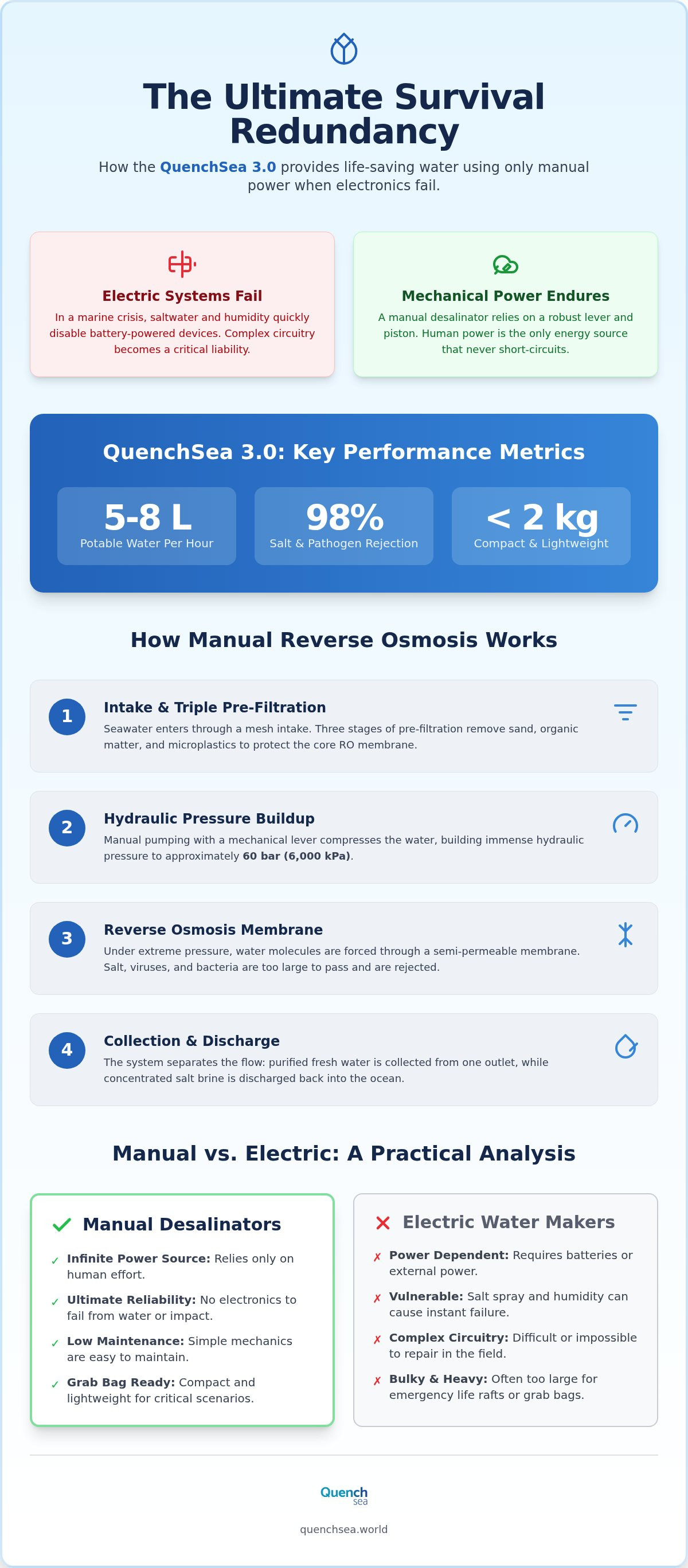
Electrical systems are the first casualties in a maritime crisis. Salt spray, humidity, and physical impact can instantly disable battery-powered water makers. When you're in a life raft, complex circuitry becomes a liability. A manual desalinator eliminates these points of failure. It relies on a mechanical lever, a robust piston, and human effort. It's a utilitarian solution for high-stakes environments. Human power is the only energy source that doesn't run out or short-circuit. Adopting a survival-grade mindset means prioritizing mechanical integrity over automation. You don't want a device that thinks for you; you want a device that works when you pump it. Reliability isn't a luxury. It's a requirement.
How Manual Reverse Osmosis Works Without Electricity
Operating a portable hand powered desalination device requires an understanding of fluid dynamics and mechanical advantage. Traditional desalination plants rely on massive electric pumps to overcome osmotic pressure. In a survival scenario, you replace those turbines with a simple lever and your own physical effort. The process is a linear sequence of mechanical events designed to strip minerals from water at a molecular level. The logistical deployment of portable desalination plants in disaster zones proves that mechanical reliability is the primary factor in survival success.
- Step 1: Intake and Triple Pre-filtration. Seawater enters the system through a mesh intake. It passes through multiple stages of sediment and micro-filtration to remove sand, organic matter, and microplastics.
- Step 2: Hydraulic Pressure Buildup. Manual pumping compresses the water. This builds hydraulic pressure to approximately 60 bar (6,000 kPa). This specific pressure level is the "tipping point" required to overcome the natural osmotic pressure of seawater.
- Step 3: Membrane Filtration. Under this extreme pressure, water molecules are forced through a semi-permeable membrane. Salt, viruses, and bacteria are too large to pass and are rejected at the molecular level.
- Step 4: Collection and Discharge. The system separates the flow. Purified fresh water flows through one outlet while the concentrated salt brine is discharged back into the ocean through a separate waste line.
The Role of Triple Filtration in Membrane Longevity
The Reverse Osmosis (RO) membrane is the most sensitive component of the device. Suspended solids and abrasive particles can "foul" or tear the membrane surface, rendering it useless. Survival-grade units utilize a tiered filtration approach. Ultra-filtration and micro-filtration stages act as a shield, ensuring the output is pathogen-free before the water even reaches the RO stage. By removing abrasive particles before they reach the core, the triple pre-filtration system effectively doubles the operational lifespan of the QuenchSea 3.0 RO membrane. Protecting this core component is essential for long-term off-grid utility.
Understanding Energy Recovery Systems
Generating 60 bar of pressure through hand power alone sounds exhausting. Modern engineering solves this through hydraulic energy recovery. These systems recycle the high-pressure brine that would otherwise be wasted. By redirecting this energy back into the pumping cycle, the mechanism reduces the physical effort required by up to 40%. This makes it possible for an average adult to maintain a steady output for extended periods. Leveraging physics allows the user to produce life-saving hydration without suffering from rapid fatigue. Investing in a QuenchSea 3.0 ensures you have this mechanical advantage when every drop counts.
Manual Desalinators vs. Traditional Water Makers: A Practical Analysis
Fixed water makers are engineered for comfort. Manual desalinators are engineered for survival. While a yacht’s modular electric system can produce 15 to 30 liters per hour, it relies on a complex web of high-voltage pumps, sensors, and plumbing. A portable hand powered desalination device operates on a different philosophy: mechanical independence. It provides a reliable backup at a fraction of the cost and weight of fixed systems. In a crisis, the ability to produce 5 to 8 liters of water per hour without drawing a single amp from your house batteries is the difference between a manageable situation and a catastrophe.
Maintenance is where the practical divide becomes most apparent. Traditional water makers require frequent "pickling" with chemicals during periods of non-use to prevent membrane fouling. They also involve intricate seal replacements and motor servicing. In contrast, manual units require minimal upkeep. They are designed to sit in a grab bag for years and function immediately when deployed. For offshore sailors, this makes the device an essential component of a life raft water supply. It occupies a tiny footprint, weighs less than 2kg, and replaces the need for hundreds of pounds of emergency plastic water bottles.
Rationing vs. Production: The Survival Math
The average human requires approximately 2 to 3 liters of water daily to maintain cognitive and physical function in a marine environment. Using a portable hand powered desalination device, a survivor can produce this entire daily requirement in roughly 30 minutes of pumping. This shifts the survival strategy from rationing a finite, stagnant supply to active production. Produced water is always superior to stored water. It hasn't been sitting in a plastic tank for months, and it can't be lost to a single leak or puncture in a storage bladder. For long-distance sailors, this production capability allows for a drastic reduction in heavy water tankage, improving vessel performance and safety.
Durability in Extreme Marine Conditions
Survival gear must withstand the most corrosive environment on earth. The 2026 standard for high-end manual units involves the use of medical-grade stainless steel and reinforced polymers. These materials are impervious to salt spray and UV degradation. Operation in rough seas is a core design requirement, not an afterthought. The devices feature ergonomic grips and stable bases that allow for efficient pumping even on the unstable floor of a life raft. By following a "no extra parts" philosophy, these units minimize the risk of losing critical components in high-stress situations. Every element is integrated, ensuring the system remains functional when conditions are at their worst.
Choosing Your Device: From Life Rafts to Coastal Survival Kits
A portable hand powered desalination device isn't just a last resort. It's a tactical asset for anyone operating in high-risk coastal environments. While many see these units as emergency-only gear, experienced offshore racers and coastal explorers view them as primary tools for water security. Whether you're navigating the Southern Ocean or preparing for a flood event in a coastal city, the ability to generate water without electricity is non-negotiable. It's about maintaining mobility and independence when infrastructure fails.
For offshore cruising, a manual unit is a mandatory redundancy that satisfies rigorous safety standards. In disaster relief, flooded coastal zones often lose access to municipal water, making decentralized production vital. Coastal cabins and remote research stations also benefit from a sustainable, non-fuel-dependent water source. Integrating this technology into a bug out bag water desalination strategy ensures that your mobility isn't limited by the weight of the water you can carry. You stop being a scavenger and become a producer.
Evaluating Output vs. Effort
Efficiency is the only metric that matters in a survival situation. You must look for a device that produces at least 4 liters per hour to justify the physical energy expenditure. If the output is too low, you'll burn more calories and lose more moisture through sweat than you gain from the device. Ergonomic handle design is critical. A poorly designed lever causes rapid fatigue and physical strain. Integrating desalination into a daily survival routine, such as pumping for 20 minutes every morning and evening, ensures a steady supply without causing exhaustion. This disciplined approach keeps you hydrated and focused on other survival tasks.
Portability and Storage Requirements
Weight is the enemy of the coastal explorer. A survival unit must be light enough to carry in a backpack for miles without causing fatigue. Look for devices that offer vacuum-sealed packaging for long-term storage. This protects the internal seals and the RO membrane from humidity and salt air until the moment of use. For detailed gear integration tips, consult our survival desalination device pillar. Choosing a compact, high-output unit ensures you're prepared for the worst without being weighed down by your gear.
Secure your water independence today by choosing the QuenchSea 3.0 for your emergency kit.
QuenchSea 3.0: The New Standard for Portable Desalination in 2026
QuenchSea 3.0 represents the peak of mechanical survival engineering. It's currently the highest output manual unit in its class. The device generates 5 to 8 liters of fresh water every hour through sheer mechanical advantage. This performance is achieved without batteries, solar panels, or fuel. It relies on a refined, high-pressure hydraulic system that generates the 60 bar of pressure required for reverse osmosis. 98% salt rejection ensures every drop meets WHO potability standards instantly. It's a rugged, ultra-compact solution for extreme environments where electronics fail.
The design serves a dual purpose. It's a tactical necessity for yachtsmen and a vital asset for disaster relief water supply efforts. When infrastructure collapses, this portable hand powered desalination device provides a localized, immediate water source. It removes the logistical nightmare of transporting heavy water pallets to remote coastal zones or flooded areas. By decentralizing water production, it empowers survivors to maintain their own hydration independently of external aid. It's about providing a mechanical solution to a biological necessity.
The QuenchSea 3.0 Advantage
Reliability depends on membrane protection. The 3.0 model utilizes a sophisticated triple filtration system that includes micro-filtration and ultra-filtration stages. This barrier stops sediment, organic matter, and microplastics from fouling the RO core, even in turbid coastal waters. Even in high-stress crises, this portable hand powered desalination device remains accessible to everyone. Clear pictorial instructions are etched directly onto the unit to ensure immediate use. This allows untrained individuals to operate the pump correctly within seconds of deployment. The 3.0 model incorporates extensive crowdfunding feedback to reinforce structural pivot points and enhance overall mechanical durability. It's built to withstand years of rigorous use.
A Global Lifeline Strategy
We view this technology as more than just a piece of survival gear. It's a humanitarian tool designed for global impact. Our mission is to deploy 100 million devices by 2035 to combat water scarcity. This ambitious goal addresses the global water crisis in developing coastal regions where fresh water is a disappearing resource. We've stripped away the unnecessary to focus on what truly works at scale. Every purchase directly funds the distribution of clean water solutions to communities facing extreme water scarcity. You're not just buying a backup for your boat; you're supporting a global lifeline.
Secure your QuenchSea 3.0 for your next offshore voyage.
Master the Mechanics of Coastal Survival
Hydration is the foundation of survival. You've seen how mechanical simplicity beats complex electronics in high-stakes marine environments. By integrating a portable hand powered desalination device into your gear, you replace fear with technical confidence. You aren't just carrying a backup; you're carrying a Red Dot Design Award winner engineered for the harshest conditions on earth. It's a tool that requires no electricity and no fuel, ensuring you stay operational when everything else fails.
The QuenchSea 3.0 delivers 5 to 8 liters of fresh water per hour with a 98% salt rejection rate. It meets WHO standards instantly. This isn't a luxury gadget. It's a utilitarian lifeline for offshore sailors and disaster relief professionals alike. Don't wait for a crisis to test your redundancies. Take command of your water security and prepare for the unpredictable reality of the open ocean.
Equip your vessel with the QuenchSea 3.0 manual desalinator today. You have the power to turn the ocean into a limitless resource. Stay prepared.
Frequently Asked Questions
Is the water produced by a hand-powered desalinator safe to drink immediately?
Yes, the output is safe for immediate consumption. The QuenchSea 3.0 achieves a 98% salt rejection rate, which brings typical seawater well below the 1,000 TDS threshold. This performance meets World Health Organization (WHO) standards for potability. The integrated triple filtration system ensures that biological contaminants and suspended solids are removed before the water reaches your cup. You don't need additional chemicals or boiling to ensure safety in a crisis.
How much physical effort is required to operate a manual desalination device?
Operating a portable hand powered desalination device requires consistent physical effort but is engineered for maximum efficiency. The QuenchSea 3.0 uses a long-stroke lever to maximize mechanical advantage. An internal energy recovery system recycles hydraulic pressure, reducing the required pumping force by approximately 40%. An average adult can maintain the 5 to 8 liters per hour output without reaching total exhaustion. It's designed for sustained use in life rafts.
How long does the reverse osmosis membrane last in a portable unit?
Membrane lifespan depends on water quality and consistent maintenance. Under standard conditions, a QuenchSea 3.0 membrane processes thousands of liters before requiring replacement. The integrated triple pre-filtration system is your primary defense, catching sediment that would otherwise cause premature fouling. If you store the unit long-term, you must "pickle" the membrane with a preservative solution. Regular use and proper rinsing with fresh water after every session significantly extend its operational life.
Can a manual desalinator work with brackish water or only seawater?
It works effectively with both seawater and brackish water. Brackish water has a lower salt concentration than the 35,000 ppm typical of the open ocean. This means the device actually operates with less physical resistance when processing brackish sources. The reverse osmosis process remains the same, stripping out dissolved minerals and contaminants. Whether you're in a flooded coastal zone or a salt marsh, the device provides a reliable source of fresh water.
What is the maintenance routine for a QuenchSea 3.0 device?
Maintenance focuses on cleanliness and membrane preservation. After every use, rinse the system with fresh water to remove residual brine. This prevents salt crystallization within the internal valves and seals. For storage exceeding two weeks, you must use a preservative solution to prevent bacterial growth on the RO membrane. Periodically inspect the intake mesh and replace pre-filters when they become discolored. These simple steps ensure the device remains survival-ready for years.
Does the device remove microplastics and viruses from the ocean water?
Yes, the system provides comprehensive filtration. The QuenchSea 3.0 uses a multi-stage approach to water quality. The pre-filters trap microplastics and larger organic sediment. The reverse osmosis membrane then acts at the molecular level. Because RO pores are significantly smaller than the diameter of viruses and bacteria, these pathogens are rejected and discharged in the brine stream. This ensures the output is not just desalinated, but biologically safe for human consumption.
Can I use a portable desalinator while on a moving boat or life raft?
Absolutely. This portable hand powered desalination device is specifically engineered for unstable marine environments. It features a rugged, compact footprint that allows for operation in the confined, moving space of a life raft or a pitching deck. The intake hose is long enough to remain submerged while the pump is secured between your feet. Its mechanical nature means it isn't affected by the motion or salt spray that typically disables electronic gear.
What happens if the intake filter gets clogged with seaweed or sand?
Clogging causes increased resistance and a noticeable drop in water output. The QuenchSea 3.0 includes a primary mesh intake designed to be easily cleared. If you're operating in turbid water, simply pull the intake hose and rinse the mesh in the ocean to clear debris. The internal triple filtration system provides additional protection, trapping smaller particles before they reach the RO membrane. Regular monitoring of the intake ensures the system maintains its peak performance.