

Imagine your vessel's electrical system goes dark 200 miles offshore, rendering your primary watermaker useless as the tropical sun begins to bake the deck. High stakes. Every drop counts. You already understand that freshwater is your most critical asset, yet selecting the right marine survival gear water options often feels like a finite countdown against space and weight constraints. Relying solely on bulky pouches is a gamble against time.
This guide empowers you to master a professional offshore hydration strategy. You'll learn how to evaluate emergency hardware objectively and secure a virtually unlimited supply of freshwater without relying on electrical power. We'll analyze the latest 2026 SOLAS requirements, compare the weight-to-yield efficiency of modern desalination devices, and demonstrate how manual reverse osmosis provides the mechanical redundancy every offshore voyager needs. From grab bag essentials to long-term survival physics, this is your blueprint for hydration reliability.
Key Takeaways
- Identify the physiological triggers of maritime dehydration and why seawater ingestion is a critical tactical error.
- Compare marine survival gear water solutions to determine the optimal balance between static rations and active production.
- Quantify the space and weight advantages of manual reverse osmosis over traditional emergency water pouches.
- Establish a ruggedized protocol for ditch bag integration, ensuring your hydration hardware survives catastrophic vessel failure.
- Secure a reliable freshwater source that operates independently of electrical power, batteries, or external fuel.
The Physiology of Offshore Survival: Why Water Is Your First Priority
Survival at sea is a race against metabolic exhaustion. While most boaters focus on life jackets and flares, the most immediate biological threat is the loss of fluid. Marine survival gear water isn't just a regulatory checkbox; it's a life-critical asset that dictates your cognitive and physical limits. The ocean environment is aggressively hostile to human fluid balance. Constant exposure to sun, wind-chill, and saltwater spray accelerates moisture loss through the skin and lungs. Without a reliable hydration strategy, your survival window closes faster than you expect.
The Rule of Threes and Ocean Hydration Dynamics
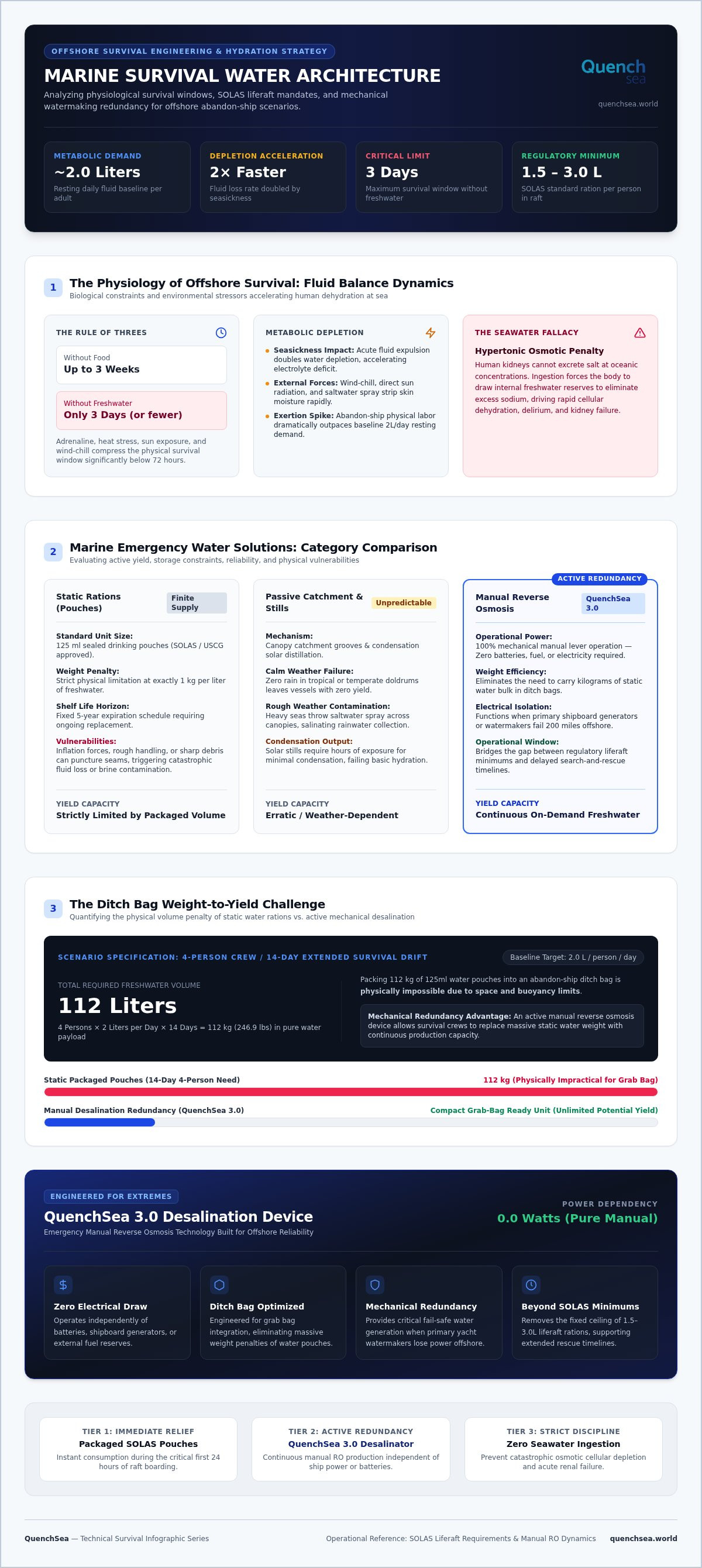
Survival logic follows the Rule of Threes. You can survive three weeks without food, but only three days without freshwater. In offshore conditions, this window often shrinks. Seasickness is the primary threat to your fluid reserves. Rapid fluid loss through vomiting doubles the rate of depletion, leading to electrolyte imbalances and cognitive decline within hours. While a resting metabolic rate requires roughly two liters of water daily, the physical exertion of an abandon-ship scenario spikes that demand. Heat stress and the adrenaline of an emergency move your body into a deficit that static rations struggle to fill.
The Fatal Fallacy of Drinking Seawater
Desperation often leads to the most dangerous survival myth: drinking seawater. This is a biological death sentence. Human kidneys aren't engineered to process the high salt concentration found in the ocean. To flush out the excess sodium, your body must expend more freshwater than it consumed from the brine itself. This hypertonic intake creates an osmotic pressure penalty that triggers rapid cellular dehydration and eventual kidney failure.
Understanding the desalination process at a cellular level reveals why humans can't survive on untreated seawater. For a biological deep-dive into these medical consequences, see our guide on why is drinking sea water dangerous. Historical lore suggesting small amounts of saltwater are safe is objectively false. It only accelerates the timeline to delirium and death.
Current SOLAS regulations mandate 1.5 to 3 liters of water per person in liferafts. This is a survival minimum, not a comfort level. If search-and-rescue operations are delayed by weather or distance, these rations disappear quickly. Relying solely on static marine survival gear water supplies creates a hard ceiling on your survival duration. You need a way to generate fresh water actively to bridge the gap between regulatory minimums and the physical reality of extended drift scenarios. Biology doesn't negotiate. Neither should your gear choices.
Marine Survival Water Gear Categories: Evaluating Your Options
Selecting marine survival gear water systems requires a balance between weight, volume, and production capability. Relying on a single static water source endangers offshore crews. If that single asset fails, punctures, or runs out, your survival timeline drops to hours. A resilient vessel architecture demands a multi-tiered approach that combines immediate consumption options with active production capability. Let's evaluate the primary categories of emergency water gear available to modern mariners.
Packaged Survival Water Pouches and Cans
Standard survival craft rely heavily on SOLAS and USCG approved 125ml drinking water pouches. These products carry a strict 5-year expiration schedule and offer excellent immediate utility. However, the weight-to-volume penalty is severe. Water weighs 1 kilogram per liter. Packing a two-week supply for a four-person crew into an abandon-ship ditch bag is physically impossible due to space constraints. Physical vulnerabilities present another critical risk. Rough handling, life raft inflation forces, or sharp objects can puncture seams, leading to total fluid loss or catastrophic saltwater contamination.
Passive Rainwater Catchment and Solar Stills
Many inflatable offshore life rafts feature canopy catchment grooves designed to channel rainwater into collection tubes. While useful in theory, passive systems are entirely dependent on erratic weather patterns. If you are stranded in tropical or temperate doldrums, calm weather means zero rainfall. Conversely, rough weather introduces heavy seas, coating the raft canopy in sea spray and rendering the collected water too salty to drink. Passive solar stills present a similar yield problem. They take hours to produce minimal condensation, failing to meet the baseline hydration requirements of an active adult.
Manual Reverse Osmosis Desalinators
Active mechanical desalination represents the ultimate off-grid safeguard. Manual reverse osmosis technology utilizes physical leverage to force seawater through a semi-permeable membrane, stripping away salts and contaminants. These devices operate completely independently of batteries, 12V or 24V yacht electrical busses, and liquid fuels. When a total power failure knocks out your primary vessel systems, manual pumping keeps you alive.
Integrating a reliable, non-electric survival desalination device into your grab bag ensures you can generate freshwater indefinitely. For offshore voyagers seeking this level of hardware-focused redundancy, exploring a dedicated manual desalinator like the QuenchSea 3.0 Desalination Device provides the necessary mechanical backup when primary vessel systems suffer a catastrophic failure.
Comparing Survival Water Solutions: Static Rations vs Active Production
Choosing marine survival gear water comes down to one metric: duration. Static rations provide a fixed safety net, while active production offers a path to long-term endurance. A solo sailor might manage with a heavy ditch bag for 48 hours, but a fully crewed yacht facing a multi-day drift scenario will quickly exhaust packaged supplies. When evaluating marine survival gear water for offshore voyages, you must account for the exponential payload advantage of active production over fixed volume storage.
- Static Pouches: 5-year shelf life; extreme weight-to-yield ratio; finite supply limited by initial pack volume.
- Rainwater Catchment: Zero additional weight; entirely weather dependent; high risk of saltwater contamination in heavy seas.
- Manual RO Units: Low hardware weight; infinite yield potential; completely independent of weather, batteries, or vessel power.
The Payload Equation: Weight vs Output Capacity
Logistics at sea are governed by the physics of weight. Freshwater has a density of 1 kilogram per liter. Packing 10 liters of water into a grab bag adds exactly 10 kilograms of dead weight, occupying significant volume that could be used for medical supplies or signaling gear. In contrast, a manual desalinator weighing less than 3 kilograms provides virtually unlimited freshwater output, delivering 5 to 8 liters per hour through mechanical force. In survival scenarios, weight saved in payload represents life-saving margin. By replacing bulk water with a mechanical device, you increase your survival duration while decreasing the physical burden of your emergency gear.
Operational Reliability During Extended Drift Scenarios
International search and rescue drift models often assume a 72-hour response window, yet real-world conditions frequently exceed these standard international response timelines. When fixed rations run low, crews enter a state of severe starvation rationing. This isn't just a matter of thirst; it's a threat to mission-critical decision making. Dehydration triggers lethargy and impaired judgment, preventing you from performing essential tasks like raft maintenance or effective signaling. Integrating a mechanical production strategy into your life raft water supply ensures your cognitive performance remains sharp. You stop counting remaining ounces and start focusing on rescue, maintaining the physical strength required to survive an extended drift.
Ditch Bag Integration: Equipping Your Emergency Marine Watermaker
Owning survival hardware is only half the battle. In a chaotic abandon-ship scenario, your marine survival gear water strategy relies entirely on how effectively you integrate that equipment into your ditch bag. You need a protocol that ensures immediate access and operational stability in heavy seas. A disorganized grab bag leads to lost components and wasted energy. Every piece of hydration hardware must have a dedicated, secured position within your emergency kit.
Ditch Bag Packing and Access Hierarchy
Position your manual desalination gear strategically. It should sit directly beneath high-priority signaling devices like EPIRBs and flares. Store the unit in a high-visibility, waterproof, and buoyant dry bag. Attach a dedicated marine lanyard to this bag; this allows you to secure it to your person or the raft during the vessel transfer. Co-locate all necessary peripherals in the same compartment. This includes spare intake pre-filters, the primary lever or handle, and flexible collection vessels. If you have to search for a small filter in the dark, you've already lost the tactical advantage.
Operating a Manual Desalinator Inside a Life Raft
Operating a mechanical device in a confined, pitching environment requires precision. Establish a stable pumping stance. Brace your body against the raft floor or tubes to minimize unnecessary energy expenditure. Be cautious with the hardware's hard edges. You must avoid puncturing the inflatable tubes at all costs. Rig the intake hose carefully. Use a pre-filter weight to keep the intake deep enough to avoid surface hydrocarbon slicks or floating debris. Position the intake away from raft ballast pockets to prevent entangling lines or clogging the membrane with trapped sediment.
Hygienic collection is paramount. Even a few drops of saltwater can ruin a liter of freshly produced water. Keep your output hose and collection vessel shielded from sea spray. Tether all survival water hardware directly to the raft chassis using high-strength cordage. If the raft capsizes, your water source must stay with the craft. Before your next offshore passage, conduct a dry-run training session with your crew. Familiarity with the pumping rhythm and hose rigging reduces panic when the situation turns critical. You don't want to learn the mechanics of your gear while you're drifting.
Prepare your vessel for total power failure by securing a field-deployable hydration solution. You can equip your grab bag with the QuenchSea 3.0 today to ensure your crew has unlimited freshwater access regardless of the environment.
Engineered for Extremes: The QuenchSea 3.0 Desalination Device
The QuenchSea 3.0 Desalination Device represents a fundamental shift in emergency hardware. While legacy systems are often heavy, expensive, or reliant on fragile electronics, this unit is engineered for pure mechanical reliability. It serves as a mission-critical component of marine survival gear water strategies, providing a bridge between catastrophic vessel failure and rescue. By removing the variables of battery life and electrical integrity, it places the power of freshwater production directly in your hands.
Mechanical Architecture and Saltwater Filtration
At the core of the device is a high-pressure hydraulic system designed to overcome osmotic pressure through manual force. The human-powered lever system generates up to 60 bar of pressure, driving seawater through a high-performance reverse osmosis membrane. To protect this membrane from premature fouling, the unit utilizes a robust triple-stage pre-filtration system. This sequence removes suspended solids, pathogens, microplastics, and parasites before the water reaches the final desalination stage.
The lever drive is optimized for smooth, fatigue-reducing operation, allowing a single user to maintain a consistent output of 5 to 8 liters per hour. This engineering focus ensures that even under the stress of a survival scenario, freshwater production remains a manageable task rather than an exhausting chore. For a technical deep-dive into the specifications and performance metrics, read our comprehensive QuenchSea 3.0 Desalination Device review.
Marine Safety Protocol and Voyage Readiness
Modern offshore safety protocols must evolve beyond simple compliance. Relying on limited static water rations is a passive strategy that leaves you vulnerable to search-and-rescue delays. Integrating the QuenchSea 3.0 into your vessel's safety inventory transforms your emergency preparedness into an empowered response. It is mandatory gear for offshore racing, coastal cruising, and transoceanic crossings where professional help may be days away.
Eliminating the hard ceiling of a fixed water supply provides immediate peace of mind. You no longer have to calculate the "end date" of your survival rations; instead, you maintain a sustainable, infinite yield as long as you can operate the lever. This level of hardware-focused redundancy is the only way to secure your hydration during a total vessel power outage. Don't leave your survival to chance or weather patterns. Equip your ditch bag with the QuenchSea 3.0 Desalination Device and secure your freshwater independence before you leave the dock.
Secure Your Offshore Freshwater Independence
Survival at sea is a calculation of resources against time. You've learned that relying on static rations creates a hard limit on your endurance, while seawater ingestion only accelerates the biological countdown. True preparedness requires a shift from passive storage to active mechanical production. By prioritizing lightweight, high-yield hardware, you eliminate the severe weight-to-volume penalty of traditional water pouches. Modern marine survival gear water strategies demand a tier-one redundancy that operates entirely outside your vessel's electrical grid.
The transition from a vulnerable passenger to an empowered survivor begins with your grab bag. The QuenchSea 3.0 Desalination Device converts raw ocean seawater into clean, drinkable water using 100% manual mechanical power. It's engineered specifically for extreme marine survival and seamless life raft integration. This hardware removes reliance on boat electrical systems and limited water rations, ensuring your hydration remains sustainable regardless of vessel condition. Take command of your safety protocol before you cross the horizon. Equip your marine survival ditch bag with the QuenchSea 3.0 Desalination Device and sail with the confidence of total freshwater autonomy.
Frequently Asked Questions
Can you drink sea water if you filter it through a standard outdoor water filter?
No, you cannot. Standard outdoor filters are designed for freshwater environments and lack the technology to remove dissolved salts. They target biological contaminants like bacteria and protozoa but let sodium ions pass through. Drinking seawater filtered through these devices still subjects your kidneys to lethal osmotic pressure. Only a reverse osmosis membrane can physically strip the salt from the brine to create potable water.
How much freshwater does an adult need per day in a life raft?
A sedentary adult in a survival craft requires a minimum of 1.5 liters of freshwater daily to maintain basic biological functions. However, extreme heat or seasickness significantly increases this demand. While SOLAS regulations mandate specific rations per person, these are survival minimums rather than comfort levels. Access to marine survival gear water that produces 5 to 8 liters per hour ensures you can meet these needs without depleting finite stores.
What is the shelf life of packaged emergency drinking water rations?
Most USCG and SOLAS approved emergency water pouches have a standardized shelf life of 5 years. This duration is dictated by the durability of the multi-layer packaging material rather than the water itself. You must inspect these rations annually for burst seams or leaks caused by temperature fluctuations and physical abrasion. Replacing these supplies every five years is a mandatory safety protocol for any offshore vessel or life raft.
How does a manual reverse osmosis watermaker work without electricity?
These devices utilize manual mechanical force to drive seawater through a semi-permeable membrane. By using a lever or handle, you create the high pressure required to overcome the natural osmotic pressure of saltwater. The system forces water molecules through microscopic pores while blocking larger salt ions and contaminants. This process requires zero batteries or fuel, relying entirely on the physical leverage provided by the human operator to generate freshwater.
What makes manual desalinators better than carrying extra water jugs in an abandon-ship bag?
The primary advantage is the infinite yield-to-weight ratio. Water weighs 1 kilogram per liter, making large storage jugs impractical for a portable ditch bag. A manual desalinator weighs less than 3 kilograms but can produce hundreds of liters over its operational lifespan. This hardware transforms your survival strategy from a finite countdown into a sustainable loop. It frees up critical space in your grab bag for medical supplies and communication equipment.
Can you use a manual desalination device in heavy seas or turbulent weather?
You can operate a manual desalinator in heavy seas, provided the unit and operator are properly secured. Success depends on tethering the device to the raft chassis to prevent it from being lost overboard during a capsize. You must also weight the intake hose so it remains submerged beneath the surface turbulence. Staying low in the raft and using a stable pumping stance helps maintain output while minimizing the risk of raft damage.
How do you prevent saltwater from contaminating your fresh drinking water inside a life raft?
Prevention requires a strict separation of intake and output lines. Ensure the intake hose is deployed on the leeward side of the raft, away from the freshwater collection area. Use a dedicated, clean vessel for the product water and shield it from sea spray using the raft canopy. Even a few drops of saltwater can ruin a liter of fresh water, so maintain a clean workspace and dry your hands before handling the output hose.