

Your high-capacity electric desalination system is a miracle of engineering until the batteries die. In a total power failure or a forced abandon-ship scenario, that expensive hardware becomes dead weight. You already understand that hydration is the non-negotiable foundation of the survival hierarchy. Yet, many offshore sailors still rely on bulky, finite water rations that won't last a week in a life raft. Finding a reliable offshore water maker that functions independently of your boat's grid is the difference between a controlled emergency and a catastrophe.
It's a stressful reality to face, but preparing for the worst-case scenario provides the ultimate peace of mind for long-range crossings. This guide will show you how to build a 2026 emergency kit that prioritizes weight efficiency and mechanical reliability. You'll learn why manual reverse osmosis is the most critical component for your survival. We will examine the technical specs of portable units, like the QuenchSea 3.0, and explain how to maintain a fail-safe hydration strategy when every drop counts.
Key Takeaways
- Master the maritime survival hierarchy to ensure your preparation focuses on the most life-critical needs first.
- Compare the vulnerabilities of electric systems against the mechanical reliability of a manual offshore water maker for emergency use.
- Use our technical checklist to verify that your desalination gear meets the rigorous standards required for high-salinity seawater.
- Optimize your ditch kit by calculating the weight-saving advantages of infinite water production over finite, heavy water pouches.
- Discover why the QuenchSea 3.0 is the definitive hardware choice for sailors who prioritize independence from vessel power.
The Offshore Survival Hierarchy: Where Hydration Fits
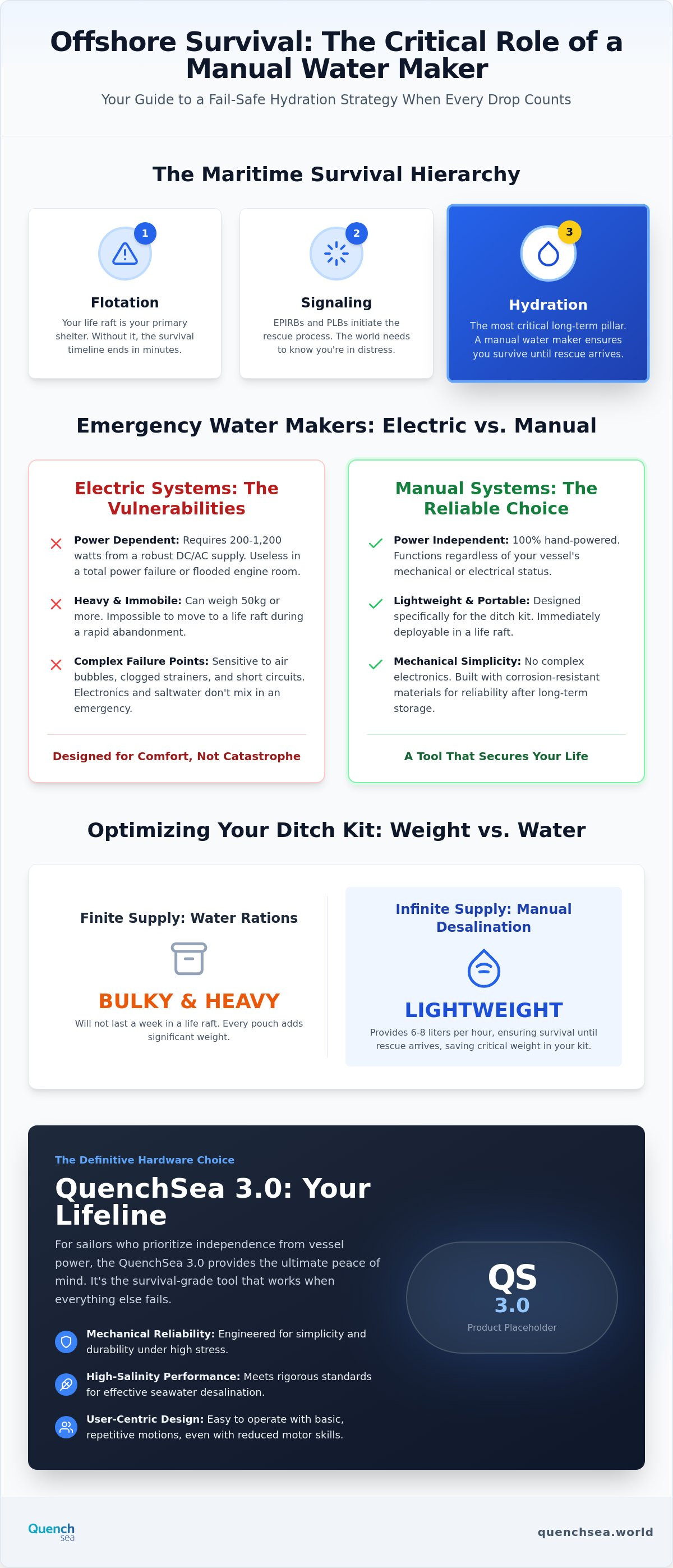
Survival at sea is a calculated progression of priorities. It begins with buoyancy. Without a life raft, the timeline ends in minutes. Once you're out of the water, the focus shifts to signaling. If the world doesn't know you're missing, your survival window is finite. The third and most critical long-term pillar is hydration. This is where an offshore water maker transitions from a luxury boat system to a life-sustaining necessity. While flotation keeps you alive for the first hour, water keeps you alive for the first month.
Establishing a hierarchy of needs helps sailors strip away the noise of gear catalogs and focus on mission-critical hardware. When you're building a 2026 emergency kit, the order of operations is clear:
- Flotation: Your life raft is your primary shelter.
- Signaling: EPIRBs and PLBs initiate the rescue process.
- Hydration: A manual RO device ensures you survive until that rescue arrives.
The Rule of 3s in a Marine Environment
The standard Rule of 3s dictates that a human can survive three hours without shelter in extreme environments and three days without water. At sea, these timelines compress. Salt spray and wind accelerate fluid loss through the skin and lungs. Dehydration isn't just a physical threat; it's a cognitive one. As your body loses water, your decision-making abilities erode. You become prone to errors in navigation or signaling. In a life raft, a clear mind is your most valuable asset. Without it, the rest of your gear is useless.
Drinking seawater is a fatal mistake. The high salt content forces your kidneys to use more water to process the salt than you actually consume. This triggers a rapid biological demand that pulls water out of your organs to compensate. Understanding the desalination process is vital for every blue water sailor. A manual water maker stops the cycle of dehydration before it starts, providing the 6-8 liters per hour necessary to maintain health and mental clarity.
Defining Survival-Grade Equipment
In a ditch-kit scenario, "survival-grade" has a specific mechanical definition. It refers to gear that operates independently of the vessel's primary systems. If your engine room is flooded, your 12V or 24V electric pumps are useless. An offshore water maker intended for a ditch kit must be hand-powered, lightweight, and immediately deployable. It's the difference between a system that serves your comfort and a tool that secures your life.
Reliability requires mechanical simplicity. Electronic complexity creates failure points. Saltwater is a relentless corrosive agent; therefore, survival gear must utilize materials like high-grade polymers and stainless steel to resist seizing after months of storage in a damp locker. It must also be easy to operate. Under high stress, your fine motor skills fail. A survival-grade tool should require only basic, repetitive motions to produce results. It's about stripping away the non-essential to focus on what works when everything else fails.
Evaluating Offshore Water Makers: Electric vs. Manual
Installed electric water makers are engineering triumphs for daily cruising. They deliver high-volume output for showers, dishwashers, and laundry. However, these systems are anchored to the boat's infrastructure. In a survival situation, that dependency is a liability. You must distinguish between your primary desalination system, designed for comfort, and your secondary offshore water maker, designed for survival. One requires a functioning engine room; the other requires only a pair of hands.
The technical divide between these two categories comes down to power and portability. A fixed marine unit can weigh 50kg or more. It's impossible to move during a rapid abandonment. Conversely, a manual device is built for the ditch kit. It's lightweight, modular, and ready for immediate deployment in a life raft. While an electric unit might produce 60 liters per hour, it produces zero if your batteries are submerged. A manual unit provides 100% availability regardless of your vessel's mechanical status.
The Failure Points of Electric Systems
Electric desalination relies on a complex chain of components. Marine water makers typically draw between 200 and 1,200 watts. This requires a robust DC or AC power supply. If the engine room floods, the electrical heart of the boat dies instantly. Short circuits and battery depletion are common in heavy seas, precisely when you need resources most. Even if power remains, high-pressure pumps are sensitive. A single air bubble in the intake line or a clogged sea strainer can shut down the entire desalination process. These are single points of failure that you can't afford when land is a thousand miles away.
The Reliability of Hand-Powered Desalination
Hand-powered units replace electrical complexity with mechanical simplicity. Your muscle becomes the infinite power source. You don't need fuel, solar panels, or a generator. The trade-off is lower throughput, but survival isn't about luxury. It's about meeting biological minimums. A high-quality manual device produces 6 to 8 liters of fresh water per hour. This is more than enough to sustain a full crew in a life raft. Because these units use fewer consumables, they don't require the frequent "pickling" or chemical maintenance that plagues larger systems during periods of inactivity.
Choosing the right hardware ensures you aren't left vulnerable when the grid goes dark. For sailors who prioritize redundancy, the QuenchSea 3.0 serves as the ultimate fail-safe backup to primary electric systems. It fits into a standard offshore ditch kit, weighing less than 2kg, and provides a portable solution that goes wherever you go. In the hierarchy of survival, a manual RO device is the only hydration tool that offers total independence from your boat's failing systems.
Technical Checklist for a Survival-Grade Water Maker
Selecting survival gear isn't about brand loyalty. It's about engineering thresholds. When your vessel is behind you and the horizon is empty, your offshore water maker must perform to a specific technical standard. If the device fails to meet these benchmarks, it's just extra weight in your ditch kit. A survival-grade unit must be built to withstand the chemical aggression of the ocean while remaining simple enough for an exhausted sailor to operate.
Your technical checklist should prioritize four critical engineering factors:
- TDS Rating: The membrane must be rated for seawater Total Dissolved Solids (TDS), which typically exceeds 35,000 ppm. Freshwater or brackish membranes will fail instantly in the open ocean.
- Weight Limit: Total unit weight shouldn't exceed 2kg. You might be injured or managing the raft with one hand. Portability is a life-saving feature during a rapid abandonment.
- Pre-filtration: Integrated sediment filters are mandatory. They catch silt and organic matter before they reach the main RO membrane, preventing premature clogging and membrane damage.
- Material Integrity: Demand non-corrosive polymers and 316 marine-grade stainless steel. Saltwater destroys inferior metals in days. Your gear must be immune to this environment.
Understanding the RO Membrane
Reverse osmosis is a game of pressure. To desalinate seawater, you must overcome its natural osmotic pressure, which is roughly 800 psi. The reverse osmosis process uses mechanical force to push water through a semi-permeable membrane. In a manual offshore water maker, your arm provides this force. High-quality membranes maximize output while minimizing the physical effort required to move the piston. This efficiency is what allows a manual unit to produce 6 to 8 liters of fresh water per hour.
Shelf life is the hidden variable in survival gear. Many membranes require "pickling" or wet storage to remain viable. For a ditch kit, look for units with membranes designed for long-term sealed storage. You don't want to discover a dried-out, cracked membrane when you're three days into a survival situation. Verify the manufacturer’s recommended replacement interval for sealed units to ensure your gear remains mission-ready.
Ergonomics and Operation
Fatigue is a silent killer in life rafts. If a device requires excessive force, you won't be able to produce enough water to stay hydrated. Look for ergonomic leverage in the pump handle. A well-designed unit allows for a 30-minute pumping session without causing muscle failure or blisters. The mechanical advantage should feel consistent throughout the stroke, allowing you to maintain production even when your energy levels are low.
Maintenance must be tool-free. You won't have a workshop or a socket set in a rubber raft. Every component, from the intake hose to the filter housing, should be accessible and serviceable by hand. Finally, consider mounting. An unstable raft makes traditional pumping difficult. Units that offer secure mounting points or tethering options allow you to maintain a steady rhythm even in heavy swells, ensuring a consistent flow of life-saving water.
Integrating Manual Desalination into Your Ditch Kit
Your ditch kit is a compromise between space, weight, and survival necessity. Every kilogram added to the bag increases the difficulty of a rapid evacuation. Traditional emergency water storage relies on heavy, finite pouches that offer no long-term security. Integrating a manual offshore water maker into your survival gear fundamentally shifts this equation, replacing bulk with capability. It's a logistics problem that requires a mechanical solution.
Weight is the enemy of the life raft. Carrying twenty liters of water adds twenty kilograms to your payload, creating a significant drag on buoyancy. In contrast, a manual desalinator weighs approximately 1kg. The break-even point occurs in less than twenty-four hours. By opting for a mechanical solution, you reclaim nineteen kilograms of weight and significant locker volume. This allows you to pack more signaling gear, medical supplies, or thermal protection without exceeding your raft's payload limits.
Production vs. Storage: The Math of Survival
The math of hydration is unforgiving. Twenty liters of water is barely enough to sustain a crew of four for three days. Once those pouches are empty, your survival window closes. An offshore water maker provides infinite production, which removes the psychological paralysis of watching a water supply dwindle. This shift in mindset allows the crew to focus on rescue rather than rationing. It transforms a desperate situation into a manageable one.
Collecting seawater from a life raft requires specific logistics. You must ensure the intake hose remains clear of the raft's floor and away from any potential contaminants near the hull. Most survival-grade units feature long, weighted intake lines to reach clean water below the surface. This setup ensures that the water entering the system is as clear as possible, protecting the internal membranes from premature clogging. Space optimization isn't just about what you pack; it's about the efficiency of the tools you choose.
Best Practices for Ditch Kit Hydration
Deploying a desalinator in a high-stress environment requires preparation. We recommend a hybrid approach. Carry twenty-four hours of water rations to provide immediate hydration while you manage the initial shock of abandonment. Once the situation stabilizes, transition to manual desalination. This strategy preserves your physical energy during the most critical first hours of survival.
- Storage: Keep the unit in a waterproof, buoyant container. It must be tethered to the ditch kit or the raft itself.
- Training: Every crew member must practice the pumping rhythm. High-stress situations degrade motor skills; muscle memory ensures production continues even in the dark. To further enhance your maritime safety expertise, you can learn more about Scubadeep's PADI certification courses designed for offshore preparedness.
- Electrolytes: Reverse osmosis produces high-purity water. Combine this with electrolyte tablets to replace minerals lost through sweat and exposure.
- Inspection: Check intake hoses and seals every six months. Salt air can degrade rubber components over time if they aren't properly stored.
Reliability is a choice made at the dock, not in the raft. If you're ready to upgrade your emergency preparedness, you can order the QuenchSea 3.0 to secure your crew's hydration for your next crossing. Proper integration of this hardware ensures that your ditch kit is a tool for survival, not just a bag of heavy rations.
QuenchSea 3.0: The Reliable Offshore Solution
Survival gear must be beyond reproach. When you're a thousand miles from the nearest coast, your equipment's reliability is your only currency. The QuenchSea 3.0 represents the pinnacle of survival-grade hardware. It's not a luxury accessory for a weekend cruise; it's a calculated response to the reality of offshore emergencies. This offshore water maker was engineered specifically for the rigors of marine survival and life raft deployment. It provides a lightweight, robust solution that fits into standard ditch kits, ensuring you have a path to hydration when all other systems fail.
The device operates on a simple premise: eliminate the need for external power. By utilizing manual human power, it bypasses the vulnerabilities of batteries, solar panels, and complex wiring. In the high-stakes environment of a life raft, simplicity is a feature. The 3.0 model produces 6 to 8 liters of fresh water per hour, a rate that far exceeds the biological requirements of a full crew. It's the centerpiece of a modern, data-driven offshore safety strategy that prioritizes mechanical certainty over electronic convenience. This approach to safety is mirrored in industrial settings where professionals can find out more about specialized enclosures used to secure hazardous work zones on offshore platforms.
Why QuenchSea 3.0 is the Standard for 2026
The 2026 maritime landscape demands equipment that can withstand increasingly extreme conditions. The QuenchSea 3.0 meets this challenge with advanced manual RO technology optimized for human power. The internal membrane and pump assembly are designed to minimize the physical effort required for desalination. This efficiency allows even an exhausted or injured survivor to maintain water production for extended periods. Its rugged construction has been tested in extreme oceanic conditions, ensuring it won't seize or fail after months of storage. The operation is linear and intuitive, requiring minimal training for a crew under stress.
Building Your Fail-Safe System
A truly fail-safe system requires more than just buying gear; it requires integration. The QuenchSea 3.0 Desalination Device replaces the need for bulky, heavy water storage that can compromise your raft's stability. By shifting from stored water to on-demand production, you increase your survival window indefinitely. This offshore water maker is designed to be the final line of defense when the boat's primary systems are underwater.
Maintenance is straightforward, keeping the unit in a "ready-to-deploy" status with minimal effort. We recommend a biannual inspection of the seals and a quick freshwater flush if the unit has been used for training. Keep the device in its protective, buoyant case and ensure it's tethered to your primary ditch kit. Don't wait for a crisis to realize your hydration strategy is insufficient. Ensure your crew is never without water by making manual desalination a mandatory part of your offshore manifest.
Secure Your Long-Range Survival Window
Survival at sea is a game of probability. You increase your odds by stripping away dependencies. Relying on vessel power for hydration is a tactical error that you can correct with the right hardware. A manual offshore water maker provides an infinite production window that finite rations simply cannot match. By prioritizing mechanical simplicity and technical reliability, you ensure your crew remains capable and hydrated regardless of your boat's status.
The QuenchSea 3.0 is the definitive choice for the 2026 blue water sailor. It's engineered for life raft deployment and requires no power, ensuring it works even in total electrical failure. This lightweight solution replaces up to 30kg of water rations with a portable, survival-ready device. Don't leave your safety to chance when you can secure it with proven engineering.
Equip your yacht with the QuenchSea 3.0 Desalinator and take command of your offshore survival strategy. Your preparation today is the foundation of your safety tomorrow.
Frequently Asked Questions
What is the most important piece of offshore survival equipment?
The most important piece of survival equipment is your life raft for flotation, but a manual desalinator is the most critical tool for extending your survival window. Without a reliable way to produce water, flotation only delays the inevitable. Hydration maintains your cognitive function and physical stamina. This allows you to manage signaling and navigation tasks effectively during an emergency.
Can I drink seawater if I have a manual offshore water maker?
You can only drink seawater after it has been processed through the device's reverse osmosis membrane. Drinking raw seawater triggers rapid dehydration and organ failure. A manual offshore water maker uses mechanical pressure to strip salt and impurities from the ocean. This produces potable water that is safe for immediate consumption. Never bypass the filtration process in a survival scenario.
How much water does a manual desalinator produce per hour?
A high-quality manual desalinator like the QuenchSea 3.0 produces 6 to 8 liters of fresh water per hour. This output is achieved through steady, manual pumping. It provides more than enough hydration for a crew of four in a life raft. Efficiency depends on maintaining a consistent rhythm and ensuring the intake pre-filter remains clear of debris.
Why should I choose a manual water maker over emergency water pouches?
Manual water makers offer infinite production and superior weight efficiency. Carrying 30 liters of water adds 30kg to your ditch kit, whereas a desalinator weighs less than 2kg. Reclaiming this weight allows for more signaling and medical gear. More importantly, it removes the psychological stress of watching a finite water supply disappear while waiting for rescue.
Is an electric water maker enough for offshore safety?
An electric system is a primary tool for comfort, but it is not a complete safety solution. Electric water makers fail when the vessel's power grid is compromised or submerged. A manual offshore water maker acts as a critical redundancy. It functions independently of the engine room, providing a fail-safe hydration strategy for abandon-ship scenarios where electronics are useless.
How often should I service my manual desalination device?
You should inspect your manual desalination device every six months. Check the integrity of the intake hoses, seals, and the membrane's condition. If the unit is used for training, perform a thorough freshwater flush to prevent salt crystallization. Most survival-grade membranes have a specific shelf life when sealed, so verify the replacement date marked by the manufacturer.
Will a manual water maker fit in a standard life raft ditch kit?
Yes, these devices are specifically engineered for portability. Most weigh under 2kg and feature a compact, modular design. They fit easily into standard offshore ditch kits alongside EPIRBs and flares. This small footprint ensures that life-saving hydration technology is always within reach during a rapid vessel abandonment.
Does the QuenchSea 3.0 remove salt and bacteria?
The QuenchSea 3.0 utilizes industrial-grade reverse osmosis membranes to remove salt, bacteria, and viruses. The process forces seawater through a semi-permeable membrane that blocks over 98% of dissolved salts. Because the membrane pores are significantly smaller than pathogens, it effectively purifies the water. This ensures the output is safe from both chemical salinity and biological contaminants.