

Could a hand-powered device help you produce water when the taps stop and the shore is your nearest source? Manual desalination for preppers can turn seawater into freshwater without electricity, batteries, or fuel. It is not a substitute for a complete emergency water plan: production takes physical effort, and operating conditions matter.
A manual desalination device works best as a coastal contingency layer, backed by stored water and other suitable sources. Standard filters and purification tablets do not remove dissolved salt, so seawater requires desalination, such as reverse osmosis or distillation. Understanding that distinction helps you choose equipment for the right job and avoid relying on a treatment method that cannot solve the problem.
This guide explains what manual reverse osmosis can and cannot do, how to prepare and operate a hand-powered device, and how to account for effort, output, and care. It also explains where QuenchSea 3.0 fits in a layered water plan, so you can decide whether it suits your coastal preparedness needs.
Key Takeaways
- Manual desalination for preppers is a coastal contingency option. Build your water plan around your location, likely needs, and available sources.
- Know the basic reverse-osmosis sequence: seawater intake, pre-filtration, pressurization, and freshwater collection.
- Give stored water, hand-powered desalination, and larger powered systems distinct roles based on what each can realistically provide.
- Use a repeatable operating checklist: inspect the device, practice beforehand, choose a suitable water source, and follow the current manual for care.
- When evaluating a manual desalinator, consider seawater suitability, portability, instructions, and maintenance. Then assess how QuenchSea 3.0 fits your plan.
Manual Desalination for Preppers: Where It Fits in a Coastal Water Plan
Manual desalination uses human-powered pressure to remove dissolved salts from seawater. It can give you another way to obtain freshwater when seawater and a suitable device are available. It addresses a specific need: access to water in coastal or marine settings. It will not help in an inland emergency where seawater is out of reach.
Desalination removes dissolved salts; ordinary particulate filtration catches suspended material but does not make seawater fresh. A standard water filter or purification tablet may address some particles or biological hazards, but it does not remove seawater’s dissolved salts. For an overview of different desalination processes and methods, including reverse osmosis, see Wikipedia.
Which prepper scenarios make seawater desalination relevant?
Manual desalination may be useful during a coastal evacuation, an offshore emergency, or an extended stay at an off-grid shoreline location. In each scenario, seawater access is part of the plan, and a hand-powered device can provide a way to produce freshwater without electricity, batteries, or fuel. It is not a universal emergency solution. For coastal evacuation planning, the coastal bug-out water guide can help you consider water alongside your other preparations.
Why keep stored water even with a manual desalinator?
A desalinator is not an instant, effort-free tap. You need access to seawater, time and space to set up, and the ability to operate the device. Any of those steps may be difficult in an emergency, and production depends on the device and how it is used. Stored water covers immediate needs without requiring setup or pumping first.
Plan for both: keep safe water available for immediate use, then treat manual desalination as a backup that may support your plan when conditions allow. In a marine emergency, access, storage, and room to operate can all affect what is practical. The life raft water supply guide explores water planning for that setting.
Think of manual desalination for preppers as one layer, not the whole reserve. A portable, hand-powered reverse-osmosis device such as QuenchSea 3.0 can support coastal preparedness, while stored water provides a supply that is ready to use. Other suitable sources add options. Build around the emergency you may actually face rather than assuming one device can cover every setting or need.
How Manual Reverse Osmosis Turns Seawater into Freshwater
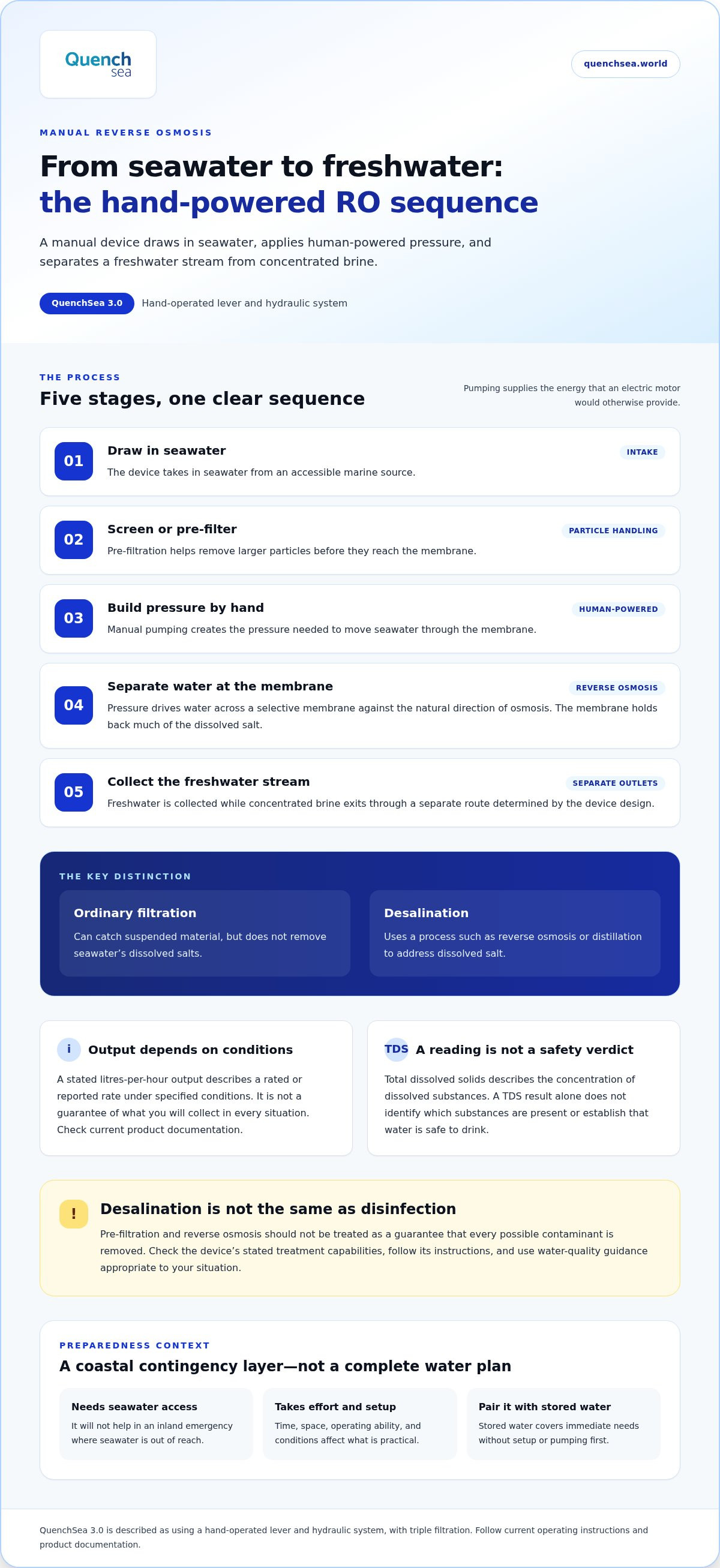
A hand-powered reverse-osmosis device follows a sequence: it draws in seawater, screens or pre-filters it, applies pressure, moves the pressurized water across a selective membrane, and collects the freshwater stream. The concentrated brine exits through a separate route determined by the device’s design.
Pressure drives water through the membrane against the natural direction of osmosis, while the membrane holds back much of the dissolved salt. The FDA’s Principles of Reverse Osmosis explains the basic process. In a manual device, pumping supplies the energy instead of an electric motor. QuenchSea 3.0 uses a hand-operated lever and hydraulic system, and its product information describes triple filtration. For a device-focused explanation, see the manual reverse-osmosis engineering explainer.
What does a hand-powered reverse-osmosis device do?
Manual pumping creates the pressure needed to move seawater through the membrane. Pre-filtration helps remove larger particles before they reach the membrane, but neither pre-filtration nor reverse osmosis should be treated as a guarantee that every possible contaminant is removed. Desalination and disinfection are different processes. Check the device’s stated treatment capabilities, follow its instructions, and use water-quality guidance appropriate to your situation.
What do output and water-quality specifications mean?
A stated output in litres per hour describes a rated or reported production rate under specified conditions. It is not a guarantee of what you will collect in every situation. Read the current product documentation for the conditions attached to any output claim. When planning, account for those limitations instead of assuming the device will produce a constant supply.
TDS, or total dissolved solids, measures the concentration of dissolved substances in water. It can help describe water quality, but a TDS result alone does not identify which substances are present or establish that water is safe to drink. Do not assume a particular threshold unless current product documentation supports it and relevant drinking-water guidance backs its use.
For manual desalination for preppers, the practical takeaway is to understand each stage and assess performance against the device’s instructions, not rely on a single headline specification. Follow current operating instructions and authoritative drinking-water guidance. To see how a hand-powered RO system is used in a portable device, review the QuenchSea 3.0 desalination device.
Manual Desalination vs. Stored Water and Other Prepper Options
Each water option solves a different problem. Stored water is ready to use, but limited by how much you can carry or store. A manual desalinator can draw on seawater where it is accessible, but requires setup and physical effort. Larger powered desalination systems can support greater production, but depend on suitable power and equipment. Choose the mix that fits your location, likely emergency duration, and access to water and energy.
- Stored water: Useful for immediate needs, short disruptions, or situations where setting up equipment is impractical. Limits include finite supply, storage space, and the need to keep the water ready for use.
- Manual desalination: Useful during a prolonged coastal or marine situation when seawater is accessible. It does not rely on electricity, batteries, or fuel, but production requires human effort and suitable operating conditions.
- Powered desalination: May suit longer-term or higher-volume needs when the system and its power source are available. It is less useful if power, equipment, or maintenance support is unavailable.
When is a manual desalinator more useful than stored water alone?
Consider a coastal evacuation or an extended off-grid shoreline stay. Stored water can cover immediate needs, while a manual device may provide another option if supplies run low and seawater remains accessible. For a short disruption, stored water may be simpler because it does not require setup, pumping, or collection. A survival desalination device guide offers broader context for assessing this type of equipment.
What are the limits of manual desalination?
Having the device is not enough. You also need a reachable seawater source, time and space to set up, the physical capacity to operate it, and a maintained system. Production can vary with operating conditions, so do not plan as if the device will deliver a fixed amount on demand. A manual desalinator also does not replace evacuation decisions, medical care, or a broader emergency plan.
Keep the treatment claim precise. Reverse osmosis is designed to separate much of the dissolved salt, but that does not mean every chemical contaminant or microbiological hazard is automatically removed. Follow the device’s current instructions and applicable drinking-water guidance.
Comparison takeaway: Manual desalination is most useful when an emergency lasts beyond your stored supply, seawater is accessible, and you can operate and maintain the device. It works best as one layer in a plan, not as a universal replacement for stored water or powered systems.
Build a Prepper Checklist for Operating a Manual Desalinator
A checklist reduces guesswork when you need to operate equipment under pressure. Build yours around the device’s current instructions, then practise the full sequence before you need freshwater. Manual desalination for preppers involves more than keeping equipment on hand: you need to know where it is, how to use it, and how to keep collected water separate from untreated seawater.
How should preppers prepare and practice before an emergency?
Rehearse the whole process during a planned practice session, not just the pumping step. Use the manufacturer’s current manual for setup, operation, and cleanup. Keep the instructions with the device, and note where the unit and its essential accessories are stored.
- Inspect: Check the device and accessories for damage, missing parts, or visible issues before use.
- Practice: Rehearse setup, pumping, collection, and cleanup in the order described by the manual.
- Source: Identify a practical seawater access point for your likely scenario. Keep untreated seawater separate from water intended for drinking.
- Operate: Follow the device’s instructions. Do not improvise steps or assume a different operating method is suitable for the equipment.
- Collect: Use a clean, suitable container. Protect its opening and contents from contact with hands, seawater, dirty surfaces, or other potential sources of contamination.
- Maintain: Clean, rinse, dry, and store the device as directed. Record maintenance needs so they are not overlooked.
Practice can reveal practical snags before an emergency: whether you can reach the planned water source, manage the setup, and keep collection containers clean. The QuenchSea 3.0 buyer’s guide provides product-specific context to help you understand the device before adding it to your readiness routine.
How should a manual desalination device be stored and maintained?
Follow the manufacturer’s directions for rinsing, drying, storage, and membrane care. Do not apply a generic maintenance schedule if the device’s instructions specify a different procedure. Set a regular reminder to inspect the unit, accessories, and stored instructions, and follow the manual for servicing or replacement needs.
Protect the device from damage and store it with the parts needed for operation. Keep containers for collected water clean and separate from those used for untreated seawater. Clear labels can help prevent mix-ups during a rushed response.
Before adding a hand-powered desalination device to your coastal kit, review the QuenchSea 3.0 device details and use its current manual to prepare your operating and maintenance checklist.
Choose a Manual Desalination Device for a Realistic Preparedness Plan
A useful device fits the emergency you are preparing for, not just the promise of a specification sheet. Start with the basics: Is it intended to treat seawater? Can you operate it manually in the conditions you expect? Can you carry, set up, and maintain it? Clear answers help you decide whether a unit belongs in your coastal kit.
Which device characteristics matter most to preppers?
Check the intended water source first. A seawater desalinator does a different job from a filter intended for freshwater. Then assess portability and setup: consider where you will store or carry the device, how you will access seawater, and whether you can follow its operating sequence under stress.
- Source suitability: Confirm the device is intended for seawater and matches your likely scenario.
- Operation: Look for instructions you can understand and practise before an emergency.
- Portability: Consider whether the device and its required accessories fit your transport or storage plan.
- Maintenance: Read the cleaning, storage, and membrane-care requirements, then decide whether they are manageable for you.
- Output: Treat stated production figures as dependent on operating conditions. Review current product specifications and their stated conditions before using them to plan your supply.
How does QuenchSea 3.0 fit a coastal preparedness kit?
QuenchSea 3.0 is a portable, hand-powered seawater reverse-osmosis device. Product information describes a manual lever-operated hydraulic system and triple filtration. It operates without electricity, batteries, or fuel, providing a desalination option where those power sources are unavailable. That makes it relevant to coastal and marine preparedness when its use and maintenance instructions fit your plan.
Manual desalination for preppers works best as one layer in a broader water strategy. Keep stored water for immediate needs, plan how you will access seawater, and include clean collection containers and suitable supplies. Do not build your reserve around an output figure without accounting for its stated conditions, the effort required, and the time needed to operate the device.
Use these criteria to decide whether a hand-powered desalinator fits your location and likely emergency. Explore QuenchSea 3.0 as one component of a layered coastal water plan.
Make Your Coastal Water Plan Ready Before You Need It
Manual desalination for preppers is a contingency tool for coastal and marine emergencies, not a complete water supply. Build your plan around stored water for immediate needs, then add desalination where seawater access, operating effort, and device care make it practical.
Know the basics: manual reverse osmosis uses pressure to separate much of the dissolved salt, but desalination does not automatically address every possible water hazard. Practise the full operating and cleanup routine before an emergency, and follow the device’s current instructions.
QuenchSea 3.0 is a hand-powered seawater reverse-osmosis device designed to operate without electricity, batteries, or fuel. Consider how it fits alongside your stored water and other supplies suited to your scenario. Explore QuenchSea 3.0 and assess whether it belongs in your coastal preparedness plan.
A realistic plan is built before conditions become difficult. Prepare your supplies, practise your process, and choose equipment that fits the role you need it to fill.
Frequently Asked Questions
Can a manual desalination device make seawater drinkable?
Yes. A manual reverse-osmosis device is designed to produce freshwater from seawater by using pressure to separate much of the dissolved salt. The resulting water’s suitability depends on the device, its condition, correct operation, and the water source. Follow the current product instructions and relevant drinking-water guidance. Do not assume desalination removes every chemical or microbiological hazard that may be present.
How much water can a hand-powered desalination device produce?
Production depends on the device and operating conditions, including how it is used and the seawater source. Treat a stated litres-per-hour figure as a product rating under specified conditions, not a guaranteed amount in every situation. Check the current manufacturer specifications and plan for the effort and time needed to operate the unit. Keep stored water available rather than relying on a single output estimate.
Is manual desalination better than storing water for emergencies?
Neither option is universally better. Stored water is ready for immediate use and can cover needs before you set up equipment. Manual desalination for preppers can add a water source during a coastal or marine emergency if seawater is accessible and you can operate the device. A layered plan uses stored water for immediate access and treats desalination as a contingency, not a replacement for your reserve.
Can you desalinate seawater by boiling it?
Boiling seawater alone does not remove the salt. The water evaporates, but the dissolved salts remain in the boiling container, making the remaining liquid saltier. To desalinate by distillation, you must capture the water vapor and cool it so it condenses into a separate clean container. Without that collection and condensation step, boiling will not turn seawater into drinkable freshwater.
Does reverse osmosis remove every contaminant from seawater?
No. Reverse-osmosis membranes separate much of the dissolved salt and can reduce dissolved solids, but do not assume they remove every possible chemical contaminant or microbiological hazard. Performance depends on the system, its condition, and correct use. Follow the device’s current instructions and applicable drinking-water guidance. A TDS reading alone also cannot identify which substances are present or prove water is safe to drink.
How should preppers maintain a manual desalination device?
Follow the manufacturer’s current directions for rinsing, cleaning, drying, storage, and membrane care. Inspect the device and accessories regularly for visible damage or missing parts, and follow the manual for servicing or replacement rather than guessing at intervals. Practise the full setup, operation, collection, and cleanup sequence before an emergency. Store clean collection containers separately from untreated seawater supplies to reduce the risk of handling contamination.