

Your $50,000 electronics suite is one short circuit away from becoming dead weight in a mid-Atlantic storm. When the primary water maker fails and the batteries go flat, the vast ocean around you transforms into a lethal desert. You understand that offshore survival relies on mechanical simplicity, not digital complexity. Relying solely on stored jerry cans or vulnerable electric systems leaves your crew exposed to the unpredictable nature of the sea.
Finding a reliable sailboat emergency water maker shouldn't cost as much as a new mainsail or require an engineering degree to maintain. This 2026 guide reveals why a manual reverse osmosis system is the ultimate line of defense against dehydration. We'll explore how the QuenchSea 3.0 offers a lightweight, hand-powered solution that fits directly into your ditch bag. You'll learn how to evaluate survival-grade hardware, manage your emergency hydration protocol, and ensure you have a freshwater source that works when everything else fails. It's time to stop fearing the power cut and start preparing for it with equipment built for the harshest environments on earth.
Key Takeaways
- Total electrical failure renders primary systems useless. Learn why a manual backup is the only guarantee of survival hydration.
- Carrying 30 days of water is physically impossible for most crews. Discover how a sailboat emergency water maker solves the weight-to-volume crisis in your ditch bag.
- Mechanical simplicity beats digital complexity in extreme conditions. Understand the physics of manual reverse osmosis and how it functions without batteries or fuel.
- Gear only works if you know how to use it. Follow our guide for pre-departure testing and rapid deployment during life-critical scenarios.
- Reliability matters when lives are on the line. Evaluate the QuenchSea 3.0 as a modern, survival-grade engineering solution for every offshore sailor.
The Critical Role of a Sailboat Emergency Water Maker in Offshore Survival
Offshore sailing demands total self-reliance. Your primary electric water maker is a marvel of engineering, but it is also a point of failure. It relies on a complex web of sensors, pumps, and high-voltage power. When the sea state turns violent or the electrical system shorts, that machine becomes an expensive paperweight. A dedicated sailboat emergency water maker serves as your final insurance policy. It bridges the gap between a mechanical crisis and a successful rescue.
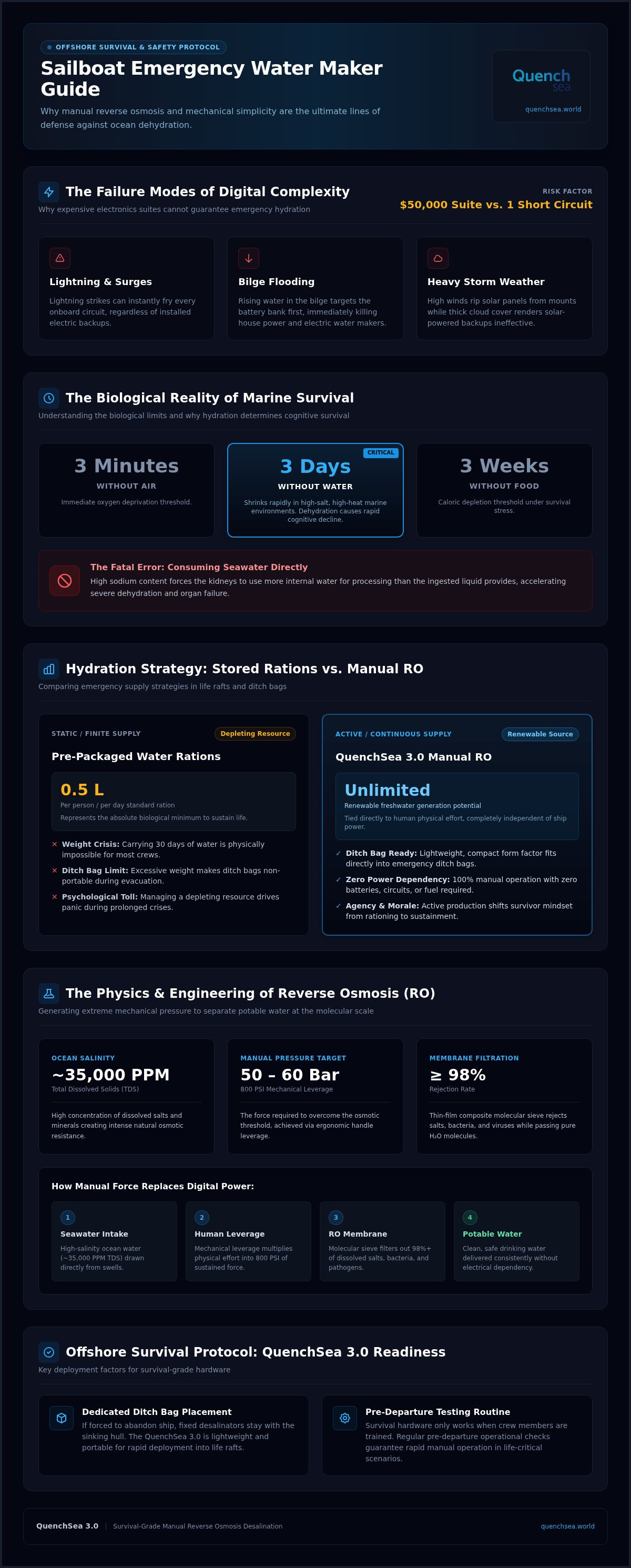
The "ditch bag" philosophy dictates that every life-critical tool must be portable. If you are forced to abandon ship, a fixed desalination system stays with the hull. Relying on pre-packaged water rations is a gamble against time. A standard life raft ration provides roughly 0.5 liters per person per day, which is the absolute minimum to sustain life. In contrast, a manual unit provides a renewable supply. This capability shifts the survival narrative from managing a depleting resource to active production. The psychological impact is profound. Having the agency to produce fresh water prevents the panic that often accompanies a resource-limited crisis.
Why Electrical Backups Are Not Enough
Many sailors assume that solar panels or spare batteries provide enough redundancy. This is a dangerous misconception. Lightning strikes can instantly fry every circuit on a yacht, regardless of backups. Flooding in the bilge often targets the battery bank first, killing the house power. Even solar-powered units fail in heavy weather when cloud cover is thick or panels are ripped from their mounts by high winds. Manual redundancy is the gold standard for offshore safety because it eliminates the middleman. By using reverse osmosis desalination through purely mechanical force, you ensure that your hydration is linked to your physical effort, not a circuit board.
The Reality of Ocean Dehydration
The biological timeline of survival is unforgiving. Most experts cite the "Rule of 3" for survival: three minutes without air, three days without water, and three weeks without food. In a high-salt, high-heat marine environment, that three-day window for water often shrinks. Dehydration leads to rapid cognitive decline, making it impossible to operate a VHF radio or signal for help. Some sailors, driven by desperation, consider the fatal mistake of consumption from the sea. You must understand that drinking sea water is dangerous because the high sodium content forces your kidneys to use more water for processing than the liquid actually provides. This accelerates organ failure. A sailboat emergency water maker like the QuenchSea 3.0 prevents this descent by providing a reliable, manual method to extract pure water from the swells.
How Manual Reverse Osmosis Desalination Works Without Electricity
To understand a sailboat emergency water maker, you must first understand the physics of resistance. Seawater is a concentrated solution of salts and minerals, typically measuring around 35,000 parts per million (PPM) of Total Dissolved Solids (TDS). Osmotic pressure is the natural force that pulls fresh water toward saltier water to achieve equilibrium. Reverse osmosis (RO) flips this process. It forces the saltwater through a microscopic barrier, leaving the salts behind. This requires immense force. In a marine environment, you must generate between 50 and 60 bar of pressure to overcome the osmotic threshold and produce potable water.
The heart of this system is the semi-permeable membrane. This thin-film composite acts as a molecular sieve. Its pores are small enough to allow water molecules through while rejecting 98% or more of dissolved salts, bacteria, and viruses. Without electricity, the sailor becomes the engine. You replace the electric motor with physical work. This mechanical approach ensures that your hydration is not dependent on a functioning alternator or a dry battery bank. It is the most reliable way to secure a freshwater source in a compromised vessel.
The Engineering of Manual Pressure
Generating 800 PSI of pressure with your hands requires smart engineering. Manual desalinators use mechanical leverage to multiply human strength. Long pump handles or ergonomic grips allow you to apply consistent force over a sustained period. There is a direct trade-off between pumping effort and water output. Higher pressure yields more water but requires more physical stamina. Manual RO is the process of forcing seawater through a membrane using human-generated pressure. This simplicity is its greatest strength. By following U.S. Coast Guard offshore safety guidelines, you can ensure your survival kit includes hardware that meets these rigorous mechanical demands.
Membrane Technology in Portable Units
Survival-grade membranes are built for durability, yet they are sensitive to particulates. Portable units include integrated pre-filtration to catch sand, silt, and bio-matter before they reach the RO membrane. This prevents "fouling," which can permanently clog the system. Maintaining membrane health is critical during long storage periods. Most membranes require a preservative solution or regular flushing with fresh water to prevent biological growth while sitting in a ditch bag. The QuenchSea 3.0 is engineered to simplify this process, using robust materials that withstand the corrosive nature of salt-heavy environments. Proper maintenance ensures that when the crisis hits, the membrane is ready to perform immediately.
Comparing Emergency Hydration: Manual Desalinators vs. Stored Rations
Water is heavy. One liter weighs one kilogram. Storing enough for a trans-oceanic emergency is a logistical nightmare. For a crew of four, thirty days of survival hydration requires at least 240 kilograms of water. This volume consumes more space than a standard life raft provides, creating a dangerous trade-off between buoyancy and essential supplies. A sailboat emergency water maker solves this weight-to-volume crisis. It converts the surrounding ocean into a renewable resource, effectively removing the "expiration date" from your survival strategy.
Rations are a countdown to zero. Every sip taken from a plastic pouch or jerry can brings you closer to a total resource depletion. This finite nature creates immense psychological stress during a crisis. In contrast, a manual unit provides an unlimited supply as long as you have the physical capacity to pump. Cruisers must view manual boat water makers as a one-time investment in autonomy rather than a recurring expense of rotating heavy, plastic-leaching water stocks.
Logistics of the Ditch Bag
Space is the primary constraint in a survival scenario. A standard 4-6 person life raft is incredibly cramped. Adding bulky 5-gallon jugs is not just difficult; it is often impossible. Weight limits for emergency deployment are also critical. During a rapid vessel abandonment, you may only have seconds to grab your gear. A portable desalinator like the QuenchSea 3.0 fits directly into a standard ditch bag. It is light enough for one-handed deployment while you navigate a pitching deck. Ease of access is everything. A portable unit beats buried water tanks or heavy jugs that are difficult to move in a panic.
Reliability and Maintenance Comparison
Stored water requires constant "maintenance" through rotation every two to five years. Plastic containers can rupture if the raft is deployed violently or if they are crushed by other gear. There is also the persistent risk of bacterial contamination in stagnant water. Manual desalinators require a different type of care. You must "pickle" the unit using a biocide solution for long-term storage to protect the membrane. Lubricating the seals ensures mechanical integrity. While both systems require attention, the desalinator offers a significantly higher return on survival capacity. If a water pouch leaks, that water is gone forever. If a manual unit needs a seal lubricated, it is a solvable mechanical problem that preserves your hydration future.
Operational Readiness: Deploying and Maintaining Your Emergency Water Maker
Survival gear is only as reliable as your last maintenance check. A sailboat emergency water maker sitting at the bottom of a locker for years without inspection is a liability, not an asset. Operational readiness requires a disciplined approach to testing and storage. Before leaving the dock, flush the unit with fresh water to verify the integrity of the seals and the smoothness of the pump stroke. If the handle resists or the valves stick, address the mechanical friction before you lose the luxury of a stable deck.
Deployment in a life raft is a chaotic process. You must secure the intake hose immediately to prevent it from tangling or sucking in surface oil and debris. Prime the pump to clear air pockets. Once the flow is established, the goal is consistency. Do not pump in frantic bursts. A steady, rhythmic movement preserves both the membrane and your physical energy. This mechanical discipline transforms a desperate situation into a managed process.
The Pumping Protocol for Survival
Fatigue is a critical failure point in survival hydration. Pumping at maximum speed leads to rapid exhaustion. Instead, adopt a pacing strategy. Alternate crew members every 20 to 30 minutes to maintain productivity without total burnout. Optimal body positioning is essential. Use your core and legs to drive the handle; don't rely solely on arm strength. In a pitching raft, brace your back against the inflated tubes to stabilize your stroke. Realistic yield for modern survival desalination devices ranges from 4 to 6 liters of fresh water per hour. This output can sustain a crew of four if the pumping rhythm is maintained.
Long-Term Storage and Pickling
Pickling is the chemical process of circulating a biocide through the RO membrane to inhibit biological growth. Without this, bacteria and mold will colonize the damp membrane during storage, causing permanent damage. Inspect your unit every 12 months. Focus on common failure points like brittle O-rings, salt crystallization in the valves, and perished seals. If you detect any loss of pressure, replace the internal components immediately. Secure the reliability of your vessel's safety protocol by investing in the QuenchSea 3.0 manual water maker to ensure your backup system is always mission-ready.
QuenchSea 3.0: The Engineering Standard for Modern Sailboat Safety
The QuenchSea 3.0 is a calculated response to the harshness of the open ocean. It provides survival-grade engineering for the everyday sailor. Historically, manual desalinators were either prohibitively expensive military assets or flimsy emergency toys. This device bridges that gap. It offers a professional, non-electric solution that fits within a standard safety budget. By focusing on mechanical reliability, it provides a level of empowerment that stored rations cannot match. It is a vital component of a modern life raft water supply.
A sailboat emergency water maker must perform in the worst conditions imaginable. The QuenchSea 3.0 utilizes manual reverse osmosis technology to deliver fresh water without the need for batteries, solar panels, or fuel. This independence from the vessel’s power grid is its primary safety feature. It transforms the sailor from a passive consumer of limited rations into an active producer of life-sustaining water. The engineering focuses on high-yield output with manageable physical effort, ensuring that even a fatigued crew can maintain hydration over long durations.
Built for Extreme Marine Environments
Corrosion is the primary enemy of offshore equipment. The QuenchSea 3.0 features a rugged, impact-resistant housing and corrosion-resistant internal components. It withstands the salt-heavy air and constant motion of a mid-passage crisis. The design prioritizes simplicity. By reducing the number of moving parts, the engineers have eliminated common failure points found in complex electric systems. In a high-stress scenario, you need hardware that works the moment it hits the water. This device delivers practical freshwater volumes for small to medium crews, providing a scalable solution for coastal cruisers and blue-water voyagers alike.
Integrating QuenchSea into Your Safety Protocol
Hardware is only effective if it's accessible and understood. Store your unit in your primary ditch bag or a dedicated emergency locker near the companionway. Rapid access is critical during a vessel abandonment. Don't wait for a storm to learn the mechanics. Train your crew on the manual RO operation during your pre-passage safety briefings. Ensure every person on board understands how to deploy the intake hose and maintain the pumping rhythm. Preparedness is a habit, not a one-time event. You don't want to be reading a manual for the first time in a pitching life raft. Ensure your vessel is truly offshore-ready with the QuenchSea 3.0 Desalination Device.
Secure Your Offshore Hydration Future
Survival on the open ocean is not a matter of luck; it is a result of calculated preparation. You have seen how electrical systems fail and how finite water rations can jeopardize a crew’s safety. A sailboat emergency water maker provides the mechanical certainty required when your primary systems go dark. By choosing manual reverse osmosis, you remove the dependency on batteries and solar panels, ensuring that your most critical resource remains available through pure physical effort.
The QuenchSea 3.0 represents a shift in survival technology. It is a portable, lightweight device engineered specifically for the extreme conditions of a life raft or a compromised yacht. It requires no electricity, batteries, or fuel to operate, making it a permanent addition to your ditch bag. Don't leave your hydration to chance or aging plastic pouches. Equip your yacht with the QuenchSea 3.0 manual desalinator today and gain the confidence that comes with survival-grade redundancy. The sea is unpredictable, but your water supply doesn't have to be.
Frequently Asked Questions
Do I really need a manual water maker if I already have a large electric one?
Yes, you need a manual backup because primary electric systems are vulnerable to total power loss. Lightning strikes, battery bank flooding, or alternator failure can render your main unit useless. A sailboat emergency water maker operates independently of the vessel’s electrical grid. This mechanical redundancy ensures you can produce fresh water even if the hull is compromised or the electronics are fried. It is the only way to guarantee hydration when power fails.
How much physical effort is required to operate a manual emergency water maker?
Operating a manual unit requires steady, rhythmic physical effort to overcome osmotic pressure. You must generate approximately 50 to 60 bar of pressure to force water through the membrane. The QuenchSea 3.0 is engineered with mechanical leverage to make this process as efficient as possible. While it is physically demanding over long periods, the design allows a single sailor to maintain a sustainable pumping pace even in high-stress survival scenarios.
Can a manual desalinator remove viruses and bacteria as well as salt?
Yes, the reverse osmosis membrane acts as a molecular sieve that rejects more than just salt. The pores are small enough to filter out the majority of dissolved solids, including bacteria and viruses. This process ensures the output is biologically safe for consumption. By removing these contaminants along with the sodium, the device provides high-quality potable water that meets survival standards in extreme marine environments.
How long can I store an emergency water maker before it needs maintenance?
You should inspect your device at least once every 12 months to ensure operational readiness. For long-term storage, the membrane must be "pickled" using a specialized biocide solution. This prevents biological growth and mold from fouling the system while it sits in your ditch bag. Regular maintenance checks should also include inspecting the O-rings and seals for signs of perishing or salt crystallization that could cause pressure leaks.
What happens if the RO membrane gets clogged with sediment or algae?
If the system clogs, you will notice a significant drop in freshwater output and increased resistance in the pump handle. The QuenchSea 3.0 includes integrated pre-filtration to catch sediment and algae before they reach the sensitive RO membrane. To prevent permanent damage, always use the cleanest seawater available and avoid pumping in silty or oil-slicked water. Regular flushing with fresh water after use helps maintain the membrane's long-term permeability.
Is the water produced by a manual desalinator safe for long-term consumption?
The water produced is safe for consumption as it effectively removes 98% of Total Dissolved Solids. Unlike drinking seawater, which causes rapid dehydration and organ failure, this desalinated water provides the hydration necessary for survival. While it lacks some minerals found in tap water, it is the gold standard for emergency hydration at sea. It allows a crew to maintain cognitive function and physical strength until rescue or landfall.
Can I use a manual water maker on land during a coastal survival situation?
You can use the device on land provided you have access to a clean seawater source. It is an ideal tool for off-grid coastal survival, disaster relief, or remote expeditions where freshwater springs are unavailable. The portable and lightweight design makes it easy to transport from a vessel to a shore-based camp. As long as the intake hose can reach the ocean, the manual pump will continue to produce fresh drinking water.
How does the QuenchSea 3.0 compare to expensive USCG-approved units?
The QuenchSea 3.0 provides a modern, survival-grade alternative to legacy units that are often prohibitively expensive for the average cruiser. It utilizes the same reverse osmosis principles and high-quality membranes used in professional maritime gear. By focusing on a streamlined, hand-powered design, it offers a portable and affordable solution without compromising on the mechanical integrity needed for offshore survival. It is built for reliability in the harshest marine environments.