

In a high-heat marine environment, your freshwater tank isn't a guarantee; it's a countdown. When the tap runs dry or the pump fails, the transition from comfort to crisis happens in seconds. Every sailor understands the deep-seated fear of dehydration when land is days away. Knowing exactly what to do if you run out of water on a boat is the difference between a controlled survival situation and a life-threatening emergency. You can't rely on luck. You can't rely on complex, power-hungry systems that fail when you need them most.
This guide provides the tactical steps and technical solutions required to secure your water supply in 2026. We'll move beyond the outdated mindset of passive rationing. Instead, we focus on active, manual production. You'll learn the immediate 24-hour survival protocol, the engineering behind fail-safe desalination, and how to select a backup system that demands zero electricity. We're stripping away the fluff to focus on the hardware and habits that keep you alive when the grid, and your tanks, go empty.
Key Takeaways
- Understand the biological "Rule of 3" and the 24-hour moratorium protocol to maximize your body's internal fluid reserves during a crisis.
- Master the immediate tactical steps of what to do if you run out of water on a boat, prioritizing active production over passive rationing.
- Evaluate the performance gaps between weather-dependent solar stills and high-pressure manual reverse osmosis technology.
- Discover how human-powered hydraulics allow the QuenchSea 3.0 to produce up to 8 liters of freshwater per hour without electricity or fuel.
- Apply a survival-grade checklist to ensure your backup desalination gear remains functional and operable in high-motion marine environments.
Why Freshwater is the #1 Priority in Marine Emergencies
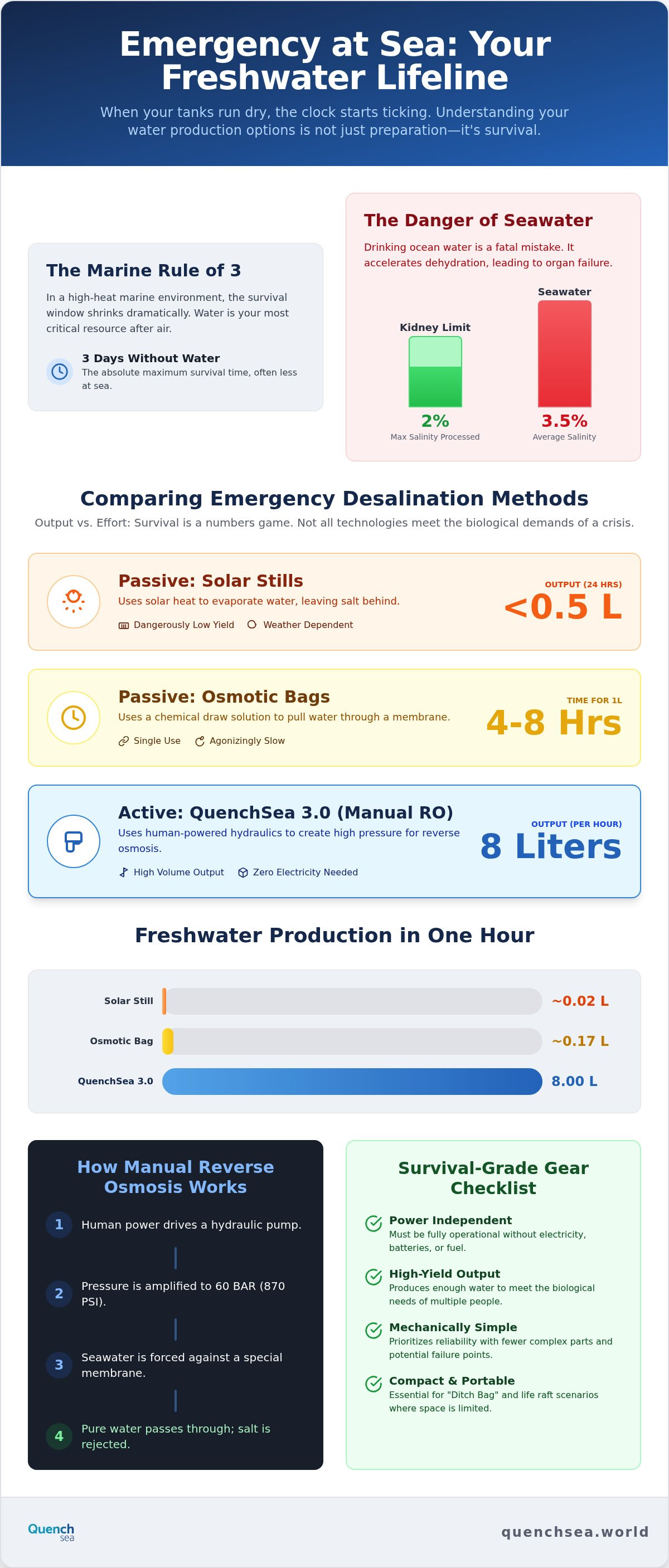
Survival offshore follows a strict, uncompromising hierarchy. Air, shelter, water, and food. The "Marine Rule of 3" dictates that a human can survive for three minutes without air, but only three days without water. In high-heat marine environments, this window often shrinks. When you face the immediate crisis of what to do if you run out of water on a boat, you must realize the ocean surrounding you is a poison, not a resource. Emergency marine water purification is the mechanical removal of salts and pathogens to meet potable standards. It's the only reliable way to reset your survival clock.
The Dangers of High Salinity and Dehydration
Ocean water has a salinity of approximately 3.5%. The human kidney is an engineering marvel, but it can only process salt concentrations up to about 2%. When you ingest seawater, your body must pull water from its own cells to dilute the excess salt for excretion. This creates a lethal osmotic imbalance. Instead of hydrating you, seawater accelerates fluid loss. It's a biological debt you can't pay back.
The symptoms of seawater-induced dehydration are rapid and severe. You'll experience lethargy and extreme thirst, followed by hallucinations and eventual organ failure. Understanding Why is Drinking Sea Water Dangerous? is critical for every offshore sailor. It reinforces why you should never drink untreated ocean water, even in the final stages of thirst. You must focus entirely on production.
Survival Scenarios: Life Rafts and Disabled Vessels
Planning for a hydration crisis requires a "Ditch Bag" philosophy. Water production must be independent of the vessel's hull. If your boat is disabled by fire or a hull breach, your fixed electric water maker is likely offline. Modern Desalination technologies have evolved, but most yacht systems still rely on 12V or 24V power. In a total electrical failure, these machines are dead weight. They offer no protection in a life raft scenario.
Space is the second major hurdle. It's logistically impossible to carry months of bottled water in a small life raft or emergency locker. You need a way to produce water on demand. Beyond the physical need, having a reliable water source has a massive psychological impact. It prevents the panic that leads to poor decision-making. Knowing you have the mechanical means to produce freshwater provides the clarity needed to manage other survival tasks. If you're wondering what to do if you run out of water on a boat, the answer starts with securing a manual production method that bypasses the boat's primary electrical systems.
Comparing Emergency Desalination Technologies
When determining what to do if you run out of water on a boat, you must evaluate your hardware through the lens of output versus effort. Survival is a numbers game. You need a technology that produces more water than your body consumes through sweat and metabolic processes. Most emergency kits rely on outdated or low-yield systems that fail to meet the biological demands of a high-heat marine environment. Understanding the energy-to-output ratio of each technology is vital for your survival strategy.
Solar stills are the most common passive option. They use heat from the sun to evaporate seawater, leaving salt behind. However, their yield is dangerously low, often producing less than 0.5 liters per day. They are entirely weather-dependent; if it's overcast or the sea state is too rough to keep the still upright, your production drops to zero. Osmotic bags offer a slightly more reliable alternative by using a chemical draw solution to pull water through a membrane. While they have high salt rejection rates, they are agonizingly slow, requiring 4 to 8 hours to produce a single liter. In a dehydration crisis, these wait times can be fatal.
Passive vs. Active Desalination
Passive systems fail because they lack the pressure required for high-volume filtration. Manual Reverse Osmosis (MROD) solves this by using human power to drive the process of reverse osmosis. This is an active desalination method. By manually pumping a lever, you create the 60 bar of pressure needed to force water molecules through a semi-permeable membrane. The mechanical advantage is clear: an active system can yield 5 to 8 liters per hour, while a passive system might take two days to reach the same volume.
Reliability and Failure Points
Survival gear must prioritize mechanical integrity over complexity. Electric water makers are excellent for daily yacht use, but they are vulnerable to battery drain, saltwater corrosion, and circuit failure. In a ditch-bag scenario, you need a tool that functions without a power source. A manual RO device with a simplified hydraulic circuit offers the highest survival probability because it removes the risk of electrical failure. Integrating a rugged manual unit into your Life Raft Water Supply ensures that your ability to hydrate remains intact even if your vessel's batteries are submerged. Choosing a survival-grade desalination tool provides the redundancy required for offshore passage making.
The Engineering of Manual Reverse Osmosis (MROD)
MROD technology utilizes human-powered hydraulic pressure to demineralize seawater without heat or fuel. This mechanical process is the most effective answer to what to do if you run out of water on a boat. At the heart of this system is the requirement to reach 60 bar of pressure. Seawater naturally wants to dilute saltier solutions through osmosis. To reverse this, you must apply force that exceeds the ocean's osmotic pressure, which typically sits around 27 bar. By hitting 60 bar, you force pure water molecules through a semi-permeable membrane while leaving salts and minerals behind.
Protecting that membrane is a critical engineering challenge. Survival-grade devices use triple-stage pre-filtration to strip away sediment, microplastics, and algae before they reach the RO core. Without this protection, the membrane fouls in minutes. High-performance systems target a 98% salt rejection rate. This ensures the output remains below 1,000 Total Dissolved Solids (TDS), meeting the threshold for safe, sustainable hydration in emergency conditions.
Membrane Integrity and Pathogen Removal
RO membranes act as a biological shield. Their pores are small enough to block viruses, bacteria, and parasites through ultrafiltration. To make this process sustainable for a single operator, engineers integrate energy recovery devices. These components capture the energy from the high-pressure waste brine and use it to assist the next pumping stroke. It's a closed-loop efficiency that reduces physical exertion significantly. Long-term reliability depends on membrane care. Periodic flushing and correct storage prevent the buildup of biological films that degrade performance over time.
Materials Matter: Survival-Grade Construction
The marine environment destroys inferior equipment. Survival-grade MROD units utilize high-grade polymers and 316 stainless steel to resist corrosion. Reliability is the priority. The device must feature a compact footprint to fit within a standard marine ditch bag without sacrificing ergonomic efficiency. A well-engineered lever system allows a fatigued survivor to maintain the necessary 60 bar pressure for extended periods. Every millimeter of the design focuses on mechanical integrity. There's no room for decorative features in a tool built to save lives.
Checklist for Selecting Survival-Grade Purification Gear
Selecting the right equipment is a life-critical decision. When you're forced to determine what to do if you run out of water on a boat, you can't afford gear failure or insufficient output. Your survival kit must meet specific technical benchmarks to remain viable in offshore conditions. Use this checklist to audit your current emergency water supply and ensure it can sustain your crew during a prolonged crisis.
- Output Volume: Does the device produce at least 2 liters of freshwater per hour per person? Any less and you'll struggle to stay ahead of metabolic dehydration in high-heat environments.
- Single-Person Operation: Can a single, exhausted survivor operate the pump in a moving life raft? Complexity leads to failure. Mechanical simplicity is a requirement.
- Quality Verification: Does the system include a way to verify water quality? A TDS (Total Dissolved Solids) reader is essential to confirm the salt rejection remains above 98%.
- Component Integrity: Are filters and parts integrated? Loose components or tools are easily lost overboard in rough seas.
- Form Factor: Is the unit lightweight and compact enough for a standard marine ditch bag? Every gram matters when you're abandoning ship.
Calculating Your Hydration Needs
Hydration requirements shift based on your environment. In temperate climates, the human body needs roughly 2 liters of water daily. In tropical marine zones, that requirement often doubles due to sweat and high humidity. The common myth of "rationing" water is a dangerous strategy. Dehydration clouds judgment and slows physical reaction times. A "produce and consume" mindset is far safer. By utilizing a high-output Survival Desalination Device, you maintain your internal fluid reserves rather than depleting them. Never wait until you're symptomatic to start production. Active hydration keeps you capable of managing other survival tasks.
Durability in Saltwater Environments
Marine gear faces extreme UV exposure and high-impact risks. Your purification tool must be engineered to withstand a 10-meter drop into the water and remain functional. Reliability means zero batteries to corrode and no delicate electronics to short-circuit. Look for language-neutral, pictorial instructions printed directly on the device body. In a crisis, you won't have the cognitive bandwidth to read complex manuals. Non-electric backups are non-negotiable for long-distance cruising. They provide the ultimate redundancy when your primary vessel systems fail. Secure your vessel's safety by investing in survival-grade desalination gear before your next passage.
QuenchSea 3.0: Portable Desalination for Life-Critical Situations
When deciding what to do if you run out of water on a boat, the QuenchSea 3.0 provides a definitive, mechanical answer. This device is not a luxury accessory; it's an essential piece of survival hardware. It produces 5 to 8 liters of freshwater per hour, providing enough volume to sustain multiple crew members even in extreme heat. By utilizing human-powered hydraulics, the system eliminates the most common failure points in marine electronics. It requires no batteries, no solar panels, and no fuel. You rely entirely on mechanical leverage to secure your survival.
The engineering behind the QuenchSea 3.0 ensures 98% salt rejection, consistently delivering water with a TDS count below 1,000. This exceeds the 2026 WHO standards for emergency drinking water potability. The device represents a shift in mission-driven engineering, moving high-performance desalination from expensive, fixed installations into a portable format. It bridges the gap between humanitarian relief needs and the high-stakes requirements of offshore yachting. Whether you are facing a total vessel power loss or a life raft deployment, this tool provides the hydraulic force necessary to demineralize the ocean.
Technical Specifications for the Serious Mariner
The QuenchSea 3.0 is optimized for the constraints of a marine ditch bag. Its weight and dimensions are minimized to ensure it doesn't displace other critical gear like EPIRBs or medical kits. Durability is built into the core, utilizing high-grade polymers that resist saltwater corrosion. To ensure readiness for long-term emergencies, the system features a triple-stage pre-filtration process. This protects the RO membrane from fouling, extending the filter lifespan and maintaining high output during extended passages. Compared to traditional electric water makers, the QuenchSea 3.0 offers the most accessible cost-to-output ratio on the market, making survival-grade technology available to every sailor.
Preparedness for Disaster and Relief
The utility of the QuenchSea 3.0 extends beyond the rail of a yacht. Its portability allows for rapid deployment in coastal communities following hurricanes, tsunamis, or infrastructure collapse. In these scenarios, the challenge is often the "last mile" of survival-getting clean water to individuals when the grid is destroyed. The device provides a tactical solution for decentralized water production. You can learn more about these applications in our guide on Disaster Relief Water Supply. Don't wait for a crisis to realize you're unprepared. Equip your vessel with the QuenchSea 3.0 Desalination Device today.
Master Your Survival Protocol
Offshore survival is a test of preparation. Relying on fixed tanks or passive solar stills leaves you vulnerable to environmental shifts and equipment failure. You've learned that active production is the only way to reset the biological clock. When you understand exactly what to do if you run out of water on a boat, you prioritize mechanical reliability over electrical complexity. Move from a mindset of desperate rationing to one of sustainable, high-volume production.
The QuenchSea 3.0 is the definitive tool for this mission. It delivers 5-8 liters per hour with a 98% salt rejection rate. It requires no electricity; it's the ultimate backup for any ditch bag or life raft. As featured in WIRED and CNN, this device provides the hydraulic power needed to survive in extreme conditions. Don't leave your hydration to chance when the grid fails or the hull is breached.
Secure your survival water supply with QuenchSea 3.0. Stay prepared. Stay hydrated. The ocean is vast, but with the right gear, you remain in control.
Frequently Asked Questions
How much water can a manual desalination device produce in an hour?
A high-performance manual desalination device like the QuenchSea 3.0 produces between 5 and 8 liters of freshwater per hour. This output is specifically engineered to meet the hydration needs of multiple survivors in high-heat marine environments. While passive systems like solar stills yield less than 0.5 liters per day, manual reverse osmosis provides the volume necessary to sustain life. Your physical effort directly correlates to the volume of potable water secured.
Is the water produced by QuenchSea 3.0 safe to drink immediately?
Yes, the freshwater produced is safe for immediate consumption as it meets the 2026 WHO standards for emergency drinking water. The QuenchSea 3.0 achieves a 98% salt rejection rate, ensuring the output remains below 1,000 Total Dissolved Solids (TDS). This level of demineralization prevents the osmotic imbalance caused by seawater ingestion. Always use a TDS pen to verify the membrane's integrity before drinking during a survival situation.
Can I use a manual water maker to purify brackish water or lake water?
You can use the QuenchSea 3.0 to purify brackish or lake water, but you must prioritize pre-filtration. Reverse osmosis membranes are engineered to remove salts and pathogens from seawater, making them highly effective for less saline sources. However, freshwater sources often contain higher levels of sediment or tannins that can foul the membrane. Using the integrated triple-stage filtration system protects the RO core from premature failure in these varied environments.
How long do the filters and membranes last in an emergency desalinator?
Filter and membrane longevity depends on the turbidity of the source water and maintenance habits. The RO membrane in a QuenchSea 3.0 can last for several years if it's flushed with freshwater and stored correctly between uses. The triple-stage pre-filters should be replaced whenever you notice a significant drop in flow or increased resistance. Carrying spare membranes and filter sets is a critical part of knowing what to do if you run out of water on a boat.
Do I need a battery or solar panel to run the QuenchSea 3.0?
No, the QuenchSea 3.0 requires zero external power sources. It operates entirely on human-powered hydraulics. This mechanical independence is a key advantage during total vessel power failure or life raft deployment. You don't need batteries, solar panels, or fuel to produce freshwater. This design ensures that your ability to hydrate remains intact even if your boat's electrical grid is completely compromised by fire or flooding.
Is it physically difficult to pump a manual reverse osmosis device?
Pumping a manual RO device requires physical effort to overcome the 60 bar of osmotic pressure needed for desalination. However, the QuenchSea 3.0 utilizes an energy recovery system to reduce the force required for each stroke. This mechanical advantage allows a single, fatigued survivor to maintain production for extended periods. The ergonomic lever design is engineered to maximize output while minimizing the caloric cost of manual water production in survival scenarios.
Does the QuenchSea 3.0 remove microplastics and pathogens from seawater?
Yes, the reverse osmosis process provides ultrafiltration that removes microplastics, viruses, bacteria, and parasites. The membrane's pores are small enough to block pathogens that cause waterborne illnesses. This biological shield is reinforced by a triple-stage pre-filtration system that captures larger contaminants before they reach the membrane. This multi-layered approach ensures that the output is not just salt-free, but biologically safe for long-term consumption during an offshore emergency.
What is the shelf life of a portable desalination device when not in use?
A portable desalination device has an almost indefinite shelf life if it's stored in a cool, dry environment and the membrane is kept in its original sealed packaging. For units that have been previously used, the membrane must be flushed and preserved with a storage solution to prevent biological growth. Regular inspections of the O-rings and seals are recommended every two years to ensure the device remains vacuum-tight and mission-ready for any sudden marine crisis.